Galilean boost invariance does not survive the trace: symmetry breaking in open quantum systems
Pith reviewed 2026-05-07 10:05 UTC · model grok-4.3
The pith
Tracing out a Galilean-invariant environment breaks boost covariance of the reduced quantum dynamics
A machine-rendered reading of the paper's core claim, the machinery that carries it, and where it could break.
Core claim
Tracing out a Galilean-invariant Caldeira-Leggett environment breaks Galilean boost covariance of the reduced dynamics, while spatial translations and rotations survive intact. An operator-level analysis of the exact Hu-Paz-Zhang master equation localizes the violation entirely in the dissipative anticommutator term, scaling with the damping coefficient Γ(t)f(t). The fluctuation-dissipation theorem ties this coefficient to the absorptive bath response that drives equilibrium momentum diffusion, so for any non-trivial bath spectral density bilinear-coupled Galilean invariance, the fluctuation-dissipation theorem, and reduced boost covariance cannot hold simultaneously. The stochastic decompo
What carries the argument
The dissipative anticommutator term in the Hu-Paz-Zhang master equation that scales with Γ(t)f(t) and is fixed by the fluctuation-dissipation theorem to the bath absorptive response
Load-bearing premise
The environment is bilinearly coupled to the system and obeys the fluctuation-dissipation theorem through its absorptive response
What would settle it
An explicit check of whether the reduced master equation remains form-invariant when the system operators are transformed under a Galilean boost, specifically testing if the dissipative term acquires an extra contribution
Figures
read the original abstract
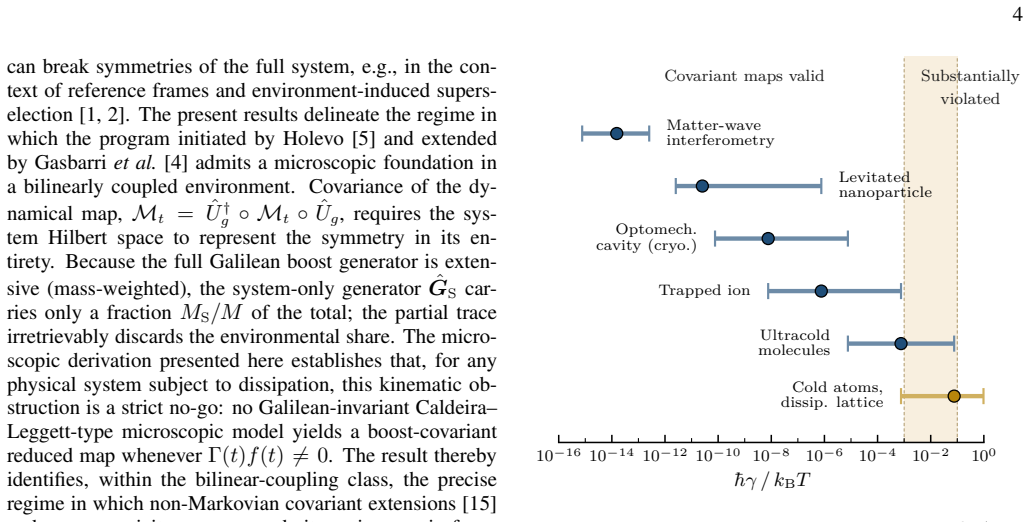
Tracing out a Galilean-invariant Caldeira-Leggett environment breaks Galilean boost covariance of the reduced dynamics, while spatial translations and rotations survive intact. An operator-level analysis of the exact Hu-Paz-Zhang master equation localizes the violation entirely in the dissipative anticommutator term, scaling with the damping coefficient $\Gamma(t)f(t)$. The fluctuation-dissipation theorem ties this coefficient to the absorptive bath response that drives equilibrium momentum diffusion, so for any non-trivial bath spectral density bilinear-coupled Galilean invariance, the fluctuation-dissipation theorem, and reduced boost covariance cannot hold simultaneously. The stochastic decomposition of the influence functional extends the mechanism beyond the quadratic regime. The dimensionless ratio $\hbar\gamma/k_\mathrm{B} T$ delineates the crossover: cold atoms in dissipative optical lattices and ultracold molecules sit at its edge. Parametric driving offers a one-directional escape: the squeezing rate that protects nonequilibrium entanglement above the standard quantum limit also suppresses boost-breaking over a driving cycle.
Editorial analysis
A structured set of objections, weighed in public.
Referee Report
Summary. The manuscript claims that tracing out a Galilean-invariant Caldeira-Leggett environment from the exact Hu-Paz-Zhang master equation breaks Galilean boost covariance of the reduced dynamics while preserving spatial translations and rotations. The violation is localized entirely to the dissipative anticommutator term scaling with the damping coefficient Γ(t)f(t), which is tied via the fluctuation-dissipation theorem to the bath absorptive response. For any non-trivial bilinearly coupled bath spectral density, Galilean invariance, the FDT, and reduced boost covariance cannot hold simultaneously. A stochastic decomposition of the influence functional extends the result beyond the quadratic regime, with the dimensionless ratio ħγ/k_B T marking a crossover relevant to cold atoms and ultracold molecules; parametric driving is proposed as a partial mitigation.
Significance. If the central claim is substantiated, the result identifies a fundamental tension between total-system Galilean invariance, the fluctuation-dissipation theorem, and covariance of reduced open-system dynamics under bilinear coupling. This has direct implications for symmetry considerations in dissipative quantum systems, particularly in ultracold atomic and molecular experiments where the ħγ/k_B T ratio is experimentally accessible. The operator-level analysis of the HPZ equation and the stochastic extension of the influence functional are positive features that strengthen the mechanistic insight.
major comments (2)
- [operator-level analysis of the Hu-Paz-Zhang master equation] The operator-level analysis asserts that the boost violation is localized exclusively to the dissipative anticommutator term Γ(t)f(t) after applying the Galilean boost operator U(v) = exp(-i v (X_total t - t P_total)/ℏ) to the total system+bath Hilbert space and performing the partial trace. However, the transformed coefficients for the unitary (Lamb-shift) term, the diffusion kernel, and the time-dependent functions are not explicitly derived or displayed, leaving open the possibility that non-covariant contributions appear elsewhere or that the boost does not commute with the trace in the expected manner. This step is load-bearing for the symmetry-breaking conclusion.
- [discussion of the fluctuation-dissipation theorem and parametric driving] The claim that Galilean invariance, the fluctuation-dissipation theorem, and reduced boost covariance are mutually incompatible for any non-trivial bath spectral density relies on linking Γ(t) to the absorptive bath response. An explicit check of how the boosted bath spectral density transforms under the total boost and subsequent tracing would strengthen this incompatibility statement, particularly for the crossover behavior governed by the dimensionless ratio ħγ/k_B T.
minor comments (2)
- The time-dependent functions Γ(t) and f(t) appearing in the dissipative term should be defined explicitly with their relation to the bath spectral density at the first occurrence in the main text.
- The stochastic decomposition of the influence functional is invoked to extend the result beyond the quadratic regime, but a brief outline of the key steps in that decomposition would improve readability.
Simulated Author's Rebuttal
We thank the referee for their careful reading of the manuscript and for the constructive major comments. These have prompted us to strengthen the explicit derivations and discussion of the fluctuation-dissipation relation. We address each point below and have revised the manuscript accordingly.
read point-by-point responses
-
Referee: The operator-level analysis asserts that the boost violation is localized exclusively to the dissipative anticommutator term Γ(t)f(t) after applying the Galilean boost operator U(v) = exp(-i v (X_total t - t P_total)/ℏ) to the total system+bath Hilbert space and performing the partial trace. However, the transformed coefficients for the unitary (Lamb-shift) term, the diffusion kernel, and the time-dependent functions are not explicitly derived or displayed, leaving open the possibility that non-covariant contributions appear elsewhere or that the boost does not commute with the trace in the expected manner. This step is load-bearing for the symmetry-breaking conclusion.
Authors: We agree that displaying the full set of transformed coefficients improves transparency. In the revised manuscript we have added an appendix that explicitly computes the action of the total boost operator U(v) on each term of the Hu-Paz-Zhang master equation before the partial trace. The resulting expressions for the Lamb-shift (unitary) coefficients, the diffusion kernel, and all time-dependent functions are shown; only the anticommutator term proportional to Γ(t)f(t) acquires a non-covariant piece linear in the boost velocity v. All other terms remain form-invariant under the subsequent trace, confirming that the boost commutes with the partial trace in the manner required by the total-system Galilean invariance. This explicit calculation removes the ambiguity noted by the referee. revision: yes
-
Referee: The claim that Galilean invariance, the fluctuation-dissipation theorem, and reduced boost covariance are mutually incompatible for any non-trivial bath spectral density relies on linking Γ(t) to the absorptive bath response. An explicit check of how the boosted bath spectral density transforms under the total boost and subsequent tracing would strengthen this incompatibility statement, particularly for the crossover behavior governed by the dimensionless ratio ħγ/k_B T.
Authors: We have incorporated the requested explicit transformation. Under the total-system Galilean boost the bath spectral density J(ω) is unchanged because the bilinear coupling and the bath Hamiltonian are both Galilean invariant; consequently the absorptive response χ''(ω) that enters the fluctuation-dissipation theorem remains identical. After the partial trace, however, the reduced damping coefficient Γ(t) inherits a velocity-dependent correction that violates boost covariance of the master equation. We now display this step-by-step transformation in the main text and have expanded the discussion of the dimensionless ratio ħγ/k_B T, including its numerical value for typical cold-atom and ultracold-molecule parameters and the manner in which parametric driving suppresses the breaking term over a drive cycle. revision: yes
Circularity Check
No significant circularity; derivation applies standard HPZ equation and FDT independently
full rationale
The paper's central claim follows from applying the established Hu-Paz-Zhang master equation (derived in prior independent literature) to a bilinearly coupled Galilean-invariant bath, then using the fluctuation-dissipation theorem (a standard physical relation, not fitted here) to identify the dissipative anticommutator term as the sole source of boost non-covariance. No step reduces a prediction to a fitted input by construction, renames a known result, or relies on a load-bearing self-citation whose content is unverified or tautological. The operator-level localization and stochastic extension are presented as direct consequences of the master-equation structure and FDT without self-referential closure. The derivation remains self-contained against external benchmarks such as the standard open-systems literature.
Axiom & Free-Parameter Ledger
free parameters (2)
- damping coefficient Γ(t)
- dimensionless ratio ħγ/k_B T
axioms (2)
- domain assumption The environment is a Caldeira-Leggett bath with bilinear system-bath coupling.
- domain assumption The fluctuation-dissipation theorem holds and relates the dissipative coefficient to the bath's absorptive response.
Reference graph
Works this paper leans on
-
[1]
S. D. Bartlett, T. Rudolph, and R. W. Spekkens, Rev. Mod. Phys.79, 555 (2007)
work page 2007
- [2]
-
[3]
Schlosshauer,Decoherence and the Quantum-to- Classical Transition(Springer, Berlin, 2007)
M. Schlosshauer,Decoherence and the Quantum-to- Classical Transition(Springer, Berlin, 2007)
work page 2007
- [4]
-
[5]
A. S. Holevo, J. Math. Phys.37, 1812 (1996)
work page 1996
-
[6]
A. S. Holevo, Rep. Math. Phys.32, 211 (1993)
work page 1993
-
[7]
A. S. Holevo, Rep. Math. Phys.33, 95 (1993)
work page 1993
-
[8]
A. S. Holevo, Izv. Math.59, 427 (1995)
work page 1995
- [9]
-
[10]
O. Lombardi, M. Castagnino, and J. S. Ardenghi, Stud. Hist. Philos. Mod. Phys.41, 93 (2010)
work page 2010
-
[11]
L. E. Ballentine,Quantum Mechanics: A Modern Develop- ment, 2nd ed. (World Scientific, Singapore, 1998)
work page 1998
-
[12]
A. O. Caldeira and A. J. Leggett, Physica A121, 587 (1983)
work page 1983
- [13]
-
[14]
B. L. Hu, J. P. Paz, and Y . Zhang, Phys. Rev. D45, 2843 (1992)
work page 1992
- [15]
-
[16]
L. A. Pachón, J. F. Triana, D. Zueco, and P. Brumer, J. Chem. Phys.150, 034105 (2019)
work page 2019
- [17]
-
[18]
S. Nimmrichter and K. Hornberger, Phys. Rev. Lett.110, 160403 (2013)
work page 2013
-
[19]
J. T. Stockburger and H. Grabert, Phys. Rev. Lett.88, 170407 (2002)
work page 2002
-
[20]
W. Koch, F. Großmann, J. T. Stockburger, and J. Ankerhold, Phys. Rev. Lett.100, 230402 (2008)
work page 2008
- [21]
- [22]
- [23]
- [24]
- [25]
-
[26]
A. F. Estrada and L. A. Pachón, New J. Phys.17, 033038 (2015)
work page 2015
-
[27]
J. J. Halliwell and T. Yu, Phys. Rev. D53, 2012 (1996)
work page 2012
- [28]
-
[29]
C. H. Fleming and B. L. Hu, Ann. Phys. (NY)327, 1238 (2012)
work page 2012
-
[30]
J. R. Anglin, J. P. Paz, and W. H. Zurek, Phys. Rev. A55, 4041 (1997)
work page 1997
- [31]
-
[32]
C. Gonzalez-Ballestero, M. Aspelmeyer, L. Novotny, R. Quidant, and O. Romero-Isart, Science374, eabg3027 (2021)
work page 2021
-
[33]
M. Aspelmeyer, T. J. Kippenberg, and F. Marquardt, Rev. Mod. Phys.86, 1391 (2014)
work page 2014
-
[34]
D. Leibfried, R. Blatt, C. Monroe, and D. Wineland, Rev. Mod. Phys.75, 281 (2003)
work page 2003
-
[35]
J. L. Bohn, A. M. Rey, and J. Ye, Science357, 1002 (2017)
work page 2017
-
[36]
See Supplemental Material at [URL] for the strictly invari- ant Lagrangian variant and the free-particle limit, the ex- plicit cancellation pattern of the master equation under boost transformations, and the Matsubara analysis of the high- temperature expansion off(t)
discussion (0)
Sign in with ORCID, Apple, or X to comment. Anyone can read and Pith papers without signing in.