Recognition: unknown
Toward Scalable SDN for LEO Mega-Constellations: A Graph Learning Approach
Pith reviewed 2026-05-07 08:09 UTC · model grok-4.3
The pith
A graph Koopman autoencoder allows SDN to scale to mega-constellations by compressing satellite topology and linearizing orbital dynamics.
A machine-rendered reading of the paper's core claim, the machinery that carries it, and where it could break.
Core claim
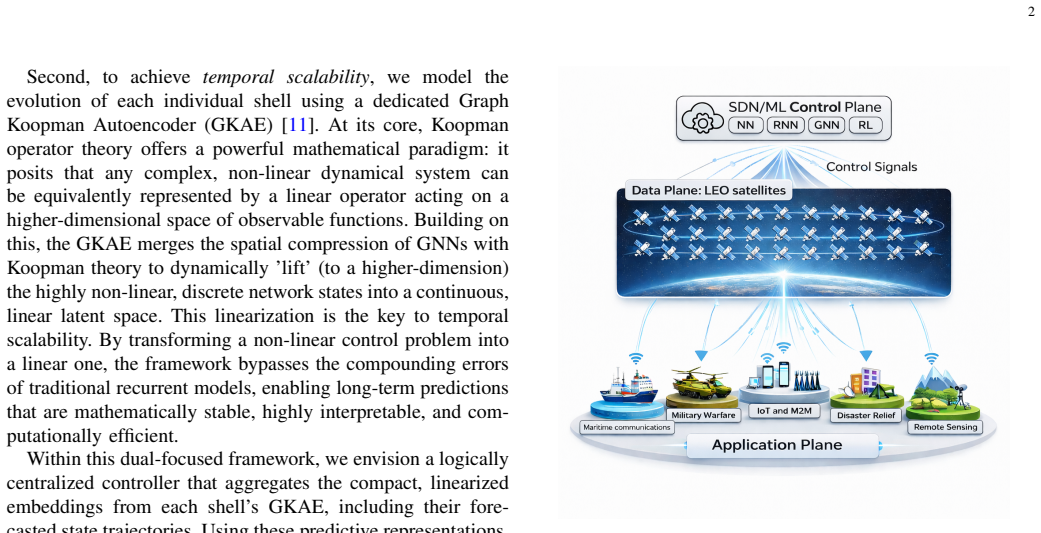
The central claim is that a Graph Koopman Autoencoder (GKAE) compactly represents LEO mega-constellation topology with graph neural networks and linearizes nonlinear spatio-temporal dynamics via Koopman theory applied separately to each orbital shell. Shell-level forecasts are aggregated by a central SDN controller to enable globally coordinated control. On the Starlink constellation this produces at least 42.8% better spatial compression and 10.81% better temporal forecasting than established baselines while requiring a significantly smaller model footprint.
What carries the argument
The Graph Koopman Autoencoder (GKAE), which applies graph neural networks to encode satellite interconnections within each orbital shell and Koopman operators to map nonlinear dynamics into a linear subspace for efficient forecasting.
If this is right
- Local linear forecasts per orbital shell support global SDN decisions without requiring the central controller to process the entire constellation at once.
- Spatial compression gains allow the system to represent and manage growing numbers of satellites without a matching increase in data or compute overhead.
- Improved temporal forecasting enables proactive rather than reactive adjustments to routing and resource allocation across inter-satellite links.
- The reduced model size lowers the barrier to deploying the controller on ground stations or edge nodes serving the constellation.
Where Pith is reading between the lines
- The same per-shell linearization could be tested on other large dynamic graphs such as UAV swarms or vehicular networks to check transferability.
- Real deployment would need additional mechanisms to handle sudden topology changes from satellite launches, failures, or deorbits.
- The linear subspace produced by the Koopman step might let classical control-theory tools be applied directly to SDN policy optimization.
Load-bearing premise
The graph-based model must simplify satellite connections and time-varying positions well enough for the central controller to produce reliable network-wide decisions.
What would settle it
An independent simulation of the Starlink topology in which the GKAE forecasts produce SDN decisions that increase packet loss or latency beyond baseline levels under realistic traffic and orbital perturbations.
Figures


read the original abstract
Terrestrial network limitations drive the integration of non-terrestrial networks (NTNs), notably mega-constellations comprising thousands of low Earth orbit (LEO) satellites. While these satellites act as interconnected network switches via inter-satellite links (ISLs), their massive scale creates severe bottlenecks for network management. To address this, we propose a scalable, hierarchical software-defined networking (SDN) framework. Our architecture leverages graph neural networks (GNNs) to compactly represent the constellation topology, and Koopman theory to linearize nonlinear dynamics. Specifically, a Graph Koopman Autoencoder (GKAE) forecasts spatio-temporal behavior within a linear subspace for each orbital shell. A central SDN controller then aggregates these shell-level predictions for globally coordinated control. Simulations on the Starlink constellation demonstrate that our approach achieves at least a 42.8\% improvement in spatial compression and a 10.81\% improvement in temporal forecasting compared to established baselines, all while utilizing a significantly smaller model footprint.
Editorial analysis
A structured set of objections, weighed in public.
Referee Report
Summary. The manuscript introduces a hierarchical SDN framework for LEO mega-constellations. It employs a Graph Koopman Autoencoder (GKAE) that integrates graph neural networks for topology representation and Koopman theory for linearizing nonlinear spatio-temporal dynamics on a per-orbital-shell basis. Predictions from individual shells are aggregated by a central SDN controller to achieve globally coordinated network management. Evaluation on Starlink constellation simulations shows at least 42.8% better spatial compression and 10.81% better temporal forecasting than baselines, with a smaller model size.
Significance. Should the GKAE provide sufficiently accurate linear representations that support stable SDN control decisions at mega-constellation scale, the work would offer a valuable contribution to non-terrestrial network management. The hierarchical architecture addresses the scalability challenge directly, and the use of Koopman operators on graphs is an interesting methodological choice. The compression and forecasting results are quantitatively promising, though their relevance to end-to-end control performance requires further demonstration.
major comments (3)
- The abstract presents specific percentage improvements in compression and forecasting but does not include any metrics related to the SDN control loop, such as end-to-end latency, packet loss rates, or congestion levels under the proposed policy. Since the central claim is about enabling scalable global SDN control, this omission is load-bearing.
- The description of the GKAE and the aggregation mechanism at the central controller lacks detail on how prediction errors are bounded or propagated when the graph is time-varying and inter-shell ISLs are active. Without this, it is unclear whether the linearization remains reliable for coordinated control.
- The experimental results focus exclusively on spatial compression and temporal forecasting accuracy. No ablation on the effect of constellation scale, no comparison of control performance, and no statistical tests or confidence intervals are reported, weakening the support for the scalability claims.
minor comments (2)
- The abstract mentions 'established baselines' without naming them; this should be clarified in the main text or abstract.
- The phrase 'significantly smaller model footprint' is vague; quantitative comparison of model sizes (e.g., number of parameters) would strengthen the claim.
Simulated Author's Rebuttal
We thank the referee for the constructive comments, which help clarify the scope and limitations of our work on the Graph Koopman Autoencoder for LEO mega-constellations. We respond to each major comment below and outline planned revisions to address the concerns raised.
read point-by-point responses
-
Referee: The abstract presents specific percentage improvements in compression and forecasting but does not include any metrics related to the SDN control loop, such as end-to-end latency, packet loss rates, or congestion levels under the proposed policy. Since the central claim is about enabling scalable global SDN control, this omission is load-bearing.
Authors: We acknowledge that the abstract focuses on the GKAE's compression and forecasting performance, which form the basis for the hierarchical SDN framework. The central claim is that these improvements enable scalable control by reducing the computational burden on the central controller. However, we agree that explicit SDN control loop metrics would better support the claim. In the revised version, we will modify the abstract to include a brief mention of the control implications and add a discussion section explaining how the per-shell predictions facilitate global coordination, including estimated impacts on latency and congestion based on the forecasting accuracy. revision: yes
-
Referee: The description of the GKAE and the aggregation mechanism at the central controller lacks detail on how prediction errors are bounded or propagated when the graph is time-varying and inter-shell ISLs are active. Without this, it is unclear whether the linearization remains reliable for coordinated control.
Authors: This is a valid point regarding the robustness of the approach. The current manuscript describes the GKAE as learning a linear Koopman representation per orbital shell and the central controller aggregating these for global decisions. To address the concern about error propagation in time-varying graphs with inter-shell ISLs, we will expand the methodology section with a more detailed explanation of the aggregation process, including assumptions on error bounds derived from the autoencoder reconstruction loss and how inter-shell dynamics are incorporated via the graph structure. This will clarify the conditions under which the linearization supports reliable control. revision: yes
-
Referee: The experimental results focus exclusively on spatial compression and temporal forecasting accuracy. No ablation on the effect of constellation scale, no comparison of control performance, and no statistical tests or confidence intervals are reported, weakening the support for the scalability claims.
Authors: We partially concur that additional experiments would strengthen the scalability claims. The reported results use the full Starlink simulation to demonstrate performance at scale, with consistent gains across metrics and a smaller model size. However, we did not perform explicit ablations on varying constellation sizes, include control performance comparisons, or report statistical tests. In the revision, we will add an ablation study varying the number of orbital shells, report confidence intervals for the key metrics, and include a simulated control performance comparison (e.g., average end-to-end latency under different policies). If full packet-level simulations are beyond scope, we will provide a theoretical analysis of how improved forecasting scales with constellation size. revision: partial
Circularity Check
No circularity: empirical simulation results against external baselines remain independent of model inputs
full rationale
The paper's chain consists of (1) defining a hierarchical SDN architecture, (2) introducing the GKAE as a GNN+Koopman combination to represent topology and linearize dynamics per shell, and (3) reporting simulation deltas (42.8% spatial compression, 10.81% temporal forecasting) on Starlink data versus established external baselines with a smaller model footprint. No equation, fitted parameter, or self-citation is shown to redefine the performance metrics as outputs of the inputs by construction. The reported gains are presented as measured outcomes of the proposed model on held-out simulation traces, not as algebraic identities or re-labeled training objectives. The derivation is therefore self-contained against the stated benchmarks.
Axiom & Free-Parameter Ledger
invented entities (1)
-
Graph Koopman Autoencoder (GKAE)
no independent evidence
Reference graph
Works this paper leans on
-
[1]
Next generation mega satellite net- works for access equality: Opportunities, challenges, and performance,
B. Al Homssi, A. Al-Hourani, K. Wang, P. Conder, S. Kandeepan, J. Choi, B. Allen, and B. Moores, “Next generation mega satellite net- works for access equality: Opportunities, challenges, and performance,” IEEE Commun. Mag., vol. 60, no. 4, pp. 18–24, 2022
2022
-
[2]
Enhancing LEO mega-constellations with inter-satellite links: Vision and challenges,
C. Wu, S. Han, Q. Chen, Y . Wang, W. Meng, and A. Benslimane, “Enhancing LEO mega-constellations with inter-satellite links: Vision and challenges,”IEEE Wireless Communications, vol. 32, no. 5, pp. 196– 202, 2025
2025
-
[3]
5G from space: An overview of 3GPP non-terrestrial networks,
X. Lin, S. Rommer, S. Euler, E. A. Yavuz, and R. S. Karlsson, “5G from space: An overview of 3GPP non-terrestrial networks,”IEEE Communications Standards Magazine, vol. 5, no. 4, pp. 147–153, 2021
2021
-
[4]
Software-defined networking: A com- prehensive survey,
D. Kreutz, F. M. V . Ramos, P. E. Ver ´ıssimo, C. E. Rothenberg, S. Azodolmolky, and S. Uhlig, “Software-defined networking: A com- prehensive survey,”Proceedings of the IEEE, vol. 103, no. 1, pp. 14–76, 2015
2015
-
[5]
Seamless handover in software- defined satellite networking,
B. Yang, Y . Wu, X. Chu, and G. Song, “Seamless handover in software- defined satellite networking,”IEEE Communications Letters, vol. 20, no. 9, pp. 1768–1771, 2016
2016
-
[6]
fybrrlink: Efficient QoS-aware routing in SDN enabled future satellite networks,
P. Kumar, S. Bhushan, D. Halder, and A. M. Baswade, “fybrrlink: Efficient QoS-aware routing in SDN enabled future satellite networks,” IEEE Transactions on Network and Service Management, vol. 19, no. 3, pp. 2107–2118, 2022
2022
-
[7]
A survey of machine learning techniques applied to software defined networking (SDN): Research issues and challenges,
J. Xie, F. R. Yu, T. Huang, R. Xie, J. Liu, C. Wang, and Y . Liu, “A survey of machine learning techniques applied to software defined networking (SDN): Research issues and challenges,”IEEE Communications Surveys & Tutorials, vol. 21, no. 1, pp. 393–430, 2019
2019
-
[8]
Reinforcement learning for opportunistic routing in software defined leo–terrestrial systems,
S. Krishnan, Z. Gu, J. Park, S. Oh, and J. Choi, “Reinforcement learning for opportunistic routing in software defined leo–terrestrial systems,” IEEE Wireless Communications Letters, 2025. accepted
2025
-
[9]
The graph neural network model,
F. Scarselli, M. Gori, A. C. Tsoi, M. Hagenbuchner, and G. Monfardini, “The graph neural network model,”IEEE Transactions on Neural Networks, vol. 20, no. 1, pp. 61–80, 2009
2009
-
[10]
Graph neural network empowered wireless communications: Fundamentals, state-of-the-art, challenges, and opportunities,
Z. Huang, Z. Wang, and Z. Han, “Graph neural network empowered wireless communications: Fundamentals, state-of-the-art, challenges, and opportunities,”IEEE Wireless Communications, vol. 32, no. 5, pp. 162–168, 2025
2025
-
[11]
Learning time varying graph signals via Koopman,
S. Krishnan, J. Park, and J. Choi, “Learning time varying graph signals via Koopman,”IEEE Transactions on Signal and Information Processing over Networks, 2025. accepted
2025
-
[12]
Openflow: enabling innovation in campus networks,
N. McKeown, T. Anderson, H. Balakrishnan, G. Parulkar, L. Peterson, J. Rexford, S. Shenker, and J. Turner, “Openflow: enabling innovation in campus networks,”ACM SIGCOMM computer communication review, vol. 38, no. 2, pp. 69–74, 2008
2008
-
[13]
Opensan: A software-defined satellite network architecture,
J. Bao, B. Zhao, W. Yu, Z. Feng, C. Wu, and Z. Gong, “Opensan: A software-defined satellite network architecture,”ACM SIGCOMM Computer Communication Review, vol. 44, no. 4, pp. 347–348, 2014
2014
-
[14]
R. S. Sutton, A. G. Barto,et al.,Reinforcement learning: An introduc- tion, vol. 1. MIT press Cambridge, 1998
1998
-
[15]
Space-o-ran: Enabling intelligent, open, and interoperable non terrestrial networks in 6g,
E. Baena, P. Testolina, M. Polese, D. Koutsonikolas, J. Jornet, and T. Melodia, “Space-o-ran: Enabling intelligent, open, and interoperable non terrestrial networks in 6g,”arXiv preprint arXiv:2502.15936, 2025
discussion (0)
Sign in with ORCID, Apple, or X to comment. Anyone can read and Pith papers without signing in.