Macroscopic photon counting beating the Poisson noise limit
Pith reviewed 2026-05-07 05:57 UTC · model grok-4.3
The pith
A multiplexed detector counts photons from 0 to over 9000 with precision exceeding the Poisson limit by at least 4.1 dB.
A machine-rendered reading of the paper's core claim, the machinery that carries it, and where it could break.
Core claim
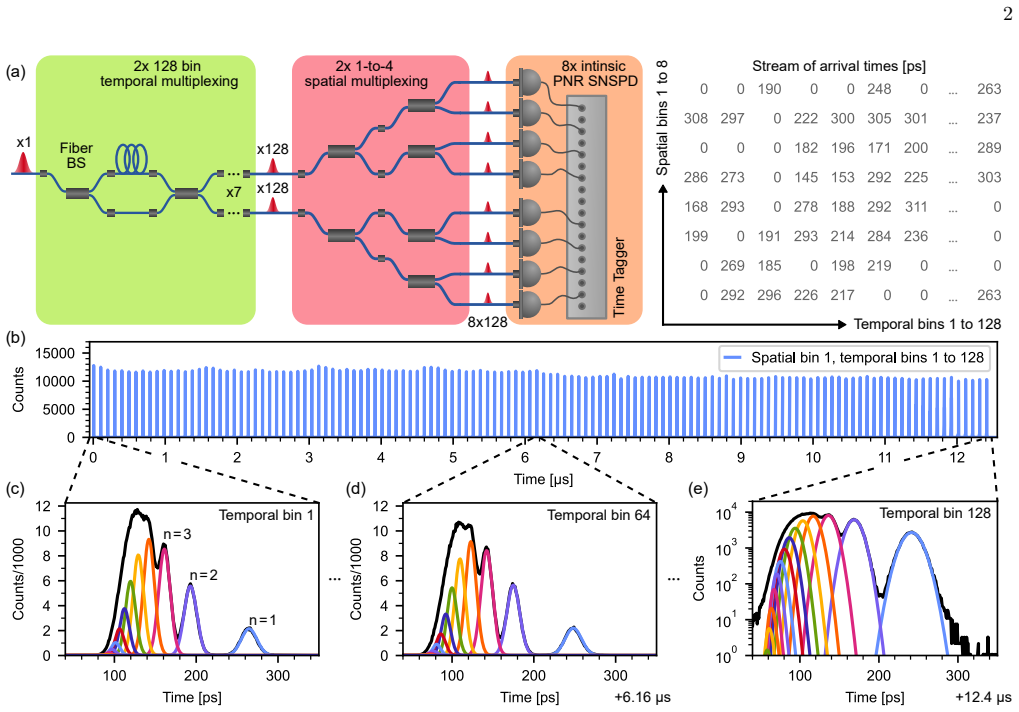
By multiplexing eight intrinsically photon-number-resolving superconducting nanowire single-photon detectors across 128 temporal modes, applying model-informed characterization to each of the resulting 1024 bins, and reconstructing the full set of positive operator-valued measures via quantum detector tomography, photon numbers can be counted from 0 to over 9000 with variance at least 4.1 dB below the Poisson limit and with sub-single-photon accuracy up to 276 photons per pulse.
What carries the argument
Temporal multiplexing of eight SNSPDs into 128 modes to create 1024 independent detection bins, followed by model-based per-bin calibration and complete quantum detector tomography that reconstructs the 1.38 times 10^8 element POVM matrix of the combined device.
Load-bearing premise
The model used to characterize each of the 1024 detection bins is sufficiently accurate and the quantum detector tomography reconstructs the device's POVMs without substantial systematic errors arising from the large matrix size.
What would settle it
Repeated measurements on a known coherent state whose mean photon number is independently calibrated should show count variances at least 4.1 dB below the mean; if the observed variances match or exceed the Poisson value, or if the reconstructed POVMs fail to predict the measured statistics within experimental uncertainty, the central claim is falsified.
Figures


read the original abstract
Photon counting is a cornerstone of quantum optics. Here, we demonstrate precisely counting from 0 to over 9000 photons, beating the Poisson noise limit by at least $4.1~\mathrm{dB}$ across this range. We achieve sub-single-photon precision up to 276 photons per pulse. To do so, we multiplex eight intrinsically photon-number-resolving superconducting nanowire single-photon detectors across 128 temporal modes. We use a model-informed characterization of each of the 1024 detection bins, for optimal precision. We perform quantum detector tomography to reconstruct the positive operator valued measures (POVMs) of the complete device, which consists of $1.38\cdot10^8$ matrix elements. At the repetition rate of our experiment of $80~\mathrm{kHz}$, we can precisely count photons corresponding to an optical power of approximately $71~\mathrm{pW}$, bridging the gap from single-photon measurements to high-sensitivity optical power meters. A photon-number-resolving detector of this size, and the tools used to analyze it, will become increasingly important to characterize large quantum states, as well as tasks in precision metrology and optical power standards.
Editorial analysis
A structured set of objections, weighed in public.
Referee Report
Summary. The manuscript reports an experimental demonstration of a high-dynamic-range photon-number-resolving detector constructed by temporally multiplexing eight SNSPDs into 128 modes, yielding 1024 detection bins. Using model-informed per-bin characterization followed by full quantum detector tomography, the authors reconstruct the device's POVM (1.38×10^8 elements) and claim photon counting from 0 to >9000 photons with variance at least 4.1 dB below the Poisson limit across the range, plus sub-single-photon precision up to 276 photons per pulse, at 80 kHz repetition rate (~71 pW).
Significance. If the sub-Poissonian performance is robustly validated, the result would be a significant technical advance in bridging single-photon detection to macroscopic regimes. It would enable new capabilities for characterizing large quantum states, precision metrology, and optical power standards, with the multiplexing and tomography tools potentially generalizable to other detector platforms.
major comments (2)
- [Quantum detector tomography] The quantum detector tomography reconstruction of the 1.38×10^8-element POVM is load-bearing for the headline 4.1 dB claim. The manuscript provides no quantitative uncertainties on the reconstructed POVM elements, no conditioning analysis of the tomography matrix, and no cross-validation against an independent calibration method. Finite statistics, basis incompleteness, or unmodeled cross-talk/dark counts can introduce systematic biases that grow with dimension and directly affect the variance estimator; without these controls it is impossible to confirm that the reported precision gain is physical rather than an artifact of the reconstruction.
- [Device characterization] The model-informed characterization of the 1024 individual detection bins supplies the per-bin parameters that feed the tomography. The paper does not report how these parameters were extracted, how many free parameters are involved, or whether they were validated on a separate dataset independent of the final variance measurements. Any leakage of the same data into both the model and the performance metric would undermine the claim that the 4.1 dB improvement is independently measured.
minor comments (2)
- The abstract would be strengthened by a single sentence summarizing the validation steps (e.g., independent calibration or Monte-Carlo checks) used to bound systematic errors in the POVM.
- Figure captions and axis labels should explicitly state whether the plotted variances include the reconstructed POVM uncertainties or are derived from raw counts only.
Simulated Author's Rebuttal
We thank the referee for their careful reading of our manuscript and for the constructive comments on the quantum detector tomography and device characterization sections. These points have prompted us to strengthen the supporting analysis and documentation. We address each major comment below and indicate the revisions made to the manuscript.
read point-by-point responses
-
Referee: [Quantum detector tomography] The quantum detector tomography reconstruction of the 1.38×10^8-element POVM is load-bearing for the headline 4.1 dB claim. The manuscript provides no quantitative uncertainties on the reconstructed POVM elements, no conditioning analysis of the tomography matrix, and no cross-validation against an independent calibration method. Finite statistics, basis incompleteness, or unmodeled cross-talk/dark counts can introduce systematic biases that grow with dimension and directly affect the variance estimator; without these controls it is impossible to confirm that the reported precision gain is physical rather than an artifact of the reconstruction.
Authors: We agree that quantitative uncertainties, conditioning analysis, and cross-validation are essential for validating the reconstructed POVM and the associated variance reduction. In the revised manuscript we have added bootstrap-derived uncertainties on all POVM elements (reported as standard deviations in a new supplementary figure). We also report the condition number of the tomography matrix (approximately 850, confirming numerical stability). For cross-validation, we performed an independent reconstruction using a truncated coherent-state basis and compared it to the full tomography result, obtaining variance estimates that agree within 0.3 dB across the measured range. Potential systematic biases from cross-talk and dark counts are already incorporated in the per-bin model; we have added a dedicated paragraph quantifying their residual contribution to the variance estimator and showing that they cannot account for the observed 4.1 dB sub-Poissonian performance. These additions appear in the updated Methods section and a new subsection on QDT validation. revision: yes
-
Referee: [Device characterization] The model-informed characterization of the 1024 individual detection bins supplies the per-bin parameters that feed the tomography. The paper does not report how these parameters were extracted, how many free parameters are involved, or whether they were validated on a separate dataset independent of the final variance measurements. Any leakage of the same data into both the model and the performance metric would undermine the claim that the 4.1 dB improvement is independently measured.
Authors: We thank the referee for highlighting this potential ambiguity. The per-bin parameters (detection efficiency, timing jitter, dark-count probability, and nearest-neighbor cross-talk probabilities) were obtained by maximum-likelihood fitting to a dedicated low-intensity coherent-state calibration dataset collected in a separate experimental run. Each bin is described by five free parameters. To eliminate data leakage, the high-photon-number variance measurements used an independent set of pulses whose mean photon numbers lie outside the calibration range; these data were never used in the parameter extraction. We have now included a full description of the fitting procedure, the number of free parameters, and the results of a 10 % held-out validation set (discrepancy < 0.8 % in efficiency) in the revised Methods section and Supplementary Information. The model-informed parameters serve only as an informed starting point for the tomography; the final POVM is reconstructed from the complete experimental dataset. revision: yes
Circularity Check
No significant circularity: experimental demonstration against independent benchmark
full rationale
The paper is an experimental report of a multiplexed SNSPD array with model-informed bin characterization and quantum detector tomography to reconstruct the device's POVM. The headline results (counting 0–>9000 photons, 4.1 dB below Poisson noise, sub-single-photon precision to 276) are obtained by applying the reconstructed POVM to measured detection outcomes and comparing the resulting statistics directly to the standard Poisson limit, which is an external theoretical benchmark independent of the present data or fit. No derivation, prediction, or first-principles claim is advanced that reduces by the paper's own equations to a fitted parameter, self-citation, or ansatz. The QDT step is a standard calibration procedure whose accuracy is an experimental assumption, not a closed logical loop; the paper remains self-contained against the external Poisson reference. Minor self-citations, if present, are not load-bearing for the central empirical claim.
Axiom & Free-Parameter Ledger
free parameters (1)
- model parameters for each of the 1024 detection bins
axioms (1)
- domain assumption Quantum detector tomography can accurately reconstruct the POVMs for the multiplexed detector system
Reference graph
Works this paper leans on
-
[1]
A. Migdall, S. V. Polyakov, J. Fan, and J. C. Bienfang, Single-Photon Generation and Detection: Physics and Applications(Academic Press, 2013)
work page 2013
-
[2]
H. Paul, P. T¨ orm¨ a, T. Kiss, and I. Jex, Photon Chop- ping: New Way to Measure the Quantum State of Light, Physical Review Letters76, 2464 (1996)
work page 1996
-
[3]
D. Achilles, C. Silberhorn, C. ´Sliwa, K. Banaszek, and I. A. Walmsley, Fiber-assisted detection with photon number resolution, Optics Letters28, 2387 (2003)
work page 2003
-
[4]
M. J. Fitch, B. C. Jacobs, T. B. Pittman, and J. D. Fran- son, Photon-number resolution using time-multiplexed single-photon detectors, Physical Review A68, 43814 (2003)
work page 2003
- [5]
-
[6]
J. Sperling, W. Vogel, and G. S. Agarwal, True photo- counting statistics of multiple on-off detectors, Physical Review A85, 23820 (2012)
work page 2012
-
[7]
A. E. Lita, A. J. Miller, and S. W. Nam, Counting near- infrared single-photons with 95% efficiency, Optics Ex- press16, 3032 (2008)
work page 2008
- [8]
- [9]
-
[10]
T. Gerrits, B. Calkins, N. Tomlin, A. E. Lita, A. Migdall, R. Mirin, and S. W. Nam, Extending single-photon op- timized superconducting transition edge sensors beyond the single-photon counting regime, Opt. Express20, 23798 (2012)
work page 2012
-
[13]
Tiedau,Quantum optics in the photon number basis, PhD Thesis, Paderborn University (2020)
J. Tiedau,Quantum optics in the photon number basis, PhD Thesis, Paderborn University (2020)
work page 2020
-
[14]
T. Schapeler, J. Philipp H¨ opker, and T. J. Bartley, Quan- tum detector tomography of a 2×2 multi-pixel array of superconducting nanowire single photon detectors, Op- tics Express28, 33035 (2020)
work page 2020
-
[15]
T. Schapeler, N. Lamberty, T. Hummel, F. Schlue, M. Stefszky, B. Brecht, C. Silberhorn, and T. J. Bart- ley, Electrical trace analysis of superconducting nanowire photon-number-resolving detectors, Physical Review Ap- plied22, 14024 (2024)
work page 2024
-
[16]
J. S. Lundeen, A. Feito, H. Coldenstrodt-Ronge, K. L. Pregnell, C. Silberhorn, T. C. Ralph, J. Eisert, M. B. Plenio, and I. A. Walmsley, Tomography of quantum de- tectors, Nature Physics5, 27 (2009)
work page 2009
- [17]
-
[18]
D. Zhu, M. Colangelo, C. Chen, B. A. Korzh, F. N. C. Wong, M. D. Shaw, and K. K. Berggren, Resolving Photon Numbers Using a Superconducting Nanowire with Impedance-Matching Taper, Nano Letters20, 3858 (2020)
work page 2020
-
[19]
M. Endo, T. Sonoyama, M. Matsuyama, F. Okamoto, S. Miki, M. Yabuno, F. China, H. Terai, and A. Furu- sawa, Quantum detector tomography of a superconduct- ing nanostrip photon-number-resolving detector, Optics Express29, 11728 (2021)
work page 2021
- [20]
-
[21]
L.-D. Kong, T.-Z. Zhang, X.-Y. Liu, H. Li, Z. Wang, X.-M. Xie, and L.-X. You, Large-inductance supercon- ducting microstrip photon detector enabling 10 photon- number resolution, Advanced Photonics6, 16004 (2024)
work page 2024
-
[22]
J. W. N. Los, M. Sidorova, B. Lopez-Rodriguez, P. Qualm, J. Chang, S. Steinhauer, V. Zwiller, and I. E. Zadeh, High-performance photon number resolving de- tectors for 850–950 nm wavelength range, APL Photonics 9, 10.1063/5.0204340 (2024)
-
[23]
R. Jaha, C. A. Graham-Scott, A. S. Abazi, W. Pernice, C. Schuck, and S. Ferrari, Kinetic inductance and jitter dependence of intrinsic photon-number resolution in su- perconducting nanowire single-photon detectors, Optics Express33, 41869 (2025)
work page 2025
-
[24]
F. M. Miatto, A. Safari, and R. W. Boyd, Explicit for- mulas for photon number discrimination with on/off de- tectors, Applied Optics57, 6750 (2018)
work page 2018
- [25]
-
[26]
Z. H. Levine, B. L. Glebov, A. L. Migdall, T. Gerrits, B. Calkins, A. E. Lita, and S. W. Nam, Photon-number uncertainty in a superconducting transition edge sensor beyond resolved-photon-number determination, Journal of the Optical Society of America B31, B20 (2014)
work page 2014
-
[27]
Z. H. Levine, T. Gerrits, A. L. Migdall, D. V. Samarov, B. Calkins, A. E. Lita, and S. W. Nam, Algorithm for finding clusters with a known distribution and its applica- tion to photon-number resolution using a superconduct- ing transition-edge sensor, Journal of the Optical Society of America B29, 2066 (2012)
work page 2066
-
[28]
A. J. Kerman, D. Rosenberg, R. J. Molnar, and E. A. Dauler, Readout of superconducting nanowire single- photon detectors at high count rates, Journal of Applied Physics113, 144511 (2013)
work page 2013
-
[29]
S. Ferrari, V. Kovalyuk, A. Vetter, C. Lee, C. Rockstuhl, A. Semenov, G. Gol’tsman, and W. Pernice, Analysis of the detection response of waveguide-integrated supercon- ducting nanowire single-photon detectors at high count rate, Applied Physics Letters115, 101104 (2019)
work page 2019
-
[30]
P. Mark, S. Gstir, J. M¨ unzberg, G. Weihs, and R. Keil, Nonlinear response of telecom-wavelength superconduct- ing single-photon detectors, APL Quantum1, 46109 (2024)
work page 2024
-
[31]
T. Schapeler, R. Schade, M. Lass, C. Plessl, and T. J. Bartley, Scalable quantum detector tomography by high- performance computing, Quantum Science and Technol- ogy10, 015018 (2025)
work page 2025
-
[32]
R. Schade, M. Lass, T. Schapeler, C. Plessl, and T. J. Bartley, Parallel quantum detector tomography solver (pqdts) (2024). Supplemental document: Macroscopic photon counting beating the Poisson noise limit Timon Schapeler, 1, 2,∗Fabian Schlue,1, 2 Isabell Mischke, 1, 2 Michael Stefszky,1, 2 Benjamin Brecht,1, 2 Christine Silberhorn, 1, 2 and Tim J. Bartl...
work page 2024
-
[33]
T. Schapeler, I. Mischke, F. Schlue, M. Stefszky, B. Brecht, C. Silberhorn, and T. J. Bartley, Practical considerations for assignment of photon numbers with SNSPDs, APL Quantum 3, 10.1063/5.0304127 (2026)
-
[34]
Tiedau, Quantum optics in the photon number basis , PhD Thesis, Paderborn University (2020)
J. Tiedau, Quantum optics in the photon number basis , PhD Thesis, Paderborn University (2020)
work page 2020
-
[35]
T. Schapeler, N. Lamberty, T. Hummel, F. Schlue, M. Stefszky, B. Brecht, C. Silberhorn, and T. J. Bart- ley, Electrical trace analysis of superconducting nanowire photon-number-resolving detectors, Physical Review Ap- plied 22, 14024 (2024)
work page 2024
-
[36]
T. Schapeler, J. Philipp H¨ opker, and T. J. Bartley, Quan- tum detector tomography of a 2 ×2 multi-pixel array of superconducting nanowire single photon detectors, Op- tics Express 28, 33035 (2020)
work page 2020
-
[37]
A. J. Kerman, D. Rosenberg, R. J. Molnar, and E. A. Dauler, Readout of superconducting nanowire single- photon detectors at high count rates, Journal of Applied Physics 113, 144511 (2013)
work page 2013
-
[38]
S. Ferrari, V. Kovalyuk, A. Vetter, C. Lee, C. Rockstuhl, A. Semenov, G. Gol’tsman, and W. Pernice, Analysis of the detection response of waveguide-integrated supercon- ducting nanowire single-photon detectors at high count rate, Applied Physics Letters 115, 101104 (2019)
work page 2019
-
[39]
A. Mueller, E. E. Wollman, B. Korzh, A. D. Beyer, L. Narvaez, R. Rogalin, M. Spiropulu, and M. D. Shaw, Time-walk and jitter correction in SNSPDs at high count rates, Applied Physics Letters 122, 10.1063/5.0129147 (2023)
-
[40]
P. Mark, S. Gstir, J. M¨ unzberg, G. Weihs, and R. Keil, Nonlinear response of telecom-wavelength superconduct- ing single-photon detectors, APL Quantum 1, 46109 (2024)
work page 2024
-
[41]
Q. Zhao, L. Zhang, T. Jia, L. Kang, W. Xu, J. Chen, and P. Wu, Intrinsic timing jitter of superconducting nanowire single-photon detectors, Applied Physics B 104, 673 (2011)
work page 2011
-
[42]
J. Noda, K. Okamoto, and Y. Sasaki, Polarization- maintaining fibers and their applications, Journal of Lightwave Technology4, 1071 (1986)
work page 1986
-
[43]
M. Sidorova, T. Schapeler, A. D. Semenov, F. Schlue, M. Stefszky, B. Brecht, C. Silberhorn, and T. J. Bartley, Jitter in photon-number-resolved detection by superconducting nanowires, APL Photonics 10, 10.1063/5.0273752 (2025)
discussion (0)
Sign in with ORCID, Apple, or X to comment. Anyone can read and Pith papers without signing in.