Sampled-data Robust Control of Electrically Stimulated Engineered Cell Factories
Pith reviewed 2026-05-09 18:26 UTC · model grok-4.3
The pith
A sampled-data robust adaptive PID controller achieves stable regulation of T4 hormone production in electrically stimulated engineered cells despite delays and uncertainties.
A machine-rendered reading of the paper's core claim, the machinery that carries it, and where it could break.
Core claim
We design a sampled-data adaptive proportional-integral-derivative (PID) controller with derivative filtering, anti-windup, saturation and rate limits, and hysteretic band-locking, together with a robust adaptive extension that accounts for parameter mismatch, sensor noise and bias, actuator mismatch, delay/jitter, and exogenous rhythmic disturbance through a scenario-based risk-aware update. We provide local sampled-data input-to-state stability interpretations for both APID and RAPID, showing that, under standard local Lyapunov and bounded-disturbance conditions, the sampled tracking error is ultimately bounded by a disturbance-dependent constant. In silico experiments demonstrate Sustaine
What carries the argument
The sampled-data adaptive PID controller and its robust extension (RAPID) that uses scenario-based risk-aware parameter updates to enforce local input-to-state stability.
If this is right
- The sampled tracking error remains ultimately bounded by a constant determined by the size of bounded disturbances.
- Sustained regulation of extracellular T4 can be maintained at multiple prescribed target levels.
- The controller handles the combination of delayed nonlinear dynamics, sparse measurements, and burst-constrained electric actuation.
- Stability holds locally whenever standard Lyapunov conditions are met and disturbances remain bounded.
Where Pith is reading between the lines
- The modeling and control structure could be applied to regulation of other secreted proteins in different engineered cell types.
- Physical wet-lab tests would be needed to check whether the ODE model's delay distribution matches observed cell behavior.
- The risk-aware update rule suggests a route for incorporating online learning to refine disturbance bounds during operation.
Load-bearing premise
The control-oriented ODE model of the T4 pathway, Hill module, and Erlang cascade sufficiently captures the real intracellular dynamics of the engineered cells.
What would settle it
If laboratory experiments on the actual engineered thyroid-like cells show that tracking error grows without bound under the same disturbance levels used in the simulations, the local stability claim would be falsified.
Figures




read the original abstract
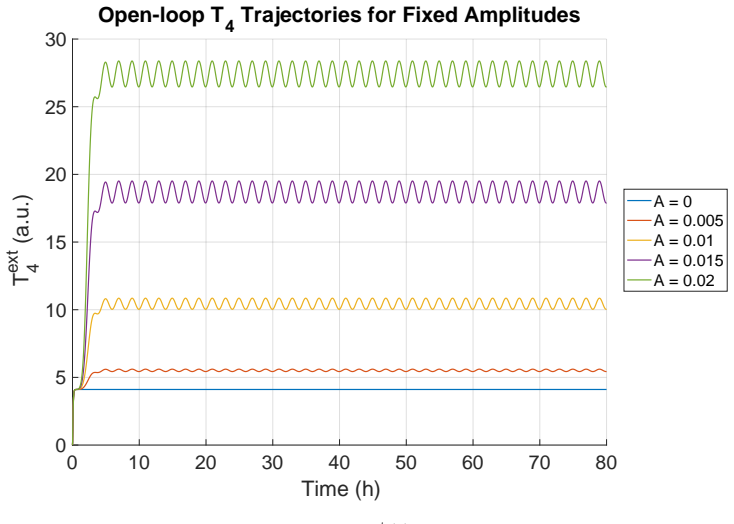
Closed-loop bioelectronic regulation of engineered secretory cell systems is challenging because electric-field (EF) stimulation acts indirectly through transcription-factor activation, in the presence of delayed, nonlinear, and noisy intracellular dynamics, sparse measurements, and constrained burst-based actuation. We develop a framework for robust closed-loop endocrine regulation in electrically stimulated engineered cell factories, illustrated through extracellular thyroid hormone \(T_4\) production in engineered thyroid-like cells. The plant is modeled by a control-oriented ODE formulation combining a reduced mechanistic \(T_4\) pathway, an EF-responsive Hill module, and a linear-chain Erlang cascade representing distributed intracellular delay. On this basis, we design a sampled-data adaptive proportional-integral-derivative (PID) controller with derivative filtering, anti-windup, saturation and rate limits, and hysteretic band-locking, together with a robust adaptive extension that accounts for parameter mismatch, sensor noise and bias, actuator mismatch, delay/jitter, and exogenous rhythmic disturbance through a scenario-based risk-aware update. We provide local sampled-data input-to-state stability interpretations for both APID and RAPID, showing that, under standard local Lyapunov and bounded-disturbance conditions, the sampled tracking error is ultimately bounded by a disturbance-dependent constant. In silico experiments demonstrate sustained regulation of extracellular \(T_4\) across prescribed targets despite significant uncertainty.
Editorial analysis
A structured set of objections, weighed in public.
Referee Report
Summary. The manuscript develops a sampled-data robust control framework for electrically stimulated engineered cell factories, illustrated on extracellular T4 regulation in engineered thyroid-like cells. The plant is modeled via a control-oriented ODE combining a reduced mechanistic T4 pathway, an EF-responsive Hill module, and a linear-chain Erlang cascade for distributed intracellular delay. An adaptive PID controller (APID) is designed with derivative filtering, anti-windup, saturation, rate limits, and hysteretic band-locking; a robust adaptive extension (RAPID) further accounts for parameter mismatch, sensor noise/bias, actuator mismatch, delay/jitter, and rhythmic disturbance via scenario-based risk-aware updates. Local sampled-data input-to-state stability interpretations are provided for both controllers under standard local Lyapunov and bounded-disturbance conditions, claiming that the sampled tracking error is ultimately bounded by a disturbance-dependent constant. In silico experiments demonstrate sustained regulation across targets despite significant uncertainty.
Significance. If the local ISS interpretations and simulation results hold, the work would offer a concrete control-theoretic contribution to bioelectronic regulation of synthetic secretory systems, addressing indirect actuation, delays, noise, and sparse measurements through practical sampled-data adaptive designs. Strengths include the explicit incorporation of implementation constraints (saturation, anti-windup) and the scenario-based robustness mechanism. The local Lyapunov-based ISS analysis provides a standard but useful stability lens. Significance is limited by the purely in silico nature of the validation and the absence of checks confirming that trajectories remain inside the local domain invoked by the stability claims.
major comments (1)
- [Abstract / stability analysis] Abstract and stability analysis section: the local sampled-data ISS claim states that 'under standard local Lyapunov and bounded-disturbance conditions, the sampled tracking error is ultimately bounded by a disturbance-dependent constant.' The in silico experiments (with parameter mismatch, sensor noise, actuator mismatch, delay/jitter, and rhythmic disturbance) provide no post-simulation verification that closed-loop trajectories remained inside the region of validity of the local Lyapunov function for either APID or RAPID. If trajectories exit this domain, the ISS bound does not apply and the sustained-regulation result rests only on the specific numerical runs rather than the stated stability interpretation.
minor comments (3)
- [In silico experiments] Simulation results lack error bars or statistical summaries across repeated runs with randomized disturbances.
- [Methods / results] Full numerical parameter values for the plant model, controller gains, and scenario-based update are not provided in a table or supplementary material, hindering reproducibility.
- [Plant modeling] The model is not validated against any real experimental data; the transfer of the stability interpretation therefore depends entirely on the untested assumption that the reduced ODE captures the dominant intracellular dynamics.
Simulated Author's Rebuttal
We thank the referee for the careful reading and constructive feedback on our manuscript. We address the major comment below and will revise the manuscript accordingly to strengthen the connection between the theoretical claims and the numerical results.
read point-by-point responses
-
Referee: [Abstract / stability analysis] Abstract and stability analysis section: the local sampled-data ISS claim states that 'under standard local Lyapunov and bounded-disturbance conditions, the sampled tracking error is ultimately bounded by a disturbance-dependent constant.' The in silico experiments (with parameter mismatch, sensor noise, actuator mismatch, delay/jitter, and rhythmic disturbance) provide no post-simulation verification that closed-loop trajectories remained inside the region of validity of the local Lyapunov function for either APID or RAPID. If trajectories exit this domain, the ISS bound does not apply and the sustained-regulation result rests only on the specific numerical runs rather than the stated stability interpretation.
Authors: We agree that the absence of explicit post-simulation verification of the local domain represents a gap in substantiating the local ISS claims. The manuscript currently presents the stability interpretation under the stated local Lyapunov and bounded-disturbance conditions but does not confirm that the simulated trajectories remained inside the relevant region for either controller. In the revised manuscript we will add a dedicated verification subsection in the simulation results. This will include an estimate of the local region (derived from the Lyapunov function level sets or state bounds used in the analysis) and explicit checks confirming that all reported trajectories, across the tested uncertainty scenarios, satisfy the local conditions. These checks will be presented alongside the existing performance plots. We believe this addition directly addresses the concern and allows the stability interpretation to apply to the numerical evidence. revision: yes
Circularity Check
No circularity detected; stability claims rest on external standard Lyapunov theory applied to the given model
full rationale
The paper's central stability result invokes standard local Lyapunov and bounded-disturbance conditions to conclude ultimate boundedness of the sampled tracking error for the APID and RAPID controllers. This is an application of established input-to-state stability theory rather than a reduction of any prediction or bound to quantities defined by the same data fits or self-citations. The model itself is presented as a control-oriented ODE formulation whose parameters are not claimed to be derived from the stability analysis. In silico experiments are numerical demonstrations under uncertainty, not predictions forced by construction from the stability derivation. No self-definitional loops, fitted inputs renamed as predictions, or load-bearing self-citations appear in the provided derivation chain. The result is therefore self-contained against external benchmarks.
Axiom & Free-Parameter Ledger
axioms (1)
- standard math standard local Lyapunov and bounded-disturbance conditions suffice for input-to-state stability
Reference graph
Works this paper leans on
-
[1]
Alon.An Introduction to Systems Biology: Design Principles of Biological Circuits
U. Alon.An Introduction to Systems Biology: Design Principles of Biological Circuits. Chapman & Hall/CRC, 2006
work page 2006
-
[2]
B. Carmona-Hidalgo, E. Herrera-Ramos, R. Rodr´ ıguez-L´ opez, L. Nou-Fontanet, J. C. Moreno, J. A. Blasco-Amaro, J. L´ eger, J. D. Ortigoza-Escobar, and NKX2-1-Related Dis- orders Guideline Working Group. Systematic review of thyroid function in nkx2-1-related disorders: Treatment and follow-up.PLoS ONE, 19(10):e0309064, 2024. 29
work page 2024
-
[3]
D. Del Vecchio and R. M. Murray.Biomolecular Feedback Systems. Princeton University Press, 2018
work page 2018
-
[4]
K. Famm, B. Litt, K. J. Tracey, E. S. Boyden, and M. Slaoui. A jump-start for electroceu- ticals.Nature, 496:159–161, 2013
work page 2013
-
[5]
Gomez, Mehdi Sadeghpour, Matthew R
Marcella M. Gomez, Mehdi Sadeghpour, Matthew R. Bennett, G´ abor Orosz, and Richard M. Murray. Stability of systems with stochastic delays and applications to genetic regulatory networks.SIAM Journal on Applied Dynamical Systems, 15(4):1844–1873, 2016
work page 2016
-
[6]
Paul J. Hurtado and Adam S. Kirosingh. Generalizations of the Linear Chain Trick: incorporating more flexible dwell time distributions into mean field ODE models.Journal of Mathematical Biology, 79(5):1831–1883, 2019
work page 2019
-
[7]
Bashir Hosseini Jafari, Ksenia Zlobina, Giovanny Marquez, Mohammad Jafari, John Sel- berg, Manping Jia, Marco Rolandi, and Marcella Gomez. A feedback control architecture for bioelectronic devices with applications to wound healing.Journal of the Royal Society Interface, 18(185):20210497, 2021
work page 2021
-
[8]
Mohammad Jafari, Giovanny Marquez, Harika Dechiraju, Marcella Gomez, and Marco Rolandi. Merging machine learning and bioelectronics for closed-loop control of biological systems and homeostasis.Cell Reports Physical Science, 4(8):101535, 2023
work page 2023
-
[9]
Input-to-state stability for discrete-time nonlinear systems.Automatica, 37(6):857–869, 2001
Zhong-Ping Jiang and Yuan Wang. Input-to-state stability for discrete-time nonlinear systems.Automatica, 37(6):857–869, 2001
work page 2001
-
[10]
Zhong-Ping Jiang and Yuan Wang. A converse lyapunov theorem for discrete-time systems with disturbances.Systems & Control Letters, 45(1):49–58, 2002
work page 2002
-
[11]
Dimitrios A. Koutsouras, George G. Malliaras, and Geert Langereis. The rise of bioelec- tronic medicine.Bioelectronic Medicine, 10(1):19, 2024
work page 2024
-
[12]
T. Kusakabe, A. Kawaguchi, N. Hoshi, R. Kawaguchi, S. Hoshi, and S. Kimura. Thyroid- specific enhancer-binding protein/nkx2.1 is required for the maintenance of ordered archi- tecture and function of the differentiated thyroid.Molecular Endocrinology, 20(8):1796– 1809, 2006
work page 2006
-
[13]
Michael Levin, John Selberg, and Marco Rolandi. Endogenous bioelectrics in development, cancer, and regeneration: Drugs and bioelectronic devices as electroceuticals for regenera- tive medicine.iScience, 22:519–533, Dec 2019
work page 2019
-
[14]
X. Li, S. Zhong, and J. Morizio. 16-channel biphasic current-mode programmable charge balanced neural stimulation.BioMedical Engineering OnLine, 16:104, 2017
work page 2017
- [15]
-
[16]
Wei Liu and Jie Huang. Sampled-data semi-global robust output regulation for a class of nonlinear systems.Journal of Systems Science and Complexity, 34:1743–1765, 2021
work page 2021
-
[17]
Springer, Berlin, Heidelberg, 1978
Norman MacDonald.Time Lags in Biological Models, volume 27 ofLecture Notes in Biomathematics. Springer, Berlin, Heidelberg, 1978
work page 1978
-
[18]
M. Mansouri and M. Fussenegger. Electrogenetics: Bridging synthetic biology and elec- tronics to remotely control the behavior of mammalian designer cells.Current Opinion in Chemical Biology, 68:102151, 2022. 30
work page 2022
-
[19]
Hernandez, Mircea Teodorescu, Marco Rolandi, Min Zhao, and Marcella Gomez
Giovanny Marquez, Mohammad Jafari, Manasa Kesapragada, Kan Zhu, Prabhat Baniya, Yao-Hui Sun, Hao-Chieh Hsieh, Cristian O. Hernandez, Mircea Teodorescu, Marco Rolandi, Min Zhao, and Marcella Gomez. Controlling cell migratory patterns under an electric field regulated by a neural network-based feedback controller.Bioengineering, 12(7):678, 2025
work page 2025
-
[20]
Dragan Neˇ si´ c and Andrew R. Teel. A framework for stabilization of nonlinear sampled- data systems based on their approximate discrete-time models.IEEE Transactions on Automatic Control, 49(7):1103–1122, 2004
work page 2004
-
[21]
Dragan Neˇ si´ c, Andrew R. Teel, and Daniele Carnevale. Explicit computation of the sam- pling period in emulation of controllers for nonlinear sampled-data systems.IEEE Trans- actions on Automatic Control, 54(3):619–624, 2009
work page 2009
-
[22]
V. M. L. Ogundipe, A. H. Groen, N. Hosper, P. W. K. Nagle, J. Hess, H. Faber, A. L. Jellema, M. Baanstra, T. P. Links, K. Unger, J. T. M. Plukker, and R. P. Coppes. Gen- eration and differentiation of adult tissue-derived human thyroid organoids.Stem Cell Reports, 16(4):913–925, 2021
work page 2021
-
[23]
P. S. Olofsson and K. J. Tracey. Bioelectronic medicine: technology targeting molecular mechanisms for therapy.Journal of Internal Medicine, 282:3–4, 2015
work page 2015
-
[24]
Subham Preetam, Arka Ghosh, Richa Mishra, Arunima Pandey, Debanjan Singha Roy, Sarvesh Rustagi, and Sumira Malik. Electrical stimulation: a novel therapeutic strategy to heal biological wounds.RSC Advances, 14(44):32142–32173, Oct 2024
work page 2024
-
[25]
J. E. Purvis and G. Lahav. Encoding and decoding cellular information through signaling dynamics.Cell, 152:945–956, 2013
work page 2013
-
[26]
Y. Qian and D. Del Vecchio. Realizing ‘integral control’ in living cells: how to overcome leaky integration due to dilution?Journal of The Royal Society Interface, 15, 2018
work page 2018
-
[27]
Machine learning-driven bioelectronics for closed-loop control of cells
John Selberg, Mohammad Jafari, Juanita Mathews, Manping Jia, Pattawong Pansodtee, Harika Dechiraju, Chunxiao Wu, Sergio Cordero, Alexander Flora, Nebyu Yonas, Sophia Jannetty, Miranda Diberardinis, Mircea Teodorescu, Michael Levin, Marcella Gomez, and Marco Rolandi. Machine learning-driven bioelectronics for closed-loop control of cells. Advanced Intellig...
work page 2020
-
[28]
C. R. Steinhardt, D. E. Mitchell, K. E. Cullen, et al. Pulsatile electrical stimulation creates predictable, correctable disruptions in neural firing.Nature Communications, 15:5861, 2024
work page 2024
- [29]
-
[30]
Ksenia Zlobina, Mohammad Jafari, Marco Rolandi, and Marcella Gomez. The role of machine learning in advancing precision medicine with feedback control.Cell Reports Physical Science, 3(11):101149, 2022
work page 2022
-
[31]
K. J. ˚Astr¨ om and T. H¨ agglund.Advanced PID Control. ISA, 2006
work page 2006
-
[32]
K. J. ˚Astr¨ om and B. Wittenmark.Computer-Controlled Systems: Theory and Design. Prentice Hall, 2010
work page 2010
-
[33]
Karl J. ˚Astr¨ om and Tore H¨ agglund. The future of PID control.Control Engineering Practice, 9(11):1163–1175, 2001. 31 0 10 20 30 40 50 60 70 80Time (h) 0 10 20 30Measured T4ext (a.u.) Measured tracking comparison Measured T4, dt = 0.1 s Measured T4, dt = 0.008333 sSetpoint 0 10 20 30 40 50 60 70 80Time (h) 0 0.002 0.004 0.006 0.008 0.01EF supplied Burs...
work page 2001
discussion (0)
Sign in with ORCID, Apple, or X to comment. Anyone can read and Pith papers without signing in.