MemORAI: Memory Organization and Retrieval via Adaptive Graph Intelligence for LLM Conversational Agents
Pith reviewed 2026-05-09 14:41 UTC · model grok-4.3
The pith
MemORAI equips LLMs with selective memory filtering, provenance tracking, and adaptive retrieval to enable coherent long-term personalized conversations.
A machine-rendered reading of the paper's core claim, the machinery that carries it, and where it could break.
Core claim
We introduce MemORAI, a framework that integrates selective memory filtering with dual-layer compression to retain user-persona-relevant content, a provenance-enriched multi-relational graph tracking factual origins at the turn level, and query-adaptive subgraph retrieval with Dynamic Weighted PageRank that applies query-conditioned edge weighting. Evaluated on LOCOMO and LongMemEval benchmarks, MemORAI achieves state-of-the-art performance in memory retrieval and personalized response generation.
What carries the argument
The provenance-enriched multi-relational graph with query-conditioned edge weighting in Dynamic Weighted PageRank, combined with dual-layer compression for selective filtering.
Load-bearing premise
That the three components of selective filtering, turn-level provenance graphs, and query-adaptive PageRank will solve dilution and uniform retrieval issues without adding biases or overhead that hurt performance on new conversation types.
What would settle it
A new benchmark with unseen conversation styles or domains where MemORAI fails to outperform existing methods or shows degraded coherence.
Figures


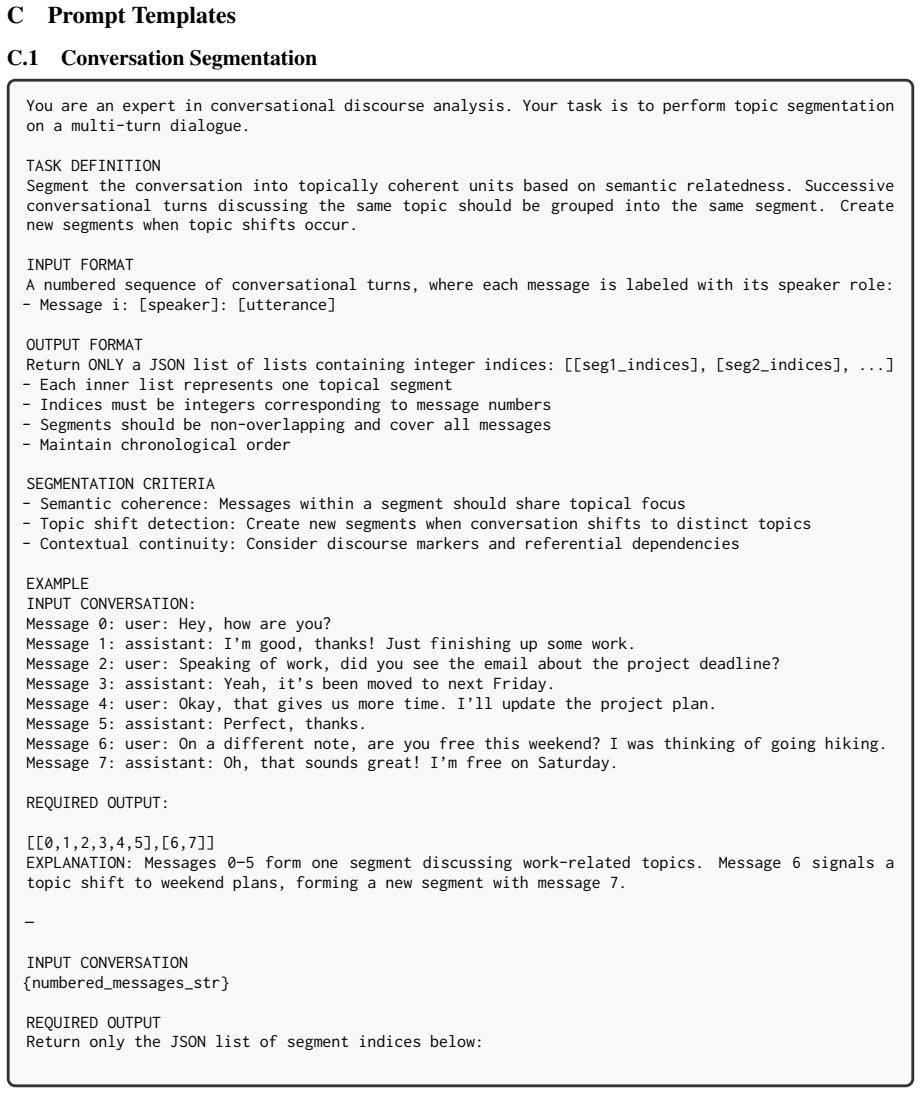
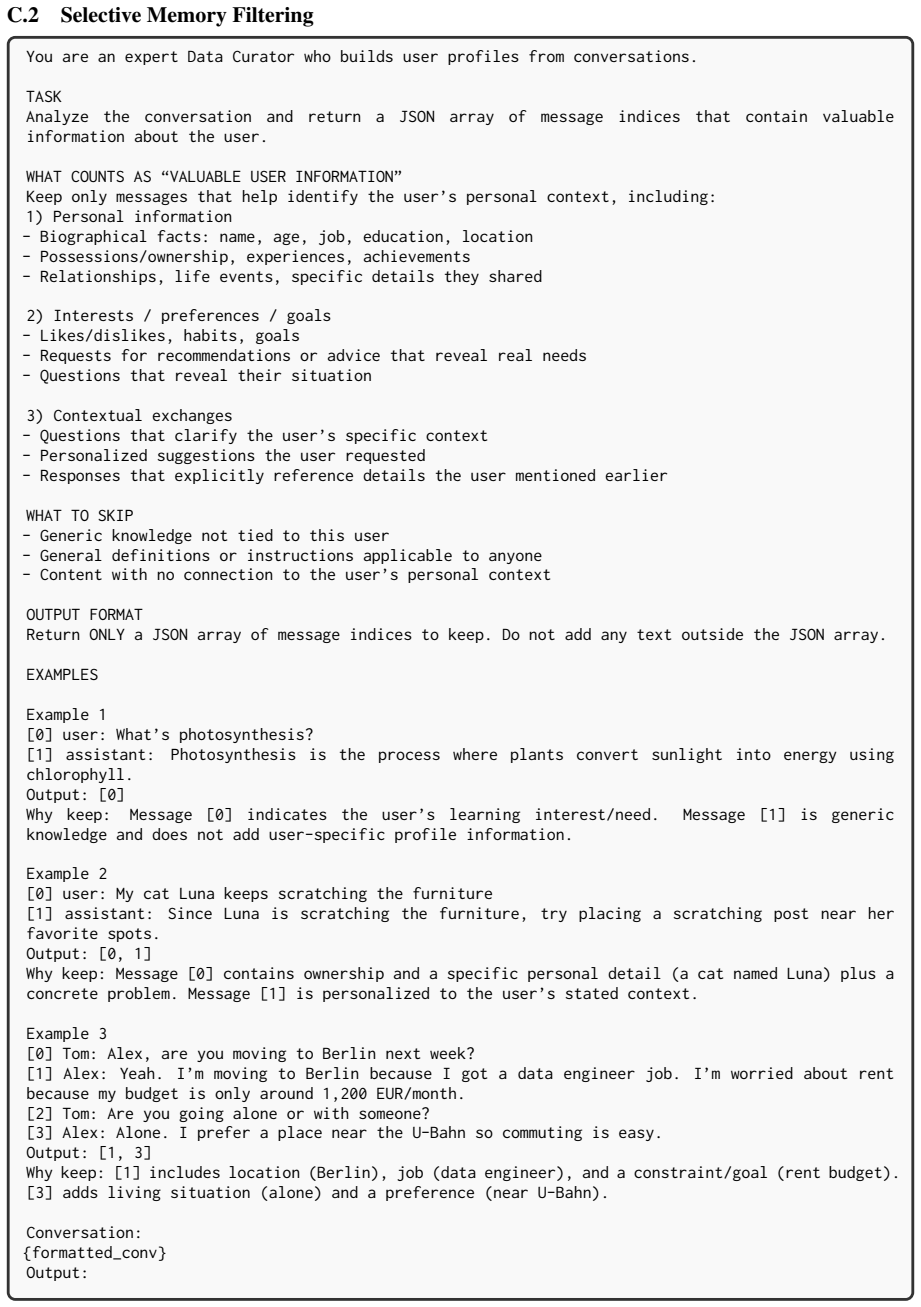
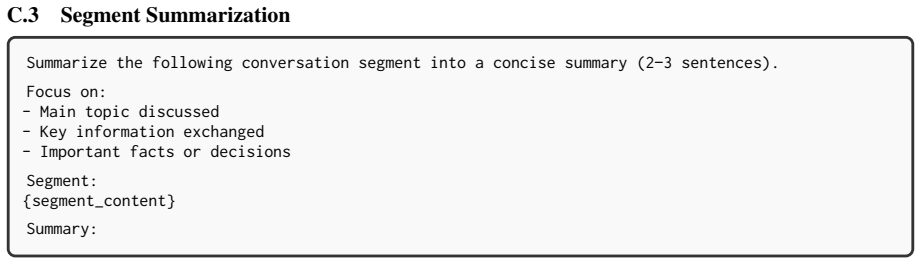

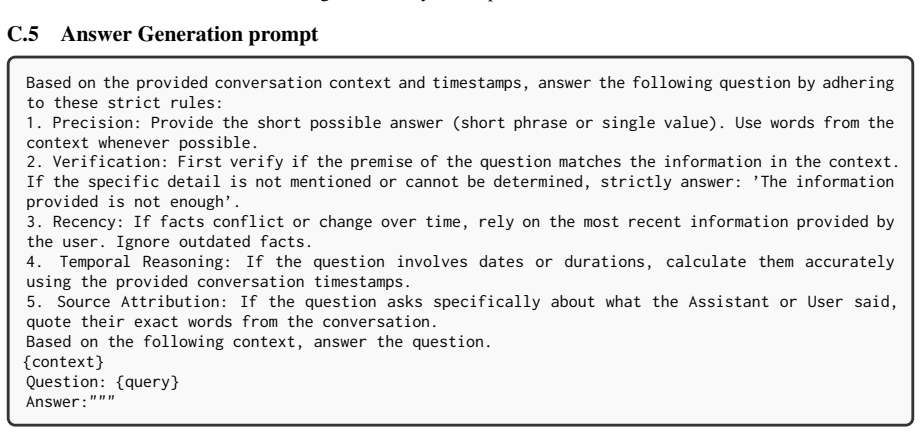


read the original abstract
Large Language Models (LLMs) lack persistent memory for long-term personalized conversations. Existing graph-based memory systems suffer from information dilution, absent provenance tracking, and uniform retrieval that ignores query context. We introduce MemORAI (Memory Organization and Retrieval via Adaptive Graph Intelligence), a framework that integrates three innovations: selective memory filtering with dual-layer compression to retain user-persona-relevant content, a provenance-enriched multi-relational graph tracking factual origins at the turn level, and query-adaptive subgraph retrieval with Dynamic Weighted PageRank that applies query-conditioned edge weighting. Evaluated on LOCOMO and LongMemEval benchmarks, MemORAI achieves state-of-the-art performance in memory retrieval and personalized response generation, demonstrating that selective storage, enriched representation, and adaptive retrieval are essential for coherent, personalized LLM agents.
Editorial analysis
A structured set of objections, weighed in public.
Referee Report
Summary. The paper introduces MemORAI, a graph-based memory framework for LLM conversational agents that combines selective memory filtering with dual-layer compression, a provenance-enriched multi-relational graph with turn-level tracking, and query-adaptive subgraph retrieval via Dynamic Weighted PageRank. It claims these components address information dilution, absent provenance, and uniform retrieval in existing systems, achieving state-of-the-art results on the LOCOMO and LongMemEval benchmarks for memory retrieval and personalized response generation.
Significance. If the empirical claims hold with proper validation, the work could meaningfully advance persistent memory mechanisms for long-context LLM agents by providing concrete engineering solutions to dilution and context-agnostic retrieval. The integration of provenance tracking and adaptive ranking is a practical contribution, though the absence of ablations, latency data, or generalization tests limits assessment of whether the gains stem from the proposed innovations or from implementation details.
major comments (3)
- [Abstract and §5] Abstract and §5 (Experiments): The central SOTA claim on LOCOMO and LongMemEval is unsupported by any reported quantitative metrics, baseline scores, ablation results, or error analysis. Without these, it is impossible to verify whether selective filtering, provenance enrichment, or Dynamic Weighted PageRank drive the gains or whether post-hoc tuning affects outcomes.
- [§3.3] §3.3 (Dynamic Weighted PageRank): The claim that query-conditioned edge weighting reliably solves uniform retrieval without introducing new biases or overhead is untested. No cross-domain, out-of-distribution, or query-type ablation experiments are described to check for degraded performance on unseen conversation styles.
- [§4] §4 (Framework components): The assertion that the three innovations are 'essential' for coherent agents rests on the unverified assumption that dual-layer compression plus turn-level provenance will not add retrieval latency or scalability costs; no runtime measurements or scaling analysis with conversation length are provided.
minor comments (2)
- [§3.2] Notation for the multi-relational graph edges and provenance tracking is introduced without a formal definition or example in the early sections, making the description harder to follow.
- [Abstract] The abstract and introduction repeat the phrase 'state-of-the-art performance' without defining the exact metrics (e.g., retrieval precision, response coherence) used for the claim.
Simulated Author's Rebuttal
We thank the referee for the thorough and constructive review. The feedback highlights important areas for strengthening the empirical support and validation of our claims. We address each major comment below and will revise the manuscript to incorporate the suggested additions and clarifications.
read point-by-point responses
-
Referee: [Abstract and §5] Abstract and §5 (Experiments): The central SOTA claim on LOCOMO and LongMemEval is unsupported by any reported quantitative metrics, baseline scores, ablation results, or error analysis. Without these, it is impossible to verify whether selective filtering, provenance enrichment, or Dynamic Weighted PageRank drive the gains or whether post-hoc tuning affects outcomes.
Authors: We agree that explicit quantitative metrics, baseline comparisons, ablations, and error analysis are necessary to substantiate the SOTA claims. The current manuscript reports overall performance improvements but does not include the detailed tables or breakdowns requested. In the revised version, we will add comprehensive results tables with exact scores on LOCOMO and LongMemEval for memory retrieval and response personalization, direct comparisons to all relevant baselines, component-wise ablations, and error analysis to demonstrate the contributions of each innovation and rule out post-hoc tuning effects. revision: yes
-
Referee: [§3.3] §3.3 (Dynamic Weighted PageRank): The claim that query-conditioned edge weighting reliably solves uniform retrieval without introducing new biases or overhead is untested. No cross-domain, out-of-distribution, or query-type ablation experiments are described to check for degraded performance on unseen conversation styles.
Authors: The evaluation on LOCOMO and LongMemEval already spans multiple conversation domains and query styles, providing initial evidence for the adaptive weighting. However, we acknowledge the value of explicit tests for generalization. We will add cross-domain, out-of-distribution, and query-type ablation experiments in the revision to quantify any potential biases or performance degradation on unseen styles, along with analysis of computational overhead introduced by the conditioning mechanism. revision: yes
-
Referee: [§4] §4 (Framework components): The assertion that the three innovations are 'essential' for coherent agents rests on the unverified assumption that dual-layer compression plus turn-level provenance will not add retrieval latency or scalability costs; no runtime measurements or scaling analysis with conversation length are provided.
Authors: We concur that efficiency and scalability claims require direct measurement. The manuscript currently focuses on accuracy but omits runtime and scaling data. In the revision, we will include retrieval latency measurements, memory footprint analysis, and scaling curves with increasing conversation length to verify that the dual-layer compression and provenance tracking do not introduce prohibitive overhead, thereby supporting the essentiality of the components on both effectiveness and practicality grounds. revision: yes
Circularity Check
No significant circularity; framework is empirical engineering without self-referential derivations
full rationale
The paper describes MemORAI as an engineering framework integrating three explicit innovations (selective filtering with dual-layer compression, turn-level provenance in a multi-relational graph, and query-conditioned Dynamic Weighted PageRank) and reports SOTA results on LOCOMO and LongMemEval benchmarks. No equations, closed-form derivations, fitted parameters renamed as predictions, or self-citation chains appear in the abstract or described structure. Performance claims rest on empirical evaluation of the proposed components rather than any reduction to inputs by construction. The central demonstration that the components are 'essential' is presented as an outcome of benchmark testing, not a definitional or self-referential necessity. This is a standard non-circular empirical systems paper.
discussion (0)
Sign in with ORCID, Apple, or X to comment. Anyone can read and Pith papers without signing in.