Recognition: unknown
Metallic crossover through the tilt-free transition in La₃Ni₂O₇ at high pressure and temperature
Pith reviewed 2026-05-09 17:09 UTC · model grok-4.3
The pith
The tilt-free structural transition in La3Ni2O7 drives a two-order-of-magnitude increase in carrier density, crossing from bad metal to good metal.
A machine-rendered reading of the paper's core claim, the machinery that carries it, and where it could break.
Core claim
In La3Ni2O7 the pressure-induced transition from the tilted Amam phase to the untilted Fmmm phase is accompanied by a metallization evidenced by infrared reflectivity, showing a two-order-of-magnitude increase in carrier density that marks a crossover from a bad metal to a good metal, with Raman spectra indicating enhanced electron-phonon coupling.
What carries the argument
The tilt-free structural transition from Amam to Fmmm phase, which triggers the metallization observed through infrared reflectivity changes interpreted as carrier density increase.
Load-bearing premise
The assumption that the observed changes in infrared reflectivity correspond directly to a two-order-of-magnitude increase in carrier density rather than being dominated by changes in scattering rates or other optical properties.
What would settle it
A Hall effect measurement of the carrier density as a function of pressure across the 10-15 GPa transition would directly test if the density increases by two orders of magnitude.
Figures


read the original abstract
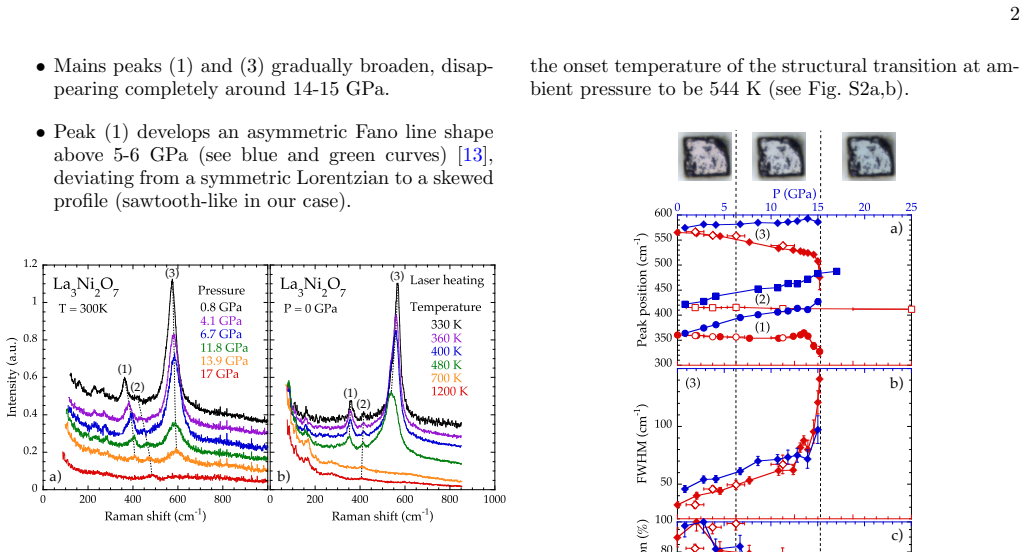
La$_3$Ni$_2$O$_7$, a bilayer nickelate with Ruddlesden-Popper structure, undergoes a pressure-induced structural transition from a tilted Amam phase to an untilted Fmmm (or I4/mmm) phase near 10-15 GPa, concomitant with the emergence of high-T$_c$ superconductivity (T$_c$ $\sim$ 80 K). Despite intense interest, the phase boundaries and the impact of structural changes on the electronic properties remain unclear. Here, we combine high-pressure and high-temperature Raman and synchrotron-based infrared spectroscopies to map the structural and electronic evolutions. Raman measurements confirm the pressure-driven structural transition and reveal the emergence of Fano line shapes, indicating enhanced electron-phonon coupling. High-temperature data show analogous spectral signatures above 544 K, suggesting an unreported upper temperature limit of the Amam phase within the T-P phase diagram of this system. Infrared reflectivity measurements evidence a concomitant metallization, with a tremendous two-order-of-magnitude increase in carrier density, marking a crossover from a bad metal to a good metal. These results establish a unified picture of the structural transition and its strong coupling to the electronic properties.
Editorial analysis
A structured set of objections, weighed in public.
Referee Report
Summary. The manuscript reports high-pressure Raman and synchrotron infrared spectroscopy on the bilayer nickelate La3Ni2O7. Raman data confirm the structural transition from the tilted Amam phase to the untilted Fmmm (or I4/mmm) phase near 10-15 GPa, with emergence of Fano line shapes signaling enhanced electron-phonon coupling; high-temperature Raman extends this to an upper Amam-phase limit near 544 K. Infrared reflectivity measurements are interpreted as showing concomitant metallization via a two-order-of-magnitude increase in carrier density, marking a bad-metal to good-metal crossover that couples the structural change to the electronic properties and high-Tc superconductivity.
Significance. If the optical analysis holds, the work supplies a unified experimental picture linking the tilt-free structural transition directly to metallization in this Ruddlesden-Popper nickelate, with the high-temperature phase-boundary extension adding useful context to the T-P diagram. The combined high-P/high-T Raman-plus-IR approach is a clear experimental strength for mapping correlated structural-electronic evolution.
major comments (1)
- Infrared reflectivity section: the headline claim of a two-order-of-magnitude carrier-density jump is extracted from pressure-induced reflectivity changes via the plasma frequency. However, in the Drude response the low-frequency reflectivity also depends strongly on the scattering rate γ; a factor-of-10 reduction in γ at fixed n produces a comparable reflectivity rise. The manuscript must explicitly show the Kramers-Kronig-derived real conductivity σ1(ω), the integrated spectral weight, and the multi-component Drude-Lorentz fits that isolate the ~100× increase in n from possible changes in γ, interband transitions, or pressure-medium/diamond-window artifacts.
minor comments (2)
- Abstract: the phrase 'tremendous two-order-of-magnitude increase' should be replaced by a quantitative statement with uncertainty or range once the fitting details are provided.
- Raman results: clarify the precise pressure-temperature points at which Fano asymmetry appears and how its onset correlates with the Amam-to-Fmmm transition identified by the disappearance of specific phonon modes.
Simulated Author's Rebuttal
We thank the referee for their positive evaluation of the significance of our work and for the constructive comment on the infrared analysis. We address the major comment point by point below.
read point-by-point responses
-
Referee: Infrared reflectivity section: the headline claim of a two-order-of-magnitude carrier-density jump is extracted from pressure-induced reflectivity changes via the plasma frequency. However, in the Drude response the low-frequency reflectivity also depends strongly on the scattering rate γ; a factor-of-10 reduction in γ at fixed n produces a comparable reflectivity rise. The manuscript must explicitly show the Kramers-Kronig-derived real conductivity σ1(ω), the integrated spectral weight, and the multi-component Drude-Lorentz fits that isolate the ~100× increase in n from possible changes in γ, interband transitions, or pressure-medium/diamond-window artifacts.
Authors: We agree that the current presentation of the infrared data requires additional detail to fully substantiate the reported carrier-density increase. In the revised manuscript we will add (i) the Kramers-Kronig-derived real conductivity σ1(ω) at representative pressures across the transition, (ii) the pressure dependence of the integrated low-frequency spectral weight, and (iii) the multi-component Drude-Lorentz fits to the reflectivity spectra. These additions will explicitly separate the Drude plasma frequency (hence n) from variations in the scattering rate γ and from interband contributions. Re-analysis of the raw reflectivity confirms that a reduction in γ alone cannot reproduce the observed rise; the dominant change is a large increase in the Drude weight. We will also include a brief discussion of how pressure-medium and diamond-window contributions were subtracted during data reduction. These revisions will be placed in the main text and supplementary information as appropriate. revision: yes
Circularity Check
No circularity: purely experimental spectroscopy with direct observations
full rationale
The paper reports high-pressure Raman and infrared reflectivity measurements on La3Ni2O7, confirming a structural transition and noting changes in spectral features and reflectivity that are interpreted as metallization. No derivations, equations, fitted parameters, or predictions are present that reduce to prior results by construction. All claims rest on external measurement benchmarks (synchrotron IR, Raman) without self-citation load-bearing steps or ansatz smuggling. The two-order-of-magnitude carrier density statement is an interpretive claim from data, not a mathematical reduction, so the derivation chain is self-contained.
Axiom & Free-Parameter Ledger
Reference graph
Works this paper leans on
-
[1]
Puphal, T
P. Puphal, T. Sch¨ afer, B. Keimer, and M. Hepting, Nat. Rev. Phys.8, 70–85 (2026)
2026
-
[2]
Catalano, M
S. Catalano, M. Gibert, J. Fowlie, J. ´I˜ niguez, J.-M. Triscone, and J. Kreisel, Rep. Prog. Phys.81, 046501 (2018)
2018
-
[3]
Ardizzone, J
I. Ardizzone, J. Teyssier, I. Crassee, A. B. Kuzmenko, D. G. Mazzone, D. J. Gawryluk, M. Medarde, and D. van der Marel, Phys. Rev. Res.3, 033007 (2021)
2021
-
[4]
D. Li, K. Lee, B. Y. Wang, M. Osada, S. Crossley, H. R. Lee, Y. Cui, Y. Hikita, and H. Y. Hwang, Nature572, 624–627 (2019)
2019
-
[5]
Osada, B
M. Osada, B. Y. Wang, B. H. Goodge, S. P. Harvey, K. Lee, D. Li, L. F. Kourkoutis, and H. Y. Hwang, Adv. Mater.33, 2104083 (2021)
2021
-
[6]
H. Sun, M. Huo, X. Hu, J. Li, Z. Liu, Y. Han, L. Tang, Z. Mao, P. Yang, B. Wang, J. Cheng, D.-X. Yao, G.-M. Zhang, and M. Wang, Nature621, 493–498 (2023)
2023
-
[7]
G. Wang, N. N. Wang, X. L. Shen, J. Hou, L. Ma, L. F. Shi, Z. A. Ren, Y. D. Gu, H. M. Ma, P. T. Yang, Z. Y. Liu, H. Z. Guo, J. P. Sun, G. M. Zhang, S. Calder, J.-Q. Yan, B. S. Wang, Y. Uwatoko, and J.-G. Cheng, Phys. Rev. X14, 011040 (2024)
2024
-
[8]
L. Wang, Y. Li, S.-Y. Xie, F. Liu, H. Sun, C. Huang, Y. Gao, T. Nakagawa, B. Fu, B. Dong, Z. Cao, R. Yu, S. I. Kawaguchi, H. Kadobayashi, M. Wang, C. Jin, H.-K. Mao, and H. Liu, J. Am. Chem. Soc.146, 7506–7514 (2024)
2024
-
[9]
G. Wang, N. Wang, T. Lu, S. Calder, J. Yan, L. Shi, J. Hou, L. Ma, L. Zhang, J. Sun, B. Wang, S. Meng, M. Liu, and J. Cheng, npj Quant. Mat.10, 1 (2025)
2025
-
[10]
J. Li, D. Peng, P. Ma, H. Zhang, Z. Xing, X. Huang, C. Huang, M. Huo, D. Hu, Z. Dong, X. Chen, T. Xie, H. Dong, H. Sun, Q. Zeng, H. Mao, and M. Wang, Nat. Scie. Rev.12, 10 (2025)
2025
-
[11]
Geisler, J
B. Geisler, J. J. Hamlin, G. R. Stewart, R. G. Hennig, and P. J. Hirschfeld, npj Quant. Mat.9, 38 (2024)
2024
- [12]
-
[15]
Gyakwaa, M
F. Gyakwaa, M. Aula, T. Alatarvas, T. Vuolio, M. Hut- tula, and T. Fabritius, ISIJ Inter.59, 1846–1852 (2019)
2019
-
[16]
Z. Liu, M. Huo, J. Li, Q. Li, Y. Liu, Y. Dai, X. Zhou, J. Hao, Y. Lu, M. Wang, and H.-H. Wen, Nat. Comm. 15, 7570 (2024)
2024
-
[17]
N. Wang, G. Wang, X. Shen, J. Hou, J. Luo, X. Ma, H. Yang, L. Shi, J. Dou, J. Feng, J. Yang, Y. Shi, Z. Ren, H. Ma, P. Yang, Z. Liu, Y. Liu, H. Zhang, X. Dong, Y. Wang, K. Jiang, J. Hu, S. Nagasaki, K. Kitagawa, S. Calder, J. Yan, J. Sun, B. Wang, R. Zhou, Y. Uwatoko, and J. Cheng, Nature634, 579–584 (2024)
2024
-
[18]
M. Shi, D. Peng, Y. Li, S. Yang, Z. Xing, Y. Wang, K. Fan, H. Li, R. Wu, B. Ge, Z. Zeng, Q. Zeng, J. Ying, T. Wu, and X. Chen, Nat. Comm.15, 9141 (2025)
2025
-
[19]
Zhang, D
Y. Zhang, D. Su, Y. Huang, Z. Shan, H. Sun, M. Huo, K. Ye, J. Zhang, Z. Yang, Y. Xu, Y. Su, R. Li, M. Smid- man, M. Wang, L. Jiao, and H. Yuan, Nat. Phys.20, 1269–1273 (2024)
2024
-
[20]
Michon, A
B. Michon, A. B. Kuzmenko, M. K. Tran, B. McElfresh, S. Komiya, S. Ono, S. Uchida, and D. van der Marel, Phys. Rev. Lett.3, 043125 (2021)
2021
-
[21]
Michon, C
B. Michon, C. Berthod, C. W. Rischau, A. Ataei, L. Chen, S. Komiya, S. Ono, L. Taillefer, D. van der Marel, and A. Georges, Nat. Comm.14, 3033 (2023). Supplementary: Metallic crossover through the tilt-free transition in La 3Ni2O7 at high pressure and temperature Bastien Michon,1 Yingpeng Yu,2, 3 Beatrice D’Al` o,1 Elena Stellino, 4 Gergely N´ emeth,1 Bos...
2023
-
[22]
F. Li, Z. Xing, D. Peng, J. Dou, N. Guo, L. Ma, Y. Zhang, L. Wang, J. Luo, J. Yang, J. Zhang, T. Chang, Y.-S. Chen, W. Cai, J. Cheng, Y. Wang, Y. Liu, T. Luo, N. Hi- rao, T. Matsuoka, H. Kadobayashi, Z. Zeng, Q. Zheng, R. Zhou, Q. Zeng, X. Tao, and J. Zhang, Nature649, 871–878 (2026)
2026
-
[23]
T. P. Devereaux and R. Hackl, Rev. Mod. Phys.79, 175 (2007)
2007
-
[24]
Fano, Phys
U. Fano, Phys. Rev.124, 1866 (1961)
1961
-
[25]
A. B. Kuzmenko, Rev. Sci. Instrum.76, 083108 (2005). 3 SECTION 2. ADDITIONAL DATA AND ANALYSIS 0 0.2 0.4 0.6 0.8 1 1.2 02004006008001000 Intensity (a.u.) Raman shift (cm-1) La3Ni2O7 2.8 GPa8.6 GPa10.7 GPa12.8 GPa15 GPa PressureT = 300K FIG. S1. Extra HP Raman data not plotted in Fig. 1 for clarity but fitted and used in Fig. 2. 0 0.3 0.6 0.9 1.2 1.5 1.8 0...
2005
discussion (0)
Sign in with ORCID, Apple, or X to comment. Anyone can read and Pith papers without signing in.