Spin-orbit coupling effects in altermagnets: Interplay of weak spin and orbital ferromagnetism with relativistic splitting of electron states
Pith reviewed 2026-05-09 17:23 UTC · model grok-4.3
The pith
In altermagnets like MnTe, weak ferromagnetism depends nonmonotonously on spin-orbit coupling strength because relativistic splitting at general k-points creates avoided crossings that shape both spin and orbital moments differently.
A machine-rendered reading of the paper's core claim, the machinery that carries it, and where it could break.
Core claim
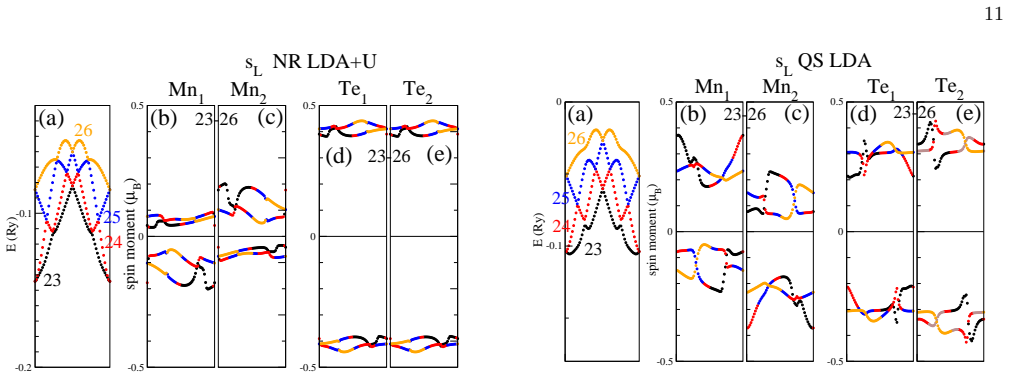
The central claim is that the nonmonotonous dependence of the weak ferromagnetic moment on SOC strength in MnTe arises from the relativistic splitting of accidental spin degeneracies at general k-points filling the Brillouin zone volume, and that a quasisymmetry calculation retaining only the collinear SOC component to the Néel vector removes spin weak ferromagnetism while preserving orbital weak ferromagnetism, thereby exposing a principal difference in how spin and orbital moments form.
What carries the argument
The magnetic structure of the electron state (MSES), which tracks the spin and orbital magnetization carried by each electron state and how nonrelativistic collinear or compensated forms evolve into complex noncollinear 3D structures under relativistic splitting.
If this is right
- The nonmonotonous dependence implies that an optimal SOC strength exists for maximizing the weak ferromagnetic moment in this class of materials.
- Relativistic splitting at general k-points and the resulting avoided crossings directly control macroscopic weak ferromagnetism through the distribution of MSESs.
- Metal-ligand hybridization is required for the formation of both the altermagnetic order and the complex MSESs observed in the relativistic regime.
- The separation between spin and orbital contributions to weak ferromagnetism opens the possibility of tuning them independently by selective modification of the SOC direction.
Where Pith is reading between the lines
- The same nonmonotonous pattern and spin-orbital asymmetry may appear in other altermagnets whose band structures contain accidental degeneracies at general k-points.
- Extending the MSES concept to transport calculations could show how the relativistic state structures influence spin Hall conductivity or anomalous Hall responses.
- Applying the quasisymmetry approximation to additional altermagnetic compounds would test whether the absence of spin weak ferromagnetism under collinear SOC is a general feature.
Load-bearing premise
DFT calculations that include spin-orbit coupling and are guided by spin-space-group symmetry analysis faithfully reproduce the atomistic magnetic structure and the relativistic electron-state splittings in MnTe.
What would settle it
An experiment or calculation that finds a strictly increasing (monotonous) dependence of the weak ferromagnetic moment on SOC strength in MnTe, or that recovers a nonzero spin weak ferromagnetic moment when only the collinear SOC component is retained, would falsify the reported nonmonotonous behavior and spin-orbital distinction.
Figures




read the original abstract
The aim of the paper is to contribute to reaching a deeper understanding of the formation of relativistic effects in altermagnets. The focus of the paper is on the phenomena of weak ferromagnetism (WFM) and relativistic DFT calculations combined with the symmetry analysis on the basis of spin space groups. The consideration is performed on two different levels. On the first level, the atomistic magnetic structure of weak ferromagnetic state is calculated. Both spin and orbital atomic moments are taken into account. We study the dependence of the WFM moment on the strength of the SOC and obtain a peculiar nonmonotonous type of dependence. An interesting result is obtained in quasisymmetry (QS) calculation where only the component of the SOC collinear to the N\'eel vector is taken into account. In QS calculation the spin WFM is absent while the orbital WFM is present. This reveals a principal difference in the formation of the spin and orbital magnetic moments. On the second level, the study is focused on the properties of individual electron states. We introduce the notion of the magnetic structure of the electron state (MSES). It is shown how the collinear spin-MSESs of both metal and ligand atoms and compensated orbital-MSES of the ligand obtained in the nonrelativiatic calculation transform into complex noncollinear 3D MSESs of both spin and orbital nature. An important role in the formation of MSESs is played by the relativistic splitting of the accidental spin degeneracies at general {\bf k} points filling the volume of the Brillouin zone. The formation of the regions of avoided crossings in the relativistic band structure is related to the nonmonotonous behavior of the WFM moment. The importance of the metal-ligand hybridization in the formation of the AM properties is discussed. Most of the calculations are performed for MnTe.
Editorial analysis
A structured set of objections, weighed in public.
Referee Report
Summary. The manuscript uses relativistic DFT calculations and spin-space-group symmetry analysis to study spin-orbit coupling effects in altermagnets, with most results for MnTe. It reports a nonmonotonous dependence of the weak ferromagnetic (WFM) moment on SOC strength. In a quasisymmetry (QS) calculation retaining only the Néel-vector-collinear SOC component, spin WFM vanishes while orbital WFM remains, indicating a principal difference in their formation mechanisms. The paper introduces the magnetic structure of the electron state (MSES) and attributes WFM behavior to relativistic splitting of accidental degeneracies at general k-points, avoided crossings in the band structure, and metal-ligand hybridization.
Significance. If the numerical results hold, the work provides a useful distinction between spin and orbital channels in altermagnetic WFM and a symmetry-based framework (MSES) for analyzing relativistic electron states. The formal spin-space-group analysis is independent of numerics and adds value; the nonmonotonic WFM(SOC) curve and QS separation, if robust, could inform material design in the altermagnet family.
major comments (2)
- [DFT calculations and results sections (as described in abstract)] The central numerical claims—the nonmonotonous WFM moment vs. SOC strength and the QS result that spin WFM is absent while orbital WFM persists—rest on DFT+SOC calculations whose robustness is not demonstrated. No convergence tests with respect to k-point sampling, exchange-correlation functional, or Hubbard U (if employed) are referenced, yet the skeptic note and the sensitivity of Mn 3d/Te p states make these parameters load-bearing for the reported nonmonotonicity and spin/orbital separation.
- [Quasisymmetry (QS) calculation subsection] The QS implementation (only the collinear-to-Néel SOC component retained) is used to claim a 'principal difference' in spin vs. orbital WFM formation. Without an explicit description of how this approximation is realized in the relativistic Hamiltonian or code (e.g., which terms of the SOC operator are kept or discarded), it is unclear whether the vanishing spin WFM is a physical outcome or an artifact of the truncation.
minor comments (3)
- [MSES introduction paragraph] The notion of MSES is introduced but its precise definition (how spin and orbital components are extracted from the DFT wavefunctions at each k) is not stated explicitly; a short formal definition or equation would aid reproducibility.
- [Discussion or conclusions] The manuscript would benefit from a brief comparison of the computed WFM moments to any available experimental values or prior calculations on MnTe, even if only to place the nonmonotonic curve in context.
- [Symmetry analysis section] Notation for the spin-space-group symmetries and the labeling of high-symmetry points in the Brillouin zone should be cross-checked against standard references to ensure consistency.
Simulated Author's Rebuttal
We thank the referee for the careful and constructive review. The comments highlight important aspects of computational robustness and methodological clarity that we will address to strengthen the manuscript. We provide point-by-point responses below.
read point-by-point responses
-
Referee: [DFT calculations and results sections (as described in abstract)] The central numerical claims—the nonmonotonous WFM moment vs. SOC strength and the QS result that spin WFM is absent while orbital WFM persists—rest on DFT+SOC calculations whose robustness is not demonstrated. No convergence tests with respect to k-point sampling, exchange-correlation functional, or Hubbard U (if employed) are referenced, yet the skeptic note and the sensitivity of Mn 3d/Te p states make these parameters load-bearing for the reported nonmonotonicity and spin/orbital separation.
Authors: We agree that explicit convergence tests are essential to substantiate the numerical claims. In the revised manuscript we will add an appendix with systematic tests: k-point meshes from 8×8×8 to 24×24×24 (confirming stability of the nonmonotonic WFM(SOC) curve), comparisons between PBE and PBEsol functionals, and Hubbard U values on Mn 3d states ranging from 0 to 5 eV. These tests show that the nonmonotonicity and the QS spin/orbital separation remain qualitatively unchanged, directly addressing the sensitivity of the Mn 3d/Te p hybridization. revision: yes
-
Referee: [Quasisymmetry (QS) calculation subsection] The QS implementation (only the collinear-to-Néel SOC component retained) is used to claim a 'principal difference' in spin vs. orbital WFM formation. Without an explicit description of how this approximation is realized in the relativistic Hamiltonian or code (e.g., which terms of the SOC operator are kept or discarded), it is unclear whether the vanishing spin WFM is a physical outcome or an artifact of the truncation.
Authors: We accept that a more precise technical description is required. In the revised manuscript we will expand the QS subsection with the explicit form of the approximated SOC operator: only the component parallel to the Néel vector is retained in the relativistic perturbation term of the Dirac Hamiltonian, while perpendicular components are set to zero before self-consistency. This projection is performed on the SOC matrix elements in the spinor basis within our DFT code. The resulting equations will be provided to show that the vanishing spin WFM follows directly from the imposed symmetry constraint, whereas orbital WFM survives due to the remaining terms, confirming the physical distinction. revision: yes
Circularity Check
No significant circularity; results are numerical DFT outputs and symmetry analysis
full rationale
The paper reports atomistic WFM moments, their nonmonotonous SOC dependence, and QS spin/orbital separation as direct outputs of DFT+SOC calculations on MnTe, together with formal spin-space-group symmetry analysis. No equations are shown that define a quantity in terms of itself or rename a fitted parameter as a prediction. The MSES construction and avoided-crossing interpretation are extracted from the computed bands without reducing to the input data by construction. No load-bearing self-citation chains or imported uniqueness theorems appear in the provided text. The derivation chain therefore remains self-contained against external DFT benchmarks and symmetry rules.
Axiom & Free-Parameter Ledger
axioms (2)
- domain assumption Standard DFT exchange-correlation functionals and pseudopotentials accurately describe the electronic and magnetic structure of MnTe
- domain assumption Spin-space-group symmetry correctly classifies the relativistic splitting of accidental degeneracies at general k-points
invented entities (1)
-
Magnetic structure of the electron state (MSES)
no independent evidence
Reference graph
Works this paper leans on
-
[1]
Most of the previous studies of WFM consider spin magnetization only. On the other hand, in a number of recent publications 12,15,19 the importance of the account for orbital magnetization is emphasized. We report cal- culations of both spin and orbital atomic moments and consider their contributions to WFM
-
[2]
We investigate the role of nonmagnetic ligand atoms in the phenomena of AM and WFM. Besides standard relativistic calculations, we perform calculations where SOC is switched off either on magnetic metal (Me) atoms or on ligands (Lg)
-
[3]
We carry out DFT calculations for various strengths of SOC
Considerable research attention has been devoted to the character of the dependence of the WFM charac- teristics on the strength of SOC 8,9,14. We carry out DFT calculations for various strengths of SOC. These calcu- lations reveal a complex nonmonotonous dependence of the WFM moment on the SOC strength. The origin of such behavior is investigated
-
[4]
An important role in the paper play the results ob- tained within so-called quasisymemtry (QS) approach. In general, the term quasisymmetry is used in cases where a part of the interaction is neglected to obtain the Hamilto- nian of a higher symmetry whose analysis provides new physical insights 20,31,32. In our case the QS Hamilto- nian contains only one...
-
[5]
To perform a DFT-based study of the influence of the SOC on the atomistic magnetic structure we need a convenient method to predict the instability of the com- pensated collinear magnetic configuration that will be obtained in the self-consistent DFT calculation. We dis- cuss an efficient tool which is based on the combination of the concept of symmetry const...
-
[6]
We introduce the notion of magnetic structure of electron state (MSES) and study how SOC influences this characteristic in the case of AM. The sum over MSESs of all occupied electron states gives the atomistic mag- netic configuration discussed above. However, much in- formation about MSES of individual electron states is lost in the integral characteristic...
-
[7]
In the consideration of the influence of SOC on in- dividual electron states a principal role is played by the aspects connected with spin degeneracy of the electron states. Indeed, according to the principles of quantum mechanics, the replacement of two degenerate states by two different linear combinations of them provides an equivalent description of the...
-
[8]
The analysis of the transformation of the electron states under the influence of SOC demonstrates the im- portance of avoided crossings of the electron bands with opposite spin projections and suggests an explanation of the nonmonotonous dependence of the WFM moment on the SOC strength. In getting a deep insight into the properties of the electron states a...
-
[9]
The method of the prediction is based on the combination of two statements 50,51
If an instability is predicted, is the character of the changes in the magnetic configuration a part of the pre- diction? The answers to both questions are positive. The method of the prediction is based on the combination of two statements 50,51. First: if g is a symmetry op- eration of the initial K-S Hamiltonian this symmetry is preserved during iterati...
-
[10]
leads to the following important conclusion. In con- trast to the L component of the Me orbital moment [panel (a) of these figures], the γ dependence of the z components is not monotonous. There are very sharp 8 features in the curves [see panels (b)(d)(e) of these fig- ures]. Also the signs of the contributions and their rela- tive signs change with the va...
-
[11]
7: Fragment of the band structure of MnTe in the inter- val [ k− ,k+]
Comparizon of the band structures obtained in nonrelativistic, quasisymmetry and relativistic calcula tions We start the analysis of the influence of the SOC on the electron states with a general comparison of the -0.1 0 E (Ry) (a) (b) (c) FIG. 7: Fragment of the band structure of MnTe in the inter- val [ k− ,k+]. LDA calculations. (a) nonrelativistic, (b)...
-
[12]
Magnetic structures of electron states In Sec. II we introduced the notion of MSES. Now we will discuss MSESs of the electron states of MnTe calculated using three different levels of the treatment of SOC. The calculations were performed with both LDA and LDA+U methods. Before analyzing the results of calculations we consider a schematic picture of the var...
discussion (0)
Sign in with ORCID, Apple, or X to comment. Anyone can read and Pith papers without signing in.