Recognition: 2 theorem links
Sapphire Photonic Crystal Fiber Sensor
Pith reviewed 2026-05-08 19:12 UTC · model grok-4.3
The pith
Femtosecond laser writing creates index-guiding sapphire photonic crystal fiber Bragg gratings for high-temperature sensing up to 1200°C.
A machine-rendered reading of the paper's core claim, the machinery that carries it, and where it could break.
Core claim
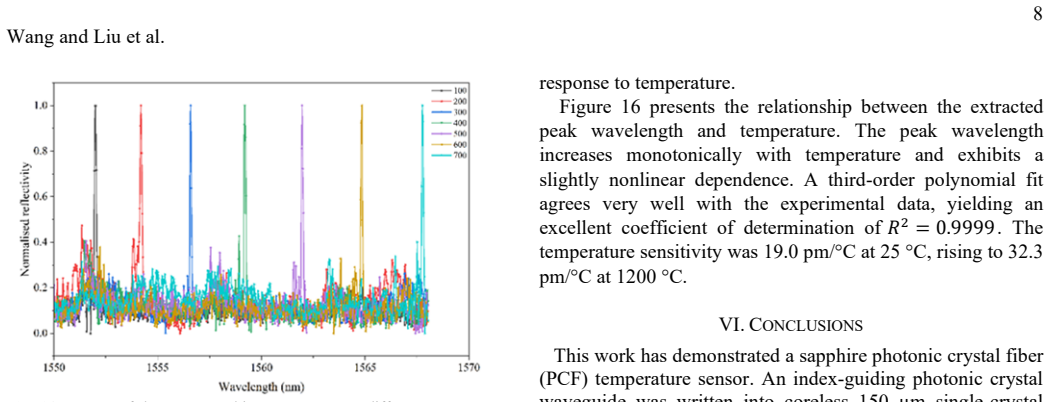
By applying femtosecond laser direct writing with spatial light modulator compensation, an index-guiding photonic crystal structure and integrated Bragg grating can be formed inside sapphire fiber to produce devices as long as 7 cm. These devices splice to standard single-mode fiber, show 0.7 dB/cm loss and 0.12 nm bandwidth, and deliver temperature sensitivities of 19.0–32.3 pm/°C over 25–1200°C, offering a six-fold reduction in fabrication time relative to previous depressed-cladding waveguides.
What carries the argument
Femtosecond laser direct writing with spatial light modulator compensation that simultaneously forms an index-guiding photonic crystal waveguide and a Bragg grating inside the sapphire fiber.
Load-bearing premise
The laser-inscribed photonic crystal waveguides remain crack-free, single-mode, and keep stable Bragg gratings after splicing and repeated exposure to 1200°C.
What would settle it
Cracking visible in the waveguide cross-section or more than a few picometers of irreversible Bragg wavelength drift after 100 hours at 1200°C would show the central claim does not hold.
Figures




read the original abstract
Sapphire optical fiber shows great promise for remote sensing in extreme environments approaching 2000 degC, by using laser-processing to form a single-mode waveguide within it. However, for practical application, longer devices with high manufacturability and reliability are required. We report the design, modeling, fabrication, and optimization of an index-guiding sapphire photonic crystal fiber Bragg grating temperature sensor. The device is fabricated using femtosecond laser direct writing to inscribe both the photonic crystal waveguide and the Bragg grating. A spatial light modulator was used to compensate for the mismatch between the immersion objective and the high-index oil used. This improved the aspect ratio and suppressed cracking during fabrication, for higher reliability. The design results in a 6-fold reduction in fabrication time over an equivalent depressed cladding waveguide, significantly reducing the cost of manufacture. Devices up to 7 cm long were fabricated and spliced to standard single-mode fiber. The propagation loss was estimated to be 0.7 dB/cm and the Bragg gratings had a bandwidth of approximately 0.12 nm. Devices were tested in a furnace showing a temperature sensitivity of between 19.0-32.3 pm/degC over a range 25-1200 degC. These longer devices have the potential to enable practical high precision extreme temperature monitoring in many applications, with lower manufacturing cost and higher reliability.
Editorial analysis
A structured set of objections, weighed in public.
Referee Report
Summary. The manuscript reports the design, modeling, fabrication, and high-temperature testing of an index-guiding sapphire photonic crystal fiber (PCF) Bragg grating temperature sensor. Femtosecond laser direct writing with spatial light modulator compensation is used to inscribe both the PCF waveguide and grating, yielding crack-free structures up to 7 cm long that are spliced to standard single-mode fiber. Key results include an estimated propagation loss of 0.7 dB/cm, grating bandwidth of ~0.12 nm, a claimed 6-fold reduction in fabrication time relative to depressed-cladding waveguides, and measured temperature sensitivity of 19.0–32.3 pm/°C over 25–1200 °C.
Significance. If the waveguides are verifiably single-mode and low-loss, the work demonstrates a practical route to longer, more manufacturable sapphire fiber sensors for extreme environments. The experimental achievement of 7 cm devices that survive splicing and furnace testing to 1200 °C, together with the SLM-enabled fabrication improvement, represents a concrete advance in device length and reliability that could support remote sensing applications in aerospace and energy systems.
major comments (3)
- [Abstract] Abstract: The propagation loss is reported as 'estimated to be 0.7 dB/cm' for devices up to 7 cm long, yet no measurement protocol (cut-back, transmission fitting, splice-loss subtraction, or length-dependent data) or supporting spectra are supplied. This detail is load-bearing for the central claim that the inscribed PCF waveguides are functional and low-loss.
- [Abstract] Abstract: No mode-field profiles, far-field patterns, or other confirmation of single-mode operation is provided for the 7 cm PCF devices, despite the design being an index-guiding photonic crystal structure. Without this, it is impossible to verify that the reported sensitivity and splicing results arise from the intended single-mode waveguides rather than multimode or defective structures.
- [Abstract] Abstract: The temperature sensitivity is stated as the range 19.0–32.3 pm/°C with no error bars, full calibration curves, statistical analysis, or explanation of the variation (device-to-device or temperature-dependent). Similarly, the 6-fold fabrication-time reduction lacks quantitative comparison (pulse counts, scan times, or line counts) to the depressed-cladding reference.
Simulated Author's Rebuttal
We thank the referee for the constructive and detailed comments, which help us improve the clarity and completeness of the manuscript. We address each major comment below and will make the indicated revisions to strengthen the presentation of our results on the sapphire PCF Bragg grating sensor.
read point-by-point responses
-
Referee: [Abstract] Abstract: The propagation loss is reported as 'estimated to be 0.7 dB/cm' for devices up to 7 cm long, yet no measurement protocol (cut-back, transmission fitting, splice-loss subtraction, or length-dependent data) or supporting spectra are supplied. This detail is load-bearing for the central claim that the inscribed PCF waveguides are functional and low-loss.
Authors: We agree that the abstract would benefit from additional detail on the loss estimation. The full manuscript describes the estimation via transmission measurements with splice-loss subtraction to the standard single-mode fiber. We will revise the abstract to briefly note the protocol and include representative transmission spectra in the revised manuscript or supplementary material. revision: yes
-
Referee: [Abstract] Abstract: No mode-field profiles, far-field patterns, or other confirmation of single-mode operation is provided for the 7 cm PCF devices, despite the design being an index-guiding photonic crystal structure. Without this, it is impossible to verify that the reported sensitivity and splicing results arise from the intended single-mode waveguides rather than multimode or defective structures.
Authors: We acknowledge the value of direct experimental confirmation. The manuscript presents design and modeling results predicting single-mode guidance for the chosen photonic crystal parameters. To address this point, we will add mode-field or far-field characterization data for the fabricated 7 cm devices in the revised manuscript. revision: yes
-
Referee: [Abstract] Abstract: The temperature sensitivity is stated as the range 19.0–32.3 pm/°C with no error bars, full calibration curves, statistical analysis, or explanation of the variation (device-to-device or temperature-dependent). Similarly, the 6-fold fabrication-time reduction lacks quantitative comparison (pulse counts, scan times, or line counts) to the depressed-cladding reference.
Authors: We will expand the results section to include error bars on the sensitivity values, representative full calibration curves, and a brief statistical summary of device-to-device variation. For the fabrication-time claim, we will insert quantitative comparisons of pulse counts, scan times, and inscribed line counts between the PCF and depressed-cladding processes to substantiate the reported improvement. revision: yes
Circularity Check
No circularity in experimental fabrication report
full rationale
The manuscript is a purely experimental report on the design, femtosecond-laser fabrication, splicing, and high-temperature testing of sapphire photonic-crystal fiber Bragg-grating sensors. No mathematical derivation chain, first-principles prediction, or fitted-parameter result is presented that could reduce to its own inputs by construction. The stated 6-fold fabrication-time reduction is a direct comparison of two physical writing strategies, not a derived quantity. Propagation loss (0.7 dB/cm), grating bandwidth (0.12 nm), and temperature sensitivity (19.0–32.3 pm/°C) are reported as measured outcomes of fabricated devices, not as outputs of any self-referential model or self-citation. Consequently the paper contains no load-bearing step of the enumerated circularity patterns.
Axiom & Free-Parameter Ledger
Reference graph
Works this paper leans on
-
[1]
D. Grobnic, S. J. Mihailov, C. W. Smelser, and H. Ding, “Sapphire Fiber Bragg Grating Sensor Made Using Femtosecond Laser Radiation for Ultrahigh Temperature Applications,” IEEE Photon. Technol. Lett., vol. 16, no. 11, Nov. 2004, doi: 10.1109/LPT.2004.834920
-
[2]
Sapphire fiber Bragg gratings for high temperature and dynamic temperature diagnostics,
T. Habisreuther, T. Elsmann, Z. Pan, A. Graf, R. Willsch, and M. A. Schmidt, “Sapphire fiber Bragg gratings for high temperature and dynamic temperature diagnostics,” Appl. Therm. Eng., vol. 91, pp. 860–865, Dec. 2015, doi: 10.1016/j.applthermaleng.2015.08.096
-
[3]
Reliable wavelength detection method of sapphire fiber Bragg gratings using added multimode fiber,
Z. Li et al., “Reliable wavelength detection method of sapphire fiber Bragg gratings using added multimode fiber,” Opt. Laser Technol., 9 Wang and Liu et al. vol. 182, p. 112185, Apr. 2025, doi: 10.1016/j.optlastec.2024.112185
-
[4]
R. Eisermann et al., “Metrological Characterization of a High- Temperature Hybrid Sensor Using Thermal Radiation and Calibrated Sapphire Fiber Bragg Grating for Process Monitoring in Harsh Environments,” Sensors, vol. 22, no. 3, p. 1034, Jan. 2022, doi: 10.3390/s22031034
-
[5]
Cascaded Sapphire Fiber Bragg Gratings Inscribed by Femtosecond Laser for Molten Steel Studies,
D. R. Alla et al., “Cascaded Sapphire Fiber Bragg Gratings Inscribed by Femtosecond Laser for Molten Steel Studies,” IEEE Trans. Instrum. Meas., vol. 73, pp. 1–8, 2024, doi: 10.1109/TIM.2023.3335530
-
[6]
D. Grobnic, S. J. Mihailov, H. Ding, F. Bilodeau, and C. W. Smelser, “Single and low order mode interrogation of a multimode sapphire fibre Bragg grating sensor with tapered fibres,” Meas. Sci. Technol., vol. 17, no. 5, pp. 980–984, May 2006, doi: 10.1088/0957- 0233/17/5/S07
-
[7]
Q. Bian, H. Zhu, J. Liang, Y. Yu, and P. Yan, “High-Order Mode Suppression in Sapphire Fiber Bragg Gratings Based on Mode Field Matching Fusion Splicing for Single-Mode Demodulation Systems,” IEEE Sens. J., vol. 23, no. 15, pp. 16953–16959, Aug. 2023, doi: 10.1109/JSEN.2023.3289933
-
[8]
X. Niu, J. Si, Y. Li, D. Zhang, and T. Chen, “Quasi-single-mode signal output of sapphire fibre Bragg grating based on single mode fibre offset coupling measurement,” Meas. Sci. Technol., vol. 36, no. 9, p. 095206, Sep. 2025, doi: 10.1088/1361-6501/ae0752
-
[9]
Single-mode sapphire fiber Bragg grating high- temperature sensor,
J. Wu et al., “Single-mode sapphire fiber Bragg grating high- temperature sensor,” Photonics Res., vol. 13, no. 12, p. 3374, Dec. 2025, doi: 10.1364/PRJ.570273
-
[10]
Fiber Bragg grating fabricated in micro-single-crystal sapphire fiber,
S. Yang, D. Homa, G. Pickrell, and A. Wang, “Fiber Bragg grating fabricated in micro-single-crystal sapphire fiber,” Opt. Lett., vol. 43, no. 1, p. 62, Jan. 2018, doi: 10.1364/OL.43.000062
-
[11]
High temperature sensing using higher-order-mode rejected sapphire fiber gratings,
C. Zhan, J. H. Kim, S. Yin, P. Ruffin, and C. Luo, “High temperature sensing using higher-order-mode rejected sapphire fiber gratings,” Optical Memory and Neural Networks, vol. 16, no. 4, pp. 204–210, Dec. 2007, doi: 10.3103/S1060992X07040030
-
[12]
Single-Mode Helical Sapphire Bragg Grating for High-Temperature Sensing,
X. Xu et al., “Single-Mode Helical Sapphire Bragg Grating for High-Temperature Sensing,” J. Lightwave Technol., vol. 43, no. 6, pp. 2982–2987, Mar. 2025, doi: 10.1109/JLT.2024.3503579
-
[13]
Single-mode θ- shaped Sapphire Fiber Bragg Grating for High Temperature Sensing,
C. He, Y. Liu, J. Wu, J. Cai, G. Wang, and X. Shu, “Single-mode θ- shaped Sapphire Fiber Bragg Grating for High Temperature Sensing,” in CLEO 2025, Washington, D.C.: Optica Publishing Group, 2025, p. AA115_2. doi: 10.1364/CLEO_AT.2025.AA115_2
-
[14]
X. Zhu et al., “A Narrow-Band Sapphire Fiber Bragg Grating High- Temperature Sensor Based on Decreasing-Ring Structure,” J. Lightwave Technol., pp. 1–9, 2026, doi: 10.1109/JLT.2026.3665819
-
[15]
Creation of an Internal Cladding in Sapphire Optical Fiber Using the 6Li(n,α)3H Reaction,
B A Wilson and T E Blue, “Creation of an Internal Cladding in Sapphire Optical Fiber Using the 6Li(n,α)3H Reaction,” IEEE Sens. J., vol. 17, no. 22, pp. 7433–7439, 2017
2017
-
[16]
M. A. Kabir, K.-C. Wu, K.-T. Chou, F. Luo, and S. Yin, “Hybrid Growth of Clad Crystalline Sapphire Fibers for Ultra-High- Temperature (>1500 °C) Fiber Optic Sensors,” Photonics, vol. 12, no. 4, p. 299, Mar. 2025, doi: 10.3390/photonics12040299
-
[17]
Sapphire photonic crystal fibers,
N. Pfeiffenberger, “Sapphire photonic crystal fibers,” Optical Engineering, vol. 49, no. 9, p. 090501, Sep. 2010, doi: 10.1117/1.3483908
-
[18]
Single-mode sapphire fiber Bragg grating,
M. Wang et al., “Single-mode sapphire fiber Bragg grating,” Opt. Express, vol. 30, no. 9, p. 15482, Apr. 2022, doi: 10.1364/OE.446664
-
[19]
Single-Mode Sapphire Fiber Temperature Sensor,
M. Wang et al., “Single-Mode Sapphire Fiber Temperature Sensor,” J. Lightwave Technol., vol. 42, no. 18, pp. 6409–6416, Sep. 2024, doi: 10.1109/JLT.2024.3438108
-
[20]
Method of laser modification of an optical fibre,
J. Fells, M. Booth, and P. Salter, “Method of laser modification of an optical fibre,” US12321007B2, Jun. 03, 2025
2025
-
[21]
Three-dimensional femtosecond laser nanolithography of crystals,
A. Ródenas et al., “Three-dimensional femtosecond laser nanolithography of crystals,” Nat. Photonics, vol. 13, no. 2, pp. 105–109, Feb. 2019, doi: 10.1038/s41566-018-0327-9
-
[22]
Y. Jia et al., “Monolithic crystalline cladding microstructures for efficient light guiding and beam manipulation in passive and active regimes,” Sci. Rep., vol. 4, no. 1, p. 5988, Aug. 2014, doi: 10.1038/srep05988
-
[23]
W. Nie et al., “Optical lattice-like cladding waveguides by direct laser writing: fabrication, luminescence, and lasing,” Opt. Lett., vol. 41, no. 10, p. 2169, May 2016, doi: 10.1364/OL.41.002169
-
[24]
J. Lv, Y. Cheng, J. R. Vazquez de Aldana, X. Hao, and F. Chen, “Femtosecond Laser Writing of Optical-Lattice-Like Cladding Structures for Three-Dimensional Waveguide Beam Splitters in LiNbO 3 Crystal,” J. Lightwave Technol., vol. 34, no. 15, pp. 3587– 3591, Aug. 2016, doi: 10.1109/JLT.2016.2573841
-
[25]
Y. Ren et al., “Optical-lattice-like waveguide structures in Ti:Sapphire by femtosecond laser inscription for beam splitting,” Opt. Mater. Express, vol. 7, no. 6, p. 1942, Jun. 2017, doi: 10.1364/OME.7.001942
-
[26]
Sapphire Photonic Crystal Waveguides with Integrated Bragg Grating Structure,
S. Kefer, G.-L. Roth, J. Zettl, B. Schmauss, and R. Hellmann, “Sapphire Photonic Crystal Waveguides with Integrated Bragg Grating Structure,” Photonics, vol. 9, no. 4, p. 234, Apr. 2022, doi: 10.3390/photonics9040234
-
[27]
Photonic Crystal Fibers: A New Class of Optical Waveguides,
J. Broeng, D. Mogilevstev, S. E. Barkou, and A. Bjarklev, “Photonic Crystal Fibers: A New Class of Optical Waveguides,” Optical Fiber Technology, vol. 5, no. 3, pp. 305–330, Jul. 1999, doi: 10.1006/ofte.1998.0279
-
[28]
Guidance varieties in photonic crystal fibers,
M. Yan and P. Shum, “Guidance varieties in photonic crystal fibers,” Journal of the Optical Society of America B, vol. 23, no. 8, p. 1684, Aug. 2006, doi: 10.1364/JOSAB.23.001684
-
[29]
Properties of photonic crystal fiber and the effective index model,
J. C. Knight, T. A. Birks, P. St. J. Russell, and J. P. de Sandro, “Properties of photonic crystal fiber and the effective index model,” Journal of the Optical Society of America A, vol. 15, no. 3, p. 748, Mar. 1998, doi: 10.1364/JOSAA.15.000748
-
[30]
Jui-Ming Hsu, Che-Wei Yao, and Jian-Zhi Chen, “Wavelength- Tunable Dispersion Compensating Photonic Crystal Fibers Suitable for Conventional/Coarse Wavelength Division Multiplexing Systems,” J. of Lightwave Technol., vol. 33, no. 11, pp. 2240–2245, Jun. 2015, doi: 10.1109/JLT.2014.2380439
-
[31]
Design of single-polarization single-mode photonic crystal fiber at 1.30 and 1.55 /spl mu/m,
Jian Ju, Wei Jin, and M. S. Demokan, “Design of single-polarization single-mode photonic crystal fiber at 1.30 and 1.55 /spl mu/m,” J. Lightwave Technol., vol. 24, no. 2, pp. 825–830, Feb. 2006, doi: 10.1109/JLT.2005.861942
-
[32]
Confinement losses in microstructured optical fibers,
T. P. White, R. C. McPhedran, C. M. de Sterke, L. C. Botten, and M. J. Steel, “Confinement losses in microstructured optical fibers,” Opt. Lett., vol. 26, no. 21, p. 1660, Nov. 2001, doi: 10.1364/OL.26.001660
-
[33]
Femtosecond laser inscription of depressed cladding single-mode mid-infrared waveguides in sapphire,
J.-P. Bérubé, J. Lapointe, A. Dupont, M. Bernier, and R. Vallée, “Femtosecond laser inscription of depressed cladding single-mode mid-infrared waveguides in sapphire,” Opt. Lett., vol. 44, no. 1, p. 37, Jan. 2019, doi: 10.1364/ol.44.000037
-
[34]
Femtosecond fiber Bragg grating fabrication with adaptive optics aberration compensation,
P. S. Salter, M. J. Woolley, S. M. Morris, M. J. Booth, and J. A. J. Fells, “Femtosecond fiber Bragg grating fabrication with adaptive optics aberration compensation,” Opt. Lett., vol. 43, no. 24, p. 5993, Dec. 2018, doi: 10.1364/OL.43.005993
-
[35]
Review and perspective: Sapphire optical fiber cladding development for harsh environment sensing,
H. Chen, M. Buric, P. R. Ohodnicki, J. Nakano, B. Liu, and B. T. Chorpening, “Review and perspective: Sapphire optical fiber cladding development for harsh environment sensing,” Appl. Phys. Rev., vol. 5, no. 1, p. 11102, Mar. 2018, doi: 10.1063/1.5010184
-
[36]
M. J. Booth, M. A. A. Neil, and T. Wilson, “Aberration correction for confocal imaging in refractive-index- mismatched media,” J. Microsc., vol. 192, no. 2, pp. 90–98, 1998, doi: 10.1111/J.1365- 2818.1998.99999.X
-
[37]
Exploring the depth range for three-dimensional laser machining with aberration correction,
P. S. Salter, M. Baum, I. Alexeev, M. Schmidt, and M. J. Booth, “Exploring the depth range for three-dimensional laser machining with aberration correction,” Opt. Express, vol. 22, no. 15, p. 17644, 2014, doi: 10.1364/oe.22.017644
-
[38]
B. P. Cumming, M. D. Turner, G. E. Schröder-Turk, S. Debbarma, B. Luther-Davies, and M. Gu, “Adaptive optics enhanced direct laser writing of high refractive index gyroid photonic crystals in chalcogenide glass,” Opt. Express, Vol. 22, Issue 1, pp. 689-698, vol. 22, no. 1, pp. 689–698, Jan. 2014, doi: 10.1364/OE.22.000689
-
[39]
Extreme environment sensing using femtosecond laser-inscribed fiber bragg gratings,
S. J. Mihailov et al., “Extreme environment sensing using femtosecond laser-inscribed fiber bragg gratings,” Sensors (Switzerland), vol. 17, no. 12, Dec. 2017, doi: 10.3390/S17122909
-
[40]
Optical properties and electronic structure of amorphous Ge and Si
H. E. LaBelle and A. I. Mlavsky, “Growth of controlled profile crystals from the melt: Part I - Sapphire filaments,” Mater. Res. Bull., vol. 6, no. 7, pp. 571–579, Jul. 1971, doi: 10.1016/0025- 5408(71)90006-7
-
[41]
T. Wang et al., “Anisotropic growth and characterizations of large length-diameter ratio sapphire fibers via laser-heated pedestal growth technique,” J. Cryst. Growth, vol. 620, p. 127363, Oct. 2023, doi: 10.1016/j.jcrysgro.2023.127363. Wang and Liu et al. 1 Sapphire Photonic Crystal Fiber Sensor (Supplementary Material) Mohan Wang, Tongyu Liu, Zipei Song...
discussion (0)
Sign in with ORCID, Apple, or X to comment. Anyone can read and Pith papers without signing in.