Distributed Observer-based Fault Detection over Intelligent Networked Multi-Vehicle Systems
Pith reviewed 2026-05-08 17:35 UTC · model grok-4.3
The pith
Connected autonomous vehicles can each detect sensor faults locally using distributed state estimation and probabilistic residual thresholds.
A machine-rendered reading of the paper's core claim, the machinery that carries it, and where it could break.
Core claim
The authors establish that local residual-based fault detection and isolation can be performed at each CAV using residuals from distributed consensus-based observers, with probabilistic threshold design that does not require bounded noise support, enabling decentralized detection of sensor anomalies in mixed human-driven and autonomous vehicle networks where individual vehicles lack full local observability.
What carries the argument
Distributed consensus-based observers that allow state estimation of HDVs from partial measurements across the CAV network, paired with local residual generators for FDI.
Load-bearing premise
The distributed consensus observers converge despite each CAV having only partial observability of the human-driven vehicles.
What would settle it
A simulation or real test where sensor faults are injected into CAV measurements and the local FDI logic fails to flag them above the probabilistic threshold, or where the distributed state estimation error does not decrease over time.
Figures



read the original abstract
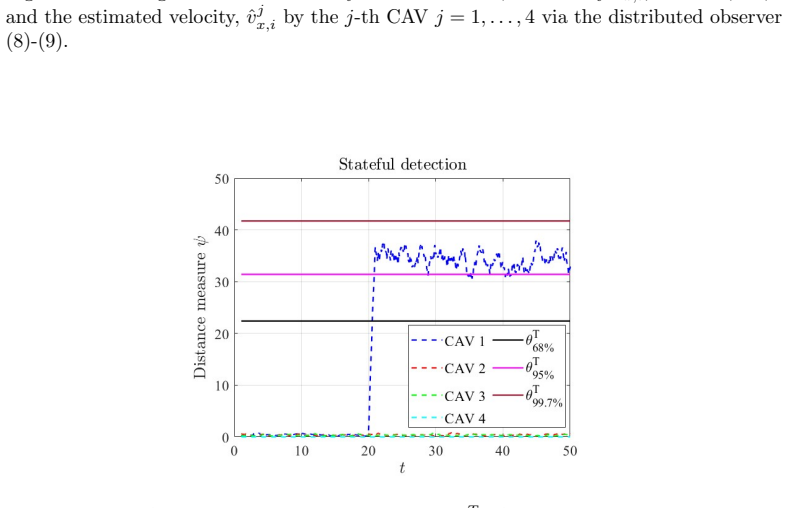
Decentralized strategies are of interest for local decision-making over multi-vehicle networks. This paper studies mixed traffic networks of human-driven and autonomous vehicles with partial sensor measurements. The idea is to enable the group of connected autonomous vehicles (CAVs) to track the state of a group of human-driven vehicles (HDVs) via distributed consensus-based observers/estimators. Particularly, we make no assumption that the group of HDVs is locally observable in the direct neighborhood of any CAV. Then, the main contribution is to design local residual-based fault detection and isolation (FDI) at every CAV to detect possible faults/attacks in the sensor measurements. This distributed detection strategy enables every CAV to locally find possible anomalies in its taken sensor measurement with no need for a central processing unit. Two FDI logics are proposed with and without considering the history of the residuals. These FDI techniques are based on probabilistic threshold design on the residuals (in contrast to the existing deterministic threshold FDI techniques) with no assumption that the noise is of bounded support. This is more realistic in real-world multi-vehicle transportation systems.
Editorial analysis
A structured set of objections, weighed in public.
Referee Report
Summary. The manuscript develops distributed consensus-based observers enabling a group of CAVs to estimate the states of HDVs in mixed traffic networks even when no individual CAV has local observability of the HDVs. It then designs local residual-based FDI at each CAV using probabilistic thresholds (with and without residual history) to detect sensor faults or attacks, without a central processor and without assuming bounded noise support, contrasting this with deterministic threshold methods.
Significance. If the observer convergence and residual distributions are rigorously established, the work offers a realistic decentralized FDI framework for intelligent transportation systems that relaxes common bounded-noise and full-observability assumptions, potentially improving fault resilience in partially observable multi-vehicle networks.
major comments (2)
- [Abstract / Observer design] The distributed observer design (as described in the abstract and setup) explicitly permits cases with no local observability of HDVs by any CAV yet provides no graph-theoretic conditions (e.g., joint observability of the union of measurement graphs or existence of a spanning tree in the CAV communication graph) guaranteeing asymptotic convergence of the consensus-based estimators. This is load-bearing because the FDI residuals are generated from estimation errors; without convergence, the residuals do not necessarily converge to the noise distribution and the probabilistic thresholds are ill-posed.
- [FDI logics] The two FDI logics rely on probabilistic threshold design on the residuals, but the manuscript provides no derivation steps or stability analysis showing how the thresholds are obtained from the limiting residual distribution (or how history is incorporated without introducing circularity). This undermines the claim of rigorous contrast to deterministic methods.
minor comments (1)
- [Abstract] The abstract states the design goals but omits any mention of simulation results, numerical validation of the probabilistic thresholds, or explicit statements of the noise model; adding a concise summary of these would improve clarity.
Simulated Author's Rebuttal
We thank the referee for the constructive comments, which highlight areas where additional rigor will strengthen the presentation of the distributed observer convergence and the FDI threshold derivations. We address each point below and will incorporate the necessary clarifications and proofs in the revised manuscript.
read point-by-point responses
-
Referee: [Abstract / Observer design] The distributed observer design (as described in the abstract and setup) explicitly permits cases with no local observability of HDVs by any CAV yet provides no graph-theoretic conditions (e.g., joint observability of the union of measurement graphs or existence of a spanning tree in the CAV communication graph) guaranteeing asymptotic convergence of the consensus-based estimators. This is load-bearing because the FDI residuals are generated from estimation errors; without convergence, the residuals do not necessarily converge to the noise distribution and the probabilistic thresholds are ill-posed.
Authors: We agree that explicit graph-theoretic conditions are essential to guarantee asymptotic convergence of the distributed observers and thereby justify the limiting residual distributions used for the probabilistic thresholds. The original manuscript relies on standard multi-agent consensus results but does not state the required conditions (e.g., the CAV communication graph containing a directed spanning tree and collective observability of the HDV states via the union of local measurement graphs). In the revision we will add a dedicated theorem and proof establishing these conditions and the resulting convergence of the estimation errors to the noise statistics, ensuring the FDI analysis is well-posed. revision: yes
-
Referee: [FDI logics] The two FDI logics rely on probabilistic threshold design on the residuals, but the manuscript provides no derivation steps or stability analysis showing how the thresholds are obtained from the limiting residual distribution (or how history is incorporated without introducing circularity). This undermines the claim of rigorous contrast to deterministic methods.
Authors: We acknowledge that the derivation of the probabilistic thresholds from the limiting residual distribution and the handling of residual history require more explicit steps. The thresholds are obtained from the asymptotic Gaussian (or sub-Gaussian) distribution of the residuals once observer convergence is established; history is incorporated via a finite-length moving window whose statistics remain independent of future samples. In the revised manuscript we will insert the full derivation, including the Lyapunov-based stability argument for the observer error and the moment analysis or central-limit result for the residual distribution, together with a clear statement that the windowed history avoids circularity. This will provide the requested rigorous contrast to deterministic bounded-noise methods. revision: yes
Circularity Check
No significant circularity detected
full rationale
The paper's chain proceeds from standard distributed consensus observer design (under partial observability) to residual generation and then to probabilistic threshold FDI logics. No equations or steps reduce by construction to fitted inputs, self-definitions, or load-bearing self-citations; the thresholds and gains are derived from noise statistics and consensus error analysis rather than being tuned on the same detection-performance data. The approach rests on external control-theoretic results for residuals and is self-contained against those benchmarks.
Axiom & Free-Parameter Ledger
axioms (2)
- domain assumption The communication graph among CAVs permits distributed state estimation of the HDV group even without local observability at any single CAV.
- domain assumption Sensor noise has known statistical properties sufficient to set probabilistic thresholds.
Reference graph
Works this paper leans on
-
[1]
M. Doostmohammadian, A. Aghasi, M. Pirani, E. Nekouei, H. Zarrabi, R. Keypour, A. I. Rikos, K. H. Johansson, Survey of distributed algo- rithms for resource allocation over multi-agent systems, Annual Reviews in Control 59 (2025) 100983
work page 2025
-
[2]
X. He, X. Ren, H. Sandberg, K. H. Johansson, Secure distributed filter- ing for unstable dynamics under compromised observations, in: IEEE 58th Conference on Decision and Control (CDC), IEEE, 2019, pp. 5344– 5349
work page 2019
-
[3]
S. Aldosari, J. M. F. Moura, Detection in sensor networks: The sad- dlepoint approximation, IEEE Transactions on Signal Processing 55 (1) (2007) 327–340
work page 2007
-
[4]
M. Doostmohammadian, M. I. Qureshi, M. H. Khalesi, H. R. Rabiee, U. A. Khan, Log-scale quantization in distributed first-order methods: Gradient-based learning from distributed data, IEEE Transactions on Automation Science and Engineering (2025) 1–12
work page 2025
-
[5]
M. Doostmohammadian, Z. R. Gabidullina, H. R. Rabiee, Machine learning and CPU (central processing unit) scheduling co-optimization over a network of computing centers, Engineering Applications of Arti- ficial Intelligence 163 (2026) 113018
work page 2026
-
[6]
S. Modalavalasa, U. K. Sahoo, A. K. Sahoo, S. Baraha, A review of robust distributed estimation strategies over wireless sensor networks, Signal Processing 188 (2021) 108150
work page 2021
-
[7]
S. He, H. Shin, S. Xu, A. Tsourdos, Distributed estimation over a low- cost sensor network: A review of state-of-the-art, Information Fusion 54 (2020) 21–43. 29
work page 2020
-
[8]
C. Fioravanti, E. Makridis, G. Oliva, M. Vrakopoulou, T. Charalambous, Distributed estimation and control for LTI systems under finite-time agreement, IEEE Transactions on Automatic Control
-
[9]
W. Xu, W. He, D. Ho, J. Kurths, Fully distributed observer-based con- sensus protocol: Adaptive dynamic event-triggered schemes, Automat- ica 139 (2022) 110188
work page 2022
-
[10]
X. Dong, G. Battistelli, L. Chisci, Y. Cai, Consensus variational bayesian moving horizon estimation for distributed sensor networks with un- known noise covariances, Signal Processing 198 (2022) 108571
work page 2022
-
[11]
L. Zou, Z. Wang, J. Hu, Q. Han, Moving horizon estimation meets multi- sensor information fusion: Development, opportunities and challenges, Information Fusion 60 (2020) 1–10
work page 2020
-
[12]
R. Olfati-Saber, Kalman-consensus filter: Optimality, stability, and per- formance, in: 48th IEEE Conference on Decision and Control, Shanghai, China, 2009, pp. 7036–7042
work page 2009
-
[13]
X. He, X. Ren, H. Sandberg, K. H. Johansson, How to secure distributed filters under sensor attacks, IEEE Transactions on Automatic Control 67 (6) (2022) 2843–2856
work page 2022
-
[14]
X. He, C. Hu, Y. Hong, L. Shi, H. Fang, Distributed kalman filters with state equality constraints: Time-based and event-triggered communica- tions, IEEE Transactions on Automatic Control 65 (1) (2019) 28–43
work page 2019
-
[15]
Y. Hua, F. Wan, H. Gan, Y. Zhang, X. Qing, Distributed estimation with cross-verification under false data-injection attacks, IEEE Trans- actions on Cybernetics 53 (9) (2022) 5840–5853
work page 2022
-
[16]
A. A. Ghods, M. Doostmohammadian, Resilient consensus-based tar- get tracking under false data injection attacks in multi-agent networks, Signals 6 (2025) 44
work page 2025
-
[17]
G. Battistelli, L. Chisci, D. Selvi, P. Tesi, Stability of consensus-based distributed estimation under denial of service, IEEE Transactions on Automatic control 69 (3) (2023) 2036–2043. 30
work page 2023
-
[18]
A. Jenabzadeh, Z. Shu, T. Huang, Q. Zhu, Y. Shang, Y. Cui, Distributed estimation and motion control in multi-agent systems under multiple attacks, IEEE Transactions on Automation Science and Engineering
-
[19]
H. Zayyani, M. Korki, Secure distributed estimation via an average dif- fusion LMS and average likelihood ratio test, Digital Signal Processing 156 (2025) 104782
work page 2025
-
[20]
H. Zayyani, F. Oruji, I. Fijalkow, An adversary-resilient doubly com- pressed diffusion LMS algorithm for distributed estimation, Circuits, Systems, and Signal Processing 41 (11) (2022) 6182–6205
work page 2022
-
[21]
M. Doostmohammadian, M. Pirani, On the design of resilient dis- tributed single time-scale estimators: A graph-theoretic approach, IEEE Transactions on Network Science and Engineering (2025) 1–10
work page 2025
-
[22]
M. Doostmohammadian, U. A. Khan, N. Meskin, On the redun- dant distributed observability of mixed traffic transportation systems, EURASIP Journal on Advances in Signal Processing 1 (61) (2025) 1–27
work page 2025
-
[23]
Q. Hou, J. Dong, Fully distributed cooperative fault-tolerant output regulation of linear heterogeneous mass: A dynamic memory event- triggered distributed observer approach, IEEE Transactions on Automa- tion Science and Engineering
- [24]
-
[25]
X. Yan, G. Zhou, D. E. Quevedo, C. Murguia, B. Chen, H. Huang, Privacy-preserving state estimation in the presence of eavesdroppers: A survey, IEEE Transactions on Automation Science and Engineering
-
[26]
N. El Faouzi, H. Leung, A. Kurian, Data fusion in intelligent trans- portation systems: Progress and challenges–a survey, Information Fu- sion 12 (1) (2011) 4–10
work page 2011
-
[27]
C. Ounoughi, S. Yahia, Data fusion for ITS: A systematic literature review, Information Fusion 89 (2023) 267–291. 31
work page 2023
-
[28]
P. Zhu, S. Jin, X. Bu, Z. Hou, Distributed data-driven control for a connected autonomous vehicle platoon subjected to false data injection attacks, IEEE Transactions on Automation Science and Engineering
-
[29]
M. Liaquat, S. Vosough, C. Roncoli, T. Charalambous, Assessing the performance of a hybrid max-weight traffic signal control algorithm in the presence of noisy queue information: An evaluation of the envi- ronmental impacts, IET Intelligent Transport Systems 18 (11) (2024) 2255–2272
work page 2024
- [30]
-
[31]
K. Zhu, Z. Wang, Z. Li, C. Xu, Secure observer-based collision-free con- trol for autonomous vehicles under non-gaussian noises, IEEE Transac- tions on Industrial Informatics
-
[32]
K. Wu, J. Hu, Z. Ding, F. Arvin, Finite-time fault-tolerant forma- tion control for distributed multi-vehicle networks with bearing mea- surements, IEEE Transactions on Automation Science and Engineering 21 (2) (2023) 1346–1357
work page 2023
- [33]
-
[34]
M. S. Chong, M. Wakaiki, J. P. Hespanha, Observability of linear systems under adversarial attacks, in: American Control Conference (ACC), IEEE, 2015, pp. 2439–2444
work page 2015
-
[35]
C. Lee, H. Shim, Y. Eun, Secure and robust state estimation under sen- sor attacks, measurement noises, and process disturbances: Observer- based combinatorial approach, in: European Control Conference (ECC), IEEE, 2015, pp. 1872–1877
work page 2015
-
[36]
A. R. Kodakkadan, M. Pourasghar, V. Puig, S. Olaru, C. Ocampo- Martinez, V. Reppa, Observer-based sensor fault detectability: About robust positive invariance approach and residual sensitivity, IFAC- PapersOnLine 50 (1) (2017) 5041–5046. 32
work page 2017
-
[37]
S. Kar, J. M. F. Moura, Gossip and distributed Kalman filtering: Weak consensus under weak detectability, IEEE Transactions on Signal Pro- cessing 59 (4) (2011) 1766–1784
work page 2011
- [38]
-
[39]
D. Song, R. Tharmarasa, T. Kirubarajan, X. Fernando, Multi-vehicle tracking with road maps and car-following models, IEEE transactions on Intelligent Transportation Systems 19 (5) (2017) 1375–1386
work page 2017
-
[40]
W. D. Blair, Y. Bar-Shalom, MSE design of nearly constant velocity kalman filters for tracking targets with deterministic maneuvers, IEEE Transactions on Aerospace and Electronic Systems 59 (4) (2023) 4180– 4191
work page 2023
- [41]
-
[42]
M. Petersen, J. Ellingson, R. Beard, Tracking multiple unmanned aerial vehicles on se(3) using a monocular camera, IEEE Transactions on Aerospace and Electronic Systems 59 (4) (2022) 3726–3735
work page 2022
-
[43]
Z. Tian, M. Cen, Y. Li, H. Zhu, Ground vehicle tracking using context- based sojourn time dependent markov model and pseudo-measurement, IEEE Access 8 (2020) 111536–111552
work page 2020
-
[44]
Bay, Fundamentals of linear state space systems, McGraw-Hill, 1999
J. Bay, Fundamentals of linear state space systems, McGraw-Hill, 1999
work page 1999
-
[45]
R. Abdollahi Biroon, Z. Abdollahi Biron, P. Pisu, False data injection attack in a platoon of cacc: real-time detection and isolation with a pde approach, IEEE Transactions on Intelligent Transportation Systems 23 (7) (2021) 8692–8703
work page 2021
-
[46]
N. Zhao, H. Zhang, P. Shi, Observer-based sampled-data adaptive tracking control for heterogeneous nonlinear multi-agent systems under denial-of-service attacks, IEEE Transactions on Automation Science and Engineering. 33
-
[47]
M. Rostami-Shahrbabaki, A. Safavi, M. Papageorgiou, P. Setoodeh, I. Papamichail, State estimation in urban traffic networks: A two-layer approach, Transportation Research Part C: Emerging Technologies 115 (2020) 102616
work page 2020
-
[48]
Y. Liu, J. An, L. Cao, C. Ahn, Modified quadratic spacing policy and extended state observer-based adaptive platoon tracking scheme for het- erogeneous vehicles, IEEE Transactions on Intelligent Transportation Systems
-
[49]
A. Abdelmawgoud, M. Jamshidi, P. Benavidez, Distributed estimation in multimissile cyber-physical systems with time delay, IEEE Systems Journal 14 (1) (2020) 1491–1502
work page 2020
- [50]
-
[51]
L. Xiao, S. Boyd, S. Kim, Distributed average consensus with least- mean-square deviation, Journal of Parallel and Distributed Computing 67 (2005) 33–46
work page 2005
-
[52]
L. E. Ghaoui, F. Oustry, M. A. Rami, A cone complementarity lineariza- tion algorithm for static output-feedback and related problems, IEEE Transactions on Automatic Control 42 (8) (1997) 1171–1176
work page 1997
-
[53]
U. A. Khan, A. Jadbabaie, Coordinated networked estimation strategies using structured systems theory, in: 49th IEEE Conference on Decision and Control, 2011, pp. 2112–2117
work page 2011
- [54]
-
[55]
M. Doostmohammadian, U. A. Khan, Minimal sufficient conditions for structural observability/controllability of composite networks via Kro- necker product, IEEE Transactions on Signal and Information process- ing over Networks 6 (2020) 78–87
work page 2020
-
[56]
M. Doostmohammadian, Recovering the structural observability of com- posite networks via cartesian product, IEEE Transactions on Signal and Information processing over Networks 6 (2020) 133–139. 34
work page 2020
-
[57]
T. Boukhobza, F. Hamelin, S. Martinez-Martinez, D. Sauter, Structural analysis of the partial state and input observability for structured lin- ear systems: Application to distributed systems, European Journal of Control 15 (5) (2009) 503–516
work page 2009
-
[58]
J. Giraldo, D. Urbina, A. Cardenas, J. Valente, M. Faisal, J. Ruths, N. O. Tippenhauer, H. Sandberg, R. Candell, A survey of physics-based attack detection in cyber-physical systems, ACM Computing Surveys 51 (4) (2018) 1–36
work page 2018
-
[59]
A. I. Zeˇ cevi´ c, D. D.ˇSiljak, Control design with arbitrary information structure constraints, Automatica 44 (10) (2008) 2642–2647
work page 2008
-
[60]
Y. Ye, A fully polynomial-time approximation algorithm for comput- ing a stationary point of the general linear complementarity problem, Mathematics of Operations Research 18 (2) (1993) 334–345
work page 1993
-
[61]
Y. Nesterov, A. Nemirovskii, Interior-point polynomial algorithms in convex programming, SIAM, 1994
work page 1994
-
[62]
U. A. Khan, A. Jadbabaie, Collaborative scalar-gain estimators for po- tentially unstable social dynamics with limited communication, Auto- matica 50 (7) (2014) 1909–1914
work page 2014
-
[63]
Z. Liu, H. He, Sensor fault detection and isolation for a lithium-ion battery pack in electric vehicles using adaptive extended kalman filter, Applied energy 185 (2017) 2033–2044
work page 2017
-
[64]
Z. Deng, Z. Ma, H. Luo, J. Guo, Z. Tian, A fault-tolerant localization method for 5g/ins based on variational bayesian strong tracking fusion filtering with multilevel fault detection, Sensors 25 (12) (2025) 3753
work page 2025
- [65]
-
[66]
P. Mwongera, W. Midgley, R. Dixon, C. Ward, Fault-tolerant control for sensor faults affecting an electromechanical railway track switch, Proceedings of the Institution of Mechanical Engineers, Part F: Journal of Rail and Rapid Transit 237 (9) (2023) 1111–1118. 35
work page 2023
-
[67]
S. Chatterjee, S. Sadhu, T. Ghoshal, Improved estimation and fault detection scheme for a class of non-linear hybrid systems using time delayed adaptive cd state estimator, IET Signal Processing 11 (7) (2017) 771–779
work page 2017
-
[68]
Krishnamoorthy, Handbook of statistical distributions with applica- tions, CRC Press, 2016
K. Krishnamoorthy, Handbook of statistical distributions with applica- tions, CRC Press, 2016
work page 2016
-
[69]
S. Raka, C. Combastel, Fault detection based on robust adaptive thresh- olds: A dynamic interval approach, Annual Reviews in Control 37 (1) (2013) 119–128
work page 2013
-
[70]
G. G. Santos, T. S. Menezes, P. H. Barra, J. M. Vieira, An efficient fault diagnostic approach for active distribution networks considering adaptive detection thresholds, International Journal of Electrical Power & Energy Systems 136 (2022) 107663
work page 2022
-
[71]
Y. Li, J. Lin, G. Niu, M. Wu, X. Wei, A hilbert–huang transform- based adaptive fault detection and classification method for microgrids, Energies 14 (16) (2021) 5040
work page 2021
-
[72]
V. Puig, S. de Oca, J. Blesa, Adaptive threshold generation in ro- bust fault detection using interval models: time-domain and frequency- domain approaches, International Journal of Adaptive Control and Sig- nal Processing 27 (10) (2013) 873–901
work page 2013
- [73]
-
[74]
H. Kerivin, A. R. Mahjoub, Design of survivable networks: A survey, Networks: An International Journal 46 (1) (2005) 1–21
work page 2005
-
[75]
J. Bausch, On the efficient calculation of a linear combination of chi- square random variables with an application in counting string vacua, Journal of Physics A 46 (2013) 505202
work page 2013
-
[76]
Umsonst, Tuning of anomaly detectors in the presence of sensor at- tacks, Ph.D
D. Umsonst, Tuning of anomaly detectors in the presence of sensor at- tacks, Ph.D. thesis, KTH Royal Institute of Technology (2019). 36
work page 2019
-
[77]
K. I. Ahmed, Modeling drivers’ acceleration and lane changing behavior, Ph.D. thesis, Massachusetts Institute of Technology (1999)
work page 1999
-
[78]
M. Brackstone, M. McDonald, Car-following: a historical review, Trans- portation Research Part F: Traffic Psychology and Behaviour 2 (4) (1999) 181–196. 37
work page 1999
discussion (0)
Sign in with ORCID, Apple, or X to comment. Anyone can read and Pith papers without signing in.