Constructing Inverse Potentials from Scattering Phase Shifts using Physics-Informed Neural Networks: Application to Neutron-Alpha Scattering
Pith reviewed 2026-05-08 18:42 UTC · model grok-4.3
The pith
A neural network with an embedded Gaussian envelope reconstructs a finite-range attractive potential from neutron-alpha phase shifts that reproduces the P_{3/2} resonance.
A machine-rendered reading of the paper's core claim, the machinery that carries it, and where it could break.
Core claim
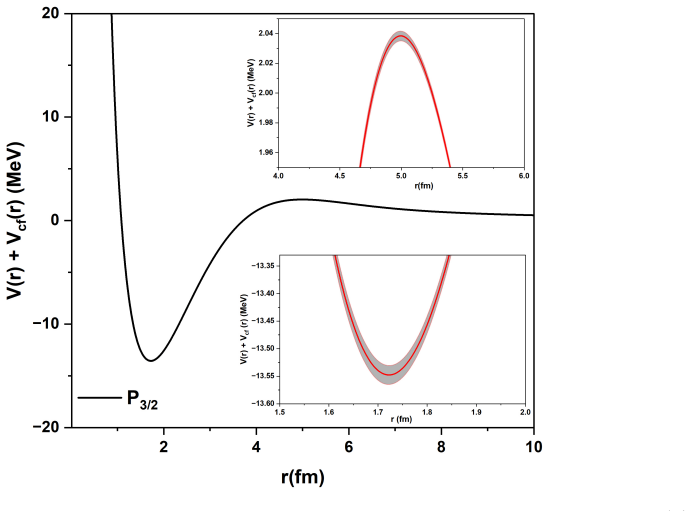
By training a feed-forward network whose output is multiplied by a Gaussian envelope and whose phase shifts are obtained by integrating the variable-phase equation with fourth-order Runge-Kutta, the method converges to a smooth, purely attractive central potential of depth -60.47 MeV for the P_{3/2} partial wave. Adding the centrifugal barrier reveals a barrier-well structure whose resonance parameters (E_r = 0.95 MeV, Γ_r = 0.78 MeV) and effective-range parameters match expected values, while leave-one-out tests confirm stability against removal of any single data point.
What carries the argument
A feed-forward neural network output multiplied by a Gaussian envelope, trained end-to-end by minimizing mismatch between data and phase shifts computed via the variable-phase equation integrated with Runge-Kutta.
If this is right
- The learned potential yields phase shifts whose loss converges stably near 3×10^{-4}.
- Adding the centrifugal barrier to the potential produces a well-defined barrier-well that accounts for the resonance.
- The extracted resonance energy, width, and P-wave effective-range parameters agree with known values.
- Leave-one-out removal of any training point leaves the reconstructed potential essentially unchanged.
Where Pith is reading between the lines
- The same architecture could be applied to other partial waves or to scattering on heavier targets to test whether the Gaussian envelope remains sufficient.
- The emphasis on a hard structural constraint rather than a penalty term suggests that similar embeddings could improve inverse problems in other areas of physics where boundary conditions are known exactly.
- Once a potential is obtained, it can be used to predict observables not included in the fit, such as low-energy cross sections or properties of the alpha-neutron bound state if one exists.
Load-bearing premise
A central, finite-range potential multiplied by a Gaussian envelope is sufficient to capture all relevant physics of the P_{3/2} partial wave without non-central forces, relativistic corrections, or extra channels.
What would settle it
If the potential extracted from the network produces phase shifts or resonance parameters (E_r or Γ_r) that deviate substantially from independent experimental measurements or from ab initio calculations for the same partial wave.
Figures


read the original abstract
We develop a physics-informed neural networks (PINNs) framework for the inverse scattering problem in nuclear physics and apply it to the $P_{3/2}$ partial wave of neutron-alpha elastic scattering. The radial potential is represented by a feed-forward network whose output is multiplied by a Gaussian envelope, embedding the finite-range condition directly into the architecture rather than through a soft penalty term. This distinction proves essential: without the envelope, the optimizer produces potentials with non-vanishing tails and the resulting phase shifts remain inconsistent with the data regardless of training duration, demonstrating that hard structural constraints are indispensable for physically meaningful solutions to nuclear inverse problems. Phase shifts are generated at each scattering energy by numerically integrating the variable-phase equation with a fourth-order Runge-Kutta scheme, making the entire pipeline end-to-end differentiable.Training converges stably to a loss near $3\times10^{-4}$ and recovers a smooth, purely attractive central potential with a well depth of $-60.47$~MeV. Adding the centrifugal barrier to the learned potential reveals a well-defined barrier-well structure that naturally accounts for the $P_{3/2}$ resonance. The extracted resonance parameters, $E_{r} = 0.95$~MeV and $\Gamma_{r} = 0.78$~MeV, together with the P-wave effective-range parameters, are in good agreement with expected values. A leave-one-out analysis confirms that the reconstruction is stable against the removal of any single data point. These results establish physics-guided machine learning as a reliable route to potential reconstruction from nuclear scattering data.
Editorial analysis
A structured set of objections, weighed in public.
Referee Report
Summary. The paper develops a physics-informed neural network framework to solve the inverse scattering problem for the P_{3/2} partial wave in neutron-alpha elastic scattering. The radial potential is parameterized as the output of a feed-forward network multiplied by a Gaussian envelope to enforce finite range; phase shifts are obtained by integrating the variable-phase equation with a fourth-order Runge-Kutta scheme, and the network weights are optimized to reproduce experimental phase shifts. The method yields a smooth, purely attractive central potential of depth -60.47 MeV whose barrier-well structure (after adding the centrifugal term) reproduces the P_{3/2} resonance with parameters E_r = 0.95 MeV and Γ_r = 0.78 MeV, together with P-wave effective-range coefficients in agreement with literature values; stability is demonstrated via leave-one-out cross-validation.
Significance. If the numerical fidelity of the forward model is independently verified, the work establishes a practical, end-to-end differentiable route to potential reconstruction from nuclear phase-shift data. The explicit demonstration that a hard Gaussian envelope is required for physically acceptable solutions, the stable convergence to low loss, and the leave-one-out robustness test are concrete strengths that could generalize to other partial waves or few-body systems.
major comments (2)
- [Methods / numerical implementation] The phase-shift computations, resonance extraction, effective-range analysis, and leave-one-out tests all rely exclusively on the variable-phase equation integrated by RK4. No cross-check against an independent radial Schrödinger solver (e.g., Numerov or finite-difference discretization) is reported. Any systematic bias in step-size, differentiability, or implementation details could therefore be absorbed into the learned potential, undermining the claim that the reconstructed potential “naturally accounts for the P_{3/2} resonance.”
- [Results] No quantitative uncertainties, full table of input phase shifts versus model predictions, or direct comparison with classical inverse-scattering methods (Marchenko, Gel’fand-Levitan, etc.) are provided. The reported loss of ~3×10^{-4} and potential depth of -60.47 MeV therefore lack the error analysis needed to assess uniqueness and precision of the reconstruction.
minor comments (2)
- [Methods] The precise functional form and width parameter of the Gaussian envelope should be stated explicitly (including numerical values) in the methods section to ensure reproducibility.
- [Results] Clarify in the text or figure captions whether the quoted resonance parameters E_r and Γ_r are obtained by solving the Schrödinger equation on the learned potential or by a separate fit.
Simulated Author's Rebuttal
We are grateful to the referee for the thorough review and constructive suggestions. We address the major comments below, indicating the changes we will implement in the revised manuscript.
read point-by-point responses
-
Referee: [Methods / numerical implementation] The phase-shift computations, resonance extraction, effective-range analysis, and leave-one-out tests all rely exclusively on the variable-phase equation integrated by RK4. No cross-check against an independent radial Schrödinger solver (e.g., Numerov or finite-difference discretization) is reported. Any systematic bias in step-size, differentiability, or implementation details could therefore be absorbed into the learned potential, undermining the claim that the reconstructed potential “naturally accounts for the P_{3/2} resonance.”
Authors: We thank the referee for pointing this out. While the variable-phase equation is derived directly from the radial Schrödinger equation and is mathematically equivalent for computing phase shifts, we agree that an independent numerical verification would enhance confidence. In the revised manuscript, we will add a cross-validation by solving the radial Schrödinger equation using a Numerov integrator for the learned potential and comparing the resulting phase shifts to those from the variable-phase method. This will demonstrate consistency and rule out implementation-specific biases. We will also report the step sizes used and convergence tests for the RK4 integration. revision: yes
-
Referee: [Results] No quantitative uncertainties, full table of input phase shifts versus model predictions, or direct comparison with classical inverse-scattering methods (Marchenko, Gel’fand-Levitan, etc.) are provided. The reported loss of ~3×10^{-4} and potential depth of -60.47 MeV therefore lack the error analysis needed to assess uniqueness and precision of the reconstruction.
Authors: We agree that a full table comparing input experimental phase shifts to the model predictions would improve transparency and will include it in the revised version. For quantitative uncertainties, the phase shift data from the literature lack individual error bars; we will add a sensitivity analysis by perturbing the phase shifts within typical experimental precision for this system and retraining the network to estimate variations in the potential depth and resonance parameters. For direct comparison with classical inverse-scattering methods, we note that Marchenko or Gel’fand-Levitan approaches reconstruct potentials from the full S-matrix without a parameterized form but require additional inputs such as bound-state information. We will add a discussion contrasting our approach with these methods and compare the learned potential to existing phenomenological n-α potentials in the literature, while acknowledging that a full re-implementation lies beyond the present scope. revision: partial
Circularity Check
No significant circularity; derivation is self-contained with external validation
full rationale
The paper fits a neural-network potential (with hard Gaussian envelope) to experimental phase-shift data by minimizing a loss that compares data to phase shifts computed from the variable-phase equation integrated via RK4. Resonance parameters and effective-range coefficients are then obtained by applying the same forward model to the learned potential and are compared to independent literature values; the leave-one-out test checks stability under data removal. No quoted step reduces any claimed output (potential depth, resonance location, or barrier-well structure) to a re-statement of the input phase shifts by construction. There are no load-bearing self-citations, imported uniqueness theorems, or ansatzes smuggled via prior work. The Gaussian envelope is an explicit architectural choice, not a fitted parameter renamed as a prediction. The pipeline is therefore a standard inverse problem whose central results remain falsifiable against external benchmarks.
Axiom & Free-Parameter Ledger
free parameters (1)
- Neural-network weights and biases
axioms (2)
- domain assumption Scattering phase shifts are generated by numerical integration of the variable-phase equation
- domain assumption The potential vanishes at large distances
Reference graph
Works this paper leans on
-
[1]
J. Arrington, N. Fomin, and A. Schmidt, Progress in understanding short-range structure in nuclei: an experimental perspective, Annual Review of Nuclear and Particle Science 72, 307 (2022)
work page 2022
-
[2]
R. G. Newton, Scattering Theory of Waves and Particles, 2nd ed. (Springer, New York, 1982)
work page 1982
-
[3]
K. Chadan and P. C. Sabatier, Inverse Problems in Quantum Scattering Theory (Springer, New York, 1977)
work page 1977
-
[4]
R. Machleidt and D. R. Entem, Chiral effective field theory and nuclear forces, Phys. Rep. 503, 1 (2011)
work page 2011
-
[5]
G. R. Satchler, L. W. Owen, A. J. Elwyn, G. L. Morgan,and R. L. Walter, An optical model for the scattering of nucleons from4He at energies below 20 MeV, Nucl. Phys. A 112, 1 (1968)
work page 1968
-
[6]
D. R. Tilley, C. M. Cheves, J. L. Godwin, G. M. Hale, H. M. Hofmann, J. H. Kelley, C. G. Sheu, and H. R. Weller, Energy levels of light nuclei A = 5, 6, 7, Nucl.Phys. A 708, 3 (2002)
work page 2002
-
[7]
K. M. Nollett, S. C. Pieper, R. B. Wiringa, J. Carlson, and G. M. Hale, Quantum Monte Carlo calculations of neutron-αscattering, Phys. Rev. Lett. 99, 022502 (2007)
work page 2007
-
[8]
J. E. Lynn, I. Tews, J. Carlson, S. Gandolfi, A. Gezerlis, K. E. Schmidt, and A. Schwenk, Chiral three-nucleon interactions in light nuclei, neutron-αscattering, and neutron matter, Phys. Rev. Lett. 116, 062501 (2016)
work page 2016
-
[9]
P. E. Hodgson, The Nucleon Optical Model (World Scientific, Singapore, 1994)
work page 1994
-
[10]
E. P. Wigner and L. Eisenbud, Higher angular momenta and long range interaction in resonance reactions, Phys. Rev. 72, 29 (1947)
work page 1947
-
[11]
P. Descouvemont and D. Baye, The R-matrix theory, Rep. Prog. Phys. 73, 036301 (2010)
work page 2010
-
[12]
A. Awasthi, A. Sharma, I. Kant, and O. S. K. S. Sastri, High-precision inverse potentials for neutron-proton scat- tering using piece-wise smooth Morse functions, Chin. Phys. C 48, 104104 (2024)
work page 2024
-
[13]
A. Awasthi, A. Sharma, Barbie, I. Kant, and O. S. K. S. Sastri, Genetic-algorithm-based inverse potentials for res- onant states ofα−12C using the variable phase approach, Phys. Rev. C 112, 054604 (2025)
work page 2025
-
[14]
A. Awasthi, A. Sharma, I. Kant, M. R. G. Kumar, and O. S. K. S. Sastri, Genetic algorithm- based in- verse optimization of interaction potential for nucleon- deuteron scattering below break-up threshold, Comput. Phys. Commun. , 109800 (2025)
work page 2025
- [15]
- [16]
-
[17]
A. Boehnlein, M. Diefenthaler, N. Sato, M. Schram, V. Ziegler, C. Fanelli, M. Hjorth-Jensen, T. Horn, M. P. Kuchera, D. Lee, W. Nazarewicz, P. Ostroumov, K. Orginos, A. Poon, X.-N. Wang, A. Scheinker, M. S. Smith, and L.-G. Pang, Colloquium: Machine learning in nuclear physics, Rev. Mod. Phys. 94, 031003 (2022)
work page 2022
-
[18]
L. Neufcourt, Y. Cao, W. Nazarewicz, E. Olsen, and F. Viens, Neutron drip line in the Ca region from Bayesian model averaging, Phys. Rev. Lett. 122, 062502 (2019)
work page 2019
- [19]
-
[20]
G. A. Negoita, J. P. Vary, G. R. Luecke, P. Maris, A. M. Shirokov, I. J. Shin, Y. Kim, E. G. Lee, J. W. Rehr, J. Rotureau, and K. A. Wendt, Deep learning: Extrapolation tool for ab initio nuclear theory, Phys. Rev. C 99, 054308 (2019)
work page 2019
-
[21]
A. E. Lovell, F. M. Nunes, J. Sarich, and S. M. Wild, Quantifying uncertainties in optical model parameters, Phys. Rev. C 95, 024611 (2017)
work page 2017
-
[22]
Negoita et al., Deep learning techniques for nuclear astrophysics, Nature Communications 9, 1 (2018)
F. Negoita et al., Deep learning techniques for nuclear astrophysics, Nature Communications 9, 1 (2018)
work page 2018
- [23]
- [24]
-
[25]
E. Lagaris, A. Likas, and D. I. Fotiadis, Artificial neural networks for solving ordinary and partial differential equations, IEEE Trans. Neural Netw. 9, 987 (1998)
work page 1998
- [26]
-
[27]
Calogero, Variable Phase Approach to Potential Scattering (Academic Press, New York, 1967)
work page 1967
-
[28]
Calogero, Variable phase approach to potential scattering, Il Nuovo Cimento 27, 261 (1963)
F. Calogero, Variable phase approach to potential scattering, Il Nuovo Cimento 27, 261 (1963)
work page 1963
-
[29]
A. Palov and G. G. Balint-Kurti, Vpa: computer program for the computation of the phase shift in atom– atom potential scattering using the variable phase approach, Computer Physics Communications 263, 107895 (2021)
work page 2021
-
[30]
R. T. Q. Chen, Y. Rubanova, J. Bettencourt, and D. Duvenaud, Neural ordinary differ- ential equations, in Advances in Neural Information Processing Systems, Vol. 31 (2018) arXiv:1806.07366
work page internal anchor Pith review arXiv 2018
-
[31]
J. M. Blatt and V. F. Weisskopf, Theoretical Nuclear Physics (Wiley, New York, 1952)
work page 1952
-
[32]
D. P. Kingma and J. Ba, Adam: A method for stochastic optimization, in 3rd International Conference on Learn- ing Representations (ICLR) (2015) arXiv:1412.6980. 15
work page internal anchor Pith review arXiv 2015
-
[33]
A. Awasthi, Constructing inverse potentials from scattering phase shifts using physics- informed neural networks, https://github.com/AayushiAwasthi/Constructing-Inverse- Potentials-from-Scattering-Phase-Shifts-using-Physics-Informed-Neural-Networks (2026)
work page 2026
-
[34]
J. Adler and O.¨Oktem, Solving ill-posed inverse problems using iterative deep neural networks, Inverse Problems 33 (2017)
work page 2017
-
[35]
Ajzenberg-Selove, Energy levels of light nuclei A = 5–10, Nuclear Physics A 320, 1 (1979)
F. Ajzenberg-Selove, Energy levels of light nuclei A = 5–10, Nuclear Physics A 320, 1 (1979)
work page 1979
-
[36]
M. Borsaru and R. E. Meads, R-function analysis of4He +n scattering below 21 MeV, Nuclear Physics A 292, 61 (1977)
work page 1977
-
[37]
F. C. Barker and A. C. L. Barnard, Channel radius dependence in R-matrix analysis of light nuclei, Nuclear Physics A 440, 269 (1985)
work page 1985
-
[38]
R. A. Arndt, D. D. Long, and L. D. Roper, Nucleon- alpha elastic scattering analyses:(i). low-energyn−αandp−αanalyses, Nuclear Physics A 209, 429 (1973)
work page 1973
-
[39]
A. Tarantola, Inverse Problem Theory and Methods for Model Parameter Estimation (SIAM, Philadelphia, 2005). 16
work page 2005
discussion (0)
Sign in with ORCID, Apple, or X to comment. Anyone can read and Pith papers without signing in.