Unified Mapping of Multi-Site Electrocatalytic Activity Using a Single Descriptor
Pith reviewed 2026-05-08 17:49 UTC · model grok-4.3
The pith
A reduced descriptor projects multi-site electrocatalytic activity onto one coordinate while retaining site heterogeneity and lateral interactions.
A machine-rendered reading of the paper's core claim, the machinery that carries it, and where it could break.
Core claim
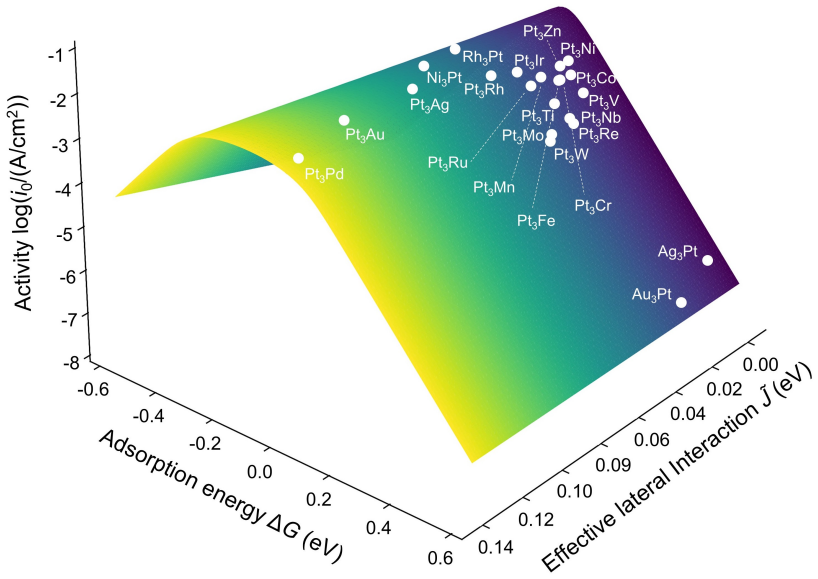
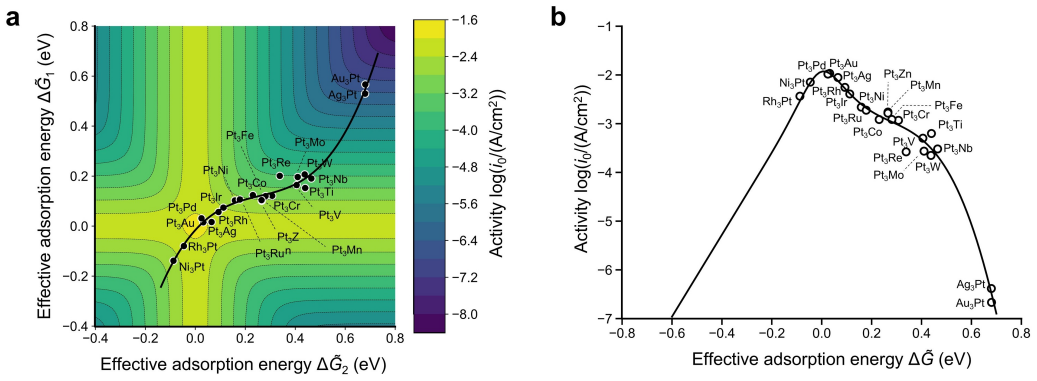
Starting from a mean-field statistical mechanics model, an effective adsorption free energy descriptor is introduced that explicitly incorporates lateral adsorbate-adsorbate interactions and enables coverage-consistent volcano relationships. For multi-site systems the nonlinear coupling between distinct adsorption environments produces multi-peaked activity trends that cannot be captured by conventional single-site descriptors; these trends are recovered by a reduced descriptor mapping that projects the multidimensional activity landscape onto a single effective coordinate while preserving the underlying physics of site heterogeneity and lateral interactions, thereby generalizing Sabatier-
What carries the argument
The reduced descriptor mapping that projects the multidimensional activity landscape onto a single effective coordinate incorporating lateral interactions and site heterogeneity.
If this is right
- Coverage-consistent volcano relationships become available once the effective descriptor is used.
- A two-dimensional activity landscape emerges whose ridge captures the joint effect of binding and lateral interactions.
- Multi-peaked activity trends appear in multi-site systems as a direct consequence of nonlinear site couplings.
- Screening of alloy catalysts with arbitrary composition becomes feasible through the single-coordinate projection.
Where Pith is reading between the lines
- Classic single-site Sabatier volcanoes emerge as special cases inside the more general ridge structure.
- Screening workflows could replace full multidimensional calculations with the single projected coordinate.
- The mapping supplies a concrete route for testing whether higher-order alloys still obey the projected one-dimensional trend.
Load-bearing premise
The mean-field statistical mechanics model holds and the nonlinear coupling in multi-site systems can be projected onto a single coordinate without losing essential physical information about interactions and heterogeneity.
What would settle it
Activity measurements on a binary alloy as a function of composition that fail to collapse onto the single predicted volcano when plotted against the reduced descriptor would falsify the mapping.
Figures
read the original abstract
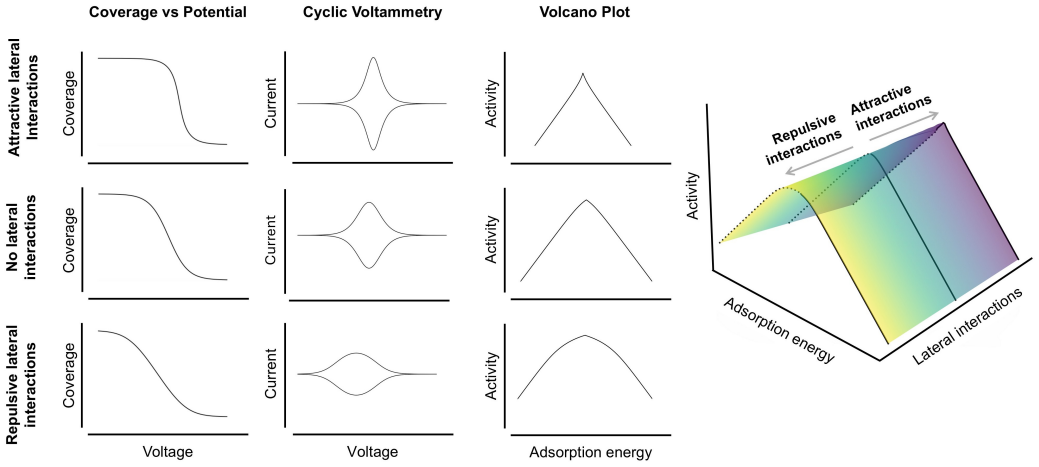
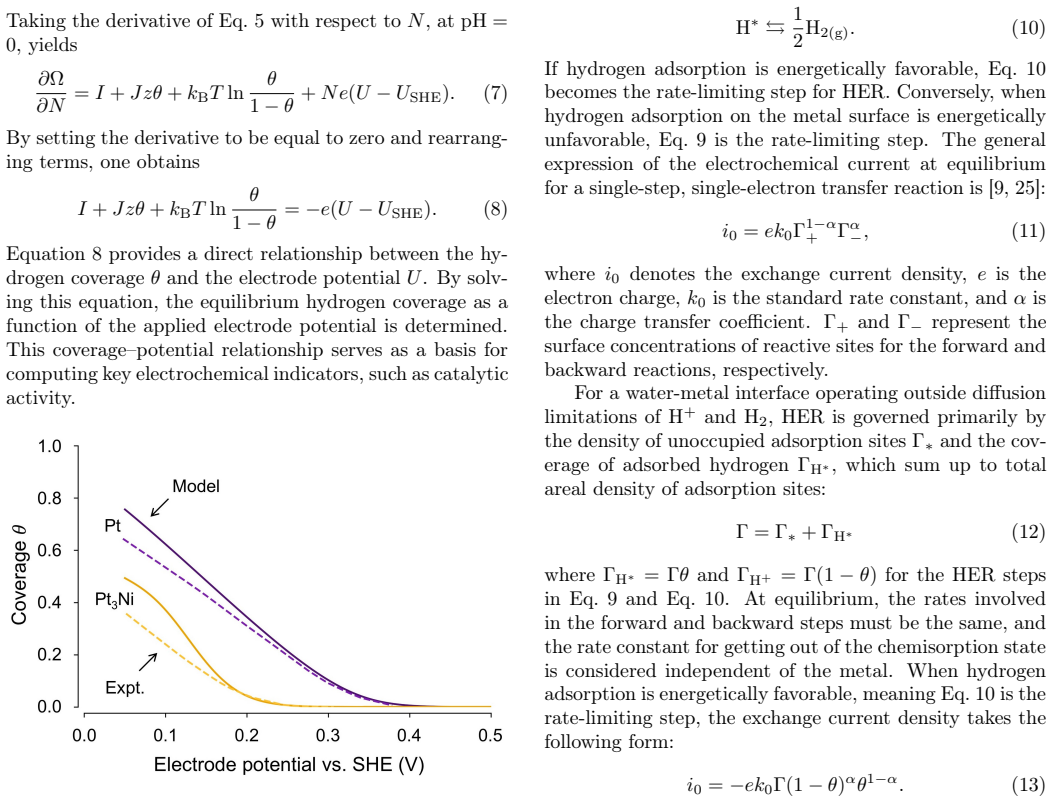
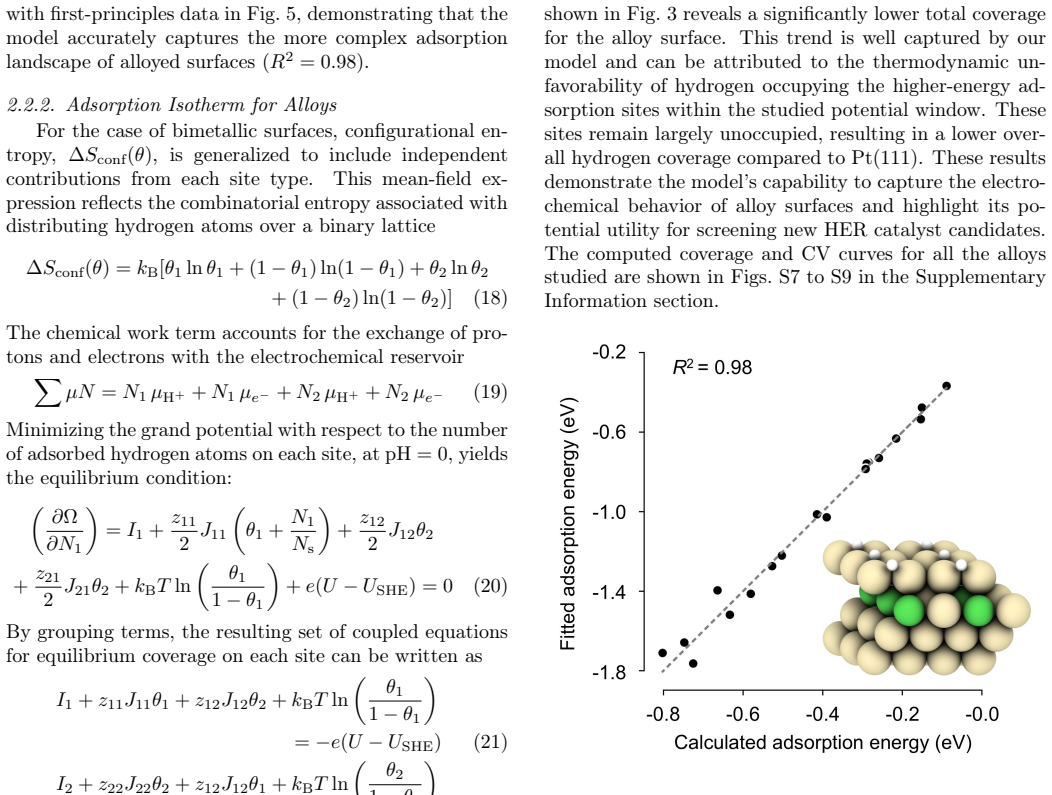
We present a precise and general method to map the activity of electrocatalysts across multiple sites. Starting from a mean-field statistical mechanics model, we introduce an effective adsorption free energy descriptor that explicitly incorporates lateral adsorbate-adsorbate interactions, enabling the construction of coverage-consistent volcano relationships. Extending this approach, we show that adsorption energetics and interaction strength define a two-dimensional activity landscape that gives rise to a "volcano ridge" that captures the coupled influence of binding and interactions on catalytic performance. For multi-site systems, we demonstrate that the inherently nonlinear coupling between distinct adsorption environments leads to multi-peaked activity trends that cannot be represented by conventional single-site descriptors. To address this, we introduce a reduced descriptor mapping that projects the multidimensional activity landscape onto a single effective coordinate while preserving the underlying physics of site heterogeneity and lateral interactions. The resulting framework generalizes Sabatier-type analysis to complex alloy catalysts and provides a physically interpretable route for screening electrocatalytic materials of arbitrary compositional complexity.
Editorial analysis
A structured set of objections, weighed in public.
Referee Report
Summary. The manuscript presents a framework for mapping multi-site electrocatalytic activity onto a single descriptor. Starting from a mean-field statistical mechanics model, it defines an effective adsorption free energy that incorporates lateral adsorbate-adsorbate interactions to generate coverage-consistent volcano relationships. It identifies a two-dimensional activity landscape in adsorption energetics and interaction strength that produces a 'volcano ridge.' For multi-site systems, nonlinear coupling between distinct adsorption environments is shown to produce multi-peaked activity trends not captured by conventional single-site descriptors. The central contribution is a reduced descriptor mapping that projects this multidimensional landscape onto one effective coordinate while preserving site heterogeneity and lateral interactions, thereby generalizing Sabatier-type analysis to complex alloy catalysts.
Significance. If the reduced mapping demonstrably retains the nonlinear multi-peaked features without loss of essential physical information, the work would represent a meaningful advance for screening complex electrocatalysts. It extends established mean-field approaches to handle compositional heterogeneity in a physically interpretable way, potentially enabling more efficient exploration of alloy spaces beyond traditional single-descriptor volcanoes. The emphasis on coverage consistency and explicit inclusion of interactions strengthens its grounding in statistical mechanics.
major comments (1)
- [Reduced descriptor mapping section] Reduced descriptor mapping section: the central claim that the projection preserves multi-peaked activity arising from nonlinear site coupling requires explicit validation. The manuscript must demonstrate (via a concrete two-site example or derivation) that the effective coordinate retains the distinct peaks rather than averaging them into a single effective volcano; if the mapping relies on moment-matching or effective averaging, this risks smoothing the very heterogeneity highlighted as a limitation of prior descriptors.
minor comments (2)
- [Two-dimensional activity landscape] The definition and construction of the 'volcano ridge' in the two-dimensional landscape should be illustrated with an explicit equation or figure caption to distinguish it clearly from standard one-dimensional volcanoes.
- [Mean-field model and effective descriptor] Notation for the effective adsorption free energy descriptor (including how lateral interactions enter) could be standardized across sections to improve readability for readers applying the method to new systems.
Simulated Author's Rebuttal
We thank the referee for their positive assessment of the work's significance and for the constructive major comment on the reduced descriptor mapping. We agree that explicit validation is needed to confirm preservation of multi-peaked features and will revise the manuscript accordingly.
read point-by-point responses
-
Referee: Reduced descriptor mapping section: the central claim that the projection preserves multi-peaked activity arising from nonlinear site coupling requires explicit validation. The manuscript must demonstrate (via a concrete two-site example or derivation) that the effective coordinate retains the distinct peaks rather than averaging them into a single effective volcano; if the mapping relies on moment-matching or effective averaging, this risks smoothing the very heterogeneity highlighted as a limitation of prior descriptors.
Authors: We appreciate this precise observation. The current derivation of the reduced mapping is constructed from the full mean-field partition function by projecting the joint activity surface onto an effective coordinate that retains site-specific adsorption energies and pairwise interaction terms as separate contributions. However, we acknowledge that a direct numerical demonstration for a minimal two-site case is not presented explicitly. In the revised manuscript we will add a new subsection containing (i) the exact two-site activity expression with distinct binding energies and interaction strengths, (ii) the resulting multi-peaked volcano surface, and (iii) the mapped single-descriptor curve obtained from the projection. This will show that the distinct peaks are recovered at their original positions rather than merged or smoothed. The mapping is not a simple moment average; it is a coverage-weighted projection that explicitly carries the nonlinear cross terms, thereby preserving the heterogeneity the referee correctly identifies as central to the advance. revision: yes
Circularity Check
No circularity: derivation starts from mean-field model and introduces independent mappings
full rationale
The provided abstract describes a chain beginning with a mean-field statistical mechanics model, from which an effective adsorption free energy descriptor is introduced to incorporate interactions and build volcano relationships. A two-dimensional landscape and volcano ridge are then shown, followed by identification of multi-peaked trends in multi-site systems. The reduced descriptor mapping is presented as a new projection onto a single coordinate that preserves heterogeneity and interactions. No equations, self-citations, fitted parameters, or prior author results are quoted that would reduce any central claim to its own inputs by construction. The framework is framed as a generalization rather than a renaming or self-referential fit, making the derivation self-contained against external benchmarks.
Axiom & Free-Parameter Ledger
axioms (1)
- domain assumption Mean-field statistical mechanics model accurately describes adsorption energetics and lateral interactions
Lean theorems connected to this paper
-
Cost/FunctionalEquation (Jcost = ½(x + x⁻¹) − 1)washburn_uniqueness_aczel unclear?
unclearRelation between the paper passage and the cited Recognition theorem.
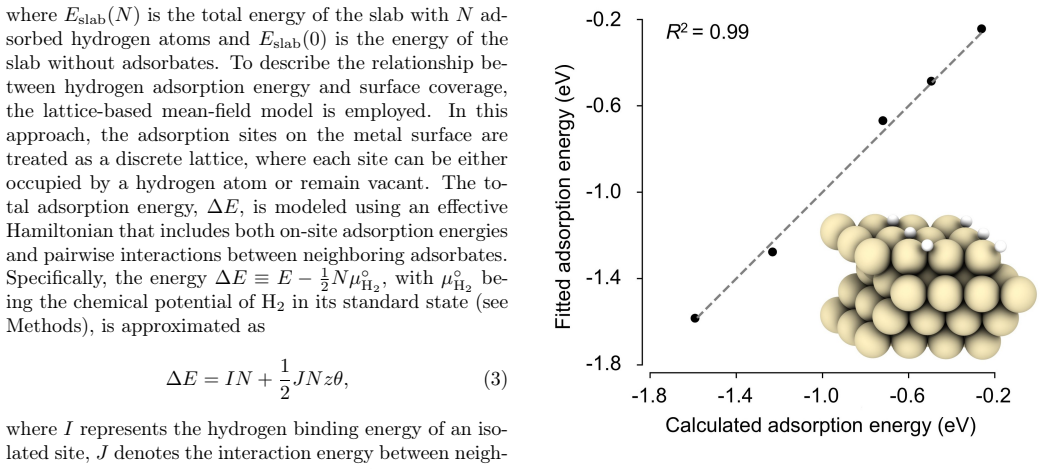
the total adsorption energy, ΔE, is modeled using an effective Hamiltonian that includes both on-site adsorption energies and pairwise interactions between neighboring adsorbates ... ΔE = IN + ½ J N z θ
-
Foundation/AlphaCoordinateFixation (J as unique calibrated cost)J_uniquely_calibrated_via_higher_derivative unclear?
unclearRelation between the paper passage and the cited Recognition theorem.
we introduce a reduced descriptor mapping that projects the multidimensional activity landscape onto a single effective coordinate ... by fitting a third-order polynomial function between them for each system
-
Foundation/BranchSelection (coupling combiner / bilinear branch)branch_selection unclear?
unclearRelation between the paper passage and the cited Recognition theorem.
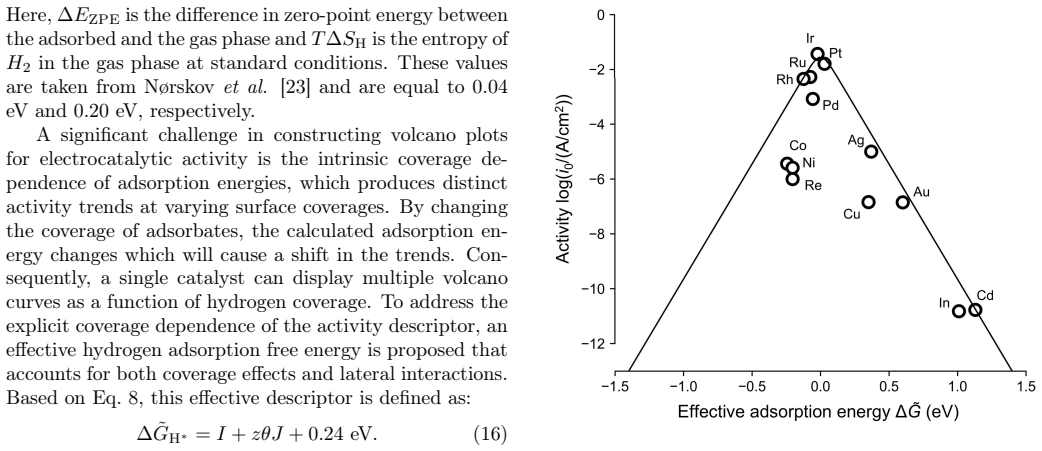
ΔG̃_H* = I + zθ J + 0.24 eV ... an effective hydrogen adsorption free energy is proposed that accounts for both coverage effects and lateral interactions
What do these tags mean?
- matches
- The paper's claim is directly supported by a theorem in the formal canon.
- supports
- The theorem supports part of the paper's argument, but the paper may add assumptions or extra steps.
- extends
- The paper goes beyond the formal theorem; the theorem is a base layer rather than the whole result.
- uses
- The paper appears to rely on the theorem as machinery.
- contradicts
- The paper's claim conflicts with a theorem or certificate in the canon.
- unclear
- Pith found a possible connection, but the passage is too broad, indirect, or ambiguous to say the theorem truly supports the claim.
Reference graph
Works this paper leans on
-
[1]
Li- brairie Polytechnique, Paris, 1913
Paul Sabatier.La Catalyse en Chimie Organique. Li- brairie Polytechnique, Paris, 1913
work page 1913
-
[2]
Paul Sabatier. Hydrogénations et déshydrogénations par catalyse.European Journal of Inorganic Chem- istry, 44:1984–2001, 1911
work page 1984
-
[3]
Wenyao Chen, Yao Shi, Changwei Liu, Zhouhong Ren, Zikun Huang, Zhou Chen, Xiangxue Zhang, Shanshan Liang, Lei Xie, Cheng Lian, et al. Restruc- turing the interfacial active sites to generalize the vol- cano curves for platinum-cobalt synergistic catalysis. Nature Communications, 15(1):8995, 2024
work page 2024
-
[4]
Caiwu Liang, Reshma R Rao, Katrine L Svane, Joseph HL Hadden, Benjamin Moss, Soren B Scott, Michael Sachs, James Murawski, Adrian Malthe Frandsen, D Jason Riley, et al. Unravelling the effects of active site density and energetics on the water ox- idation activity of iridium oxides.Nature Catalysis, 7(7):763–775, 2024
work page 2024
-
[5]
Changming Ke, Zijing Lin, and Shi Liu. Three- dimensional activity volcano plot under an external electric field.ACS Catalysis, 12(21):13542–13548, 2022
work page 2022
-
[6]
Lars C Grabow, Britt Hvolbæk, and Jens K Nørskov. Understanding trends in catalytic activity: the effect of adsorbate–adsorbate interactions for co oxidation overtransitionmetals.Topics in Catalysis, 53(5):298– 310, 2010
work page 2010
-
[7]
Revisiting volcano plots: An an- alytical 3d approach.CCS Chemistry, pages 1–10, 2025
Yifan Wang, Yecheng Leng, Wenguang Tu, Zhigang Zou, and Xi Zhu. Revisiting volcano plots: An an- alytical 3d approach.CCS Chemistry, pages 1–10, 2025
work page 2025
-
[8]
Liang Qi and Ju Li. Adsorbate interactions on surface lead to a flattened sabatier volcano plot in reduction of oxygen.Journal of Catalysis, 295:59–69, 2012
work page 2012
-
[9]
Timothy T Yang and Wissam A Saidi. Reconciling the volcano trend with the butler–volmer model for thehydrogenevolutionreaction.The Journal of Phys- ical Chemistry Letters, 13(23):5310–5315, 2022
work page 2022
-
[10]
Caoxin Lin, Zhiqiao Huang, Zeyi Zhang, Tang Zeng, Runzhe Chen, Yangyang Tan, Wei Wu, Shichun Mu, and Niancai Cheng. Structurally ordered pt3co nanoparticles anchored on n-doped graphene for highly efficient hydrogen evolution reaction.ACS Sustainable Chemistry & Engineering, 8(45):16938– 16945, 2020
work page 2020
-
[11]
Song Lin Zhang, Xue Feng Lu, Zhi-Peng Wu, Deyan Luan, and Xiong Wen Lou. Engineering platinum– cobalt nano-alloys in porous nitrogen-doped carbon nanotubes for highly efficient electrocatalytic hydro- genevolution.Angewandte Chemie International Edi- tion, 60(35):19068–19073, 2021
work page 2021
-
[12]
Wenhao Yu, Yanyun Zhang, Yingnan Qin, Dan Zhang, Kang Liu, GA Bagliuk, Jianping Lai, and Lei Wang. High-density frustrated lewis pair for high- performance hydrogen evolution.Advanced Energy Materials, 13(2):2203136, 2023
work page 2023
-
[13]
Xiao-Fang Zhang, Han-Bin Meng, Hong-Yan Chen, Jiu-Ju Feng, Ke-Ming Fang, and Ai-Jun Wang. Bimetallic ptco alloyed nanodendritic assemblies as an advanced efficient and robust electrocatalyst for highly efficient hydrogen evolution and oxygen reduc- tion.Journal of Alloys and Compounds, 786:232–239, 2019
work page 2019
-
[14]
Yueyang Qiao, Jiayao Cui, Fangren Qian, Xiaoyi Xue, Xiangping Zhang, Haitao Zhang, Wenqi Liu, Xiao- jin Li, and Qingjun Chen. Pt3fe nanoparticles on b, n-codoped carbon as oxygen reduction and ph- universal hydrogen evolution electrocatalysts.ACS Applied Nano Materials, 5(1):318–325, 2021
work page 2021
-
[15]
Xing Zhong, Lei Wang, Zhenzhan Zhuang, Xianlang Chen, Jian Zheng, Yulin Zhou, Guilin Zhuang, Xi- aonian Li, and Jianguo Wang. Double nanoporous structurewithnanoporousptfeembeddedingraphene nanopores: highly efficient bifunctional electrocata- lysts for hydrogen evolution and oxygen reduction. Advanced Materials Interfaces, 4(5):1601029, 2017
work page 2017
-
[16]
Xianbiao Fu, Jakob B Pedersen, Yuanyuan Zhou, Mattia Saccoccio, Shaofeng Li, Rokas Sažinas, Katja Li, Suzanne Z Andersen, Aoni Xu, Niklas H Deissler, et al. Continuous-flow electrosynthesis of ammonia by nitrogen reduction and hydrogen oxidation.Science, 379(6633):707–712, 2023
work page 2023
-
[17]
Soumi Mondal, Shreya Sarkar, Debabrata Bagchi, Tisita Das, Risov Das, Ashutosh Kumar Singh, Ponnappa Kechanda Prasanna, CP Vinod, Sudip Chakraborty, and Sebastian C Peter. Morphology- tuned pt3ge accelerates water dissociation to industrial-standard hydrogen production over a wide ph range.Advanced Materials, 34(30):2202294, 2022
work page 2022
-
[18]
Weiyu Zhang, Bolong Huang, Kai Wang, Wenxiu Yang, Fan Lv, Na Li, Yuguang Chao, Peng Zhou, Yong Yang, Yingjie Li, et al. Wox-surface decorated ptni@ pt dendritic nanowires as efficient ph-universal 10 hydrogen evolution electrocatalysts.Advanced Energy Materials, 11(3):2003192, 2021
work page 2021
-
[19]
Beibei Pang, Xiaokang Liu, Tianyang Liu, Tao Chen, XinyiShen, WeiZhang, SicongWang, TongLiu, Dong Liu, Tao Ding, et al. Laser-assisted high-performance ptru alloy for ph-universal hydrogen evolution.En- ergy & Environmental Science, 15(1):102–108, 2022
work page 2022
-
[20]
Jinli Chen, Guangfu Qian, Hao Zhang, Shouquan Feng, Yanshan Mo, Lin Luo, and Shibin Yin. Ptco@ ptsn heterojunction with high stability/activity for ph-universal h2 evolution.Advanced Functional Ma- terials, 32(5):2107597, 2022
work page 2022
-
[21]
Zhenrui Ni, Cheng Luo, Bei Cheng, Panyong Kuang, Youji Li, and Jiaguo Yu. Construction of hierarchical and self-supported nife-pt3ir electrode for hydrogen production with industrial current density.Applied Catalysis B: Environmental, 321:122072, 2023
work page 2023
-
[22]
Work function, electronegativity, and electrochemical behaviour of metals: Iii
Sergio Trasatti. Work function, electronegativity, and electrochemical behaviour of metals: Iii. electrolytic hydrogen evolution in acid solutions.Journal of Elec- troanalytical Chemistry and Interfacial Electrochem- istry, 39(1):163–184, 1972
work page 1972
-
[23]
Jens Kehlet Nørskov, Thomas Bligaard, Ashildur Lo- gadottir, JR Kitchin, Jingguang G Chen, S Pandelov, and UJJoTES Stimming. Trends in the exchange cur- rent for hydrogen evolution.Journal of The Electro- chemical Society, 152(3):J23, 2005
work page 2005
-
[24]
Vojislav R Stamenkovic, Ben Fowler, Bongjin Simon Mun, Guofeng Wang, Philip N Ross, Christopher A Lucas, and Nenad M Markovic. Improved oxygen re- duction activity on pt3ni (111) via increased surface site availability.science, 315(5811):493–497, 2007
work page 2007
-
[25]
Electrochemical methods: fundamentals and applica- tions
Allen J Bard, Larry R Faulkner, and Henry S White. Electrochemical methods: fundamentals and applica- tions. John Wiley & Sons, 2022
work page 2022
-
[26]
Vojislav R Stamenkovic, Bongjin Simon Mun, Matthias Arenz, Karl JJ Mayrhofer, Christopher A Lucas, Guofeng Wang, Philip N Ross, and Nenad M Markovic. Trends in electrocatalysis on extended and nanoscale pt-bimetallic alloy surfaces.Nature mate- rials, 6(3):241–247, 2007
work page 2007
-
[27]
Lazar Rakočević, Ivana Stojković Simatović, Alek- sandar Maksić, Vladimir Rajić, Svetlana Štrbac, and Irina Srejić. Ptau nanoparticles supported by reduced graphene oxide as a highly active catalyst for hydro- gen evolution.Catalysts, 12(1):43, 2021
work page 2021
-
[28]
Fang Sun, Lubing Qin, Zhenghua Tang, and Qing Tang. Revisiting the activity origin of the ptau 24 (sr) 18 nanocluster for enhanced electrocatalytic hy- drogen evolution by combining first-principles simu- lations with the experimental in situ ftir technique. Chemical Science, 15(39):16142–16155, 2024
work page 2024
-
[29]
Mei Wu, Pei Kang Shen, Zidong Wei, Shuqin Song, and Ming Nie. High activity ptpd-wc/c electrocata- lystforhydrogenevolutionreaction.Journal of Power Sources, 166(2):310–316, 2007
work page 2007
-
[30]
Dinesh Bhalothia, Tzu-Hsi Huang, Chia-Wen Chang, Ting-Han Lin, Shun-Chi Wu, Kuan-Wen Wang, and Tsan-Yao Chen. High-performance and stable hy- drogen evolution reaction achieved by pt trimer dec- oration on ultralow-metal loading bimetallic ptpd nanocatalysts.ACS Applied Energy Materials, 3(11):11142–11152, 2020
work page 2020
-
[31]
Balasingh Thangadurai Jebaslinhepzybai, Natarajan Prabu, and Manickam Sasidharan. Facile galvanic re- placement method for porous pd@ pt nanoparticles as an efficient her electrocatalyst.International Journal of Hydrogen Energy, 45(19):11127–11137, 2020
work page 2020
-
[32]
Qing Liu, Ya-Mei He, Xuexiang Weng, Ai-Jun Wang, Pei-Xian Yuan, Ke-Ming Fang, and Jiu-Ju Feng. One- pot aqueous fabrication of reduced graphene oxide supported porous ptag alloy nanoflowers to greatly boost catalytic performances for oxygen reduction and hydrogen evolution.Journal of colloid and in- terface science, 513:455–463, 2018
work page 2018
-
[33]
Meng Huang, Hanyu Zhang, Song Yin, Xiaoxue Zhang, and Jun Wang. Ptag alloy nanoparticles em- bedded in polyaniline as electrocatalysts for formate oxidation and hydrogen evolution.ACS Applied Nano Materials, 3(4):3760–3766, 2020
work page 2020
-
[34]
Xuexiang Weng, Qing Liu, Ai-Jun Wang, Junhua Yuan, and Jiu-Ju Feng. Simple one-pot synthesis of solid-core@ porous-shell alloyed ptag nanocrystals for the superior catalytic activity toward hydrogen evo- lution and glycerol oxidation.Journal of Colloid and Interface Science, 494:15–21, 2017
work page 2017
-
[35]
Paolo Giannozzi, Stefano Baroni, Nicola Bonini, Mat- teo Calandra, Roberto Car, Carlo Cavazzoni, Davide Ceresoli, Guido L Chiarotti, Matteo Cococcioni, Is- maila Dabo, et al. QUANTUM ESPRESSO: a mod- ular and open-source software project for quantum simulations of materials.Journal of Physics: Con- densed Matter, 21(39):395502, 2009
work page 2009
-
[36]
Paolo Giannozzi, Oliviero Andreussi, Thomas Brumme, Oana Bunau, M Buongiorno Nardelli, Mat- teo Calandra, Roberto Car, Carlo Cavazzoni, Da- vide Ceresoli, Matteo Cococcioni, et al. Advanced capabilities for materials modelling with Quantum ESPRESSO.Journal of Physics: Condensed Matter, 29(46):465901, 2017. 11
work page 2017
-
[37]
François Jollet, Marc Torrent, and Natalie Holzwarth. Generation of Projector Augmented-Wave atomic data: A 71 element validated table in the XML format.Computer Physics Communications, 185(4):1246–1254, 2014
work page 2014
-
[38]
Generalized gradient approximation made sim- ple.Physical Review Letters, 77(18):3865, 1996
John P Perdew, Kieron Burke, and Matthias Ernzer- hof. Generalized gradient approximation made sim- ple.Physical Review Letters, 77(18):3865, 1996
work page 1996
-
[39]
Nicola Marzari, David Vanderbilt, Alessandro De Vita, and MC Payne. Thermal contraction and disordering of the Al (110) surface.Physical Review Letters, 82(16):3296, 1999. 12
work page 1999
discussion (0)
Sign in with ORCID, Apple, or X to comment. Anyone can read and Pith papers without signing in.