A Paradigm for Interpreting Metrics and Identifying Critical Errors in Automatic Speech Recognition
Pith reviewed 2026-05-07 16:33 UTC · model grok-4.3
The pith
Incorporating any speech metric into a Minimum Edit Distance produces an interpretable error rate that aligns with human perception of transcription mistakes.
A machine-rendered reading of the paper's core claim, the machinery that carries it, and where it could break.
Core claim
The central claim is that any chosen metric can be incorporated into a Minimum Edit Distance framework to yield an equivalent error rate, called minED. This minED parallels transcription errors with human perception and enables an original analysis of error severity from that perspective.
What carries the argument
The Minimum Edit Distance (minED) created by incorporating a chosen metric, which acts as the interpretable equivalent to standard error rates while approximating human judgment.
If this is right
- Any existing metric can be converted into an error-rate equivalent that is directly comparable across systems.
- Errors in transcriptions can be ranked and studied according to their human-perceived impact rather than just count.
- Critical errors can be identified more reliably for applications that require human-like evaluation.
- The paradigm allows direct study of how linguistic and semantic information influences perceived error severity.
Where Pith is reading between the lines
- This conversion could support training ASR models with objectives that optimize for human-aligned scores instead of raw WER.
- The approach might extend to other sequence tasks where interpretability of evaluation metrics is needed.
- Real-time systems could use minED to flag and prioritize correction of the most perceptually damaging errors.
Load-bearing premise
That embedding any chosen metric into the minED framework will preserve its approximation to human perception without introducing inconsistencies or losing the metric's original properties.
What would settle it
A controlled comparison where minED scores from multiple metrics fail to rank transcription errors by severity in the same order as direct human ratings, or where minED shows no improvement in correlation with human judgments over the raw metric.
Figures


read the original abstract
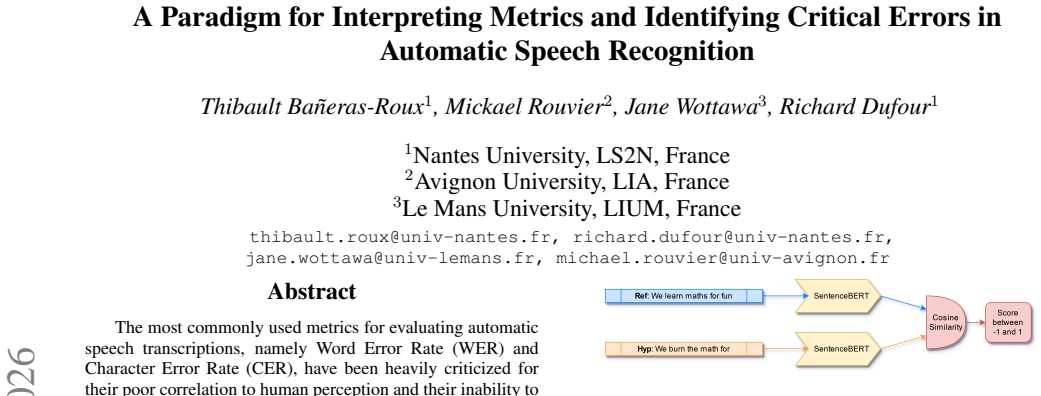
The most commonly used metrics for evaluating automatic speech transcriptions, namely Word Error Rate (WER) and Character Error Rate (CER), have been heavily criticized for their poor correlation to human perception and their inability to take into account linguistic and semantic information. While metric-based embeddings, seeking to approximate human perception, have been proposed, their scores remain difficult to interpret, unlike WER and CER. In this article, we overcome this problem by proposing a paradigm that consists in incorporating a chosen metric into it in order to obtain an equivalent of the error rate: a Minimum Edit Distance (minED). This approach parallels transcription errors with their human perception, also allowing an original study of the severity of these errors from a human perspective.
Editorial analysis
A structured set of objections, weighed in public.
Referee Report
Summary. The manuscript proposes a paradigm for evaluating automatic speech recognition (ASR) transcriptions by incorporating a chosen metric into a Minimum Edit Distance (minED) framework. This is intended to yield an interpretable error-rate equivalent that aligns transcription errors with human perception, overcoming limitations of WER and CER such as poor correlation with human judgment and lack of linguistic/semantic awareness, while also enabling analysis of error severity from a human perspective.
Significance. If the incorporation mechanism can be rigorously defined and shown to preserve metric properties while approximating human perception, the work could provide a useful bridge between embedding-based metrics and traditional interpretable error rates, potentially improving ASR evaluation practices.
major comments (2)
- [Abstract] Abstract and introduction: the central construction—how a chosen metric is 'incorporated' into minED to obtain an equivalent error rate—is not defined. It is unclear whether the metric replaces substitution costs, defines alignment costs, or is used in another way; whether the resulting minED satisfies metric axioms (symmetry, triangle inequality); or how optimization over alignments is performed. Without this, the claim that minED parallels errors with human perception cannot be evaluated.
- [Abstract] The manuscript provides no derivation, validation data, or implementation details showing that the minED output preserves the original metric's semantics or approximates human perception without introducing inconsistencies (e.g., when the input metric is non-metric or high-dimensional). This is load-bearing for the equivalence claim.
minor comments (1)
- [Abstract] The abstract uses 'it' ambiguously when referring to the paradigm; clarify the referent.
Simulated Author's Rebuttal
We thank the referee for their insightful comments on our manuscript. We address the concerns regarding the definition of the paradigm and the supporting details below, and we will revise the manuscript to improve clarity and provide additional information.
read point-by-point responses
-
Referee: [Abstract] Abstract and introduction: the central construction—how a chosen metric is 'incorporated' into minED to obtain an equivalent error rate—is not defined. It is unclear whether the metric replaces substitution costs, defines alignment costs, or is used in another way; whether the resulting minED satisfies metric axioms (symmetry, triangle inequality); or how optimization over alignments is performed. Without this, the claim that minED parallels errors with human perception cannot be evaluated.
Authors: The manuscript does define the incorporation in the body of the paper, but we agree that the abstract and introduction are too brief. The paradigm incorporates the metric by using it as the substitution cost in the edit distance calculation, with the minED found through standard dynamic programming optimization over possible alignments. We will revise the abstract and introduction to include this explicit description. We will also add a discussion on the metric properties, noting that symmetry and triangle inequality are preserved if the original metric satisfies them. revision: yes
-
Referee: [Abstract] The manuscript provides no derivation, validation data, or implementation details showing that the minED output preserves the original metric's semantics or approximates human perception without introducing inconsistencies (e.g., when the input metric is non-metric or high-dimensional). This is load-bearing for the equivalence claim.
Authors: We will add a derivation in the revised manuscript to show preservation of semantics. Implementation details, including how to handle the optimization, will be provided. For validation, the paper includes an analysis of error severity from a human perspective using the paradigm, but we acknowledge the lack of large-scale human judgment correlation studies. We will clarify this scope and discuss potential inconsistencies for non-metric cases. revision: partial
- Large-scale empirical validation data against human perception, as the work is focused on proposing the paradigm rather than extensive benchmarking.
Circularity Check
No circularity detected; minED paradigm is self-contained proposal
full rationale
The paper's central proposal is to incorporate an arbitrary chosen metric into a Minimum Edit Distance (minED) construction to yield an interpretable error-rate equivalent. No equations, fitted parameters, or reductions are exhibited in the provided text that would make the output equivalent to its inputs by construction. The approach is described as building directly on existing metrics (WER, CER) and prior metric-based embeddings without self-referential fitting, self-citation load-bearing premises, or ansatz smuggling. The derivation chain therefore remains independent and does not reduce to a renaming or self-definition of the target result.
Axiom & Free-Parameter Ledger
Reference graph
Works this paper leans on
-
[1]
Introduction Although Automatic Speech Recognition (ASR) performance greatly improved with the recent progress in machine learning and the massive increase in data used for model training, tran- scription errors are still present, their proportion depending on the context in which these systems are used. Evaluating an ASR system typically involves a compa...
-
[2]
A Paradigm for Interpreting Metrics and Identifying Critical Errors in Automatic Speech Recognition
Dataset with human perception annotations The HATS dataset1 [12] is an open-access corpus for French, in- tended to evaluate the correlation between ASR evaluation met- rics and human perception from the reader’s perspective. It was created using the REPERE corpus [13], containing audio and manually written transcripts of radio and television broadcast in...
work page internal anchor Pith review Pith/arXiv arXiv 2026
-
[3]
A Paradigm for Metric Interpretation The purpose of this paradigm is to provide interpretability for metrics that have scores that are difficult to comprehend. This consists in calculating the minimum number of modifications to be applied to the hypothesis so that it is sufficiently close to the reference regarding its human perception. Following this ide...
-
[4]
she worked on state of the art systems
Analysis 4.1. Linguistic analysis Using the minWED paradigm, each error in the hypothesis corresponds either to a word in the reference (substituted or deleted) or to an insertion (i.e.word only present in the hypoth- esis). Using a state-of-the-art part-of-speech (POS) tagger for French [21], we propose to linguistically associate a morpho- syntactic cla...
-
[5]
Conclusions and perspectives We have proposed a paradigm (minED) allowing both to make Automatic Speech Recognition (ASR) metrics interpretable but also to highlight critical transcription errors from the point of view of human perception. Our study indicates that the minED approach presents a more comprehensible strategy for evaluat- ing Automatic Speech...
-
[6]
The use of MinWED and MinED metrics lead to a decrease in correlation with human perception
Limitations Although the proposed paradigm allows metrics to be inter- pretable, there are limitations to consider. The use of MinWED and MinED metrics lead to a decrease in correlation with human perception. Depending on the threshold, this decrease may ren- der the use of metrics other than WER irrelevant. Secondly, as modern metrics are not always cons...
-
[7]
Automatic hu- man utility evaluation of ASR systems: Does WER really predict performance?
B. Favre, K. Cheung, S. Kazemian, A. Lee, Y . Liu, C. Munteanu, A. Nenkova, D. Ochei, G. Penn, S. Tratzet al., “Automatic hu- man utility evaluation of ASR systems: Does WER really predict performance?” inINTERSPEECH, 2013, pp. 3463–3467
work page 2013
-
[8]
N. Ruiz and M. Federico, “Phonetically-oriented word error align- ment for speech recognition error analysis in speech translation,” in2015 IEEE Workshop on Automatic Speech Recognition and Understanding (ASRU). IEEE, 2015, pp. 296–302
work page 2015
-
[9]
S. Kafle and M. Huenerfauth, “Evaluating the usability of auto- matically generated captions for people who are deaf or hard of hearing,” inProceedings of the 19th International ACM SIGAC- CESS Conference on Computers and Accessibility, 2017, pp. 165– 174
work page 2017
-
[10]
Meaning Error Rate: ASR domain-specific metric framework,
L. Gordeeva, V . Ershov, O. Gulyaev, and I. Kuralenok, “Meaning Error Rate: ASR domain-specific metric framework,” inProceed- ings of the 27th ACM SIGKDD Conference on Knowledge Dis- covery & Data Mining, 2021, pp. 458–466
work page 2021
-
[11]
Qual- itative Evaluation of Language Model Rescoring in Automatic Speech Recognition,
T. Ba ˜neras-Roux, M. Rouvier, J. Wottawa, and R. Dufour, “Qual- itative Evaluation of Language Model Rescoring in Automatic Speech Recognition,” inInterspeech 2022, 2022
work page 2022
-
[12]
Learning word vectors for 157 languages,
´E. Grave, P. Bojanowski, P. Gupta, A. Joulin, and T. Mikolov, “Learning word vectors for 157 languages,” inProceedings of the Eleventh International Conference on Language Resources and Evaluation (LREC 2018), 2018
work page 2018
-
[13]
Enriching word vectors with subword information,
P. Bojanowski, E. Grave, A. Joulin, and T. Mikolov, “Enriching word vectors with subword information,”Transactions of the as- sociation for computational linguistics, vol. 5, pp. 135–146, 2017
work page 2017
-
[14]
S. Kim, A. Arora, D. Le, C.-F. Yeh, C. Fuegen, O. Kalinli, and M. L. Seltzer, “Semantic Distance: A New Metric for ASR Per- formance Analysis Towards Spoken Language Understanding,” in Proc. Interspeech 2021, 2021, pp. 1977–1981
work page 2021
-
[15]
Bertscore: Evaluating text generation with bert,
T. Zhang*, V . Kishore*, F. Wu*, K. Q. Weinberger, and Y . Artzi, “Bertscore: Evaluating text generation with bert,” inInternational Conference on Learning Representations, 2020. [Online]. Available: https://openreview.net/forum?id=SkeHuCVFDr
work page 2020
-
[16]
Ap- plying bert to document retrieval with birch,
Z. A. Yilmaz, S. Wang, W. Yang, H. Zhang, and J. Lin, “Ap- plying bert to document retrieval with birch,” inProceedings of the 2019 Conference on Empirical Methods in Natural Language Processing and the 9th International Joint Conference on Natu- ral Language Processing (EMNLP-IJCNLP): System Demonstra- tions, 2019, pp. 19–24
work page 2019
-
[17]
A fine-grained analysis of bertscore,
M. Hanna and O. Bojar, “A fine-grained analysis of bertscore,” inProceedings of the Sixth Conference on Machine Translation, 2021, pp. 507–517
work page 2021
-
[18]
Anonymous, “HATS: An open dataset integrating human percep- tion applied to the evaluation of Automatic Speech Recognition metrics,” 2023
work page 2023
-
[19]
The repere corpus: a multimodal corpus for person recognition,
A. Giraudel, M. Carr ´e, V . Mapelli, J. Kahn, O. Galibert, and L. Quintard, “The repere corpus: a multimodal corpus for person recognition,” inInternational Conference on Language Resources and Evaluation (LREC), 2012, pp. 1102–1107
work page 2012
-
[20]
Evaluating User Perception of Speech Recognition System Quality with Semantic Distance Metric,
S. Kim, D. Le, W. Zheng, T. Singh, A. Arora, X. Zhai, C. Fuegen, O. Kalinli, and M. Seltzer, “Evaluating User Perception of Speech Recognition System Quality with Semantic Distance Metric,” in Proc. Interspeech 2022, 2022, pp. 3978–3982
work page 2022
-
[21]
SpeechBrain: A general- purpose speech toolkit
M. Ravanelli, T. Parcollet, P. Plantinga, A. Rouhe, S. Cornell, L. Lugosch, C. Subakan, N. Dawalatabad, A. Heba, J. Zhong, J.-C. Chou, S.-L. Yeh, S.-W. Fu, C.-F. Liao, E. Rastorgueva, F. Grondin, W. Aris, H. Na, Y . Gao, R. D. Mori, and Y . Ben- gio, “SpeechBrain: A general-purpose speech toolkit,” 2021, arXiv:2106.04624
-
[22]
The Kaldi speech recognition toolkit,
D. Povey, A. Ghoshal, G. Boulianne, L. Burget, O. Glembek, N. Goel, M. Hannemann, P. Motlicek, Y . Qian, P. Schwarzet al., “The Kaldi speech recognition toolkit,” inIEEE 2011 workshop on automatic speech recognition and understanding, no. CONF. IEEE Signal Processing Society, 2011
work page 2011
-
[23]
S. Nowak and S. R ¨uger, “How reliable are annotations via crowd- sourcing: a study about inter-annotator agreement for multi-label image annotation,” inProceedings of the international conference on Multimedia information retrieval, 2010, pp. 557–566
work page 2010
-
[24]
Sentence-BERT: Sentence Em- beddings using Siamese BERT-Networks,
N. Reimers and I. Gurevych, “Sentence-BERT: Sentence Em- beddings using Siamese BERT-Networks,” inProceedings of the 2019 Conference on Empirical Methods in Natural Language Processing and the 9th International Joint Conference on Natural Language Processing (EMNLP-IJCNLP), 2019, pp. 3982–3992
work page 2019
-
[25]
CamemBERT: a Tasty French Language Model,
L. Martin, B. Muller, P. J. O. Su ´arez, Y . Dupont, L. Romary, ´E. V . De La Clergerie, D. Seddah, and B. Sagot, “CamemBERT: a Tasty French Language Model,” inProceedings of the 58th An- nual Meeting of the Association for Computational Linguistics, 2020, pp. 7203–7219
work page 2020
-
[26]
Bert: Pre- training of deep bidirectional transformers for language under- standing,
J. Devlin, M.-W. Chang, K. Lee, and K. Toutanova, “Bert: Pre- training of deep bidirectional transformers for language under- standing,” inProceedings of the 2019 Conference of the North American Chapter of the Association for Computational Linguis- tics: Human Language Technologies, Volume 1 (Long and Short Papers), 2019, pp. 4171–4186
work page 2019
-
[27]
Antilles: An open french linguistically enriched part-of-speech corpus,
Y . Labrak and R. Dufour, “Antilles: An open french linguistically enriched part-of-speech corpus,” inText, Speech, and Dialogue: 25th International Conference, TSD 2022, Brno, Czech Republic, September 6–9, 2022, Proceedings. Springer, 2022, pp. 28–38
work page 2022
discussion (0)
Sign in with ORCID, Apple, or X to comment. Anyone can read and Pith papers without signing in.