Recognition: unknown
GeoTopoDiff: Learning Geometry--Topology Graph Priors through Boundary-Constrained Mixed Diffusion for Sparse-Slice 3D Porous Reconstruction
Pith reviewed 2026-05-07 17:44 UTC · model grok-4.3
The pith
GeoTopoDiff reconstructs 3D porous microstructures from sparse CT slices by learning geometry and topology priors in a mixed graph state space.
A machine-rendered reading of the paper's core claim, the machinery that carries it, and where it could break.
Core claim
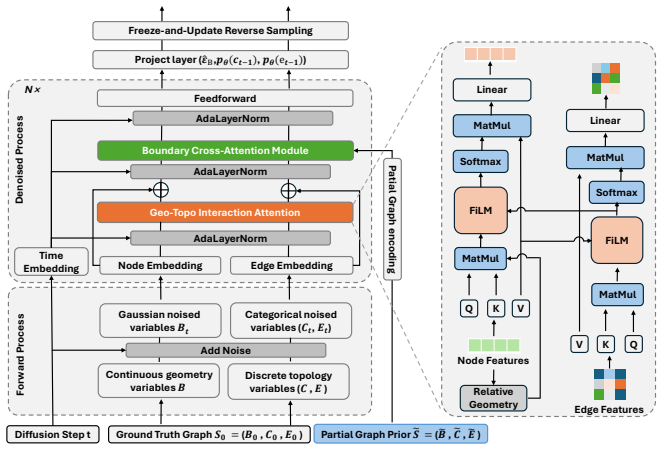
GeoTopoDiff transfers the learning of diffusion priors from a voxel-based space to a mixed graph state space, which simultaneously encompasses continuous pore geometry and discrete pore-throat topology. A topology-aware partial graph prior from sparsely observed CT slices is introduced to constrain the reverse denoising process and produce topologically faithful 3D reconstructions.
What carries the argument
Mixed graph state space that combines continuous pore geometry with discrete pore-throat topology, constrained by a topology-aware partial graph prior from sparse slices.
If this is right
- Morphology-related reconstruction errors fall by 19.8 percent on average.
- Topology-sensitive transport errors fall by 36.5 percent on average.
- The approach supports larger fields of view and higher throughput by requiring fewer full CT scans.
- Posterior uncertainty during denoising is reduced when observations are sparse.
- Public models and code enable further work on 3D porous microstructure simulation.
Where Pith is reading between the lines
- The same mixed-space idea could apply to reconstructing other 3D structures where both shape and connectivity matter, such as vascular networks or fracture patterns.
- Accurate topology preservation may improve downstream fluid-flow simulations in batteries, filters, or geological reservoirs.
- Experiments with varying slice counts could determine the minimum number of observations needed for reliable results.
- Automatic extraction of the partial graph prior might further reduce manual steps in the pipeline.
Load-bearing premise
A graph of pore connections taken from only a few CT slices can guide the generation of the complete 3D pore network while keeping connections accurate.
What would settle it
Reconstruct a held-out porous sample from sparse slices, then compare its measured fluid permeability or diffusion coefficient to the value computed from the generated topology to check whether errors fall within the reported 36.5 percent reduction.
Figures



read the original abstract
Diffusion-based voxel prior modelling is challenging for the reconstruction of large-scale 3D porous microstructures. Due to the demanding requirements for simultaneously modelling both the continuous pore morphology and the discrete pore-throat topology, the diffusion models require fully observed CT scans to provide topology-faithful priors, which results in an inherent trade-off among throughput, topological fidelity, and field of view in practical industrial applications. We propose GeoTopoDiff, a graph diffusion-based framework for reconstructing 3D porous microstructures from sparse CT slices. GeoTopoDiff transfers the learning of diffusion priors from a voxel-based space to a mixed graph state space, which simultaneously encompasses continuous pore geometry and discrete pore-throat topology. A topology-aware partial graph prior from sparsely observed CT slices is introduced to constrain the reverse denoising process. Experiments on anisotropic PTFE and Fontainebleau sandstone show that GeoTopoDiff reduces morphology-related errors by 19.8% and topology-sensitive transport errors by 36.5% on average. Our findings suggest that the mixed graph state space promotes the diffusion denoising process to reduce posterior uncertainty under a sparse observations. All models and code have been made publicly available to facilitate the exploration of diffusion models in the field of 3D porous microstructures simulation.
Editorial analysis
A structured set of objections, weighed in public.
Referee Report
Summary. The paper introduces GeoTopoDiff, a graph diffusion framework that reconstructs 3D porous microstructures from sparse CT slices by operating in a mixed graph state space combining continuous pore geometry and discrete pore-throat topology. It extracts a topology-aware partial graph prior from the observed slices and uses boundary constraints to guide the reverse denoising process. Experiments on anisotropic PTFE and Fontainebleau sandstone report average reductions of 19.8% in morphology-related errors and 36.5% in topology-sensitive transport errors, with all models and code released publicly.
Significance. If the central claims hold, the work could meaningfully advance practical 3D imaging of porous media in materials science and industrial applications by reducing reliance on dense CT scans while attempting to preserve topology relevant to transport properties. The public code release is a clear strength for reproducibility, and the mixed graph formulation offers a principled way to handle the hybrid continuous-discrete nature of pore networks.
major comments (3)
- [Abstract] Abstract: the reported 19.8% morphology and 36.5% transport error reductions are presented without naming the baseline methods, the exact definitions of the error metrics (e.g., which morphological descriptors or transport simulations), the number of samples, or any statistical tests. These omissions are load-bearing for the claim that the topology prior drives the gains.
- [Method] Method section (graph prior construction): the topology-aware partial graph prior is extracted from sparse 2D slices and asserted to constrain the mixed diffusion reverse process, yet no analysis shows how local 2D-derived edges enforce global 3D pore-throat connectivity. For anisotropic PTFE this risks the 36.5% transport improvement being driven by the geometry component or test-set statistics rather than faithful topology recovery.
- [Experiments] Experiments section: the comparison between anisotropic PTFE and isotropic Fontainebleau sandstone does not include an ablation isolating the partial graph prior from the mixed diffusion alone, leaving open whether the topology-sensitive error drop is attributable to the claimed prior or to other modeling choices.
minor comments (2)
- [Abstract] Abstract, final sentence: 'under a sparse observations' is grammatically incorrect and should read 'under sparse observations'.
- [Experiments] The manuscript would benefit from a short table summarizing the exact slice spacing, field of view, and voxel resolution used in the sparse observations for both materials.
Simulated Author's Rebuttal
We thank the referee for their constructive feedback and positive assessment of the work's potential significance. We address each major comment point by point below and will revise the manuscript accordingly to improve clarity and rigor.
read point-by-point responses
-
Referee: [Abstract] Abstract: the reported 19.8% morphology and 36.5% transport error reductions are presented without naming the baseline methods, the exact definitions of the error metrics (e.g., which morphological descriptors or transport simulations), the number of samples, or any statistical tests. These omissions are load-bearing for the claim that the topology prior drives the gains.
Authors: We agree that the abstract would benefit from greater specificity to support the claims. In the revised version, we will name the baseline methods (voxel-based diffusion and mixed graph diffusion without the topology prior), define the morphology metrics (porosity, specific surface area, and pore-size distribution) and transport metrics (permeability via lattice-Boltzmann simulation), state the number of test samples (10 per material), and note that the reported reductions are averages with standard deviations provided in the main text. This will make the quantitative claims self-contained. revision: yes
-
Referee: [Method] Method section (graph prior construction): the topology-aware partial graph prior is extracted from sparse 2D slices and asserted to constrain the mixed diffusion reverse process, yet no analysis shows how local 2D-derived edges enforce global 3D pore-throat connectivity. For anisotropic PTFE this risks the 36.5% transport improvement being driven by the geometry component or test-set statistics rather than faithful topology recovery.
Authors: We appreciate this observation. The method constructs the partial graph by extracting 2D pore graphs and propagating connectivity via boundary constraints during denoising, but we acknowledge the absence of explicit global-connectivity analysis. In revision we will add quantitative verification (e.g., Euler number, connected-component count, and throat-length statistics) comparing reconstructions with and without the prior against ground truth, thereby demonstrating that 2D-derived edges enforce 3D topology and contribute to the transport-error reduction. revision: yes
-
Referee: [Experiments] Experiments section: the comparison between anisotropic PTFE and isotropic Fontainebleau sandstone does not include an ablation isolating the partial graph prior from the mixed diffusion alone, leaving open whether the topology-sensitive error drop is attributable to the claimed prior or to other modeling choices.
Authors: We agree that an explicit ablation would strengthen attribution. We will add an ablation study in the experiments section that disables the topology-aware partial-graph constraint (retaining only the mixed graph diffusion) and reports the resulting morphology and transport errors for both materials. This will isolate the prior's contribution to the topology-sensitive error reductions. revision: yes
Circularity Check
No significant circularity detected
full rationale
The abstract and available context describe a data-driven learning process for graph priors in a mixed geometry-topology state space, with the partial graph extracted from sparse slices used to constrain diffusion. No equations, self-definitional reductions, fitted inputs renamed as predictions, or load-bearing self-citations are present in the provided text. The reported error reductions are framed as experimental outcomes from the proposed framework rather than tautological consequences of the inputs. The derivation chain appears self-contained, relying on external data and standard diffusion mechanics without internal circularity.
Axiom & Free-Parameter Ledger
Reference graph
Works this paper leans on
-
[1]
Advances in Water Resources , volume =
Pore-Scale Imaging and Modelling , author =. Advances in Water Resources , volume =. 2013 , doi =
2013
-
[2]
Advances in Water Resources , volume=
X-ray imaging and analysis techniques for quantifying pore-scale structure and processes in subsurface porous medium systems , author=. Advances in Water Resources , volume=. 2013 , publisher=
2013
-
[3]
2002 , doi =
Random Heterogeneous Materials: Microstructure and Macroscopic Properties , author =. 2002 , doi =
2002
-
[4]
Reconstructing Random Media. II. Three-Dimensional Media from Two-Dimensional Cuts , author =. Physical Review E , volume =. 1998 , doi =
1998
-
[5]
Progress in Materials Science , volume =
Computational Microstructure Characterization and Reconstruction: Review of the State-of-the-Art Techniques , author =. Progress in Materials Science , volume =. 2018 , doi =
2018
-
[6]
Physical Review E , volume =
Reconstruction of Three-Dimensional Porous Media Using Generative Adversarial Neural Networks , author =. Physical Review E , volume =. 2017 , doi =
2017
-
[7]
Transport in Porous Media , volume =
Stochastic Reconstruction of an Oolitic Limestone by Generative Adversarial Networks , author =. Transport in Porous Media , volume =. 2018 , doi =
2018
-
[8]
Nature Machine Intelligence , volume =
Generating Three-Dimensional Structures from a Two-Dimensional Slice with Generative Adversarial Network-Based Dimensionality Expansion , author =. Nature Machine Intelligence , volume =. 2021 , doi =
2021
-
[9]
Computational Materials Science , volume=
Generative adversarial networks for reconstructing 3D porous media from 2D images , author=. Computational Materials Science , volume=
-
[10]
Computer Methods in Applied Mechanics and Engineering , volume=
An end-to-end three-dimensional reconstruction framework of porous media from a single two-dimensional image based on deep learning , author=. Computer Methods in Applied Mechanics and Engineering , volume=
-
[11]
Computational Materials Science , volume=
Slice-to-voxel stochastic reconstructions on porous media with hybrid deep generative model , author=. Computational Materials Science , volume=
-
[12]
Physical Review E , volume =
Generative Adversarial Networks for Reconstruction of Three-Dimensional Porous Media from Two-Dimensional Slices , author =. Physical Review E , volume =. 2022 , doi =
2022
-
[13]
Computer Methods in Applied Mechanics and Engineering , volume=
Hierarchical reconstruction of 3D well-connected porous media from 2D exemplars using statistics-informed neural networks , author=. Computer Methods in Applied Mechanics and Engineering , volume=
-
[14]
Advances in Neural Information Processing Systems , volume =
Denoising Diffusion Probabilistic Models , author =. Advances in Neural Information Processing Systems , volume =
-
[15]
Advances in Neural Information Processing Systems , volume =
Structured Denoising Diffusion Models in Discrete State-Spaces , author =. Advances in Neural Information Processing Systems , volume =
-
[16]
npj Computational Materials , volume =
Multi-Plane Denoising Diffusion-Based Dimensionality Expansion for 2D-to-3D Reconstruction of Microstructures with Harmonized Sampling , author =. npj Computational Materials , volume =. 2024 , doi =
2024
-
[17]
Computational Materials Science , volume=
A diffusion-model-based framework for microstructure reconstruction , author=. Computational Materials Science , volume=
-
[18]
2015 , publisher=
Ronneberger, Olaf and Fischer, Philipp and Brox, Thomas , booktitle=. 2015 , publisher=
2015
-
[19]
Perez, Ethan and Strub, Florian and de Vries, Harm and Dumoulin, Vincent and Courville, Aaron , booktitle=
-
[20]
Journal of Contaminant Hydrology , volume =
Review of Pore Network Modelling of Porous Media: Experimental Characterisations, Network Constructions and Applications to Reactive Transport , author =. Journal of Contaminant Hydrology , volume =. 2016 , doi =
2016
-
[21]
International Conference on Machine Learning , pages=
Self-attention generative adversarial networks , author=. International Conference on Machine Learning , pages=
-
[22]
Nature Reviews Methods Primers , volume=
X-ray computed tomography , author=. Nature Reviews Methods Primers , volume=. 2021 , doi=
2021
-
[23]
Earth-Science Reviews , volume=
High-resolution X-ray computed tomography in geosciences: A review of the current technology and applications , author=. Earth-Science Reviews , volume=. 2013 , doi=
2013
-
[24]
International Conference on Learning Representations , year =
Diffusion Posterior Sampling for General Noisy Inverse Problems , author =. International Conference on Learning Representations , year =
-
[25]
Proceedings of the IEEE/CVF Conference on Computer Vision and Pattern Recognition , pages =
Solving 3D Inverse Problems Using Pre-Trained 2D Diffusion Models , author =. Proceedings of the IEEE/CVF Conference on Computer Vision and Pattern Recognition , pages =
-
[26]
International Conference on Learning Representations , year =
Decomposed Diffusion Sampler for Accelerating Large-Scale Inverse Problems , author =. International Conference on Learning Representations , year =
-
[27]
Proceedings of the IEEE/CVF International Conference on Computer Vision , pages =
Improving 3D Imaging with Pre-Trained Perpendicular 2D Diffusion Models , author =. Proceedings of the IEEE/CVF International Conference on Computer Vision , pages =
-
[28]
Advances in Neural Information Processing Systems , volume =
DiffusionBlend: Learning 3D Image Prior through Position-Aware Diffusion Score Blending for 3D Computed Tomography Reconstruction , author =. Advances in Neural Information Processing Systems , volume =
-
[30]
Developments in X-Ray Tomography XIV , volume=
CoCoDiff: A Contextual Conditional Diffusion Model for Low-Dose CT Image Denoising , author=. Developments in X-Ray Tomography XIV , volume=. 2022 , organization=
2022
-
[31]
IEEE Transactions on Medical Imaging , volume=
CoreDiff: Contextual Error-Modulated Generalized Diffusion Model for Low-Dose CT Denoising and Generalization , author=. IEEE Transactions on Medical Imaging , volume=. 2024 , doi=
2024
-
[32]
Medical Physics , volume=
Diffusion Probabilistic Priors for Zero-Shot Low-Dose CT Image Denoising , author=. Medical Physics , volume=. 2025 , doi=
2025
-
[33]
Journal of Medical Imaging , volume=
CT Reconstruction Using Diffusion Posterior Sampling Conditioned on a Nonlinear Measurement Model , author=. Journal of Medical Imaging , volume=. 2024 , doi=
2024
-
[34]
IEEE Transactions on Medical Imaging , volume=
Solving Zero-Shot Sparse-View CT Reconstruction With Variational Score Solver , author=. IEEE Transactions on Medical Imaging , volume=. 2025 , doi=
2025
-
[35]
IEEE Transactions on Medical Imaging , volume=
Domain Progressive Low-Dose CT Imaging Using Iterative Partial Diffusion Model , author=. IEEE Transactions on Medical Imaging , volume=. 2025 , doi=
2025
-
[36]
Geoenergy Science and Engineering , volume =
Reconstruction of 3D Digital Rocks with Controllable Porosity Using CVAE-GAN , author =. Geoenergy Science and Engineering , volume =. 2023 , doi =
2023
-
[37]
Scientific Reports , volume =
Microstructure Reconstruction of 2D/3D Random Materials via Diffusion-Based Deep Generative Models , author =. Scientific Reports , volume =. 2024 , doi =
2024
-
[38]
Proceedings of the 39th International Conference on Machine Learning , series =
Score-Based Generative Modeling of Graphs via the System of Stochastic Differential Equations , author =. Proceedings of the 39th International Conference on Machine Learning , series =. 2022 , url =
2022
-
[39]
International Conference on Learning Representations , year =
DiGress: Discrete Denoising Diffusion for Graph Generation , author =. International Conference on Learning Representations , year =
-
[40]
International Conference on Learning Representations , year =
GeoDiff: A Geometric Diffusion Model for Molecular Conformation Generation , author =. International Conference on Learning Representations , year =
-
[41]
Proceedings of the IEEE/CVF Conference on Computer Vision and Pattern Recognition , pages=
Microdiffusion: Implicit representation-guided diffusion for 3d reconstruction from limited 2d microscopy projections , author=. Proceedings of the IEEE/CVF Conference on Computer Vision and Pattern Recognition , pages=
-
[42]
The Twelfth International Conference on Learning Representations , year=
Latent 3d graph diffusion , author=. The Twelfth International Conference on Learning Representations , year=
-
[43]
Simulation of stratified two-phase flow regime using air-water model in ANSYS Fluent
Monachan, Binet and Thomas, Rijo J and Steaphen, Deepak and Skaria, Mathew and Shafi, KA , booktitle=. Simulation of stratified two-phase flow regime using air-water model in ANSYS Fluent. 2019 , organization=
2019
-
[44]
Johnson, Jonathan Ho, Daniel Tarlow, and Rianne van den Berg
Jacob Austin, Daniel D. Johnson, Jonathan Ho, Daniel Tarlow, and Rianne van den Berg. Structured denoising diffusion models in discrete state-spaces. In Advances in Neural Information Processing Systems, volume 34, pages 17981--17993, 2021
2021
-
[45]
Martin J. Blunt, Branko Bijeljic, Hu Dong, Oussama Gharbi, Stefan Iglauer, Peyman Mostaghimi, Adriana Paluszny, and Christopher Pentland. Pore-scale imaging and modelling. Advances in Water Resources, 51: 0 197--216, 2013. doi:10.1016/j.advwatres.2012.03.003
-
[46]
Ramin Bostanabad, Yichi Zhang, Xiaolin Li, Tucker Kearney, L. Catherine Brinson, Daniel W. Apley, Wing Kam Liu, and Wei Chen. Computational microstructure characterization and reconstruction: Review of the state-of-the-art techniques. Progress in Materials Science, 95: 0 1--41, 2018. doi:10.1016/j.pmatsci.2018.01.005
-
[47]
Reconstruction of 3d digital rocks with controllable porosity using cvae-gan
Peng Chi, Jianmeng Sun, Xin Luo, Ruikang Cui, and Huaimin Dong. Reconstruction of 3d digital rocks with controllable porosity using cvae-gan. Geoenergy Science and Engineering, 230: 0 212264, 2023. doi:10.1016/j.geoen.2023.212264
-
[48]
McCann, Marc L
Hyungjin Chung, Jeongsol Kim, Michael T. McCann, Marc L. Klasky, and Jong Chul Ye. Diffusion posterior sampling for general noisy inverse problems. In International Conference on Learning Representations, 2023 a . URL https://openreview.net/forum?id=OnD9zGAGT0k
2023
-
[49]
McCann, Marc L
Hyungjin Chung, Dohoon Ryu, Michael T. McCann, Marc L. Klasky, and Jong Chul Ye. Solving 3d inverse problems using pre-trained 2d diffusion models. In Proceedings of the IEEE/CVF Conference on Computer Vision and Pattern Recognition, pages 22542--22551, 2023 b
2023
-
[50]
Decomposed diffusion sampler for accelerating large-scale inverse problems
Hyungjin Chung, Suhyeon Lee, and Jong Chul Ye. Decomposed diffusion sampler for accelerating large-scale inverse problems. In International Conference on Learning Representations, 2024. URL https://openreview.net/forum?id=DsEhqQtfAG
2024
-
[51]
Veerle Cnudde and Matthieu N. Boone. High-resolution x-ray computed tomography in geosciences: A review of the current technology and applications. Earth-Science Reviews, 123: 0 1--17, 2013. doi:10.1016/j.earscirev.2013.04.003
-
[52]
Hierarchical reconstruction of 3d well-connected porous media from 2d exemplars using statistics-informed neural networks
Yixiang Fu, Shuang Chen, et al. Hierarchical reconstruction of 3d well-connected porous media from 2d exemplars using statistics-informed neural networks. Computer Methods in Applied Mechanics and Engineering, 406: 0 116049, 2023
2023
-
[53]
Cocodiff: A contextual conditional diffusion model for low-dose ct image denoising
Qi Gao and Hongming Shan. Cocodiff: A contextual conditional diffusion model for low-dose ct image denoising. In Developments in X-Ray Tomography XIV, volume 12242, page 122420I. SPIE, 2022. doi:10.1117/12.2634939
-
[54]
Denoising diffusion probabilistic models
Jonathan Ho, Ajay Jain, and Pieter Abbeel. Denoising diffusion probabilistic models. In Advances in Neural Information Processing Systems, volume 33, pages 6840--6851, 2020
2020
-
[55]
Microdiffusion: Implicit representation-guided diffusion for 3d reconstruction from limited 2d microscopy projections
Mude Hui, Zihao Wei, Hongru Zhu, Fei Xia, and Yuyin Zhou. Microdiffusion: Implicit representation-guided diffusion for 3d reconstruction from limited 2d microscopy projections. In Proceedings of the IEEE/CVF Conference on Computer Vision and Pattern Recognition, pages 11460--11469, 2024
2024
-
[56]
Score-based generative modeling of graphs via the system of stochastic differential equations
Jaehyeong Jo, Seul Lee, and Sung Ju Hwang. Score-based generative modeling of graphs via the system of stochastic differential equations. In Proceedings of the 39th International Conference on Machine Learning, volume 162 of Proceedings of Machine Learning Research, pages 10362--10383. PMLR, 2022. URL https://proceedings.mlr.press/v162/jo22a.html
2022
-
[57]
Steve Kench and Samuel J. Cooper. Generating three-dimensional structures from a two-dimensional slice with generative adversarial network-based dimensionality expansion. Nature Machine Intelligence, 3 0 (4): 0 299--305, 2021. doi:10.1038/s42256-021-00322-1
-
[58]
Kang-Hyun Lee and Gun Jin Yun. Multi-plane denoising diffusion-based dimensionality expansion for 2d-to-3d reconstruction of microstructures with harmonized sampling. npj Computational Materials, 10: 0 99, 2024. doi:10.1038/s41524-024-01280-z
-
[59]
Improving 3d imaging with pre-trained perpendicular 2d diffusion models
Suhyeon Lee, Hyungjin Chung, Minyoung Park, Jonghyuk Park, Wi-Sun Ryu, and Jong Chul Ye. Improving 3d imaging with pre-trained perpendicular 2d diffusion models. In Proceedings of the IEEE/CVF International Conference on Computer Vision, pages 10710--10720, 2023
2023
-
[60]
Microstructure reconstruction of 2d/3d random materials via diffusion-based deep generative models
Xianrui Lyu and Xiaodan Ren. Microstructure reconstruction of 2d/3d random materials via diffusion-based deep generative models. Scientific Reports, 14: 0 5041, 2024. doi:10.1038/s41598-024-54861-9
-
[61]
Simulation of stratified two-phase flow regime using air-water model in ansys fluent
Binet Monachan, Rijo J Thomas, Deepak Steaphen, Mathew Skaria, and KA Shafi. Simulation of stratified two-phase flow regime using air-water model in ansys fluent . In Journal of Physics: Conference Series, volume 1355, page 012014. IOP Publishing, 2019
2019
-
[62]
Fessler, and Liyue Shen
Bowen Song, Jason Hu, Zhaoxu Luo, Jeffrey A. Fessler, and Liyue Shen. Diffusionblend: Learning 3d image prior through position-aware diffusion score blending for 3d computed tomography reconstruction. In Advances in Neural Information Processing Systems, volume 37, 2024
2024
-
[63]
Salvatore Torquato. Random Heterogeneous Materials: Microstructure and Macroscopic Properties, volume 16 of Interdisciplinary Applied Mathematics. Springer, New York, 2002. doi:10.1007/978-1-4757-6355-3
-
[64]
Sheppard
Dorthe Wildenschild and Adrian P. Sheppard. X-ray imaging and analysis techniques for quantifying pore-scale structure and processes in subsurface porous medium systems. Advances in Water Resources, 51: 0 217--246, 2013
2013
-
[65]
Withers, Charles Bouman, Simone Carmignato, Veerle Cnudde, Domenico Grimaldi, Chris K
Philip J. Withers, Charles Bouman, Simone Carmignato, Veerle Cnudde, Domenico Grimaldi, Chris K. Hagen, Eric Maire, Marena Manley, Anton Du Plessis, and Stuart R. Stock. X-ray computed tomography. Nature Reviews Methods Primers, 1: 0 18, 2021. doi:10.1038/s43586-021-00015-4
-
[66]
Low-dose ct using denoising diffusion probabilistic model for 20 speedup
Wenjun Xia, Qing Lyu, and Ge Wang. Low-dose ct using denoising diffusion probabilistic model for 20 speedup. arXiv preprint arXiv:2209.15136, 2022
-
[67]
Qingrong Xiong, Todor G. Baychev, and Andrey P. Jivkov. Review of pore network modelling of porous media: Experimental characterisations, network constructions and applications to reactive transport. Journal of Contaminant Hydrology, 192: 0 101--117, 2016. doi:10.1016/j.jconhyd.2016.07.002
-
[68]
Geodiff: A geometric diffusion model for molecular conformation generation
Minkai Xu, Lantao Yu, Yang Song, Chence Shi, Stefano Ermon, and Jian Tang. Geodiff: A geometric diffusion model for molecular conformation generation. In International Conference on Learning Representations, 2022. URL https://openreview.net/forum?id=PzcvxEMzvQC
2022
-
[69]
C. L. Y. Yeong and S. Torquato. Reconstructing random media. ii. three-dimensional media from two-dimensional cuts. Physical Review E, 58 0 (1): 0 224--233, 1998. doi:10.1103/PhysRevE.58.224
-
[70]
Latent 3d graph diffusion
Yuning You, Ruida Zhou, Jiwoong Park, Haotian Xu, Chao Tian, Zhangyang Wang, and Yang Shen. Latent 3d graph diffusion. In The Twelfth International Conference on Learning Representations, 2024
2024
-
[71]
Slice-to-voxel stochastic reconstructions on porous media with hybrid deep generative model
Rui Zhang, Heng Li, et al. Slice-to-voxel stochastic reconstructions on porous media with hybrid deep generative model. Computational Materials Science, 186: 0 110018, 2021
2021
-
[72]
Advances in Water Resources , volume=
Pore-scale imaging and modelling , author=. Advances in Water Resources , volume=. 2013 , publisher=
2013
-
[73]
2002 , publisher=
Random Heterogeneous Materials: Microstructure and Macroscopic Properties , author=. 2002 , publisher=
2002
-
[74]
Yeong, C. L. Y. and Torquato, S. , journal=. Reconstructing random media
-
[75]
Progress in Materials Science , volume=
Computational microstructure characterization and reconstruction: Review of the state-of-the-art techniques , author=. Progress in Materials Science , volume=. 2018 , publisher=
2018
-
[76]
Physical Review E , volume=
Reconstruction of three-dimensional porous media using generative adversarial neural networks , author=. Physical Review E , volume=
-
[77]
Transport in Porous Media , volume=
Stochastic reconstruction of an oolitic limestone by generative adversarial networks , author=. Transport in Porous Media , volume=. 2018 , publisher=
2018
-
[78]
Nature Machine Intelligence , volume=
Generating three-dimensional structures from a two-dimensional slice with generative adversarial network-based dimensionality expansion , author=. Nature Machine Intelligence , volume=
-
[79]
Computational Geosciences , volume=
GAN-based stochastic reconstruction of porous media from two-dimensional images , author=. Computational Geosciences , volume=
-
[80]
Advances in Neural Information Processing Systems , volume=
Denoising diffusion probabilistic models , author=. Advances in Neural Information Processing Systems , volume=
-
[81]
Advances in Neural Information Processing Systems , volume=
Structured denoising diffusion models in discrete state-spaces , author=. Advances in Neural Information Processing Systems , volume=
discussion (0)
Sign in with ORCID, Apple, or X to comment. Anyone can read and Pith papers without signing in.