Recognition: 3 theorem links
· Lean TheoremOn the spin dependence of the emergent gravity phenomena as observed in axially symmetric black hole accretion with spatially varying adiabatic index
Pith reviewed 2026-05-08 18:38 UTC · model grok-4.3
The pith
Acoustic horizons in black hole accretion flows exhibit surface gravity that depends on the central spin.
A machine-rendered reading of the paper's core claim, the machinery that carries it, and where it could break.
Core claim
Steady-state, axisymmetric, low-angular-momentum accretion under a pseudo-Kerr potential yields multi-transonic solutions that may contain a stationary shock. The acoustic geometry associated with these flows contains acoustic black holes at the sonic points and an acoustic white hole at the shock. Surface gravities of the acoustic horizons are computed via a generalized expression incorporating the spatial variation of the sound speed.
What carries the argument
The acoustic metric constructed from the accretion flow's velocity field and local sound speed, which determines the causal structure for linear perturbations and the locations of effective horizons.
If this is right
- The solutions admit multiple sonic points and stationary shocks for appropriate parameter choices.
- Linear stability analysis establishes that the stationary transonic flows are stable against radial perturbations.
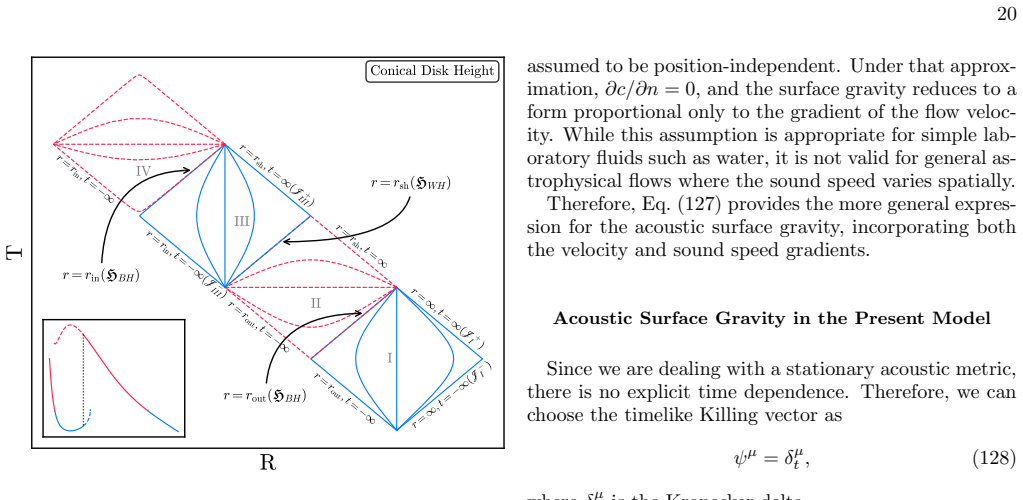
- The Carter-Penrose diagram of the acoustic spacetime reveals the causal structure with black and white hole horizons.
- The surface gravity calculation accounts for position-dependent sound speed and reveals spin dependence.
Where Pith is reading between the lines
- Observable signatures in the light curves or spectra of accreting compact objects could potentially carry information about these effective gravitational effects if the acoustic horizons influence the emitted radiation.
- Similar constructions might be applied to other transonic astrophysical systems to explore emergent causal structures.
- Full general relativistic treatments could be compared to the pseudo-potential results to assess the approximation's accuracy for horizon properties.
Load-bearing premise
The accretion flow remains steady and axisymmetric with low angular momentum, and the pseudo-Kerr potential provides a sufficiently accurate description of the spacetime to locate critical points and define the acoustic metric.
What would settle it
Numerical hydrodynamical simulations of the time-dependent accretion equations for different black hole spin parameters, compared against the analytic surface gravity values, would directly test the predicted spin dependence.
Figures



read the original abstract
The present work addresses an axisymmetrically accreting black hole system from three perspectives: the astrophysical, the dynamical systems, and the emergent gravity standpoint. Steady-state equations governing low angular momentum axially symmetric accretion under a pseudo-Kerr potential are formulated for a multi-species flow with a spatially varying adiabatic index. The resulting transonic solutions are shown to be multi-transonic and may accommodate a stationary shock. Critical points are classified via perturbative dynamical systems methods, and linear stability analysis confirms that the stationary solutions remain stable under radial perturbation. The ensuing acoustic geometry harbours acoustic black holes at the sonic points and an acoustic white hole at the shock location, whose causal structure is constructed via the Carter--Penrose diagram. The surface gravity associated with each acoustic horizon is computed using a generalized expression that accounts for the spatial variation of the local sound speed.
Editorial analysis
A structured set of objections, weighed in public.
Referee Report
Summary. The manuscript formulates steady-state equations for low-angular-momentum, axisymmetric accretion onto black holes under a pseudo-Kerr potential, allowing a spatially varying adiabatic index to model multi-species flow. It obtains multi-transonic solutions that can include stationary shocks, classifies critical points via dynamical-systems methods, performs linear stability analysis under radial perturbations, constructs an acoustic metric with acoustic black holes at sonic points and an acoustic white hole at the shock, presents the causal structure via Carter-Penrose diagrams, and evaluates surface gravities with a generalized expression that incorporates the position-dependent sound speed.
Significance. If the acoustic metric derivation remains valid for non-barotropic flow, the work would usefully extend analog-gravity studies in accretion to more realistic variable-γ cases and could illuminate spin dependence of emergent phenomena. The dynamical-systems classification of critical points and the explicit stability analysis constitute clear technical strengths that ground the astrophysical solutions.
major comments (2)
- [Acoustic geometry and Carter-Penrose diagram] The construction of the acoustic metric (section describing the effective geometry from the continuity and Euler equations) does not demonstrate that the standard wave equation on an effective metric continues to hold when γ = γ(r). With a spatially varying adiabatic index the flow is non-barotropic; the linearization typically introduces entropy-gradient or source terms that can modify the horizon structure and the Carter-Penrose diagram. The manuscript should supply the explicit perturbation equations and the resulting effective metric components, or show why such corrections vanish.
- [Surface-gravity computation] The generalized surface-gravity formula that accounts for varying sound speed is stated without derivation from the acoustic metric (no equation number or explicit limit is given). It is therefore unclear whether the expression follows from the standard κ = (1/2) lim (∇_μ χ^ν ∇_ν χ^μ) / |χ| evaluated on the acoustic horizon or is instead a local redefinition of c_s. The paper must derive the formula from the metric and verify consistency with the horizon classification.
minor comments (2)
- The abstract and introduction refer to 'Carter--Penrose diagram' but the text does not specify the coordinate choice or the precise null geodesics used to construct it; a brief appendix or figure caption clarifying the diagram would improve readability.
- Notation for the position-dependent adiabatic index and sound speed should be introduced once and used consistently; occasional switches between γ(r) and Γ(r) or c_s(r) and a(r) are distracting.
Simulated Author's Rebuttal
We thank the referee for the thorough review and constructive feedback on our manuscript. We address the two major comments below and will revise the paper to incorporate the requested clarifications and derivations.
read point-by-point responses
-
Referee: [Acoustic geometry and Carter-Penrose diagram] The construction of the acoustic metric (section describing the effective geometry from the continuity and Euler equations) does not demonstrate that the standard wave equation on an effective metric continues to hold when γ = γ(r). With a spatially varying adiabatic index the flow is non-barotropic; the linearization typically introduces entropy-gradient or source terms that can modify the horizon structure and the Carter-Penrose diagram. The manuscript should supply the explicit perturbation equations and the resulting effective metric components, or show why such corrections vanish.
Authors: We appreciate the referee highlighting this point. The acoustic metric in the manuscript is obtained by linearizing the continuity and radial Euler equations for the multi-species flow with γ(r) under the pseudo-Kerr potential. Although the flow is non-barotropic, the steady-state background has constant entropy along streamlines, and the irrotational acoustic perturbations yield a wave equation on an effective metric with position-dependent sound speed; entropy-gradient source terms do not appear in the acoustic sector for the radial perturbations considered. To address the concern explicitly, we will add the full linearized perturbation equations, derive the effective metric components step by step, and confirm that no modifications arise to the horizon locations or the Carter-Penrose diagram in the revised manuscript. revision: yes
-
Referee: [Surface-gravity computation] The generalized surface-gravity formula that accounts for varying sound speed is stated without derivation from the acoustic metric (no equation number or explicit limit is given). It is therefore unclear whether the expression follows from the standard κ = (1/2) lim (∇_μ χ^ν ∇_ν χ^μ) / |χ| evaluated on the acoustic horizon or is instead a local redefinition of c_s. The paper must derive the formula from the metric and verify consistency with the horizon classification.
Authors: We agree that the surface-gravity expression requires an explicit derivation. The formula is obtained by applying the standard definition κ = (1/2) lim (∇_μ χ^ν ∇_ν χ^μ) / |χ| to the acoustic metric, with the Killing vector χ constructed from the stationary background and the metric components incorporating the local c_s(r). We will insert the full derivation (including the explicit limit evaluation at each acoustic horizon) and verify consistency with the dynamical-systems classification of critical points and shocks in the revised manuscript. revision: yes
Circularity Check
Derivation chain is self-contained with no circular reductions
full rationale
The paper formulates the governing steady-state equations for axisymmetric low-angular-momentum accretion under a pseudo-Kerr potential for multi-species flow with spatially varying adiabatic index, obtains the transonic solutions (including possible stationary shocks), classifies critical points via dynamical-systems perturbation methods, performs linear stability analysis, constructs the acoustic geometry from those solutions (with acoustic horizons at sonic points and white hole at the shock), and evaluates surface gravity via a generalized expression that incorporates the position-dependent sound speed. No step in the provided abstract or description reduces a claimed result to a fitted parameter renamed as prediction, a self-citation chain, or an ansatz imported by definition; the acoustic-metric construction follows the standard procedure of linearizing the fluid equations around the background flow solution. The potential non-barotropic character of varying-γ flow raises a question of physical consistency but does not constitute circularity in the mathematical derivation chain.
Axiom & Free-Parameter Ledger
axioms (2)
- domain assumption The accretion flow is steady-state, axisymmetric, and possesses low specific angular momentum.
- domain assumption A pseudo-Kerr potential adequately captures the essential relativistic effects for locating sonic points and constructing the acoustic metric.
Lean theorems connected to this paper
-
Foundation.AlexanderDuality / Constants (c=1, ℏ, G as φ-powers)reality_from_one_distinction unclear?
unclearRelation between the paper passage and the cited Recognition theorem.
The surface gravity associated with each acoustic horizon is computed using a generalized expression that accounts for the spatial variation of the local sound speed... κ = (√(1+Φ)/(1−c_s²)) (du/dr − dc_s/dr)|_{r_c}
-
Foundation.ArithmeticFromLogic / Cost.FunctionalEquationwashburn_uniqueness_aczel unclear?
unclearRelation between the paper passage and the cited Recognition theorem.
Critical points are classified via perturbative dynamical systems methods... det J < 0 saddle (inner/outer sonic), det J > 0, Tr J = 0 center (middle).
-
Unification / spacetime emergence certificateRealityCertificate.spacetime_emergence unclear?
unclearRelation between the paper passage and the cited Recognition theorem.
ds² = −(ρ₀/c_{s0})[−c_{s0}²(dx⁰)² + δ_ij(dxⁱ − uⁱdx⁰)(dxʲ − uʲdx⁰)] — acoustic metric for linear perturbations on a Newtonian background.
What do these tags mean?
- matches
- The paper's claim is directly supported by a theorem in the formal canon.
- supports
- The theorem supports part of the paper's argument, but the paper may add assumptions or extra steps.
- extends
- The paper goes beyond the formal theorem; the theorem is a base layer rather than the whole result.
- uses
- The paper appears to rely on the theorem as machinery.
- contradicts
- The paper's claim conflicts with a theorem or certificate in the canon.
- unclear
- Pith found a possible connection, but the passage is too broad, indirect, or ambiguous to say the theorem truly supports the claim.
Reference graph
Works this paper leans on
-
[1]
are the three components of the back- ground velocityu 0. B. Analogue Gravity Metric The general propagation equation for a massless scalar field is given by: ∂µ √−g gµν∂νϕ = 0 (74) Comparing (72) with (74) we get, f µν = √−g gµν (75) withg=det(g µν). A simple algebraic manipulation leads us to the relation det (fµν) =g(76) Exploiting (73) and (76), we fo...
-
[2]
Theouter acoustic black hole horizonB out BH at r=x out, where the outgoing family of null rays is momentarily frozen
-
[3]
Theacoustic white hole horizonB W H atr= rsh, across which acoustic perturbations can only emerge (from the compressed post-shock region) but cannot enter
-
[4]
Theinner acoustic black hole horizonB in BH at r=x in, which irreversibly captures all inward- propagating perturbations. Tortoise Coordinate and Null Coordinates To resolve the coordinate singularity at each acoustic horizon and construct the global extension, we introduce the acoustic tortoise coordinater ∗ defined by dr∗ dr = 1 c2 s0 −u 2 0 .(120) 19 T...
-
[5]
(122) remains finite and non-zero at r=r c; the horizon corresponds to the locus eUc = 0 (fu- ture horizon) oreVc = 0 (past horizon), and the metric ex- tends smoothly across both
in Eq. (122) remains finite and non-zero at r=r c; the horizon corresponds to the locus eUc = 0 (fu- ture horizon) oreVc = 0 (past horizon), and the metric ex- tends smoothly across both. An acoustic black hole hori- zon admits only the future branch ( eUc = 0), whereas an acoustic white hole horizon admits only the past branch (eVc = 0). Carter–Penrose D...
-
[6]
E. P. T. Liang and K. A. Thompson, Astrophys. J.240, 271 (1980)
1980
-
[7]
M. A. Abramowicz and W. H. Zurek, Astrophys. J.246, 314 (1981)
1981
-
[8]
Fukue, Publ
J. Fukue, Publ. Astron. Soc. Jpn.35, 355 (1983)
1983
-
[9]
J. F. Lu, Astron. Astrophys.148, 176 (1985)
1985
-
[10]
J. F. Lu, Gen. Relativ. Gravit.18, 45 (1986)
1986
-
[11]
Fukue, Publ
J. Fukue, Publ. Astron. Soc. Jpn.39, 309 (1987)
1987
-
[12]
O. M. Blaes, Mon. Not. R. Astron. Soc.227, 975 (1987)
1987
-
[13]
S. K. Chakrabarti, Astrophys. J.347, 365 (1989)
1989
-
[14]
S. K. Chakrabarti,Theory of Transonic Astrophysical Flows(1990). 22
1990
-
[15]
Nakayama, Mon
K. Nakayama, Mon. Not. R. Astron. Soc.270, 871 (1994)
1994
-
[16]
Yang and M
R. Yang and M. Kafatos, Astron. Astrophys.295, 238 (1995)
1995
-
[17]
S. K. Chakrabarti, Mon. Not. R. Astron. Soc.283, 325 (1996)
1996
-
[18]
V. I. Pariev, Mon. Not. R. Astron. Soc.283, 1264 (1996)
1996
-
[19]
F. Y. J. F. Lu, K. N. Yu and E. C. M. Young, Astron. Astrophys.321, 665 (1997)
1997
-
[20]
Peitz and S
J. Peitz and S. Appl, Mon. Not. R. Astron. Soc.286, 681 (1997)
1997
- [21]
-
[22]
T. K. D. P. Barai and P. J. Wiita, Astrophys. J. Lett. 613, L49 (2004)
2004
-
[23]
Takahashi, Mon
R. Takahashi, Mon. Not. R. Astron. Soc.382, 567 (2007)
2007
-
[24]
Nagakura and S
H. Nagakura and S. Yamada, Astrophys. J.689, 391 (2008)
2008
-
[25]
Nagakura and S
H. Nagakura and S. Yamada, Astrophys. J.696, 2026 (2009)
2026
-
[26]
T. K. Das and B. Czerny, New Astron.17, 254 (2012)
2012
-
[27]
Kumar, C
R. Kumar, C. B. Singh, I. Chattopadhyay, and S. K. Chakrabarti, Monthly Notices of the Royal Astronomical Society436, 2864 (2013)
2013
-
[28]
R. Kumar and I. Chattopadhyay, Mon. Not. R. Astron. Soc.443, 3444 (2014), arXiv:1407.2130 [astro-ph.HE]
-
[29]
Tarafdar and T
P. Tarafdar and T. K. Das, Int. J. Mod. Phys. D24, 1550096 (2015)
2015
-
[30]
Sukov´ a and A
P. Sukov´ a and A. Janiuk, J. Phys. Conf. Ser.600, 012012 (2015)
2015
-
[31]
I. Chattopadhyay and R. Kumar, Mon. Not. R. Astron. Soc.459, 3792 (2016), arXiv:1605.00752 [astro-ph.HE]
-
[32]
T. Le, K. S. Wood, M. T. Wolff, P. A. Becker, and J. Put- ney, Astrophys. J.819, 112 (2016)
2016
-
[33]
Sukov´ a, S
P. Sukov´ a, S. Charzy´ nski, and A. Janiuk, Mon. Not. R. Astron. Soc.472, 4327 (2017)
2017
-
[34]
Kumar and I
R. Kumar and I. Chattopadhyay, Monthly No- tices of the Royal Astronomical Society469, 4221 (2017), https://academic.oup.com/mnras/article- pdf/469/4/4221/17715028/stx1091.pdf
2017
-
[35]
Palit, A
I. Palit, A. Janiuk, and P. Sukova, Mon. Not. R. Astron. Soc.487, 755 (2019)
2019
-
[36]
Palit, A
I. Palit, A. Janiuk, and B. Czerny, Astrophys. J.904, 21 (2020)
2020
- [37]
-
[38]
Tarafdar, S
P. Tarafdar, S. Maity, and T. K. Das, Phys. Rev. D103, 023023 (2021)
2021
-
[39]
S. Sarkar and I. Chattopadhyay, International Journal of Modern Physics D28, 1950037 (2019), arXiv:1811.05947 [astro-ph.HE]
- [40]
-
[41]
I. Chattopadhyay and D. Ryu, Astrophys. J.694, 492 (2009), arXiv:0812.2607 [astro-ph]
-
[42]
Barcel´ o, S
C. Barcel´ o, S. Liberati, and M. Visser, Living Reviews in Relativity14, 3 (2011)
2011
-
[43]
M. A. Shaikh, I. Firdousi, and T. K. Das, Classical and Quantum Gravity34, 155008 (2017)
2017
-
[44]
Tarafdar, D
P. Tarafdar, D. A. Bollimpalli, S. Nag, and T. K. Das, Phys. Rev. D100, 043024 (2019)
2019
-
[45]
Maity, M
S. Maity, M. A. Shaikh, P. Tarafdar, and T. K. Das, Phys. Rev. D106, 044062 (2022)
2022
-
[46]
I. V. Artemova, G. Bjoernsson, and I. D. Novikov, As- trophys. J.461, 565 (1996)
1996
-
[47]
Dhruv, B
V. Dhruv, B. Prather, G. N. Wong, and C. F. Gam- mie, The Astrophysical Journal Supplement Series277, 16 (2025)
2025
-
[48]
Porthet al., The Astrophysical Journal Supplement Series243, 26 (2019)
O. Porthet al., The Astrophysical Journal Supplement Series243, 26 (2019)
2019
-
[49]
Mitra and S
S. Mitra and S. Das, The Astrophysical Journal971, 28 (2024)
2024
-
[50]
Sharma, L
A. Sharma, L. Medeiros, G. N. Wong, C.-k. Chan, G. Halevi, P. D. Mullen, and J. M. Stone, The Astro- physical Journal985, 40 (2025)
2025
-
[51]
Dexter, Monthly Notices of the Royal Astronomical Society462, 115 (2016), https://academic.oup.com/mnras/article- pdf/462/1/115/18469081/stw1526.pdf
J. Dexter, Monthly Notices of the Royal Astronomical Society462, 115 (2016), https://academic.oup.com/mnras/article- pdf/462/1/115/18469081/stw1526.pdf
2016
-
[52]
J. D. Schnittman and J. H. Krolik, The Astrophysical Journal777, 11 (2013)
2013
-
[53]
Z. Hu, Y. Hou, H. Yan, M. Guo, and B. Chen, The Eu- ropean Physical Journal C82, 1166 (2022)
2022
-
[54]
Y. Zhu, R. Narayan, A. Sadowski, and D. Psaltis, Monthly Notices of the Royal Astronomical Society451, 1661 (2015), https://academic.oup.com/mnras/article- pdf/451/2/1661/5705021/stv1046.pdf
2015
-
[55]
P. Pihajoki, A. Rantala, and P. H. Johansson, inNew Frontiers in Black Hole Astrophysics, IAU Symposium, Vol. 324, edited by A. Gomboc (2017) pp. 347–350, arXiv:1612.02828 [astro-ph.IM]
-
[56]
R. V. Shcherbakov and L. Huang, Monthly No- tices of the Royal Astronomical Society410, 1052 (2011), https://academic.oup.com/mnras/article- pdf/410/2/1052/3438342/mnras0410-1052.pdf
2011
-
[57]
S. K. Chakrabarti and R. Khanna, Mon. Not. R. Astron. Soc.256, 300 (1992)
1992
-
[58]
Løv˚ as, International Journal of Modern Physics D7, 471 (1998)
T. Løv˚ as, International Journal of Modern Physics D7, 471 (1998)
1998
-
[59]
O. Semer´ ak and V. Karas, Astron. Astrophys.343, 325 (1999), arXiv:astro-ph/9901289 [astro-ph]
work page internal anchor Pith review arXiv 1999
-
[60]
Mukhopadhyay, The Astrophysical Journal581, 427 (2002)
B. Mukhopadhyay, The Astrophysical Journal581, 427 (2002)
2002
-
[61]
S. K. Chakrabarti and S. Mondal, Monthly No- tices of the Royal Astronomical Society369, 976 (2006), https://academic.oup.com/mnras/article- pdf/369/2/976/11182178/mnras0369-0976.pdf
2006
-
[62]
Ghosh and B
S. Ghosh and B. Mukhopadhyay, The Astrophysical Journal667, 367 (2007)
2007
-
[63]
Ghosh, T
S. Ghosh, T. Sarkar, and A. Bhadra, Monthly Notices of the Royal Astronomical Society445, 4460–4476 (2014)
2014
-
[64]
V. Karas and M. A. Abramowicz, inProceedings of RAG- time 10-13: Workshops on black holes and neutron stars (2014) pp. 121–128, arXiv:1412.6832 [astro-ph.HE]
-
[65]
S. K. Chakrabarti and S. Das, Monthly Notices of the Royal Astronomical Society327, 808 (2001), https://onlinelibrary.wiley.com/doi/pdf/10.1046/j.1365- 8711.2001.04758.x
-
[66]
S. Nag, S. Acharya, A. K. Ray, and T. K. Das, New Astronomy17, 285 (2012)
2012
-
[67]
Bili´ c, A
N. Bili´ c, A. Choudhary, T. K. Das, and S. Nag, Classical and Quantum Gravity31, 035002 (2013)
2013
-
[68]
I. Hubeny and V. Hubeny, Astrophys. J.505, 558 (1998), arXiv:astro-ph/9804288 [astro-ph]. 23
- [69]
-
[70]
V. S. Beskin, Physics Uspekhi40, 659 (1997)
1997
-
[71]
Beskin and A
V. Beskin and A. Tchekhovskoy, Astronomy & Astro- physics433, 619–628 (2005)
2005
-
[72]
V. S. Beskin,MHD Flows in Compact Astrophysical Ob- jects: Accretion, Winds and Jets(2009)
2009
-
[73]
S. A. Balbus and J. F. Hawley, Rev. Mod. Phys.70, 1 (1998)
1998
-
[74]
T. Paul, A. Chakraborty, S. Ghose, and T. K. Das, arXiv e-prints , arXiv (2025)
2025
-
[75]
Bondi, Mon
H. Bondi, Mon. Not. R. Astron. Soc.112, 195 (1952)
1952
- [76]
-
[77]
W. G. Unruh, Phys. Rev. Lett.46, 1351 (1981)
1981
-
[78]
Visser, Classical and Quantum Gravity15, 1767 (1998)
M. Visser, Classical and Quantum Gravity15, 1767 (1998)
1998
-
[79]
T. K. Das, Classical and Quantum Gravity21, 5253 (2004). Appendix A Here we describe accretion flow dynamics for matter in hydrostatic equilibrium in the vertical direction (V E model) and for matter flow with constant height (CH model). Vertical Equilibrium (V E) model Disk height forV Emodel is given by HV E(r,Θ) =c s r r Γ|FABN| = r 2Θr3−β(r−r +)β τ , ...
2004
discussion (0)
Sign in with ORCID, Apple, or X to comment. Anyone can read and Pith papers without signing in.