Robust certification of high-dimensional quantum devices
Pith reviewed 2026-05-08 16:54 UTC · model grok-4.3
The pith
A prepare-and-measure protocol certifies non-classical behavior in high-dimensional systems by checking rank stability of correlations without any shared entanglement or incompatible measurements.
A machine-rendered reading of the paper's core claim, the machinery that carries it, and where it could break.
Core claim
In a prepare-and-measure scenario the rank-stability analysis of observed correlations certifies non-classicality for high-dimensional quantum states even when noise is present and without requiring preshared entanglement or measurement incompatibility. Experiments performed with orbital angular momentum modes of single photons confirm that the protocol remains robust under realistic conditions.
What carries the argument
Rank-stability analysis applied to the correlation matrix generated in a minimal prepare-and-measure experiment with high-dimensional states.
If this is right
- Quantum communication links can be validated without distributing entanglement or using incompatible measurements.
- Higher-dimensional encodings become practical because the certification scales with the dimension provided by orbital angular momentum.
- Noise-tolerant certification reduces the need for error correction overhead in device testing.
- The same prepare-and-measure structure can support dimension-efficient protocols for quantum information tasks.
- Secure communication systems gain a lightweight verification step that works over distance.
Where Pith is reading between the lines
- The approach may be combined with existing quantum key distribution hardware to add an independent certification layer.
- Similar rank-based tests could be explored for other high-dimensional degrees of freedom such as time-bin or frequency modes.
- If the protocol generalizes, it could lower the experimental barrier for certifying quantum devices in networked settings.
Load-bearing premise
The observed correlations maintain a stable rank that cannot be reproduced by any classical model once noise is taken into account.
What would settle it
An experiment in which the measured correlation matrix exhibits a rank that matches classical bounds while the sender uses genuine high-dimensional quantum states would show the certification procedure fails.
Figures



read the original abstract
Certifying quantum behavior from classically accessible data is essential for secure communication and scalable quantum technologies. While powerful certification methods such as Bell nonlocality and quantum steering exist, their implementation typically requires entanglement or additional assumptions, and experimental demonstrations mainly focus on low-dimensional systems. In minimal prepare-and-measure scenarios, where a sender encodes information into quantum states and a receiver performs a single measurement, robust certification becomes particularly challenging, especially in the presence of noise and in higher-dimensional Hilbert spaces. Here, we propose, design, and experimentally implement a protocol that certifies quantumness between two distant parties without the need for preshared resources or measurement incompatibility. The experiments are carried out using the orbital angular momentum degrees of freedom of single photons, chosen for providing increased dimensionality that is scalable. We demonstrate the robustness of the protocol through rank-stability analysis of the observed correlations, which enables the certification of non-classicality even in the presence of noise. Our results provide a practical route to validate high-dimensional quantum communication systems and open new possibilities for secure and dimension-efficient quantum information processing.
Editorial analysis
A structured set of objections, weighed in public.
Referee Report
Summary. The manuscript proposes, designs, and experimentally implements a prepare-and-measure protocol for certifying quantumness between distant parties using high-dimensional orbital angular momentum (OAM) states of single photons. The protocol requires neither preshared entanglement nor incompatible measurements; non-classicality is certified via rank-stability analysis of the observed correlations, which is shown to remain robust under noise. Experiments demonstrate the approach in a scalable high-dimensional setting.
Significance. If the rank-stability certification holds under the reported noise levels and dimension scaling, the work supplies a minimal-resource route to device-independent validation of high-dimensional quantum channels and sources. This is practically relevant for quantum communication protocols that must operate without entanglement distribution or trusted measurement devices, and the experimental use of OAM photons provides concrete evidence of scalability beyond qubit systems.
minor comments (4)
- [§3.2] §3.2: the definition of the rank-stability threshold is stated in terms of the observed correlation matrix, but the precise numerical cutoff used for certification (and its dependence on the estimated noise level) should be given explicitly rather than left as a reference to the supplementary material.
- [Figure 4] Figure 4: the error bars on the rank-stability curves are not explained in the caption; it is unclear whether they represent statistical fluctuations over repeated measurements or propagated uncertainties from the OAM mode preparation.
- [§5] §5: the discussion of dimension scalability would benefit from a brief statement of the largest Hilbert-space dimension for which the protocol was tested and the corresponding photon-counting statistics.
- [Abstract and §4] The abstract claims 'robust certification ... even in the presence of noise,' yet the main text does not quantify the maximum tolerable noise fraction before the rank-stability criterion fails; adding this bound would strengthen the robustness claim.
Simulated Author's Rebuttal
We thank the referee for the positive evaluation and recommendation of minor revision. No specific major comments were raised in the report, so we have no point-by-point responses. We will incorporate minor revisions to improve clarity, presentation, and any potential ambiguities in the manuscript.
Circularity Check
No significant circularity in rank-stability certification
full rationale
The paper's central derivation proposes a prepare-and-measure protocol whose non-classicality is certified by rank-stability analysis applied directly to experimentally observed correlations in high-dimensional OAM photon states. This chain is self-contained: the certification criterion operates on the measured data matrix rank properties under noise, without reducing any prediction or uniqueness claim to a fitted parameter, self-definition, or load-bearing self-citation. The experimental implementation and robustness demonstration supply independent external content, consistent with the protocol's stated assumptions on minimal resources and dimension scalability.
Axiom & Free-Parameter Ledger
axioms (1)
- domain assumption Quantum correlations in minimal prepare-and-measure scenarios can certify non-classicality without preshared resources or measurement incompatibility using rank-stability analysis.
Reference graph
Works this paper leans on
-
[1]
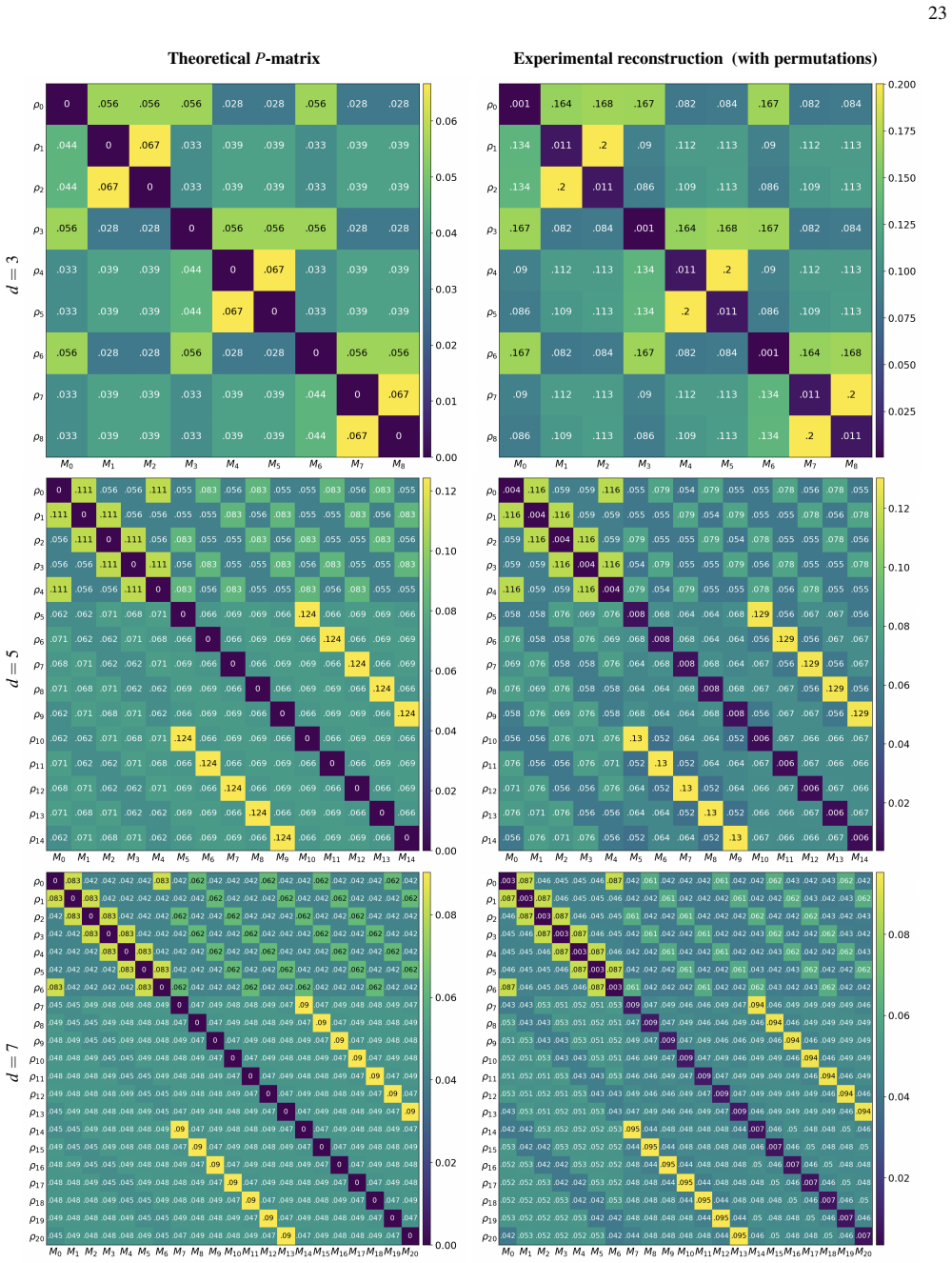
Combined data TheoreticalP-matrix Experimental reconstruction d=3 d=5 d=7 Fig. 6.Experimental results taken for the convex protocol.TheoreticalP-matrices with zeros on the diagonal (left) and their experimentally reconstructed counterparts (right) ford=3,5,7 (top–bottom). The OAM (ℓ)↔qudit mappings (order of|0⟩,|1⟩, . . . ,|6⟩) chosen to minimize ∥E∥2 are...
-
[2]
Coherent TheoreticalP-matrix Experimental reconstruction d=3 d=5 d=7 Fig. 7.Experimental results taken for the coherent protocol.TheoreticalP-matrices with zeros on the diagonal (left) and their experi- mentally reconstructed counterparts (right) ford=3,5,7 (top–bottom). The OAM (ℓ)↔qudit mappings (order of|0⟩,|1⟩, . . . ,|6⟩) chosen to minimize∥E∥ 2 are:...
-
[3]
Incoherent heavy TheoreticalP-matrix Experimental reconstruction d=3 d=5 d=7 Fig. 8.Experimental results taken for the incoherent protocol.TheoreticalP-matrices with zeros on the diagonal (left) and their experi- mentally reconstructed counterparts (right) ford=3,5,7 (top–bottom). The OAM (ℓ)↔qudit mappings (order of|0⟩,|1⟩, . . . ,|6⟩) chosen to minimize...
-
[4]
Maximal TheoreticalP-matrix Experimental reconstruction d=3 d=5 d=7 Fig. 9.Experimental results taken for the maximal protocol.TheoreticalP-matrices with zeros on the diagonal (left) and their experi- mentally reconstructed counterparts (right) ford=3,5,7 (top–bottom). The OAM (ℓ)↔qudit mappings (order of|0⟩,|1⟩, . . . ,|6⟩) chosen to minimize∥E∥ 2 are:P ...
-
[5]
Details A Toptica CTL 780 laser delivering 75 mW at 775.0 nm was focused to a 500 m spot at the entrance face of a 5 mm-long periodically poled KTiOPO 4 (PPKTP) crystal, phase-matched for type-0 spontaneous parametric down-conversion. Residual pump light was removed with an 800 nm long-pass filter, after which the down-converted photons were spectrally cl...
-
[6]
Alignment To align the setup prior to single-photon measurements, we followed two main steps: 1.Back-propagation and spiral-bandwidth metric.We performed a standard back-propagation using a 1550 nm, 50 mW laser. Specifically, a Gaussian beam was injected backward through the fiber normally connected to APD A (see Fig. 3), and the coupled power was measure...
-
[7]
The key idea is to exploit allphysically allowedpermutations of the already chosen qudit basis
Permutations Since Alice and Bob have the freedom to decide which element from the qudit labels(q)corresponds to each element of the OAM labels(ℓ), the reconstructedP-matrix could be passed through a symmetry-based averaging procedure designed to dilute configuration-dependent systematic errors, such as SLM pixel discretization, small but fixed beam misal...
-
[8]
Possible direct implementation In this section, a “triangular interferometer” built from OAM tools that can provide a practical way to perform general three- element POVMs on superpositions of at most two topological charges, without resorting to indirect tomographic reconstruction is presented. A PPBS–waveplate block which serves Bob to send the desired ...
-
[9]
SLMa imprints the state|φ A⟩= (|0⟩+|1⟩)/ √ 2 with diffraction efficiency√ 0.667, while SLM b imprints|φ B⟩= (|2⟩+|−1⟩)/ √ 2 with efficiency √ 0.333. If|φ A⟩and|φ B⟩are orthogonal (as here) the relative phaseδcontrolled by the piezo does not change the output statistics; if they overlap,δis scanned rapidly so that the coherence averages to zero. Blocking o...
-
[10]
Implementation with laser beam For the laser-beam implementation of the setup, a 1550 nm laser with an output power of 50mW replaced the single-photon source. Since coincidence detection was no longer required, the second detection arm was removed, and the two APDs were substituted by a single power meter. This device measured the intensity coupled into t...
-
[11]
Dimension 3 Here we will write explicitly the measurements, to built the intuition behind Eqs. (6), (7) and (8). Bob chooses at random to measure on one of the bases B1 = ( |M0⟩=|0⟩,|M 1⟩= |1⟩+|2⟩√ 2 ,|M 2⟩= |1⟩ − |2⟩√ 2 ) (15) B2 = ( |M3⟩=|1⟩,|M 4⟩= |0⟩+|2⟩√ 2 ,|M 5⟩= |0⟩ − |2⟩√ 2 ) (16) B3 = ( |M6⟩=|2⟩,|M 7⟩= |0⟩+|1⟩√ 2 ,|M 8⟩= |0⟩ − |1⟩√ 2 ) (17) with ...
-
[12]
Dimension 5 First approach:Computational basis measurements repeatd−2 times, coherent superposition measurements do not repeat. B1 = ( |M0⟩=|0⟩,|M 1⟩=|1⟩,|M 2⟩=|2⟩,|M 8⟩= |3⟩+|4⟩√ 2 ,|M 13⟩= |3⟩ − |4⟩√ 2 ) (22) B2 = ( |M1⟩=|1⟩,|M 2⟩=|2⟩,|M 3⟩=|3⟩,|M 9⟩= |4⟩+|0⟩√ 2 ,|M 14⟩= |4⟩ − |0⟩√ 2 ) (23) B3 = ( |M2⟩=|2⟩,|M 3⟩=|3⟩,|M 4⟩=|4⟩,|M 5⟩= |0⟩+|1⟩√ 2 |M10⟩= |0...
-
[13]
Dimension 7 The measurements are performed similarly as for dimensions 3 and 5, merging two approaches with different coherences. The states are given as follows: ρ0 =0.125|2⟩ ⟨2|+0.125|3⟩ ⟨3|+0.125|4⟩ ⟨4|+0.125|5⟩ ⟨5|+0.250|1⟩ ⟨1|+0.250|6⟩ ⟨6| ρ1 =0.125|3⟩ ⟨3|+0.125|4⟩ ⟨4|+0.125|5⟩ ⟨5|+0.125|6⟩ ⟨6|+0.250|0⟩ ⟨0|+0.250|2⟩ ⟨2| ρ2 =0.125|0⟩ ⟨0|+0.125|4⟩ ⟨4|+...
discussion (0)
Sign in with ORCID, Apple, or X to comment. Anyone can read and Pith papers without signing in.