Neural Discovery of Strichartz Extremizers
Pith reviewed 2026-05-08 16:42 UTC · model grok-4.3
The pith
Neural optimization shows mKdV breathers approach the sharp Airy-Strichartz bound without attaining it.
A machine-rendered reading of the paper's core claim, the machinery that carries it, and where it could break.
Core claim
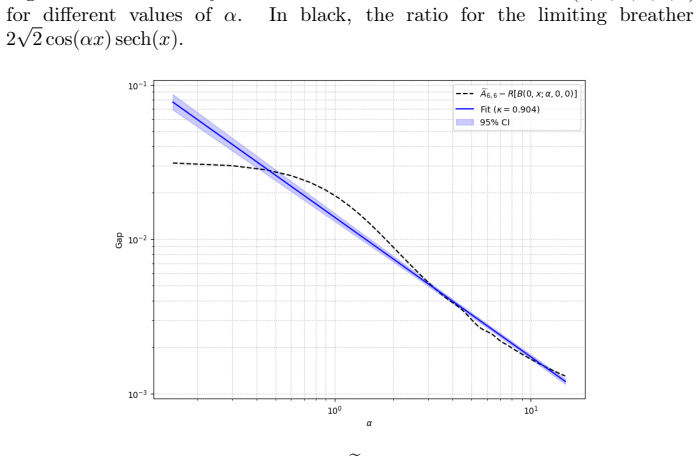
In the critical Airy-Strichartz inequality the optimization does not converge to any L2 profile. Instead the iterates self-organize as mKdV breathers B(0,·;α,1,0,0) with growing frequency α, and the discovered ratio approaches the universal lower bound Ã_{q,r} from below with a gap that scales like α^{-0.9}. The same behavior is recovered with an independent Hermite-basis ansatz. The authors conjecture that the supremum equals Ã_{q,r} and is approached but not attained along this breather family.
What carries the argument
A neural-network pipeline that searches for critical points of the Strichartz ratio functional without analytical priors.
If this is right
- Gaussians are the extremizers for all 59 further admissible Strichartz pairs tested in one dimension.
- The method can serve as a validator for conjectural sharp constants when analytical proofs are unavailable.
- In settings where an extremizer does not exist, the supremum may still be characterized by an asymptotic family of soliton-like objects.
Where Pith is reading between the lines
- Similar numerical pipelines could be used to conjecture the structure of extremizers or their absence in other nonlinear dispersive inequalities.
- Analytical work on the Airy-Strichartz problem might usefully focus on the asymptotic behavior of high-frequency breathers rather than on existence of a fixed profile.
- If the conjecture holds, the Airy-Strichartz inequality would furnish a concrete example where the sharp constant is known but never achieved.
Load-bearing premise
The network iterates reliably locate the relevant minimizing sequences and the observed power-law improvement continues for arbitrarily large breather frequencies.
What would settle it
A direct computation or proof showing that the ratio for breathers eventually stops improving or that some other profile exceeds the Frank-Sabin bound.
Figures




read the original abstract
Strichartz inequalities are a cornerstone of the modern theory of dispersive PDEs, but their extremizers are known explicitly only in a handful of sharp cases. The non-convexity of the underlying functional makes the problem hard, and to our knowledge no systematic numerical attack has been attempted. We propose a simple neural-network-based pipeline that searches for extremizers as critical points of the Strichartz ratio, and apply it in three settings. First, on the Schr\"odinger group we recover the Gaussian extremizers of Foschi and Hundertmark--Zharnitsky in dimensions $d=1,2$ to within $10^{-3}$ relative error, with no analytical prior. Second, on $59$ further admissible pairs in $d=1$ where the answer is conjectural, the method consistently finds Gaussians, supporting the conjecture that Gaussians are the universal extremizers in the admissible range. Third, on the critical Airy--Strichartz inequality at $\gamma=1/q$, where existence is open, the optimization does not converge to any $L^2$ profile: instead, the iterates organize themselves as mKdV breathers $B(0,\cdot;\alpha,1,0,0)$ with growing internal frequency $\alpha$, and the discovered ratio approaches the Frank--Sabin universal lower bound $\widetilde A_{q,r}$ from below with a power-law gap $\sim\alpha^{-0.9}$. We confirm the same picture with an independent Hermite-basis ansatz. We propose a precise conjecture: the supremum equals $\widetilde A_{q,r}$ and is approached, but not attained, along the breather family. The pipeline thus serves both as a validator on known cases and as a discovery tool when no extremizer exists.
Editorial analysis
A structured set of objections, weighed in public.
Referee Report
Summary. The manuscript introduces a neural-network optimization pipeline to numerically locate critical points of the Strichartz ratio functional. It recovers the known Gaussian extremizers for the Schrödinger equation in d=1 and d=2 to relative error ~10^{-3}, obtains consistent Gaussian profiles across 59 additional admissible (q,r) pairs in d=1, and for the critical Airy-Strichartz inequality finds that the iterates organize as mKdV breathers B(0,·;α,1,0,0) whose ratios approach the Frank-Sabin bound Ã_{q,r} from below with an observed gap scaling as ~α^{-0.9}. An independent Hermite-basis ansatz yields the same picture, leading to the conjecture that the supremum equals Ã_{q,r} but is not attained along the breather family.
Significance. If the numerical evidence and extrapolation hold, the work supplies both a practical discovery tool for non-convex extremal problems in dispersive PDEs and a concrete conjecture resolving the open existence question for Airy-Strichartz extremizers. The validation on known cases, cross-check with an independent ansatz, and parameter-free nature of the optimization (no fitted parameters or self-referential definitions) are genuine strengths that could guide future analytical work.
major comments (1)
- [Airy-Strichartz section (breather family B(0,·;α,1,0,0) and associated ratio plots)] The central conjecture (stated in the abstract and elaborated in the Airy-Strichartz discussion) that the supremum equals Ã_{q,r} and is not attained rests on the observed power-law gap ~α^{-0.9} for finite-α breathers. No asymptotic analysis, a-priori estimate, or rigorous justification is supplied showing that this scaling persists as α→∞ or that no other L² sequence can exceed the breather ratios; the functional landscape is non-convex and all computations use finite discretization. This extrapolation is load-bearing for both the identification of the supremum and the non-attainment statement.
minor comments (2)
- [Abstract] The abstract introduces the notation Ã_{q,r} without a brief definition or reference; a parenthetical reminder of the Frank-Sabin universal lower bound would improve readability.
- [Numerical method section] The description of the neural-network pipeline should include explicit statements on the number of independent random initializations, convergence tolerances, and how local minima are distinguished from the reported breathers.
Simulated Author's Rebuttal
We thank the referee for the thoughtful review and for identifying the central role of the Airy-Strichartz conjecture. We address the major comment below, maintaining that the manuscript accurately presents a numerically supported conjecture rather than a theorem.
read point-by-point responses
-
Referee: [Airy-Strichartz section (breather family B(0,·;α,1,0,0) and associated ratio plots)] The central conjecture (stated in the abstract and elaborated in the Airy-Strichartz discussion) that the supremum equals Ã_{q,r} and is not attained rests on the observed power-law gap ~α^{-0.9} for finite-α breathers. No asymptotic analysis, a-priori estimate, or rigorous justification is supplied showing that this scaling persists as α→∞ or that no other L² sequence can exceed the breather ratios; the functional landscape is non-convex and all computations use finite discretization. This extrapolation is load-bearing for both the identification of the supremum and the non-attainment statement.
Authors: We agree that the conjecture is based on numerical extrapolation and that the manuscript supplies no rigorous asymptotic analysis or a-priori estimate. The paper is a computational study whose primary contribution is the discovery, via two independent methods (neural optimization and Hermite-basis ansatz), that the iterates consistently organize as the mKdV breather family B(0,·;α,1,0,0) and that the ratio approaches the Frank-Sabin bound from below with an observed power-law gap. The non-convexity of the functional and the finite discretization are implicit limitations of any numerical approach and are consistent with the framing of the result as a conjecture. We do not claim that the observed scaling persists for all α or that the breather family is the unique maximizing sequence; we only report the empirical behavior and propose the precise statement for future analytical investigation. Because the manuscript already presents the claim as a conjecture rather than a theorem, we see no need to alter the statement itself. revision: no
- Rigorous asymptotic analysis of the breather ratios as α→∞ or a proof that no other L² sequence can exceed the observed ratios.
Circularity Check
No circularity: numerical optimization on the ratio functional yields an observation-based conjecture
full rationale
The paper optimizes the Strichartz ratio directly via neural network (and independent Hermite ansatz) without fitting parameters that are then renamed as predictions. Known cases recover Gaussians to 10^{-3} error with no analytical prior. For the Airy case the iterates organize as mKdV breathers whose ratios approach the externally cited Frank-Sabin bound Ã_{q,r} with observed power-law gap; the conjecture that the supremum equals this bound and is approached but not attained is stated as an inference from the finite-α numerics rather than a self-definitional or fitted-input reduction. No self-citation chain, uniqueness theorem, or ansatz smuggling is load-bearing; the derivation chain remains self-contained against external benchmarks.
Axiom & Free-Parameter Ledger
axioms (2)
- domain assumption The Strichartz ratio functional admits critical points that can be located by gradient-based optimization of a neural-network parametrization.
- standard math Admissible pairs (q,r) for Strichartz inequalities satisfy the usual scaling and Sobolev embedding conditions.
Reference graph
Works this paper leans on
-
[1]
Alejo,Geometric breathers of the mKdV, Acta Appl
M.A. Alejo,Geometric breathers of the mKdV, Acta Appl. Math. 121 (2012), no. 1, 137–155
work page 2012
-
[2]
M.A. Alejo,Focusing mKdV breather solutions with nonvanishing boundary condi- tions by the Inverse Scattering Method, J. Nonlinear Math. Phys. 19 (2012), no. 1, 1250009
work page 2012
-
[3]
Alejo,On the ill-posedness of the Gardner equation, J
M.A. Alejo,On the ill-posedness of the Gardner equation, J. Math. Anal. Appl. 396 (2012), no. 1, 256–260. 13
work page 2012
-
[4]
M.A. Alejo,Dynamics of breathers in the Gardner hierarchy: universality of the variational characterization, Proyecciones 42 (2023), no. 4, 833–860
work page 2023
-
[5]
Alejo,Higher order mKdV breathers: nonlinear stability, to appear in Proyecciones (2024)
M.A. Alejo,Higher order mKdV breathers: nonlinear stability, to appear in Proyecciones (2024)
work page 2024
- [6]
-
[7]
M.A. Alejo and C. Muñoz,Nonlinear stability of mKdV breathers, Commun. Math. Phys. 324 (2013), 233–262
work page 2013
-
[8]
M.A. Alejo and C. Muñoz,An introduction to the mathematics of breathers: basic theory and models, World Scientific,https://doi.org/10.1142/14785
- [9]
-
[10]
G. Bai, U. Koley, S. Mishra, and R. Molinaro,Physics informed neural networks (PINNs) for approximating nonlinear dispersive PDEs, J. Comput. Math. (2022)
work page 2022
-
[11]
J. Bennett, N. Bez, A. Carbery, and D. Hundertmark,Heat-flow monotonicity of Strichartz norms, Anal. PDE 2 (2009), 147–158
work page 2009
-
[12]
N. Bez and K.M. Rogers,A sharp Strichartz estimate for the wave equation with data in the energy space, J. Eur. Math. Soc. (JEMS) 15 (2013), no. 3, 805–823
work page 2013
-
[13]
J. Bourgain,Fourier transform restriction phenomena for certain lattice subsets and applications to nonlinear evolution equations, Geom. Funct. Anal. 3 (1993), 107–156, 209–262
work page 1993
-
[14]
J. Boussinesq,Théorie des ondes et des remous qui se propagent le long d’un canal rectangulaire horizontal, J. Math. Pures Appl. 17 (1872), 55–108
-
[15]
Carneiro,A sharp inequality for the Strichartz norm, Int
E. Carneiro,A sharp inequality for the Strichartz norm, Int. Math. Res. Not. (2009), 3127–3145
work page 2009
-
[16]
Cazenave,Semilinear Schrödinger Equations, Courant Lect
T. Cazenave,Semilinear Schrödinger Equations, Courant Lect. Notes Math., vol. 10, AMS/Courant Inst., New York, 2003
work page 2003
- [17]
-
[18]
G. Chen and J. Liu,Soliton resolution for the focusing modified KdV equation, Ann. Inst. H. Poincaré C, Anal. Non Linéaire 38 (2021), no. 6, 2005–2071
work page 2021
-
[19]
Z. Chen, W. Shi, H. He, and J. Fang,PINN approach for KdV and mKdV equations, preprint (2023)
work page 2023
-
[20]
M. Christ and R. Quilodrán,Gaussians rarely extremize adjoint Fourier restriction inequalities for paraboloids, Proc. Amer. Math. Soc. 142 (2014), 887–896. 14
work page 2014
-
[21]
M. Christ and S. Shao,Existence of extremals for a Fourier restriction inequality, Anal. PDE 5 (2012), no. 2, 261–312
work page 2012
-
[22]
M. Christ and S. Shao,On the extremizers of an adjoint Fourier restriction inequality, Adv. Math. 230 (2012), 957–977
work page 2012
-
[23]
J. Colliander, M. Keel, G. Staffilani, H. Takaoka, and T. Tao,Sharp global well- posedness for KdV and modified KdV onR and T, J. Amer. Math. Soc. 16 (2003), no. 3, 705–749
work page 2003
-
[24]
L.Fanelli, L.Vega, andN.Visciglia,Existence of maximizers for Sobolev–Strichartz inequalities, Adv. Math. 229 (2012), 1912–1923
work page 2012
- [25]
-
[26]
Foschi,Maximizers for the Strichartz inequality, J
D. Foschi,Maximizers for the Strichartz inequality, J. Eur. Math. Soc. 8 (2007), 739–774
work page 2007
-
[27]
D. Foschi and D. Oliveira e Silva,Some recent progress on sharp Fourier restriction theory, Anal. Math. 43 (2017), 241–265
work page 2017
-
[28]
R.L. Frank and J. Sabin,Extremizers for the Airy–Strichartz inequality, Math. Ann. 372 (2018), 1121–1166
work page 2018
- [29]
-
[30]
J. Ginibre and G. Velo,The global Cauchy problem for the nonlinear Schrödinger equation revisited, Ann. Inst. H. Poincaré Anal. Non Linéaire 2 (1985), no. 4, 309–327
work page 1985
-
[31]
R. Goldstein and D.M. Petrich,The Korteweg–de Vries hierarchy as dynamics of closed curves in the plane, Phys. Rev. Lett. 67 (1991), 3203–3206
work page 1991
-
[32]
F. Gonçalves and G. Negro,Local maximizers of adjoint Fourier restriction estimates for the cone, paraboloid and sphere, Anal. PDE 15 (2022), 1097–1130
work page 2022
-
[33]
C. Gorria, M.A. Alejo, and L. Vega,Discrete conservation laws and the convergence of long-time simulations of the mKdV equation, J. Comput. Phys. 235 (2013), 274–285
work page 2013
-
[34]
Guo,Global well-posedness of Korteweg–de Vries equation inH −3/4, J
Z. Guo,Global well-posedness of Korteweg–de Vries equation inH −3/4, J. Math. Pures Appl. (9) 91 (2009), 583–597
work page 2009
-
[35]
Hirota,Exact solution of the Korteweg–de Vries equation for multiple collisions of solitons, Phys
R. Hirota,Exact solution of the Korteweg–de Vries equation for multiple collisions of solitons, Phys. Rev. Lett. 27 (1971), no. 18, 1192–1194
work page 1971
-
[36]
R. Hirota,Exact solution of the modified Korteweg–de Vries equation for multiple collisions of solitons, J. Phys. Soc. Japan 33 (1972), no. 5, 1456–1458
work page 1972
-
[37]
D. Hundertmark and V. Zharnitsky,On sharp Strichartz inequalities in low dimensions, Int. Math. Res. Not. (2006), Art. 34080. 15
work page 2006
-
[38]
D. Hundertmark and S. Shao.Analyticity of extremisers to the Airy Strichartz inequality.Bull. Lond. Math. Soc. 44 (2012), no. 2, 336–352
work page 2012
-
[39]
Jeavons,Optimal constants and maximising functions for Strichartz inequalities, Ph.D
C. Jeavons,Optimal constants and maximising functions for Strichartz inequalities, Ph.D. thesis, Univ. of Birmingham, 2015
work page 2015
-
[40]
Y. Jin, G. Giorgi, and S. Mishra,PINNs for blow-up dynamics of PDEs, preprint (2023)
work page 2023
-
[41]
G.E. Karniadakis, I.G. Kevrekidis, L. Lu, P. Perdikaris, S. Wang, and L. Yang, Physics-informed machine learning, Nat. Rev. Phys. 3 (2021), 422–440
work page 2021
-
[42]
Kato,On the Cauchy problem for the (generalized) Korteweg–de Vries equation, Adv
T. Kato,On the Cauchy problem for the (generalized) Korteweg–de Vries equation, Adv. Math. Suppl. Stud., Stud. Appl. Math. 8 (1983), 93–128
work page 1983
-
[43]
M. Keel and T. Tao,Endpoint Strichartz estimates, Amer. J. Math. 120 (1998), 955–980
work page 1998
- [44]
- [45]
- [46]
- [47]
-
[48]
R. Killip and M. Visan,KdV is well-posed inH −1, Ann. of Math. 190 (2019), no. 1, 249–305
work page 2019
-
[49]
N. Kishimoto,Well-posedness of the Cauchy problem for the Korteweg–de Vries equation at the critical regularity, Differential Integral Equations 22 (2009), 447– 464
work page 2009
-
[50]
D.J. Korteweg and G. de Vries,On the change of form of long waves advancing in a rectangular canal, and on a new type of long stationary waves, Philos. Mag. 39 (1895), 422–443
-
[51]
Kunze,On the existence of a maximizer for the Strichartz inequality, Commun
M. Kunze,On the existence of a maximizer for the Strichartz inequality, Commun. Math. Phys. 243 (2003), 137–162
work page 2003
-
[52]
Z. Li, N. Kovachki, K. Azizzadenesheli, B. Liu, K. Bhattacharya, A. Stuart, and A. Anandkumar,Fourier neural operator for parametric partial differential equations, in: Int. Conf. Learn. Repr. (ICLR), 2021
work page 2021
-
[53]
L. Lu, P. Jin, G. Pang, Z. Zhang, and G.E. Karniadakis,Learning nonlinear operators via DeepONet based on the universal approximation theorem of operators, Nat. Mach. Intell. 3 (2021), 218–229
work page 2021
-
[54]
Lamb,Elements of Soliton Theory, Wiley-Interscience, New York, 1980
G.L. Lamb,Elements of Soliton Theory, Wiley-Interscience, New York, 1980. 16
work page 1980
-
[55]
F. Linares and G. Ponce,Introduction to Nonlinear Dispersive Equations, 2nd ed., Universitext, Springer, New York, 2015
work page 2015
-
[56]
Y. Martel,Asymptotic N-soliton-like solutions of the subcritical and critical generalized Korteweg–de Vries equations, Amer. J. Math. 127 (2005), no. 5, 1103– 1140
work page 2005
-
[57]
Y. Martel and F. Merle,Instability of solitons for the critical generalized Korteweg– de Vries equation, Geom. Funct. Anal. 11 (2001), 74–123
work page 2001
-
[58]
Y. Martel and F. Merle,Stability of blow-up profile and lower bounds for blow-up rate for the critical generalized KdV equation, Ann. of Math. 155 (2002), no. 1, 235–280
work page 2002
-
[59]
Y. Martel and F. Merle,Blow up in finite time and dynamics of blow-up solutions for the L2-critical generalized KdV equation, J. Amer. Math. Soc. 15 (2002), no. 3, 617–664
work page 2002
- [60]
-
[61]
S. Mishra and R. Molinaro,Estimates on the generalization error of physics- informed neural networks for approximating PDEs, IMA J. Numer. Anal. (2022)
work page 2022
-
[62]
Muñoz,Stability of integrable and nonintegrable structures, Adv
C. Muñoz,Stability of integrable and nonintegrable structures, Adv. Differential Equations 19 (2014), no. 9–10, 947–996
work page 2014
-
[63]
Muñoz,Instability in nonlinear Schrödinger breathers, Proyecciones 36 (2017), no
C. Muñoz,Instability in nonlinear Schrödinger breathers, Proyecciones 36 (2017), no. 4, 653–683
work page 2017
-
[64]
C. Muñoz and A. Rojas,Quantification of error bounds and related estimates for Neural Inverse Operators, preprint (2026)
work page 2026
-
[65]
C. Muñoz and N. Valenzuela,Bounds on the approximation error for deep neural networks applied to dispersive models: nonlinear waves, Partial Differ. Equ. Appl. 7 (2026), Paper No. 8
work page 2026
-
[66]
K. Nakayama, H. Segur, and M. Wadati,Integrability, the motion of curves, Phys. Rev. Lett. 69 (1992), 2603–2606
work page 1992
-
[67]
K. Nakayama and M. Wadati,Motion of curves in the plane, J. Phys. Soc. Japan 62 (1993), 473–479
work page 1993
-
[68]
K. Ohkuma and M. Wadati,Multi-pole solutions of the modified Korteweg–de Vries equation, J. Phys. Soc. Japan 51 (1982), no. 6, 2029–2035
work page 1982
- [69]
-
[70]
M. Raissi and G.E. Karniadakis,Hidden physics models, J. Comput. Phys. 357 (2018), 125–141
work page 2018
- [71]
- [72]
-
[73]
Shao,Maximizers for the Strichartz and the Sobolev–Strichartz inequalities, Electron
S. Shao,Maximizers for the Strichartz and the Sobolev–Strichartz inequalities, Electron. J. Differential Equations (2009), No. 3
work page 2009
-
[74]
R.S. Strichartz,Restrictions of Fourier transforms to quadratic surfaces and decay of solutions of wave equations, Duke Math. J. 44 (1977), 705–714
work page 1977
-
[75]
Tao,Nonlinear Dispersive Equations: Local and Global Analysis, CBMS Reg
T. Tao,Nonlinear Dispersive Equations: Local and Global Analysis, CBMS Reg. Conf. Ser. Math., vol. 106, AMS, Providence, RI, 2006
work page 2006
-
[76]
Wadati,The modified Korteweg–de Vries equation, J
M. Wadati,The modified Korteweg–de Vries equation, J. Phys. Soc. Japan 34 (1973), 1289–1296
work page 1973
-
[77]
Yajima,Existence of solutions for Schrödinger evolution equations, Commun
K. Yajima,Existence of solutions for Schrödinger evolution equations, Commun. Math. Phys. 110 (1987), 415–426. A The linear Schrödinger case Recall the Schrödinger–Strichartz estimate (1), and define the sharp constant Sd,q,r := sup ∥eit∆u0∥Lq t Lrx(R×Rd) :∥u 0∥L2(Rd) = 1 .(12) Foschi’sTheoremandthesharpconstantsfor( d, q, r) ∈ {(1, 6, 6), (2, 4, 4), (1, ...
discussion (0)
Sign in with ORCID, Apple, or X to comment. Anyone can read and Pith papers without signing in.