Exact identification of unknown unitary processes
Pith reviewed 2026-05-08 16:24 UTC · model grok-4.3
The pith
The optimal probability to identify faulty unknown unitaries in a series of devices is independent of how many devices there are.
A machine-rendered reading of the paper's core claim, the machinery that carries it, and where it could break.
Core claim
The paper shows that the optimal success probability for exactly identifying the anomalous devices when there is one or two of them is independent of the total number of devices n. This result is obtained by modeling the different hypotheses with representation-theoretic tools in the zero-error setting. They introduce a protocol with ancillary systems that achieves this optimal probability and has the advantage of permitting independent tests of each device. For arbitrary k anomalies and local dimension d, the protocol performance is evaluated and its global optimality is conjectured.
What carries the argument
Representation-theoretic tools for modeling the zero-error identification of unknown unitary anomalies in a series of devices.
If this is right
- The success probability remains the same for any total number of devices.
- The ancillary protocol allows independent testing of each device.
- The protocol can be applied to arbitrary numbers of anomalies and dimensions.
- It is conjectured to be optimal in the general case.
Where Pith is reading between the lines
- If the independence holds, then verifying faults in larger quantum systems does not require proportionally more resources.
- The independent testing feature could simplify debugging in quantum circuits.
- Proving the conjecture would establish an optimal general method for this type of identification.
Load-bearing premise
That there is complete ignorance about which specific unitary transformations the devices are applying.
What would settle it
Measuring the success probability for identifying a single anomaly with different total device numbers, such as 5 and 20, to see if it stays constant.
Figures



read the original abstract
The accurate identification of faulty hardware is a fundamental requirement for reliable quantum information processing. We address this problem in a quantum setting, where a series of $n$ devices is intended to apply the same unitary operation, but $k$ malfunctioning devices among them apply a different, unknown unitary action. Under the assumption of complete ignorance regarding the specific unitary transformation applied, we model our hypotheses using representation-theoretic tools and study the zero-error protocol for identifying these faulty devices. We derive the optimal success probability for the single- and two-anomaly scenarios, demonstrating that it is independent of the total number of devices in the series. Furthermore, we present a simple protocol that makes use of ancillary systems that achieves this optimal limit. Notably, this protocol offers significant operational advantages, such as allowing us to test each device independently. Finally, we extend our analysis to the general scenario in which both the number of anomalies and the local dimension of the systems are arbitrary, evaluating our protocol's performance and conjecturing its global optimality in the general case.
Editorial analysis
A structured set of objections, weighed in public.
Referee Report
Summary. The paper addresses the problem of identifying k faulty devices among a series of n that apply an unknown unitary instead of the intended one, under complete ignorance of the unitary. Using representation-theoretic tools to model the hypotheses, it derives the optimal zero-error success probability for the cases k=1 and k=2, showing this probability is independent of n. A simple ancillary-assisted protocol is presented that achieves this optimum and permits independent testing of each device. The analysis is extended to arbitrary k and local dimension d, with an evaluation of the protocol's performance and a conjecture that it is globally optimal.
Significance. If the central derivations hold, the result establishes a clean, n-independent bound on zero-error identification of unknown unitary anomalies together with an explicit, operationally convenient protocol that saturates it for small k. The independence from n and the independent-testing feature are practically relevant for scalable quantum hardware verification, and the representation-theoretic approach is standard yet applied here to yield falsifiable, parameter-free probabilities. The conjecture for general k,d invites follow-up work.
major comments (2)
- [§3] §3 (single-anomaly case): the optimality claim for the derived success probability requires an explicit information-theoretic or minimax argument showing that no other measurement strategy can exceed the reported value; the current representation-theoretic bound should be cross-checked against the protocol's achieved rate to confirm saturation rather than merely matching.
- [§4] §4 (two-anomaly case): the extension of the n-independence result to k=2 relies on the ancillary protocol enabling independent tests; the manuscript should include a short calculation demonstrating that the joint success probability factors exactly as the product of single-device probabilities under the stated group-invariance assumptions.
minor comments (4)
- [Introduction] The notation for the unknown unitary U and the faulty unitary V should be introduced once with a clear statement of the assumption that V is drawn from the same Haar measure or completely unknown.
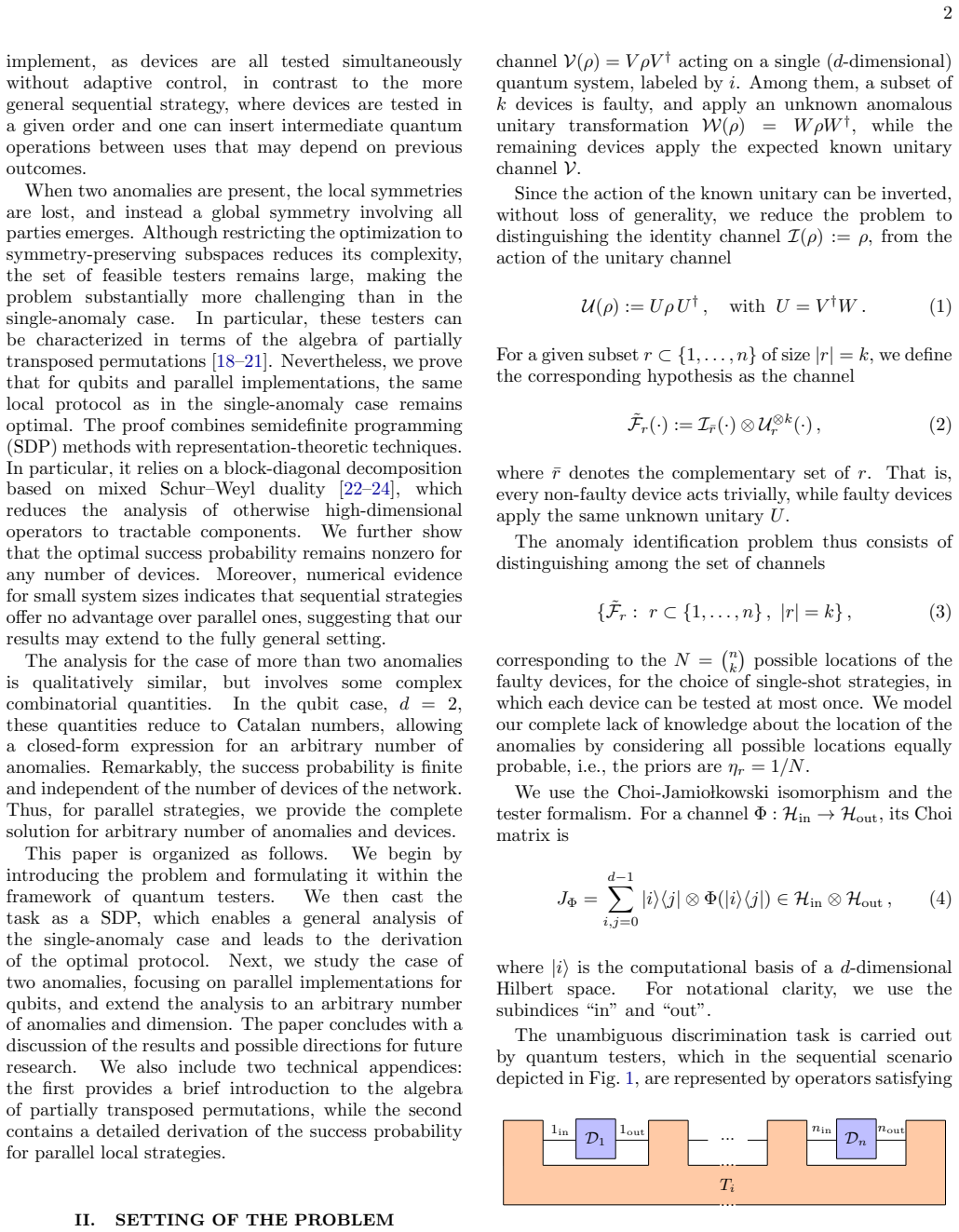
- [Protocol description] Figure 1 (protocol diagram) would benefit from an explicit label indicating the ancillary system dimension and the measurement basis used for the final identification step.
- [General case] In the general-k section, the performance evaluation table or plot should report both the conjectured optimal probability and the protocol's achieved value for at least two values of d>2 to allow direct comparison.
- [Introduction] A brief remark on the relation to prior work on quantum channel discrimination or unitary tomography would help situate the zero-error focus.
Simulated Author's Rebuttal
We thank the referee for the careful reading, positive assessment, and constructive suggestions. We address each major comment below and will revise the manuscript to incorporate the requested clarifications.
read point-by-point responses
-
Referee: [§3] §3 (single-anomaly case): the optimality claim for the derived success probability requires an explicit information-theoretic or minimax argument showing that no other measurement strategy can exceed the reported value; the current representation-theoretic bound should be cross-checked against the protocol's achieved rate to confirm saturation rather than merely matching.
Authors: The representation-theoretic analysis in §3 derives the success probability directly from the multiplicity of the relevant irreducible representations in the decomposition of the n-fold tensor product Hilbert space under the action of the unitary group. This yields the exact maximum probability attainable by any POVM, because the zero-error success probability is bounded above by the normalized dimension of the invariant subspace corresponding to the correct hypothesis (via Schur-Weyl duality). The ancillary protocol saturates this bound by achieving the full projection onto that subspace. To make the saturation explicit, we will add a short paragraph in the revised §3 that directly compares the protocol's achieved rate to the representation-theoretic value and notes that no strategy can exceed it, as any other measurement would have success probability at most the maximum eigenvalue of the corresponding projector. revision: yes
-
Referee: [§4] §4 (two-anomaly case): the extension of the n-independence result to k=2 relies on the ancillary protocol enabling independent tests; the manuscript should include a short calculation demonstrating that the joint success probability factors exactly as the product of single-device probabilities under the stated group-invariance assumptions.
Authors: We will insert the requested short calculation in the revised §4. Under the ancillary-assisted protocol, each device is tested with its own independent ancillary system, and the overall state is a tensor product. Because the measurement for each test is invariant under the simultaneous unitary conjugation on the system-ancilla pair, the joint probability of correctly identifying both anomalies factors exactly as the product of the individual single-anomaly probabilities. The group-invariance eliminates cross terms, confirming that the n-independence for k=2 follows immediately from the k=1 result. revision: yes
Circularity Check
No significant circularity; derivation self-contained
full rationale
The paper models hypotheses for unknown unitaries via standard representation theory under complete ignorance, derives the optimal zero-error success probability for k=1 and k=2 anomalies (showing n-independence), and explicitly constructs an ancillary-assisted protocol that saturates the bound while enabling independent testing. No load-bearing step reduces by the paper's own equations to a fitted parameter, self-definition, or self-citation chain; the group-invariance approach and protocol construction are independent of the target success probability and follow directly from the stated assumptions without circular reduction.
Axiom & Free-Parameter Ledger
axioms (1)
- domain assumption complete ignorance regarding the specific unitary transformation applied
Reference graph
Works this paper leans on
-
[1]
Two anomalies When considering the scenario ofk= 2 anomalies, the symmetry constraints and feasibility conditions in the SDP take a simpler form, allowing for a fully analytical solution. More importantly, fork≤n/2—a natural regime given thatkrepresents the number of anomalies—numerical checks for small values ofn(n= 4 andn= 5) show that parallel and sequ...
-
[2]
Extension to an arbitrary number of anomalies We can tackle the general scenario of arbitrary number of anomalous devices and local dimension using the same local parallel strategy. The performance of this strategy in the general scenario can be explicitly expressed in terms of the local dimension of the subsystems as (see Appendix B) Ps(k, d) = 1 dk tr C...
-
[3]
Tartakovsky, I
A. Tartakovsky, I. Nikiforov, and M. Basseville, Sequential analysis: Hypothesis testing and changepoint detection(CRC press, 2014)
2014
-
[4]
V. A. Siris and F. Papagalou, inIEEE Global Telecommunications Conference, 2004. GLOBECOM’04., Vol. 4 (IEEE, 2004) pp. 2050–2054
2004
-
[5]
Thottan and C
M. Thottan and C. Ji, IEEE Transactions on signal processing51, 2191 (2003)
2003
-
[6]
Ahmed, A
M. Ahmed, A. N. Mahmood, and M. R. Islam, Future Generation Computer Systems55, 278 (2016)
2016
-
[7]
Zipfel, F
J. Zipfel, F. Verworner, M. Fischer, U. Wieland, M. Kraus, and P. Zschech, Computers & Industrial Engineering177, 109045 (2023)
2023
-
[8]
D. Nigg, M. M¨ uller, E. A. Martinez, P. Schindler, M. Hennrich, T. Monz, M. A. Martin-Delgado, and R. Blatt, Science345, 302 (2014)
2014
-
[9]
C´ orcoles, E
A. C´ orcoles, E. Magesan, S. J. Srinivasan, A. W. Cross, M. Steffen, J. M. Gambetta, and J. M. Chow, Nature Communications6, 6979 (2015)
2015
-
[10]
Aruteet al., Nature574, 505 (2019)
F. Aruteet al., Nature574, 505 (2019)
2019
- [11]
-
[12]
Liao, W.-Q
S.-K. Liao, W.-Q. Cai, W.-Y. Liu, L. Zhang, Y. Li, J.-G. Ren, J. Yin, Q. Shen, Y. Cao, Z.-P. Li, and others, Nature 549, 43 (2017)
2017
-
[13]
Degen, F
C. Degen, F. Reinhard, and P. Cappellaro, Reviews of Modern Physics89, 035002 (2017)
2017
-
[14]
Reiter, A
F. Reiter, A. S. Sørensen, P. Zoller, and C. A. Muschik, Nature communications8, 1822 (2017)
2017
-
[15]
Skotiniotis, S
M. Skotiniotis, S. Llorens, R. Hotz, J. Calsamiglia, and R. Mu˜ noz-Tapia, Physical Review Research6, 033329 (2024)
2024
-
[16]
Llorens, G
S. Llorens, G. Sent´ ıs, and R. Munoz-Tapia, Quantum8, 1452 (2024)
2024
-
[17]
Choi, Linear algebra and its applications10, 285 (1975)
M.-D. Choi, Linear algebra and its applications10, 285 (1975)
1975
-
[18]
Jamio lkowski, Reports on mathematical physics3, 275 (1972)
A. Jamio lkowski, Reports on mathematical physics3, 275 (1972)
1972
-
[19]
Chiribella, G
G. Chiribella, G. M. D’Ariano, and P. Perinotti, Physical Review A80, 022339 (2009)
2009
-
[20]
A. Cox, M. De Visscher, S. Doty, and P. Martin, Journal of Algebra320, 169 (2008)
2008
- [21]
-
[22]
Balanz´ o-Juand´ o, M
M. Balanz´ o-Juand´ o, M. Studzi´ nski, and F. Huber, Journal of Physics A: Mathematical and Theoretical57, 115202 (2024)
2024
-
[23]
M. Studzi´ nski, T. M lynik, M. Mozrzymas, M. Horodecki, and D. Grinko, arXiv:2501.13067 (2026)
-
[24]
V. G. Turaev, Mathematics of the USSR-Izvestiya35, 411 (1990)
1990
-
[25]
Koike, Advances in Mathematics74, 57 (1989)
K. Koike, Advances in Mathematics74, 57 (1989)
1989
-
[26]
Grinko,Mixed Schur–Weyl duality in quantum information, Ph.D
D. Grinko,Mixed Schur–Weyl duality in quantum information, Ph.D. thesis, Institute for Logic, Language and Computation (2025)
2025
-
[27]
Collins and P
B. Collins and P. ´Sniady, Communications in Mathematical Physics264, 773 (2006)
2006
-
[28]
A. A. Mele, Quantum8, 1340 (2024)
2024
-
[29]
Weingarten, Journal of Mathematical Physisc19 (1978)
D. Weingarten, Journal of Mathematical Physisc19 (1978). 9
1978
-
[30]
Collins, S
B. Collins, S. Matsumoto, and J. Novak, Notices of the American Mathematical Society69, 1 (2022)
2022
-
[31]
M. T. Quintino, Q. Dong, A. Shimbo, A. Soeda, and M. Murao, Physical review letters123, 210502 (2019)
2019
-
[32]
Sedl´ ak, A
M. Sedl´ ak, A. Bisio, and M. Ziman, Physical Review Letters122, 170502 (2019)
2019
-
[33]
Ac´ ın, Physical Review Letters87, 177901 (2001)
A. Ac´ ın, Physical Review Letters87, 177901 (2001)
2001
-
[34]
Diebra, S
A. Diebra, S. Llorens, E. Bagan, G. Sent´ ıs, and R. Mu˜ noz-Tapia, Physical Review Research8, L012001 (2026)
2026
-
[35]
E. M. Rains, the electronic journal of combinatorics , R12 (1998)
1998
-
[36]
Abramowitz and I
M. Abramowitz and I. A. Stegun,Handbook of mathematical functions with formulas, graphs, and mathematical tables(US Government printing office, 1968)
1968
-
[37]
Sent´ ıs, E
G. Sent´ ıs, E. Bagan, J. Calsamiglia, and R. Mu˜ noz-Tapia, Physical Review A88, 052304 (2013)
2013
-
[38]
Llorens, W
S. Llorens, W. Gonz´ alez, G. Sent´ ıs, J. Calsamiglia, R. Mu˜ noz-Tapia, and E. Bagan, Quantum9, 1687 (2025)
2025
-
[39]
Llorens, A
S. Llorens, A. Diebra, M. Sedl´ ak, and R. Mu˜ noz-Tapia, Exact-identification-unknown-unitary (2026),https://github.com/SantiagoLlorens/ Exact-identification-unknown-unitary
2026
-
[40]
Grinko, A
D. Grinko, A. Burchardt, and M. Ozols, walledbrauer-gtbasis (2023),https://github.com/ dgrinko/walledbrauer-gtbasis. 10 Appendix A: Algebra of partially transposed permutations In this appendix, we provide a concise introduction to the representation-theoretic framework underlying the symmetry analysis of the main text. We describe the algebra of partiall...
2023
discussion (0)
Sign in with ORCID, Apple, or X to comment. Anyone can read and Pith papers without signing in.