Plasma effects on lifetimes and screening of Rydberg excitons
Pith reviewed 2026-05-08 17:39 UTC · model grok-4.3
The pith
Plasma-induced scattering induces finite lifetimes for Rydberg excitons and shows Debye screening overestimates internal field screening.
A machine-rendered reading of the paper's core claim, the machinery that carries it, and where it could break.
Core claim
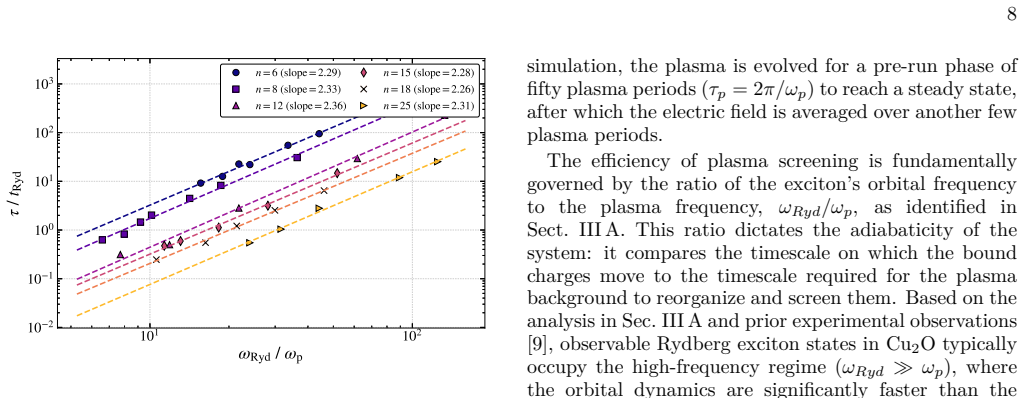
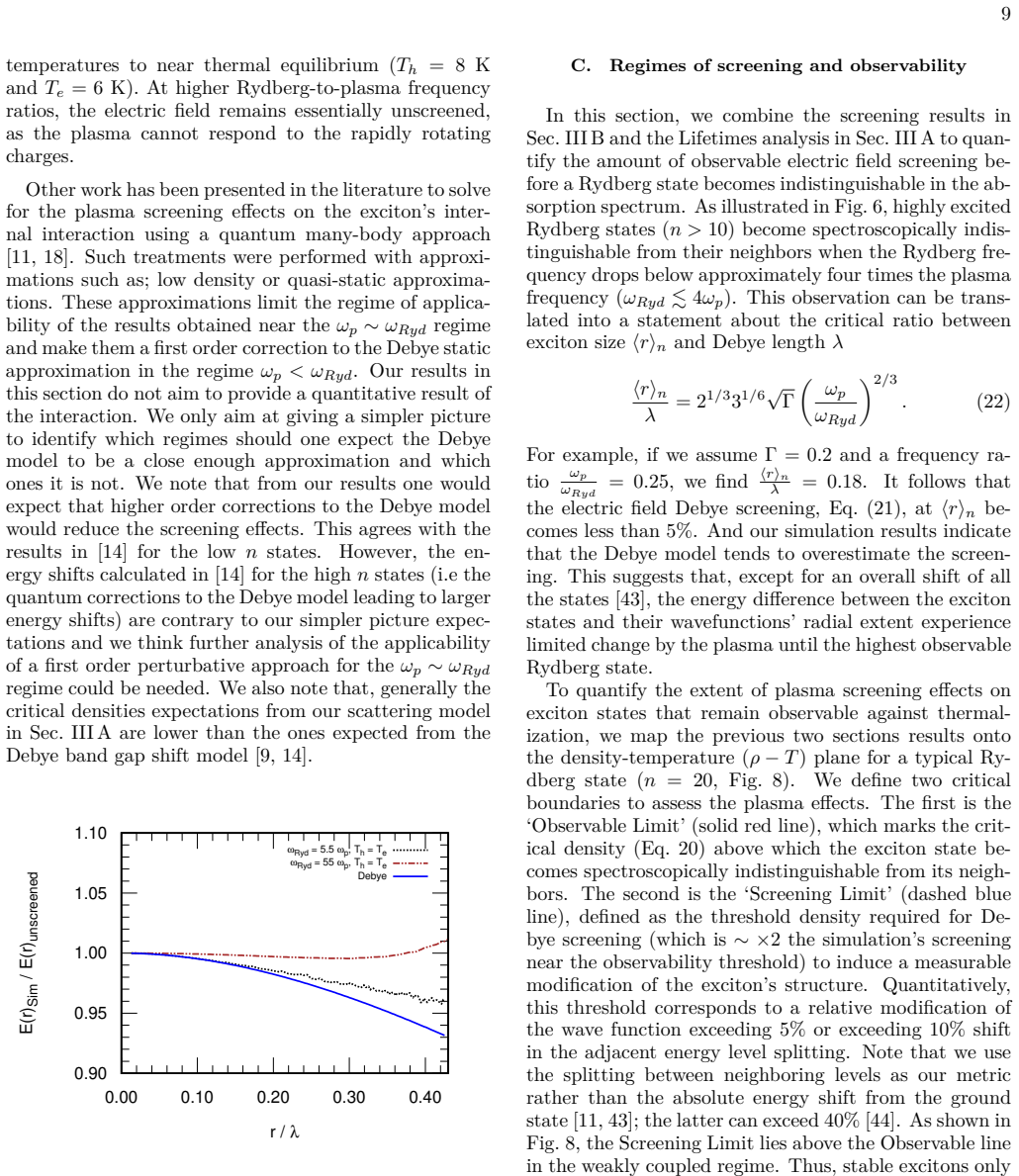
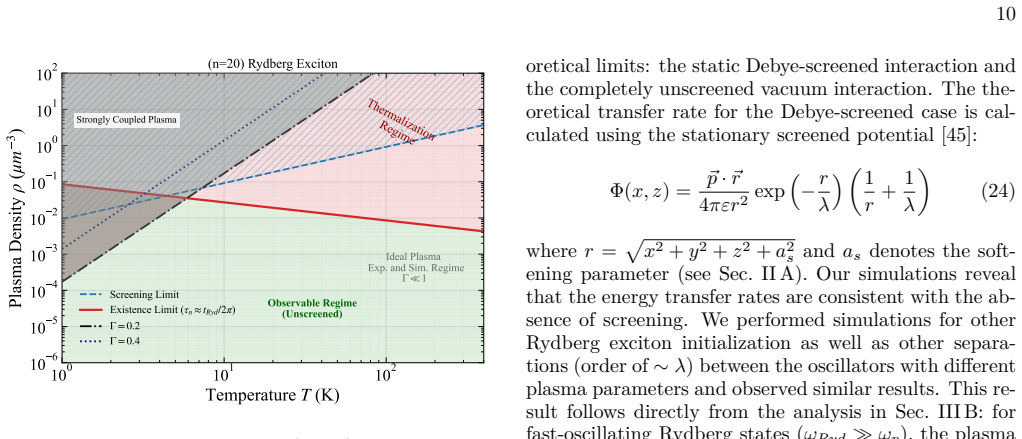
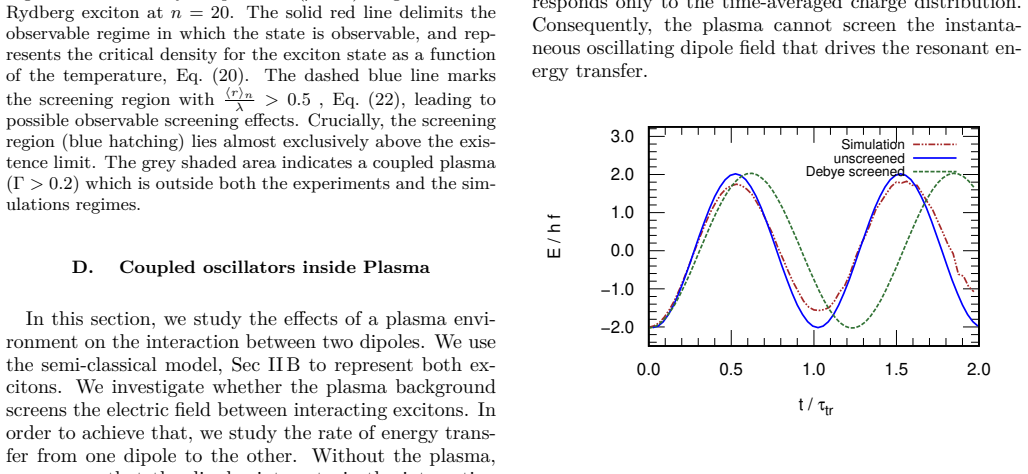
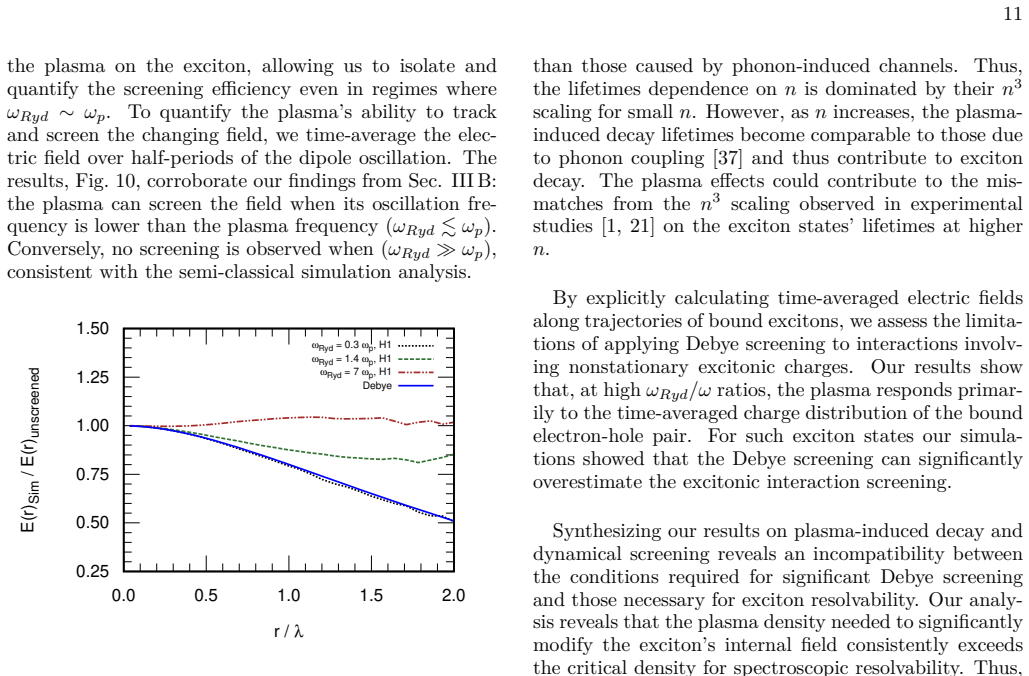
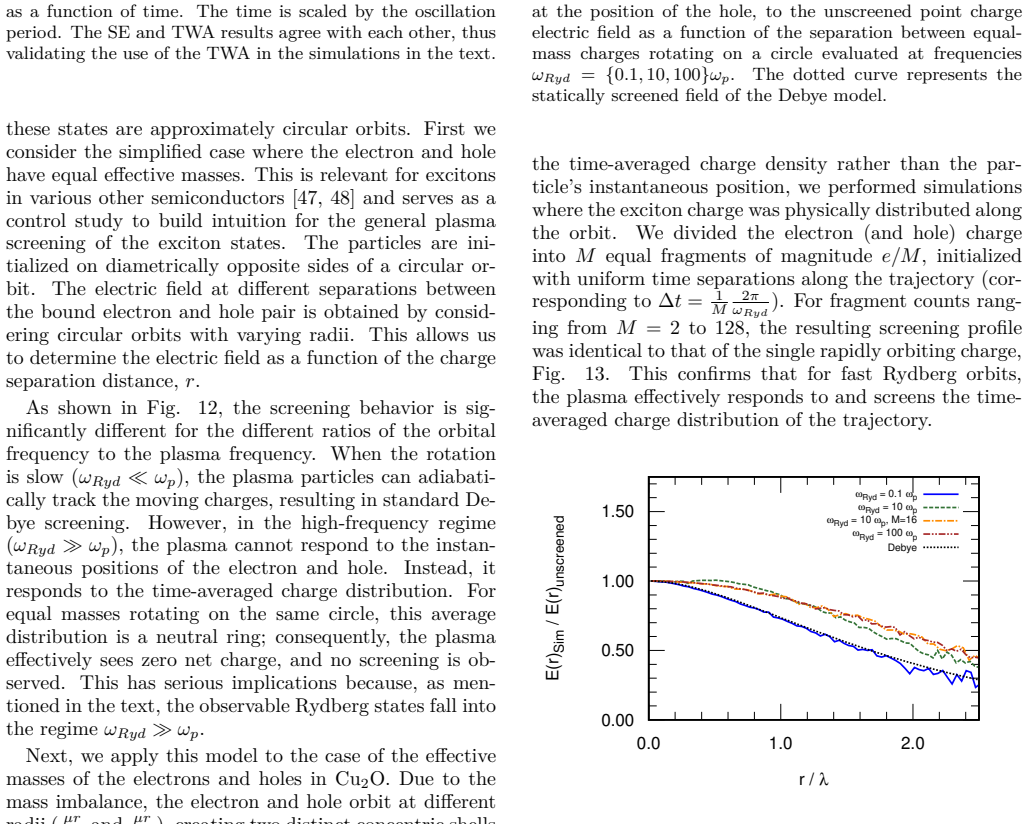
The authors establish that plasma-induced scattering induces finite exciton lifetimes with specific scaling relations with plasma density, principal quantum number n and temperature, possibly providing an explanation for experimentally observed deviations from the n^3 scaling at high principal quantum numbers. By explicitly computing time-averaged electric fields, they show that Debye screening overestimates the screening of the exciton's internal field, especially for high angular momentum states. Furthermore, exciton-exciton interactions are not Debye screened at separations comparable to the Debye length for Rydberg excitons that are well resolvable in absorption measurements.
What carries the argument
Classical orbit model and harmonic-oscillator representation evolved via the truncated Wigner approximation, used to follow exciton dynamics and compute time-averaged electric fields when orbital frequencies exceed the plasma frequency.
Load-bearing premise
The orbital frequencies of the excitons exceed the plasma frequency, which invalidates treating the screened charge as stationary.
What would settle it
Direct measurement of exciton lifetimes as a function of plasma density, temperature, and principal quantum number n to test whether the observed dependence matches the predicted scaling relations, or comparison of internal electric fields in high angular momentum states against Debye predictions.
Figures
read the original abstract
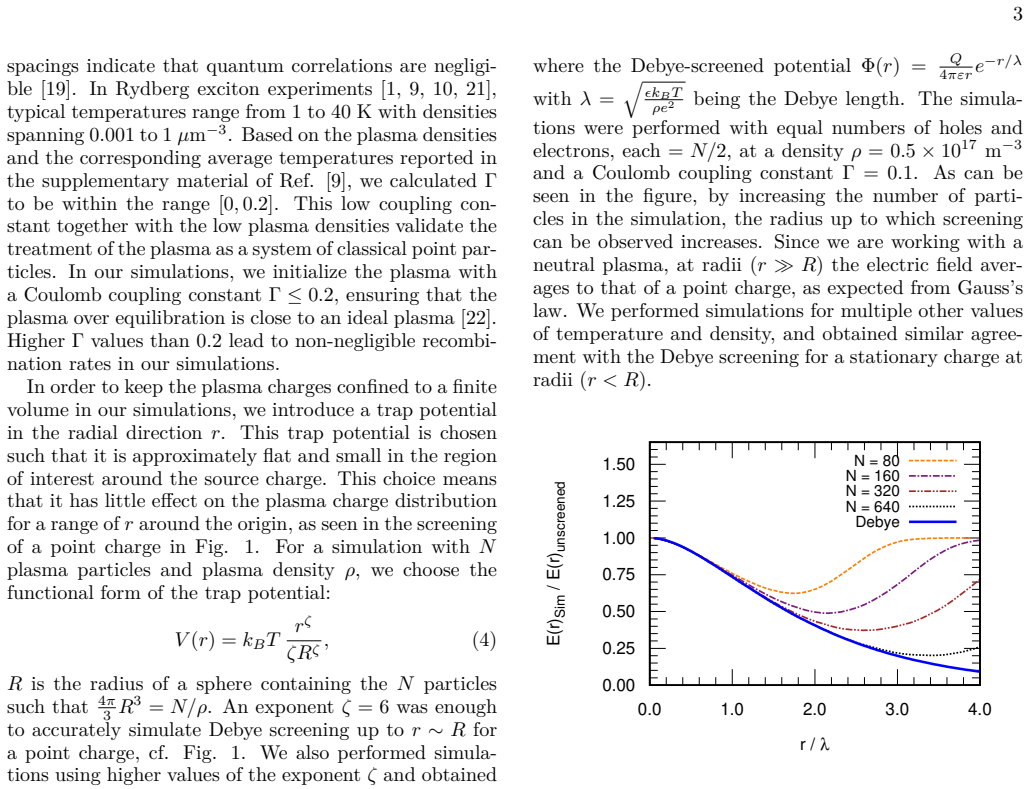
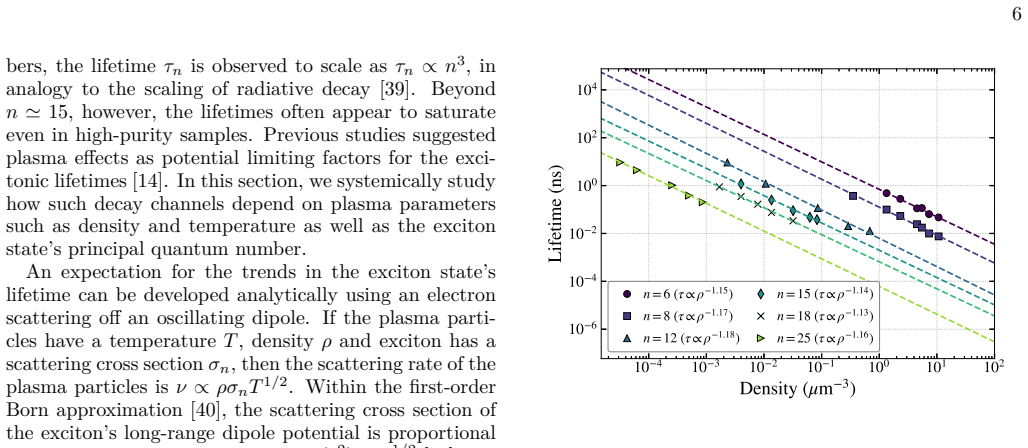
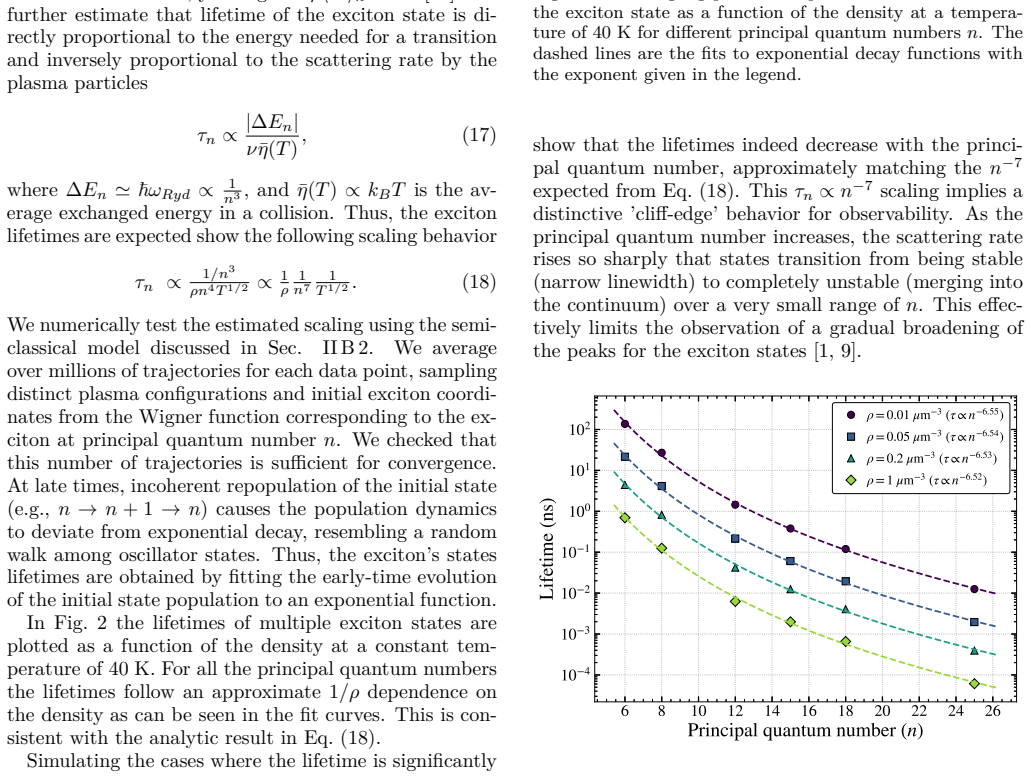
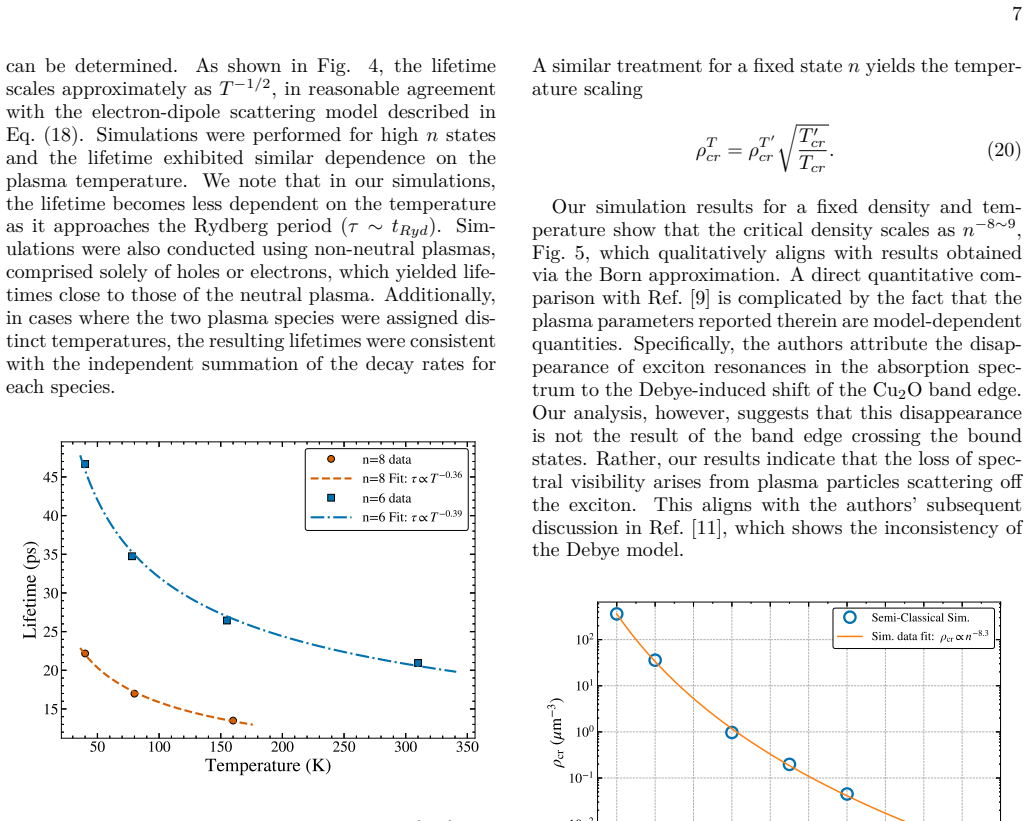
We simulate the effects of a neutral electron--hole plasma on Rydberg excitons in cuprous oxide (Cu$_2$O), focusing on the validity of Debye screening and the role of plasma-induced thermalization. Unlike atomic Rydberg states, excitons in Cu$_2$O consist of quasiparticles with comparable effective masses whose orbital frequencies can exceed the plasma frequency, invalidating the assumption of a stationary screened charge. Using two complementary approaches, a classical orbit model and a harmonic-oscillator representation evolved via the truncated Wigner approximation, we study exciton lifetimes and interaction screening under realistic plasma conditions. We find numerically that plasma-induced scattering induces finite exciton lifetimes with specific scaling relations with plasma density, principal quantum number $n$ and temperature, possibly providing an explanation for experimentally observed deviations from the $n^3$ scaling at high principal quantum numbers. By explicitly computing time-averaged electric fields, we show that Debye screening overestimates the screening of the exciton's internal field, especially for high angular momentum states. Furthermore, we demonstrate that exciton-exciton interactions are not Debye screened at separations comparable to the Debye length for Rydberg excitons that are well resolvable in absorption measurements.
Editorial analysis
A structured set of objections, weighed in public.
Referee Report
Summary. The manuscript uses two numerical approaches—a classical orbit model and a harmonic-oscillator representation evolved with the truncated Wigner approximation—to simulate the interaction of a neutral electron-hole plasma with Rydberg excitons in Cu₂O. It reports that plasma-induced scattering produces finite exciton lifetimes obeying specific scalings with plasma density, principal quantum number n, and temperature, and suggests this may account for observed deviations from the n³ lifetime scaling at high n. The work also computes time-averaged electric fields to argue that Debye screening overestimates screening of the exciton’s internal field (especially for high-l states) and that exciton-exciton interactions remain unscreened at separations comparable to the Debye length for experimentally resolvable states. The analysis rests on the premise that exciton orbital frequencies exceed the plasma frequency, invalidating a stationary screened-charge picture.
Significance. If the numerical results survive scrutiny of the underlying dynamical assumptions, the paper would usefully demonstrate the breakdown of the Debye approximation for time-dependent exciton-plasma coupling in semiconductors and offer a concrete mechanism for high-n lifetime anomalies. The complementary use of classical trajectories and truncated-Wigner evolution is a methodological strength that allows cross-checks on the reported scalings and field averages. The work is therefore potentially significant for both theory of Rydberg excitons and interpretation of cuprous-oxide experiments, provided the regime of validity is clarified.
major comments (2)
- [Abstract] Abstract and the paragraph stating the model assumptions: the central claim that plasma-induced scattering may explain deviations from n³ scaling at high principal quantum numbers rests on the dynamical premise that exciton orbital frequencies exceed the plasma frequency. For hydrogenic states the orbital frequency scales as n^{-3} while the plasma frequency is fixed by density; consequently the assumption is violated precisely in the high-n regime invoked for the explanatory claim. This tension is load-bearing for both the lifetime scalings and the time-averaged-field screening results.
- [Methods] The section describing the classical orbit model and truncated-Wigner implementation: no quantitative validation against known limits (e.g., low-density or low-n regimes where Debye screening should recover) or error estimates on the extracted lifetimes and field averages are provided. Without such checks the reported scalings with density, n, and T cannot be assessed for numerical convergence or sensitivity to the truncation in the Wigner expansion.
minor comments (1)
- [Introduction] Notation for the plasma frequency and orbital frequency should be introduced with explicit definitions and units in the first appearance to aid readability.
Simulated Author's Rebuttal
We are grateful to the referee for their thorough review and valuable feedback, which has helped us identify areas for clarification and improvement in our manuscript. We address the major comments below and outline the revisions we plan to make.
read point-by-point responses
-
Referee: [Abstract] Abstract and the paragraph stating the model assumptions: the central claim that plasma-induced scattering may explain deviations from n³ scaling at high principal quantum numbers rests on the dynamical premise that exciton orbital frequencies exceed the plasma frequency. For hydrogenic states the orbital frequency scales as n^{-3} while the plasma frequency is fixed by density; consequently the assumption is violated precisely in the high-n regime invoked for the explanatory claim. This tension is load-bearing for both the lifetime scalings and the time-averaged-field screening results.
Authors: The referee correctly identifies a potential inconsistency in the scaling. Our simulations are performed in parameter regimes where, for the plasma densities and temperatures relevant to Cu₂O experiments, the orbital frequency exceeds the plasma frequency up to moderately high n (e.g., n around 10-20 depending on density). We propose the plasma scattering as a possible explanation only within this valid regime. To address this, we will revise the abstract and the model assumptions paragraph to explicitly state the range of n and densities for which the premise holds, and include a brief analysis or plot of the frequency ratio versus n. This will strengthen the manuscript by delineating the applicability of our results. We note that since plasma frequency scales with the square root of density, the high-n violation depends on the specific experimental conditions, and our results highlight the importance of the dynamical regime. revision: partial
-
Referee: [Methods] The section describing the classical orbit model and truncated-Wigner implementation: no quantitative validation against known limits (e.g., low-density or low-n regimes where Debye screening should recover) or error estimates on the extracted lifetimes and field averages are provided. Without such checks the reported scalings with density, n, and T cannot be assessed for numerical convergence or sensitivity to the truncation in the Wigner expansion.
Authors: We agree that additional validation is necessary to support the reliability of our numerical results. In the revised version, we will incorporate quantitative benchmarks: specifically, we will demonstrate recovery of the Debye screening limit at low plasma densities and low n, where the time-dependent effects become negligible. We will also provide error bars or estimates on the lifetimes and time-averaged fields by performing convergence tests with respect to the Wigner truncation order and simulation parameters. Sensitivity to initial conditions and averaging procedures will be discussed. These additions will allow readers to assess the robustness of the reported scalings. revision: yes
Circularity Check
No significant circularity; results from forward numerical simulations
full rationale
The paper's central results on finite exciton lifetimes, scaling relations with n, density and temperature, and time-averaged fields are obtained via explicit numerical integration of a classical orbit model and truncated Wigner evolution of a harmonic-oscillator representation. These are forward computations from the stated dynamical equations and initial conditions under the orbital-frequency assumption; the emergent scalings and screening comparisons are not presupposed by definition, fitted to the target observables, or reduced to self-citations. The derivation chain remains self-contained against external benchmarks and does not invoke load-bearing self-referential steps.
Axiom & Free-Parameter Ledger
axioms (2)
- domain assumption The truncated Wigner approximation is appropriate for evolving the harmonic-oscillator representation of the exciton
- domain assumption Orbital frequencies of the excitons can exceed the plasma frequency under the studied conditions
Reference graph
Works this paper leans on
-
[1]
Classical Model In the classical model, we let the exciton’s electron and hole follow fixed classical Keplerian orbits. The pair is initialized with energies and relative motion semi-major 4 axis an matching the hydrogenic states: En = − µ 2ℏ2 e2 4πϵ 2 1 n2 = − e2 4πϵ 1 2an (5) The orbital semi-major axes of each of the electron and hole are determined by...
-
[2]
For these states, the Hamiltonian simplifies according to two physical features
Semi-Classical model To refine our estimate of plasma-induced decay rates, we employ a semi-classical model based on the properties of excitons at high principal quantum number ( n ≫ 1). For these states, the Hamiltonian simplifies according to two physical features. First, the energy spectrum is approximately equidistant, with a separation ℏωRyd be- twee...
-
[3]
Giant rydberg exci- tons in the copper oxide Cu 2O
Tomasz Kazimierczuk, Dietmar Fröhlich, Stefan Scheel, Heinrich Stolz, and Manfred Bayer. Giant rydberg exci- tons in the copper oxide Cu 2O. Nature, 514(7522):343– 347, 2014
work page 2014
-
[4]
Giant rydberg excitons in cu 2 o probed by photoluminescence excitation spectroscopy
Marijn AM Versteegh, Stephan Steinhauer, Josip Bajo, Thomas Lettner, Ariadna Soro, Alena Romanova, Samuel Gyger, Lucas Schweickert, André Mysyrowicz, and Val Zwiller. Giant rydberg excitons in cu 2 o probed by photoluminescence excitation spectroscopy. Physical Review B , 104(24):245206, 2021
work page 2021
-
[5]
Large scale purification in semiconduc- tors using rydberg excitons
Martin Bergen, Valentin Walther, Binodbihari Panda, Mariam Harati, Simon Siegeroth, Julian Heckötter, and Marc Aßmann. Large scale purification in semiconduc- tors using rydberg excitons. Nature Communications , 14(1):8235, 2023
work page 2023
-
[6]
Quantum interference of rydberg excitons in Cu 2O: Quantum beats
Sylwia Zielińska-Raczyńska and David Ziemkiewicz. Quantum interference of rydberg excitons in Cu 2O: Quantum beats. Physical Review B , 111(20):205201, 2025
work page 2025
-
[7]
J Heckötter, D Janas, R Schwartz, M Aßmann, and M Bayer. Experimental limitation in extending the ex- citon series in Cu 2O towards higher principal quantum numbers. Physical Review B , 101(23):235207, 2020
work page 2020
-
[8]
In- teraction of charged impurities and rydberg excitons in cuprous oxide
Sjard Ole Krüger, Heinrich Stolz, and Stefan Scheel. In- teraction of charged impurities and rydberg excitons in cuprous oxide. Phys. Rev. B , 101:235204, Jun 2020
work page 2020
-
[9]
Mikhail M Glazov and Alexey Chernikov. Breakdown of the static approximation for free carrier screening of ex- citons in monolayer semiconductors. physica status solidi (b), 255(12):1800216, 2018
work page 2018
- [10]
-
[11]
Rydberg excitons in the presence of an ultralow- density electron-hole plasma
J Heckötter, M Freitag, D Fröhlich, M Aßmann, M Bayer, P Grünwald, F Schöne, D Semkat, H Stolz, and S Scheel. Rydberg excitons in the presence of an ultralow- density electron-hole plasma. Physical Review Letters , 121(9):097401, 2018
work page 2018
-
[12]
Plasma-enhanced interaction and optical nonlinearities of Cu 2O rydberg excitons
Valentin Walther and Thomas Pohl. Plasma-enhanced interaction and optical nonlinearities of Cu 2O rydberg excitons. Physical Review Letters , 125(9):097401, 2020
work page 2020
-
[13]
Heinrich Stolz, Dirk Semkat, Rico Schwartz, Julian Heckötter, Marc Aßmann, Wolf-Dietrich Kraeft, Hol- ger Fehske, and Manfred Bayer. Scrutinizing the debye plasma model: Rydberg excitons unravel the properties of low-density plasmas in semiconductors. Physical Re- view B , 105(7):075204, 2022
work page 2022
-
[14]
Energy spectrum of hydrogen atoms in dense plasmas
J Seidel, S Arndt, and WD Kraeft. Energy spectrum of hydrogen atoms in dense plasmas. Physical Review E , 52(5):5387, 1995
work page 1995
-
[15]
Two-particle energy spectrum in dense electron–hole plasmas
S Arndt, WD Kraeft, and J Seidel. Two-particle energy spectrum in dense electron–hole plasmas. physica status solidi (b) , 194(2):601–617, 1996
work page 1996
-
[16]
In- fluence of electron-hole plasma on rydberg excitons in cuprous oxide
Dirk Semkat, Holger Fehske, and Heinrich Stolz. In- fluence of electron-hole plasma on rydberg excitons in cuprous oxide. Physical Review B , 100(15):155204, 2019
work page 2019
-
[17]
Quan- tum many-body effects on rydberg excitons in cuprous oxide
Dirk Semkat, Holger Fehske, and Heinrich Stolz. Quan- tum many-body effects on rydberg excitons in cuprous oxide. The European Physical Journal Special Topics , 230(4):947–950, 2021
work page 2021
-
[18]
Coherent transfer matrix analysis of the transmis- sion spectra of rydberg excitons in cuprous oxide
Heinrich Stolz, Rico Schwartz, Julian Heckötter, Marc Aßmann, Dirk Semkat, Sjard O Krüger, and Manfred Bayer. Coherent transfer matrix analysis of the transmis- sion spectra of rydberg excitons in cuprous oxide. Phys- ical Review B , 104(3):035206, 2021
work page 2021
-
[19]
Angel Alastuey, Françoise Cornu, and Ph A Martin. Van der waals forces in presence of free charges: an exact derivation from equilibrium quantum correlations. The Journal of chemical physics , 127(5), 2007
work page 2007
-
[20]
Electron theory of the optical properties of laser-excited semiconductors
Hartmut Haug and Stefan Schmitt-Rink. Electron theory of the optical properties of laser-excited semiconductors. Progress in Quantum Electronics , 9(1):3–100, 1984
work page 1984
-
[21]
Introduction to plasma physics and controlled fusion, volume 1
Francis F Chen et al. Introduction to plasma physics and controlled fusion, volume 1. Springer, 1984
work page 1984
-
[22]
The energy level spectrum of the yellow excitons in cuprous oxide
J Heckötter, A Farenbruch, D Fröhlich, M Aßmann, DR Yakovlev, M Bayer, MA Semina, MM Glazov, P Rommel, J Ertl, et al. The energy level spectrum of the yellow excitons in cuprous oxide. Physics Reports , 1100:1–69, 2025
work page 2025
-
[23]
Direct measurement of the lifetime and coherence time of Cu 2O rydberg ex- citons
Poulab Chakrabarti, Kerwan Morin, Delphine Lagarde, Xavier Marie, and Thomas Boulier. Direct measurement of the lifetime and coherence time of Cu 2O rydberg ex- citons. Physical Review Letters , 134(12):126902, 2025
work page 2025
-
[24]
Luis Conde. An introduction to Plasma Physics and its space applications, Volume 1: Fundamentals and elemen- tary processes. Morgan & Claypool Publishers, 2018
work page 2018
-
[25]
Numerical recipes 3rd edition: The art of scientific computing
William H Press. Numerical recipes 3rd edition: The art of scientific computing . Cambridge university press, 2007
work page 2007
-
[26]
Early time properties of ultracold neutral plasmas
K Niffenegger, KA Gilmore, and F Robicheaux. Early time properties of ultracold neutral plasmas. Journal of Physics B: Atomic, Molecular and Optical Physics , 44(14):145701, 2011
work page 2011
-
[27]
1., classical me- chanics, 1980
H Goldstein, C Poole, J Safko, et al. 1., classical me- chanics, 1980
work page 1980
-
[28]
Coupled valence band dispersions and the quan- tum defect of excitons in Cu 2O
Florian Schöne, Sjard-Ole Krüger, Peter Grünwald, Marc Aßmann, Julian Heckötter, Johannes Thewes, Heinrich Stolz, Dietmar Fröhlich, Manfred Bayer, and Stefan Scheel. Coupled valence band dispersions and the quan- tum defect of excitons in Cu 2O. Journal of Physics B: Atomic, Molecular and Optical Physics , 49(13):134003, 2016
work page 2016
-
[29]
Deviations of the exciton level spectrum in Cu2O from the hydrogen series
F Schöne, S-O Krüger, P Grünwald, H Stolz, S Scheel, M Aßmann, J Heckötter, J Thewes, D Fröhlich, and M Bayer. Deviations of the exciton level spectrum in Cu2O from the hydrogen series. Physical Review B , 93(7):075203, 2016
work page 2016
-
[30]
Classical view of the properties of rydberg atoms: Application of the correspondence principle
TP Hezel, CE Burkhardt, M Ciocca, L W He, and JJ Lev- enthal. Classical view of the properties of rydberg atoms: Application of the correspondence principle. Am. J. Phys, 60(4):329–335, 1992
work page 1992
-
[31]
E. Wigner. On the quantum correction for thermody- namic equilibrium. Phys. Rev. , 40:749–759, Jun 1932
work page 1932
-
[32]
Wolfgang P Schleich. Quantum optics in phase space . John Wiley & Sons, 2011
work page 2011
-
[33]
William B. Case. Wigner functions and Weyl trans- forms for pedestrians. American Journal of Physics , 76(10):937–946, 10 2008
work page 2008
-
[34]
Discrete truncated wigner approxi- mation
Stefanie Czischek. Discrete truncated wigner approxi- mation. In Neural-Network Simulation of Strongly Cor- related Quantum Systems , pages 85–109. Springer, 2020
work page 2020
-
[35]
M. Nedjalkov, D. Querlioz, P. Dollfus, and H. Kosina. Wigner Function Approach, pages 289–358. Springer New York, New York, NY, 2011. 15
work page 2011
-
[36]
Comparison of de- terministic and stochastic methods for time-dependent wigner simulations
Sihong Shao and Jean Michel Sellier. Comparison of de- terministic and stochastic methods for time-dependent wigner simulations. Journal of Computational Physics , 300:167–185, 2015
work page 2015
-
[37]
Simula- tion of the time evolution of the wigner function with a first-principles monte carlo method
MS Torres Jr, G Tosi, and JMA Figueiredo. Simula- tion of the time evolution of the wigner function with a first-principles monte carlo method. Physical Review E , 80(3):036701, 2009
work page 2009
-
[38]
A tempera- ture study of high-n rydberg states in Cu 2O
Julian Heckötter, Binodbihari Panda, Katharina Brägel- mann, Marc Aßmann, and Manfred Bayer. A tempera- ture study of high-n rydberg states in Cu 2O. Advanced Quantum Technologies, 8(2):2300426, 2025
work page 2025
-
[39]
Heinrich Stolz, Florian Schöne, and Dirk Semkat. Inter- action of rydberg excitons in cuprous oxide with phonons and photons: optical linewidth and polariton effect. New Journal of Physics , 20(2):023019, 2018
work page 2018
-
[40]
Linewidths in excitonic absorption spectra of cuprous ox- ide
Frank Schweiner, Jörg Main, and Günter Wunner. Linewidths in excitonic absorption spectra of cuprous ox- ide. Phys. Rev. B , 93:085203, Feb 2016
work page 2016
-
[41]
Intensity of optical absorption by exci- tons
Roger J Elliott. Intensity of optical absorption by exci- tons. Physical Review, 108(6):1384, 1957
work page 1957
-
[42]
Jun John Sakurai and Jim Napolitano. Modern quantum mechanics. Cambridge University Press, 2020
work page 2020
-
[43]
Electron scattering by polar molecules
Yukikazu Itikawa. Electron scattering by polar molecules. Physics Reports, 46(4):117–164, 1978
work page 1978
-
[44]
Takashi Fujimoto. Broadening of spectral lines. In Plasma Spectroscopy. Oxford University Press, 06 2004
work page 2004
-
[45]
Zustandssumme und effektive ionisierungsspannung eines atoms im inneren des plas- mas
G Ecker and W Weizel. Zustandssumme und effektive ionisierungsspannung eines atoms im inneren des plas- mas. Annalen der Physik , 452(2-3):126–140, 1956
work page 1956
-
[46]
Values are obtained by numerically solving the Schrödinger equation for a Debye screened Coulomb po- tential [ 10, 43]
-
[47]
Bound electronic states in a statically screened electric-dipole potential
JM Ugalde and C Sarasola. Bound electronic states in a statically screened electric-dipole potential. Physical Review A , 54(4):2868, 1996
work page 1996
-
[48]
Asymmet- ric rydberg blockade of giant excitons in cuprous oxide
Julian Heckötter, Valentin Walther, Stefan Scheel, Man- fred Bayer, Thomas Pohl, and Marc Aßmann. Asymmet- ric rydberg blockade of giant excitons in cuprous oxide. Nature communications, 12(1):3556, 2021
work page 2021
-
[49]
Non- generic dispersion of excitons in the bulk of wse 2
R Schuster, Y Wan, M Knupfer, and B Büchner. Non- generic dispersion of excitons in the bulk of wse 2. Phys- ical Review B , 94(8):085201, 2016
work page 2016
-
[50]
Electronic and thermoelectric properties of few- layer transition metal dichalcogenides
Darshana Wickramaratne, Ferdows Zahid, and Roger K Lake. Electronic and thermoelectric properties of few- layer transition metal dichalcogenides. The Journal of chemical physics , 140(12), 2014
work page 2014
discussion (0)
Sign in with ORCID, Apple, or X to comment. Anyone can read and Pith papers without signing in.