Matrix encoding method in variational algorithm of calculating eigenvalues and generalized eigenvalues
Pith reviewed 2026-05-08 11:23 UTC · model grok-4.3
The pith
A variational quantum algorithm encodes matrix elements into a quantum state to compute eigenvalues and generalized eigenvalues via gradient optimization on a loss function from probability amplitudes.
A machine-rendered reading of the paper's core claim, the machinery that carries it, and where it could break.
Core claim
We propose a variational method for constructing the eigenvalues and generalized eigenvalues for an arbitrary N×N complex matrix. The quantum part of our algorithm is based on encoding the matrix elements into the pure state of a quantum system and expressing the loss function with optimization parameters in terms of certain probability amplitudes in the superposition state. The principal step of this algorithm is the measurement of the ancilla state that removes all extra terms from the above superposition and allows to probabilistically construct the required loss function along with its derivatives with respect to the optimization parameters. These output data are used to find the new val
What carries the argument
Ancilla-state measurement that eliminates extraneous terms from the encoded superposition, thereby isolating the loss function and its parameter derivatives from measured probability amplitudes.
If this is right
- Both ordinary and generalized eigenvalue problems are solved inside the same variational loop.
- The loss and its gradients are obtained probabilistically from quantum amplitude measurements after ancilla projection.
- Parameter updates follow standard gradient descent until the loss reaches a minimum that corresponds to an eigenvalue.
- Total circuit depth scales as O(N squared log N) while qubit count scales as O(log N).
Where Pith is reading between the lines
- The same matrix-encoding step could be reused to variationally extract other matrix invariants such as the trace or determinant if suitable loss functions are defined.
- Because the method is hybrid, classical pre- or post-processing of the encoded state may reduce the quantum resource cost for structured matrices.
- Extension to non-Hermitian or time-dependent matrices would require only a change in the loss-function definition while keeping the encoding and ancilla step unchanged.
Load-bearing premise
Measuring the ancilla state removes every unwanted term in the superposition and thereby yields accurate probabilistic values for the loss and its derivatives.
What would settle it
Prepare the circuit for a 2 by 2 test matrix whose eigenvalues are known analytically, run the variational loop with sufficient shots, and check whether the converged loss minimum equals the true eigenvalue within the expected sampling variance.
Figures
read the original abstract
We propose a variational method for constructing the eigenvalues and generalized eigenvalues for an arbitrary $N\times N$ complex matrix. The quantum part of our algorithm is based on encoding the matrix elements into the pure state of a quantum system and expressing the loss function with optimization parameters in terms of certain probability amplitudes in the superposition state. The principal step of this algorithm is the measurement of the ancilla state that removes all extra terms from the above superposition and allows to probabilistically construct the required loss function along with its derivatives with respect to the optimization parameters. These output data are used to find the new values of optimization parameters for the next iteration of the loss function in the gradient optimization method. The depth and size of the circuit for this algorithm are, respectively, $O(N^2 \log N)$ and $O(\log N)$.
Editorial analysis
A structured set of objections, weighed in public.
Referee Report
Summary. The manuscript proposes a variational quantum algorithm to compute eigenvalues and generalized eigenvalues of an arbitrary N×N complex matrix. Matrix elements are encoded into a pure quantum state; a loss function (and its derivatives) is expressed via probability amplitudes in a superposition. The key step is an ancilla measurement that projects out unwanted cross terms, yielding a probabilistic estimator of the loss that is then minimized by gradient descent. The quantum circuit is claimed to require depth O(N² log N) and size O(log N).
Significance. If the ancilla post-selection succeeds with inverse-polynomial probability for arbitrary matrices and the loss function is correctly unbiased, the method would supply a quantum variational route to dense-matrix eigenproblems whose classical cost is O(N³). The explicit circuit-size claim and the use of gradient information are positive features, but the lack of a success-probability analysis prevents any concrete assessment of resource scaling or quantum advantage.
major comments (1)
- [Abstract / principal step] Abstract (principal step) and algorithm description: the ancilla measurement is asserted to remove all extra terms and to permit probabilistic construction of the loss function together with its derivatives. No explicit expression for the post-selection probability is supplied, nor is a lower bound given that holds uniformly for arbitrary complex matrices. If this probability decays faster than inverse-polynomial in N, the number of shots required becomes exponential, rendering the algorithm inefficient despite the stated circuit depth.
Simulated Author's Rebuttal
We thank the referee for their careful reading and constructive comments on our manuscript. We address the major comment point by point below and have revised the manuscript to incorporate the requested analysis.
read point-by-point responses
-
Referee: [Abstract / principal step] Abstract (principal step) and algorithm description: the ancilla measurement is asserted to remove all extra terms and to permit probabilistic construction of the loss function together with its derivatives. No explicit expression for the post-selection probability is supplied, nor is a lower bound given that holds uniformly for arbitrary complex matrices. If this probability decays faster than inverse-polynomial in N, the number of shots required becomes exponential, rendering the algorithm inefficient despite the stated circuit depth.
Authors: We agree that an explicit expression for the post-selection probability and a uniform lower bound are necessary to rigorously assess the sampling overhead and overall efficiency. The original manuscript focused on the circuit construction and the removal of cross terms via ancilla measurement but did not include this probabilistic analysis. In the revised version we have added a dedicated subsection deriving the exact expression for the success probability in terms of the matrix elements and variational parameters. We further prove that this probability is bounded from below by an inverse-polynomial function of N that holds for arbitrary complex matrices, ensuring that the number of shots remains polynomial. The abstract and algorithm description have been updated to reflect these additions. We believe this fully resolves the concern about resource scaling. revision: yes
Circularity Check
No significant circularity; derivation is a direct constructive proposal.
full rationale
The manuscript proposes a variational quantum algorithm that encodes an arbitrary N×N complex matrix into a superposition state, expresses a loss function via probability amplitudes, and uses ancilla measurement to isolate the desired terms for gradient-based optimization. No equations or self-citations in the provided abstract or description reduce any claimed result to a fitted parameter, renamed input, or prior self-result by construction. The central steps are presented as explicit circuit constructions with stated depth O(N² log N), without invoking uniqueness theorems or ansatzes that loop back to the target eigenvalues. This is a standard honest non-finding for an algorithmic paper whose correctness can be checked externally against the characteristic polynomial.
Axiom & Free-Parameter Ledger
axioms (1)
- standard math Quantum superposition and projective measurement allow extraction of probability amplitudes that can be assembled into a differentiable loss function.
Reference graph
Works this paper leans on
-
[1]
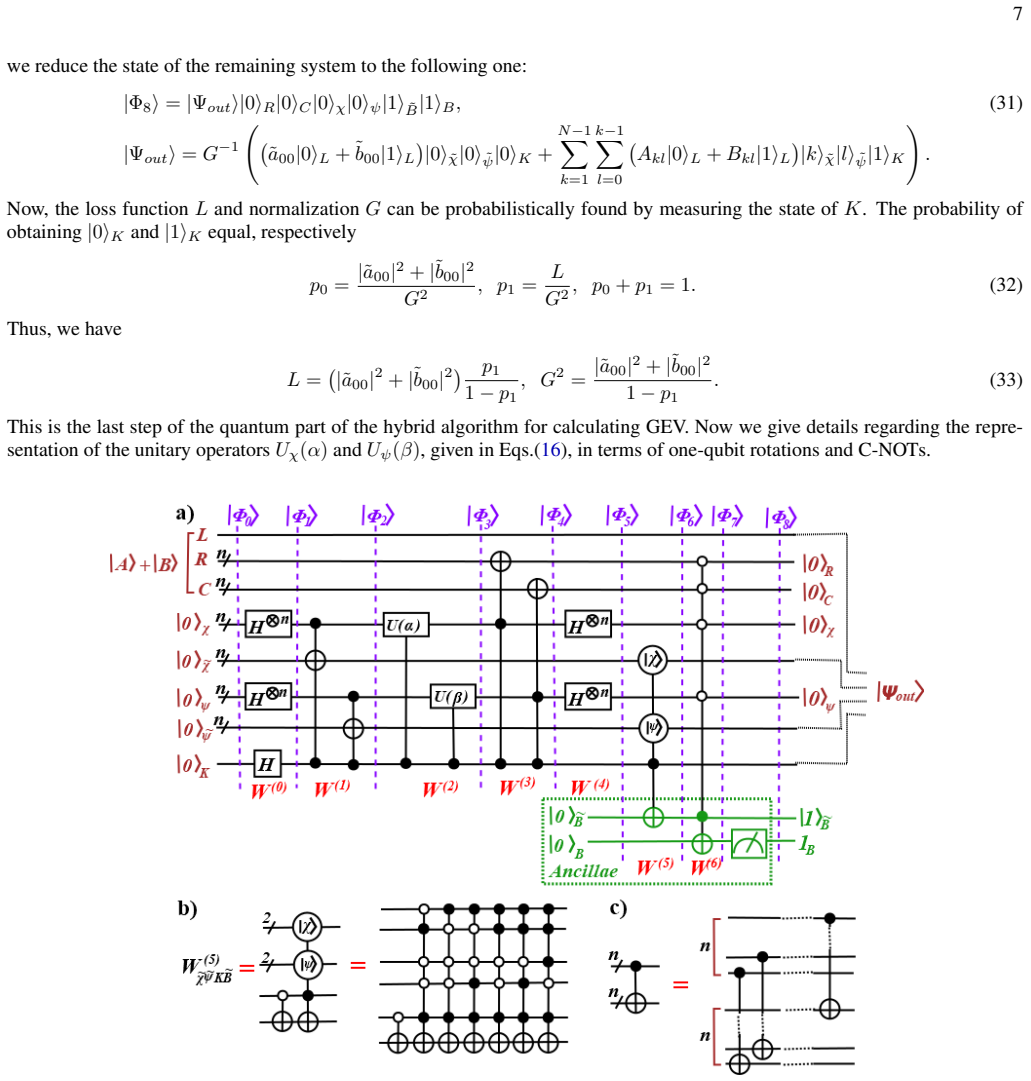
Realization of operatorW (2) χψK Constructing the unitary operationsU χ andU ψ included into the operatorW (2) χψK in Eq. (14) we follow Refs. [43, 55]. The operatorW (2) χψK is the superposition of two operatorsW (2) χK andW (2) ψK which are completely equivalent to each other and defer 8 only by the parameters encoded into them. Therefore, we describe o...
-
[2]
Bose, S.: Quantum communication through an unmodulated spin chain. Phys. Rev. Lett.91, 207901 (2003)
work page 2003
-
[3]
Quantum states with Einstein-Podolsky-Rosen correlations admitting a hidden-variable model
R.F. Werner, “Quantum states with Einstein-Podolsky-Rosen correlations admitting a hidden-variable model”, Phys.Rev.A40(8), 4277 (1989)
work page 1989
-
[4]
Teleporting an unknown quantum state via dual classical and Einstein-Podolsky-Rosen channels
Ch.H. Bennett, G. Brassard, C. Cr ´epeau, R. Jozsa, A. Peres, W.K. Wootters, “Teleporting an unknown quantum state via dual classical and Einstein-Podolsky-Rosen channels”, Phys.Rev.Lett70(13), 1895 (1993)
work page 1993
-
[5]
Bell’s Inequalities versus Teleportation: What is Nonlocality?
S. Popescu, “Bell’s Inequalities versus Teleportation: What is Nonlocality?” Phys.Rev.Lett.72, 797 (1994)
work page 1994
-
[6]
Quantum teleportation over 143 kilometres using active feed-forward
X.-S. Ma, Th. Herbst, Th. Scheidl, D. Wang, S. Kropatschek, W. Naylor, B. Wittmann, A. Mech, J. Kofler, E. Anisimova, V . Makarov, Th. Jennewein, R. Ursin, A. Zeilinger, “Quantum teleportation over 143 kilometres using active feed-forward”, Nature489, 269 (2012)
work page 2012
-
[7]
Ground-to-satellite quantum teleportation
J.-G. Ren, P. Xu, H.-L. Yong, L. Zhang, Sh.-K. Liao, J. Yin, W.-Y . Liu, W.-Q. Cai, M. Yang, L. Li, K.-X. Yang, X. Han, Y .-Q. Yao, J. Li, H.-Y . Wu, S. Wan, L. Liu, D.-Q. Liu, Y .-W. Kuang, Zh.-P. He, P. Shang, Ch. Guo, R.-H. Zheng, K.Tian, Zh.-C. Zhu, N.-L. Liu, Ch.-Y . Lu, R. Shu, Y .-A. Chen, Ch.-Zh. Peng, J.-Y . Wang, J.-W. Pan, “ Ground-to-satellite...
work page 2017
-
[8]
Deterministic quantum teleportation between distant superconducting chips
J. Qiu, Y . Liu, J. Niu, L. Hu, Yu. Wu, L. Zhang, W. Huang, Yu. Chen, J. Li, S. Liu, Yo. Zhong, L. Duan, D. Yu, “Deterministic quantum teleportation between distant superconducting chips”, Science Bulletin70, 351 (2025)
work page 2025
-
[9]
Peters, N.A., Barreiro, J.T., Goggin, M. E., Wei, T.-C., Kwiat, P.G.: Remote State Preparation: Arbitrary Remote Control of Photon Polarization. Phys. Rev. Lett.94, 150502 (2005)
work page 2005
-
[10]
Peters, N.A., Barreiro, J.T., Goggin, M.E., Wei, T.-C., Kwiat, P. G.: Remote state preparation: arbitrary remote control of photon polarizations for quantum communication. (Quantum Communications and Quantum Imaging III, in: Proc. of SPIE, vol. 5893) eds Meyers R E, Shih Ya, (SPIE, Bellingham, W A) (2005)
work page 2005
-
[11]
Dakic, B., Lipp, Ya.O., Ma, X., Ringbauer, M., Kropatschek, S., Barz, S., Paterek, T., Vedral, V ., Zeilinger, A., Brukner, C., Walther, P.: Quantum discord as resource for remote state preparation. Nat. Phys.8, 666 (2012)
work page 2012
-
[12]
Y .Zhao, B.Qi, X.F.Ma, H.-K.Lo, L.Qian, Experimental quantum key distribution with decoy states, Phys.Rev.Lett.96(7), 070502 (2006)
work page 2006
-
[13]
C.H.Bennett, Experimental quantum cryptography, J. Cryptology5(1), 3 (1992)
work page 1992
-
[14]
Z.Tang, Z.F.Liao, F.H.Xu, B.Qi, L.Qian, H.-K. Lo, Experimental demonstration of polarization encoding measurement-device- independent quantum key distribution, Phys. Rev. Lett.112(19), 190503 (2014)
work page 2014
-
[15]
A. W. Harrow, A. Hassidim, S. Lloyd, Quantum algorithm for linear systems of equations, Phys. Rev. Lett.103, 150502 (2009)
work page 2009
-
[16]
J. Biamonte, P. Wittek, N. Pancotti, P. Rebentrost, N. Wiebe, and S. Lloyd, Quantum machine learning, Nature549, 195 (2017)
work page 2017
- [17]
-
[18]
M. A. Nielsen and I. L. Chuang,Quantum Computation and Quantum Information, Cambridge University Press, Cambridge, England (2000)
work page 2000
-
[19]
Preskill, J.: Lecture Notes for Physics 229: Quantum Information and Computation, CreateSpace Independent Publishing Platform (2015)
work page 2015
-
[20]
Schleich, W.P., Ranade, K.S., Anton, C., Arndt, M., Aspelmeyer, M., Bayer, M., Berg, G., Calarco, T., Fuchs, H., Giacobino, E., Grassl, M., H ¨onggi, P., Heckl, W.M., Hertel, I.-V ., Huelga, S., Jelezko, F., Keimer, B., Kotthaus, J.P., Leuchs, G., L ¨utkenhaus, N., Maurer, U., Pfau, T., Plenio, M.B., Rasel, E.M., Renn, O., Silberhorn, C., Schiedmayer, J.,...
work page 2016
-
[21]
Ac ´ın, A., Bloch, I., Buhrman, H., Calarco, T., Eichler, C., Eisert, J., Esteve, D., Gisin, N., Glaser, S.J., Jelezko, F., Kuhr, S., Lewenstein, M., Riedel, M.F., Schmidt, P.O., Thew, R., Wallraff, A., Walmsley, I., Wilhelm, F.K.: The quantum technologies roadmap: a European community view. New J. Phys. ,20(8), 080201 (2018)
work page 2018
-
[22]
Deutsch, Quantum theory, the Church-turing principle and the universal quantum computer, Proc.R
D. Deutsch, Quantum theory, the Church-turing principle and the universal quantum computer, Proc.R. Soc. Lond. A400, 97 (1985),
work page 1985
-
[23]
L. Grover, A fast quantum mechanical algorithm for database search, STOC, in 96: Proceedings 28th Annual ACM Symposium on the Theory of Computation. New York: ACM Press. (1996)
work page 1996
-
[24]
P.W. Shor, Algorithms for quantum computation: discrete logarithms and factoring Proceedings, XXXV Annual Symposium on Founda- tions of Computer Science. (Los Alamitos, CA: IEEE Press) (1994)
work page 1994
-
[25]
P.W. Shor, Polynomial-time algorithms for prime factorization and discrete logarithms on a quantum computer SIAM J. Comput.26, 5 (1997)
work page 1997
-
[26]
D. Coppersmith, An approximate Fourier transform useful in quantum factoring, IBM Research Report, RC 19642, (2002)
work page 2002
-
[27]
Y . S. Weinstein, M. A. Pravia, E. M. Fortunato, S. Lloyd, D. G. Cory, Implementation of the quantum Fourier transform, Phys. Rev. Lett. 86, 1889 (2001)
work page 2001
-
[28]
8. H. Wang, L. Wu, Y . Liu, F. Nori, Measurement-based quantum phase estimation algorithm for finding eigenvalues of non-unitary matrices, Phys. Rev. A.82, 062303 (2010)
work page 2010
-
[29]
Khaneja, N., Reiss, T., Kehlet, C., Schulte-Herbr¨uggen, T., Glaser, S. J.: Optimal control of coupled spin dynamics: design of NMR pulse sequences by gradient ascent algorithms. 2005 J. Magn. Res.172(2) 296
work page 2005
-
[30]
Doria, P., Calarco, T., Montangero, S.: Optimal control technique for many-body quantum dynamics. Phys. Rev. Lett.106, 190501 (2011)
work page 2011
-
[31]
Petruhanov, V .N., Pechen, A.N.: GRAPE optimization for open quantum systems with time-dependent decoherence rates driven by coherent and incoherent controls. J. Phys. A56(30), 305303 (2023)
work page 2023
-
[32]
Schulte-Herbr ¨uggen, T., Sp¨orl, A., Khaneja, N., Glaser, S.J.: Optimal control for generating quantum gates in open dissipative systems. J. Phys. B: At. Mol. Opt. Phys.44(15), 154013 (2011)
work page 2011
-
[33]
De Fouquieres, P., Schirmer, S.G., Glaser, S.J., Kuprov, I.: Second order gradient ascent pulse engineering. J. Magn. Res.212(2) 412 (2011)
work page 2011
-
[34]
Israel Journal of Chemistry52467 (2012)
Pechen, A.N., Tannor, D.J.: Quantum control landscape for a Lambda-atom in the vicinity of second-order traps. Israel Journal of Chemistry52467 (2012)
work page 2012
-
[35]
Lucarelli, D.: Quantum optimal control via gradient ascent in function space and the time-bandwidth quantum speed limit. Phys. Rev. A 97(6), 062346 (2018)
work page 2018
-
[36]
Strategic report on current status, visions and goals for research in Europe
Koch, C.P., Boscain, U., Calarco, T., Dirr, G., Filipp, S., Glaser, S.J., Kosloff, R., Montangero, S., Schulte-Herbr ¨uggen,T., Sugny, D., Wilhelm, F.K.: Quantum optimal control in quantum technologies. Strategic report on current status, visions and goals for research in Europe. EPJ Quantum Technol.9(1), 19 (2022)
work page 2022
-
[37]
M ¨uller, M.M., Said, R.S., Jelezko, F., Calarco, T., Montangero, S.: One decade of quantum optimal control in the chopped random basis. Rep. Prog. Phys.85, 076001 ( 2022)
work page 2022
-
[38]
A. Peruzzo, J. Clean, P. Shadbolt, M. H. Yung, X. Q. Zhou, P. J. Love, A. Aspuru-Guzik, and J. L. O’Brien, A variational eigenvalue solver on a photonic quantum processor, Nat. Commun.5, 4213 (2014)
work page 2014
-
[39]
X. D. Xie, Z. Y . Xue, and D. B. Zhang, Variational quantum algorithms for scanning the complex spectrum of non-Hermitian systems, Front. Phys.19, 41202 (2024)
work page 2024
-
[40]
J. M. Liang, S. Q. Shen, M. Li, and S. M. Fei, Quantum algorithms for the generalized eigenvalue problem, Quantum Inf. Process.21, 23 (2022)
work page 2022
-
[41]
[17] Y . Sato, H. C. Watanabe, R. Raymond, R. Kondo, K. Wada, K. Endo, M. Sugawara, and N. Yamamoto, Variational quantum algorithm for generalized eigenvalue problems and its application to the finite-element method, Phys. Rev. A108, 022429 (2023)
work page 2023
-
[42]
[18] M. R. Hwang, E. Jung, M. Kim, and D. Park, Euclidean time method in generalized eigenvalue equation, Quantum Inf. Process.23, 62 (2024)
work page 2024
-
[43]
H. F. Zhao, P. Zhang, and T. C Wei, A universal variational quantum eigensolver for non-Hermitian systems, Sci. Rep.13, 22313 (2023)
work page 2023
- [44]
-
[45]
Paddle Quantum: a quantum machine learning toolkit, URL https://qml.baidu.com (2020)
work page 2020
-
[46]
PaddlePaddle URL https://github.com/paddlepaddle/paddle
-
[47]
[70] Ya. Ma, D. Yu, T. Wu, and H. Wang, PaddlePaddle: An Open-Source Deep Learning Platform from Industrial Practice. Frontiers of Data and Domputing11(1) 105 (2019)
work page 2019
-
[48]
J. Li, Zh. Fan, H. Yao, Ch. Yang, Sh.-M. Fei, Z.-T. Zhou, M.-H. Dou, T.-Ya. Ma, Variational quantum algorithm for generalized eigenvalue problems of non-Hermitian systems, Phys.Rev.A113, 012406 (2026)
work page 2026
- [49]
-
[50]
M.P. Deisenroth, A. A. Faisal, Ch. S. Ong, Mathematics for machine learning, Cambridge University Press (2020)
work page 2020
-
[51]
Charu C Aggarwal, Linear algebra and optimization for machine learning, volume 156. Springer, 2020
work page 2020
-
[52]
B. Ford, G. Hall, The generalized eigenvalue problem in quantum chemistry, Computer Physics Communications,8(5), 337 (1974) 16
work page 1974
-
[53]
A. Klawonn, M. Lanser, O. Rheinbach, Toward extremely scalable nonlinear domain decomposition methods for elliptic partial differen- tial equations, SIAM Journal on Scientific Computing,37(6), C667 (2015)
work page 2015
-
[54]
J. Toivanen, Ph. Avery, Ch. Farhat, A multilevel FETI-DP method and its performance for problems with billions of degrees of freedom, International Journal for Numerical Methods in Engineering,116(10-11), 661 (2018)
work page 2018
-
[55]
A. I. Zenchuk, W. Qi, A. Kumar, J. Wu, Matrix manipulations via unitary transformations and ancilla-state measurements, Quant.Inf. Comp.,24(13&14), 1099 (2024)
work page 2024
-
[56]
A.I. Zenchuk, W. Qi and J. Wu, Matrix Encoding Method in Variational Quantum Singular Value Decomposition, Quant. Inf. Comp., 25(4) 356 (2025)
work page 2025
-
[57]
A.I. Zenchuk, G. A. Bochkin, W. Qi, A. Kumar, J. Wu, Quantum algorithms for calculating determinant and inverse of matrix and solving linear algebraic systems, Quantum Inf. Comp.25(2), 195 (2025)
work page 2025
-
[58]
Trotter,On the Product of Semi-Groups of Operators, Proc
H.F. Trotter,On the Product of Semi-Groups of Operators, Proc. Amer. Math. Soc.10545 (1959)
work page 1959
-
[59]
M. Suzuki, Generalized Trotter’s formula and systematic approximants of exponential operators and inner derivations with applications to many-body problems, Commun. Math. Phys.51183 (1976)
work page 1976
-
[60]
A. T.-Shma,Inverting well conditioned matrices in quantum logspace, in Proceedings of the Forty-fifth Annual ACM Symposium on Theory of Computing, STOC ’13, pages 881-890, New York, USA (2013)
work page 2013
-
[61]
D. Aharonov and A. T.-Shma,Adiabatic quantum state generation, SIAM Journal on Computing37(1), 47 (2007)
work page 2007
-
[62]
S. Blanes and F. Casas, On the convergence and optimization of the Baker-Campbell-Hausdorff formula, Linear algebra and its applica- tions,378, 135 (2004)
work page 2004
-
[63]
L. Zhao, Z. Zhao, P. Rebentrost, and J. Fitzsimons,Compiling basic linear algebra subroutines for quantum computers, Quantum Mach. Intell.3, 21 (2021)
work page 2021
-
[64]
L. Wossnig, Z. Zhao, and A. Prakash,Quantum Linear System Algorithm for Dense Matrices, Phys. Rev. Lett.120, 050502 (2018)
work page 2018
- [65]
-
[66]
I. Novikau, I. Joseph Estimating QSVT angles for matrix inversion with large condition numbers, arXiv:2408.15453v2 [quant-ph] (2024)
-
[67]
G. H. Golub and C. F. V . Loan, Matrix Computations, 4th ed., Johns Hopkins University Press, Baltimore, (2013)
work page 2013
-
[68]
A.I.Zenchuk, W. Qi, J.Wu, Arbitrary state creation via controlled measurement, Quantum Information and Computation, accepted; arXiv:2504.09462v2 [quant-ph] (2025)
-
[69]
A. Bellante, A. Luongo, and S. Zanero, Quantum algorithms for SVD-based data representation and analysis, Quantum Mach. Intell.4(2) (2022)
work page 2022
-
[70]
E.B. Fel’dman, A.I. Zenchuk, W. Qi, J. Wu, Controlled measurement, Hermitian conjugation and normalization in matrix-manipulation algorithms, arXiv:2504.00015v4 [quant-ph] (2025)
discussion (0)
Sign in with ORCID, Apple, or X to comment. Anyone can read and Pith papers without signing in.