Recognition: unknown
Fluid Antenna Systems Enabling 6G HRLLC With Port Switching Delay
Pith reviewed 2026-05-08 04:57 UTC · model grok-4.3
The pith
Fluid antenna systems for 6G achieve a unique optimal number of ports that maximizes reliability and rate when switching delays shorten the effective blocklength.
A machine-rendered reading of the paper's core claim, the machinery that carries it, and where it could break.
Core claim
The central claim is that the average block error rate and average achievable rate over spatially correlated fading channels admit exact closed-form expressions when port switching delay linearly reduces effective blocklength. Under this model, reliability, achievable rate, and energy efficiency are each strictly unimodal functions of the port dimension, guaranteeing a unique optimal port configuration. The analysis further yields an explicit switching-delay threshold that separates the regime in which fluid antenna systems deliver net gains from the regime in which fixed-position antennas are preferable.
What carries the argument
The strictly unimodal dependence of block error rate, achievable rate, and energy efficiency on the number of ports, produced by the trade-off between added spatial diversity and the linear reduction in effective blocklength caused by port switching delay.
If this is right
- A single best port count always exists for any fixed switching delay.
- Fluid antenna systems improve hyper-reliable low-latency performance over fixed antennas only when switching delay lies below the derived threshold.
- The closed-form expressions allow direct calculation of the optimal port count without Monte Carlo simulation.
- Energy efficiency reaches its maximum at the same port count that optimizes reliability and rate.
- Designers can use the threshold value to decide whether fluid-antenna hardware is worthwhile for a target switching speed.
Where Pith is reading between the lines
- Simple one-dimensional search methods could locate the optimal port count in real time if the unimodal shape holds in practice.
- If actual switching delays prove nonlinear in the number of ports, the guarantee of a unique optimum would no longer apply.
- The same unimodal analysis could be applied to other metrics such as latency or to multi-user fluid-antenna scenarios.
Load-bearing premise
The assumption that port switching delay reduces effective blocklength in a strictly linear way and that the spatial correlation structure permits closed-form averaging of error probabilities.
What would settle it
Measure block error rates in a fluid-antenna hardware prototype across a range of port counts and switching delays, then check whether the observed error rate decreases to a minimum and then rises again, and whether the measured crossover point matches the derived delay threshold.
Figures



read the original abstract
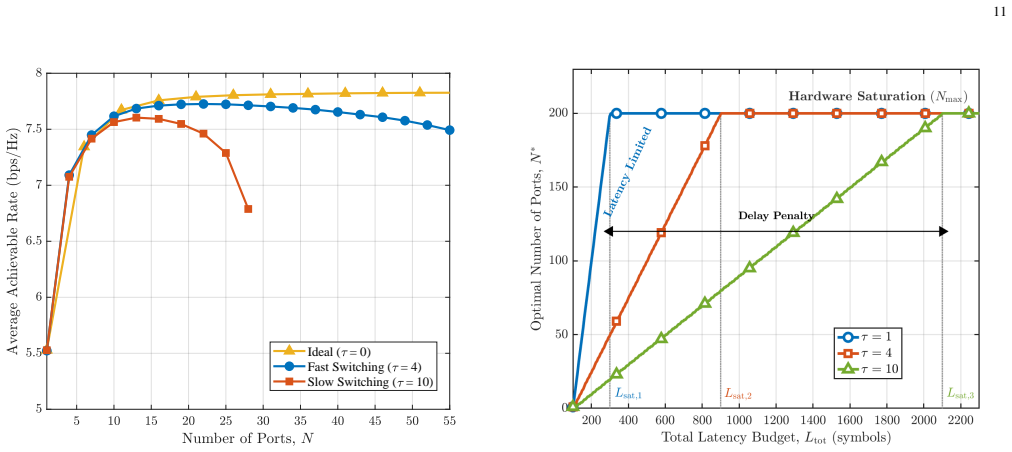
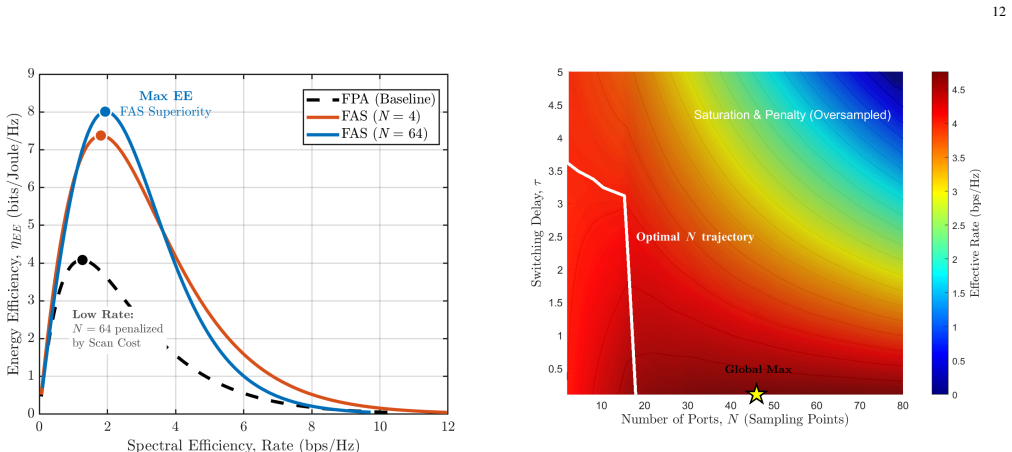
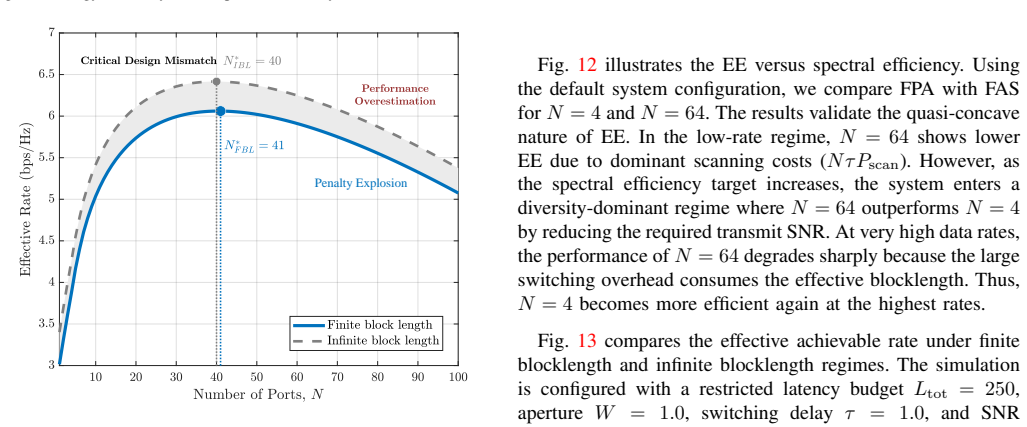
Fluid antenna systems (FAS) exploit antenna position reconfigurability to unlock massive spatial diversity within compact form factors, making them a promising enabler for 6G user terminals (UTs). However, practical port switching incurs latency and signaling overhead, which can be particularly detrimental to hyper-reliable low-latency communications (HRLLC) under finite blocklength operation. This paper investigates FASenabled HRLLC by explicitly capturing the coupled effects of spatial correlation, port switching delay, and finite blocklength coding. We derive exact closed-form expressions for the average block error rate (BLER) and average achievable rate over spatially correlated fading channels. The resulting analysis reveals a fundamental design trade-off: increasing the number of ports improves diversity but linearly reduces the effective blocklength, thereby intensifying finite-blocklength penalties. A key theoretical contribution is a rigorous proof that reliability, achievable rate, and energy efficiency are strictly unimodal in the port dimension, ensuring a unique optimal port configuration. Furthermore, we characterize an explicit switching-delay threshold that separates regimes where FAS yields net gains over fixed-position antenna (FPA) systems. Numerical results validate the analysis and show that substantial HRLLC performance gains are achievable when the switching latency remains below the derived bound.
Editorial analysis
A structured set of objections, weighed in public.
Referee Report
Summary. The paper examines the use of fluid antenna systems (FAS) to enable hyper-reliable low-latency communications (HRLLC) in 6G networks, taking into account the delays associated with port switching and the constraints of finite blocklength coding. It derives exact closed-form expressions for the average block error rate (BLER) and the average achievable rate in the presence of spatially correlated fading channels. A rigorous proof is provided showing that reliability, achievable rate, and energy efficiency are strictly unimodal functions of the number of ports, leading to a unique optimal port configuration. Additionally, an explicit threshold on the switching delay is characterized that determines when FAS provides performance gains compared to fixed-position antenna (FPA) systems.
Significance. If the theoretical results hold under the stated assumptions, the work offers important analytical tools for optimizing FAS configurations in HRLLC scenarios. The closed-form expressions and the unimodality proof enable efficient design without extensive simulations, and the delay threshold provides a clear criterion for practical implementation. This contributes to the understanding of trade-offs between diversity gains and latency penalties in reconfigurable antenna systems for next-generation wireless communications.
major comments (2)
- [§3.2 and §4] §3.2 and §4: The closed-form averaging for BLER and rate (leading to the unimodality proof) requires a specific spatial correlation structure (typically exponential or Toeplitz) that permits analytical integration over the joint port distribution. The paper should explicitly state the covariance model used and provide a brief robustness check or counterexample showing whether unimodality persists under other common correlation models (e.g., Jakes or measured array correlations).
- [§4.1, Eq. (15)] §4.1, Eq. (15) (or equivalent definition of effective blocklength): The model n_eff = n - c·N assumes a strictly linear penalty per additional port. This linearity is load-bearing for the single sign-change argument in the derivative that establishes strict unimodality of BLER, rate, and EE. If switching incurs a fixed overhead plus per-port cost, or if c depends on N or SNR, the derivative may change sign more than once. Please justify the linear model with hardware references or extend the proof to cover mild nonlinearities.
minor comments (2)
- [Abstract and §1] The abstract and introduction repeatedly use 'exact closed-form'; clarify whether the expressions involve special functions (Meijer-G, hypergeometric) that still require numerical quadrature in practice.
- [§5] Numerical validation figures should overlay the closed-form curves with Monte-Carlo markers and report the number of channel realizations used to confirm agreement.
Simulated Author's Rebuttal
We thank the referee for the constructive and detailed comments, which help clarify key aspects of our analysis. We address each major comment below and outline the revisions we will incorporate.
read point-by-point responses
-
Referee: [§3.2 and §4] §3.2 and §4: The closed-form averaging for BLER and rate (leading to the unimodality proof) requires a specific spatial correlation structure (typically exponential or Toeplitz) that permits analytical integration over the joint port distribution. The paper should explicitly state the covariance model used and provide a brief robustness check or counterexample showing whether unimodality persists under other common correlation models (e.g., Jakes or measured array correlations).
Authors: We agree that the closed-form derivations rely on a specific correlation structure to enable analytical integration. The manuscript employs the standard exponential correlation model for fluid antenna systems, which depends on the normalized port separation distances and permits the required joint distribution averaging. We will explicitly state this covariance model in §3.2. For robustness under alternative models such as Jakes' or measured array correlations, a complete analytical extension would require new integration techniques outside the current scope. However, we will add a brief numerical robustness discussion (via Monte Carlo validation) in the revised §4 showing that the unimodality trend persists approximately for the Jakes model under typical parameters. revision: partial
-
Referee: [§4.1, Eq. (15)] §4.1, Eq. (15) (or equivalent definition of effective blocklength): The model n_eff = n - c·N assumes a strictly linear penalty per additional port. This linearity is load-bearing for the single sign-change argument in the derivative that establishes strict unimodality of BLER, rate, and EE. If switching incurs a fixed overhead plus per-port cost, or if c depends on N or SNR, the derivative may change sign more than once. Please justify the linear model with hardware references or extend the proof to cover mild nonlinearities.
Authors: The linear model n_eff = n - c·N is introduced as a first-order approximation capturing the cumulative port-switching latency in sequential selection among N ports, which aligns with the dominant delay component in current fluid antenna hardware implementations. We will add supporting references to hardware literature on reconfigurable and fluid antennas demonstrating this proportional scaling. For mild nonlinearities (e.g., bounded fixed overhead or weak dependence of c on N), the single sign-change property in the derivative can be preserved under standard regularity conditions on the BLER and rate functions; we will include a short remark in the revised §4.1 outlining this extension and noting that strong nonlinearities fall outside the paper's modeling assumptions. revision: yes
Circularity Check
No circularity: closed-form BLER/rate derivations and unimodality proof are self-contained from standard models
full rationale
The paper starts from standard spatially correlated fading channels and finite-blocklength information-theoretic expressions to derive exact closed-form average BLER and achievable rate. The strict unimodality of reliability, rate, and energy efficiency w.r.t. port count N, plus the switching-delay threshold, are then obtained by direct differentiation and sign-change analysis of those closed forms under the assumed covariance structure. No step reduces to a fitted parameter renamed as prediction, self-definitional loop, or load-bearing self-citation chain; the results are conditional on the model but mathematically independent of the target claims. This is the expected honest non-finding for a derivation paper whose central steps remain externally falsifiable.
Axiom & Free-Parameter Ledger
axioms (2)
- domain assumption Spatially correlated fading channels admit a correlation structure that permits exact closed-form averaging of BLER and rate
- domain assumption Port switching delay reduces effective blocklength in a linear fashion
Reference graph
Works this paper leans on
-
[1]
A survey of scheduling in 5G URLLC and outlook for emerging 6G systems,
M. E. Haque, F. Tariq, M. R. A. Khandaker, K. K. Wong, and Y . Zhang, “A survey of scheduling in 5G URLLC and outlook for emerging 6G systems,”IEEE Access, vol. 11, pp. 34372–34396, Apr. 2023
2023
-
[2]
A vision of 6G URLLC: Physical-layer technologies and enablers,
A. Pourkabirian, M. S. Kordafshari, A. Jindal, and M. H. Anisi, “A vision of 6G URLLC: Physical-layer technologies and enablers,”IEEE Commun. Standards Mag., vol. 8, no. 2, pp. 20–27, Jun. 2024
2024
-
[3]
Optimized payload length and power allocation for generalized superimposed pilot in URLLC transmissions,
X. Zhou, Y . Zhu, W. Xia, J. Zhang, and K. K. Wong, “Optimized payload length and power allocation for generalized superimposed pilot in URLLC transmissions,”IEEE Trans. Commun., vol. 72, no. 10, pp. 6073–6086, Oct. 2024
2024
-
[4]
Transmissive RIS transmitter enabled spatial modulation MIMO systems,
X. Zhu, Q. Wu, and W. Chen, “Transmissive RIS transmitter enabled spatial modulation MIMO systems,”IEEE J. Sel. Areas Commun., vol. 43, no. 3, pp. 899–911, Mar. 2025
2025
-
[5]
Performance analysis of RIS-aided double spatial scat- tering modulation for mmWave MIMO systems,
X. Zhuet al., “Performance analysis of RIS-aided double spatial scat- tering modulation for mmWave MIMO systems,”IEEE Trans. Wireless Commun., vol. 23, no. 6, pp. 6139–6155, Jun. 2024
2024
-
[6]
Fluid antenna systems,
K. K. Wong, A. Shojaeifard, K.-F. Tong, and Y . Zhang, “Fluid antenna systems,”IEEE Trans. Wireless Commun., vol. 20, no. 3, pp. 1950–1962, Mar. 2021
1950
-
[7]
Performance limits of fluid antenna systems,
K. K. Wong, A. Shojaeifard, K.-F. Tong, and Y . Zhang, “Performance limits of fluid antenna systems,”IEEE Commun. Lett., vol. 24, no. 11, pp. 2469–2472, Nov. 2020
2020
-
[8]
A tutorial on fluid antenna system for 6G networks: Encompassing communication theory, optimization methods and hard- ware designs,
W. K. Newet al., “A tutorial on fluid antenna system for 6G networks: Encompassing communication theory, optimization methods and hard- ware designs,”IEEE Commun. Surv. Tuts., vol. 27, no. 4, pp. 2325–2377, Aug. 2025
2025
-
[9]
Fluid antenna systems: Redefining reconfigurable wireless communications,
W. K. Newet al., “Fluid antenna systems: Redefining reconfigurable wireless communications,”IEEE J. Sel. Areas Commun., doi:10.1109/ JSAC.2025.3632097, 2026
-
[10]
A contemporary survey on fluid antenna systems: Fundamentals and networking perspectives,
H. Honget al., “A contemporary survey on fluid antenna systems: Fundamentals and networking perspectives,”IEEE Trans. Netw. Sci. Eng., vol. 13, pp. 2305–2328, 2026
2026
-
[11]
Y . Shenet al., “Design and implementation of mmWave surface wave enabled fluid antennas and experimental results for fluid antenna multi- ple access,”arXiv preprint, arXiv:2405.09663, May 2024
-
[12]
Fluid antenna systems enabling 6G: Principles, applica- tions, and research directions,
T. Wuet al., “Fluid antenna systems enabling 6G: Principles, applica- tions, and research directions,”IEEE Wireless Commun., doi:10.1109/ MWC.2025.3629597, 2025
-
[13]
Historical review of fluid antenna and movable antenna,
L. Zhu, and K. K. Wong, “Historical review of fluid antennas and movable antennas,”arXiv preprint, arXiv:2401.02362v2, Jan. 2024
-
[14]
Movable antenna empowered downlink NOMA systems: Power allocation and antenna position optimization,
Y . Zhou, W. Chen, Q. Wu, X. Zhu, and N. Cheng, “Movable antenna empowered downlink NOMA systems: Power allocation and antenna position optimization,”IEEE Wireless Commun. Lett., vol. 13, no. 10, pp. 2772–2776, Oct. 2024
2024
-
[15]
A novel pixel-based reconfigurable antenna applied in fluid antenna systems with high switching speed,
J. Zhanget al., “A novel pixel-based reconfigurable antenna applied in fluid antenna systems with high switching speed,”IEEE Open J. Antennas and Propag., vol. 6, no. 1, pp. 212–228, Feb. 2025
2025
-
[16]
K. K. Wong, C. Wang, S. Shen, C.-B. Chae, and R. Murch, “Recon- figurable pixel antennas meet fluid antenna systems: A paradigm shift to electromagnetic signal and information processing,”IEEE Wireless Commun., doi:10.1109/MWC.2025.3625130, 2025
-
[17]
Fluid antenna multiple access,
K. K. Wong and K.-F. Tong, “Fluid antenna multiple access,”IEEE Trans. Wireless Commun., vol. 21, no. 7, pp. 4801–4815, Jul. 2022
2022
-
[18]
Multi-port selection for FAMA: Massive connectivity with fewer RF chains than users,
H. Honget al., “Multi-port selection for FAMA: Massive connectivity with fewer RF chains than users,”arXiv preprint, arXiv:2511.17897, 2025
-
[19]
Fluid antenna system enhancing orthogonal and non-orthogonal multiple access,
W. K. Newet al., “Fluid antenna system enhancing orthogonal and non-orthogonal multiple access,”IEEE Commun. Lett., vol. 28, no. 1, pp. 218–222, Jan. 2024
2024
-
[20]
LLM-based port selection and beamforming for mul- tiuser MISO with fluid antenna systems,
W. Guoet al., “LLM-based port selection and beamforming for mul- tiuser MISO with fluid antenna systems,”IEEE Trans. Netw. Sci. Eng., vol. 13, pp. 4026–4042, 2026
2026
-
[21]
Fluid antenna multiple access assisted integrated data and energy transfer: Outage and multiplexing gain analysis,
X. Lin, Y . Zhao, H. Yang, J. Hu, and K. K. Wong, “Fluid antenna multiple access assisted integrated data and energy transfer: Outage and multiplexing gain analysis,”IEEE Trans. Wireless Commun., vol. 24, no. 9, pp. 7777–7793, Sept. 2025
2025
-
[22]
From fixed to fluid: Unlocking the new potential with fluid RIS (FRIS),
H. Xiaoet al., “From fixed to fluid: Unlocking the new potential with fluid RIS (FRIS),”arXiv preprint, arXiv:2509.18899, 2025
-
[23]
Fluid reconfigurable intelligent surface (FRIS) enabling secure wireless com- munications,
X. Zhu, K. K. Wong, B. Tang, W. Chen, and C. B. Chae, “Fluid reconfigurable intelligent surface (FRIS) enabling secure wireless com- munications,”arXiv preprint, arXiv:2511.15860, 2025
-
[24]
A framework of FAS-RIS systems: Performance analysis and throughput optimization,
J. Yaoet al., “A framework of FAS-RIS systems: Performance analysis and throughput optimization,”IEEE Trans. Wireless Commun., doi:10. 1109/TWC.2025.3590458, 2025
-
[25]
FAS-RIS for V2X: Unlocking realistic performance analysis with finite elements,
T. Wuet al., “FAS-RIS for V2X: Unlocking realistic performance analysis with finite elements,”arXiv preprint, arXiv:2512.18970, 2025
-
[26]
Fluid antenna system-enabled UA V-to-ground communications,
X. Zhu, K. K. Wong, Q. Wu, H. Shin, and Y . Zhang, “Fluid antenna system-enabled UA V-to-ground communications,”arXiv preprint, arXiv: 2511.17416, 2025
-
[27]
Fluid antenna system-enabled UA V communications in the finite blocklength regime,
X. Zhuet al., “Fluid antenna system-enabled UA V communications in the finite blocklength regime,”arXiv preprint, arXiv:2511.21834, 2025
-
[28]
Delay efficient FA-assisted satellite communication network with mobile edge computing,
J. Zhaoet al., “Delay efficient FA-assisted satellite communication network with mobile edge computing,”IEEE Int. Things J., doi:10.1109/ JIOT.2025.3645072, 2025
-
[29]
Fluid antenna system: New insights on outage probability and diversity gain,
W. K. New, K. K. Wong, H. Xu, K.-F. Tong, and C.-B. Chae, “Fluid antenna system: New insights on outage probability and diversity gain,” IEEE Trans. Wireless Commun., vol. 23, no. 1, pp. 128–140, Jan. 2024
2024
-
[30]
An information-theoretic characterization of MIMO-FAS: Optimiza- tion, diversity-multiplexing tradeoff andq-outage capacity,
W. K. New, K. K. Wong, H. Xu, K.-F. Tong, and C.-B. Chae, “An information-theoretic characterization of MIMO-FAS: Optimiza- tion, diversity-multiplexing tradeoff andq-outage capacity,”IEEE Trans. Wireless Commun., vol. 23, no. 6, pp. 5541-5556, Jun. 2024
2024
-
[31]
On fundamental limits of slow-fluid antenna multiple access for unsourced random access,
Z. Zhanget al., “On fundamental limits of slow-fluid antenna multiple access for unsourced random access,”IEEE Wireless Commun. Lett., vol. 14, no. 11, pp. 3455–3459, Nov. 2025
2025
-
[32]
Coded pattern unsourced random access with analyses on sparse pattern demapper,
Z. Zhanget al., “Coded pattern unsourced random access with analyses on sparse pattern demapper,”IEEE Trans. Wireless Commun., doi:10. 1109/TWC.2025.3617544, 2025
-
[33]
Z. Zhang, K. K. Wong, J. Dang, Z. Zhang, and C.-B. Chae, “On fundamental limits for fluid antenna-assisted integrated sensing and communications for unsourced random access,”IEEE J. Sel. Areas Commun., doi:10.1109/JSAC.2025.3608113, 2025
-
[34]
Fluid antenna systems: A geometric approach to error probability and fundamental limits,
X. Zhuet al., “Fluid antenna systems: A geometric approach to error probability and fundamental limits,”arXiv preprint, arXiv:2509.08815, 2025
-
[35]
Movable antenna enhanced NOMA short-packet transmission,
X. He, W. Chen, Q. Wu, X. Zhu, and N. Cheng, “Movable antenna enhanced NOMA short-packet transmission,”IEEE Commun. Lett., vol. 28, no. 9, pp. 2196–2200, Sept. 2024
2024
discussion (0)
Sign in with ORCID, Apple, or X to comment. Anyone can read and Pith papers without signing in.