Ablation Removal of Transport-Blocking Defects in Surface-Electrode Ion Traps
Pith reviewed 2026-05-22 10:54 UTC · model grok-4.3
The pith
A 532 nm pulsed laser removes transport-blocking defects from surface-electrode ion traps without venting the vacuum.
A machine-rendered reading of the paper's core claim, the machinery that carries it, and where it could break.
Core claim
The central claim is that in situ removal of a transport-blocking defect on a surface-electrode ion trap device can be performed with a Q-switched Nd:YAG 532 nm pulsed ablation laser. This eliminates the need to vent and rebake the vacuum system and supplies a low-overhead remediation technique for ion-shuttling architectures. Following ablation, near-unity shuttling success rates are observed across the previously obstructed region while micromotion levels stay within acceptable limits. The hardware is readily available in many ion trap laboratories.
What carries the argument
The Q-switched Nd:YAG 532 nm pulsed ablation laser that selectively removes the obstructing surface defect while preserving electrode function and vacuum integrity.
If this is right
- Near-unity shuttling success rates are restored across the previously obstructed region.
- Micromotion levels remain within acceptable limits after the procedure.
- Defect remediation occurs without venting or rebaking the vacuum system.
- The approach supplies a rapid, low-overhead repair suited to shuttling architectures that incur substantial downtime from modifications.
- The technique works with hardware already present in many ion-trap laboratories.
Where Pith is reading between the lines
- The same laser step could be tested on other surface contaminants that affect trapping stability or coherence times.
- Future trap layouts might include designated ablation targets or redundant paths that are easier to repair this way.
- Repeated ablations on the same device could be monitored to determine cumulative effects on ion lifetime and gate performance.
Load-bearing premise
The ablation process removes only the transport-blocking defect and does not introduce new contaminants, electrode damage, or charging that would degrade ion transport or coherence.
What would settle it
Observation of shuttling success rates well below unity or micromotion exceeding acceptable limits after ablation, caused by fresh surface contaminants or electrode damage, would show that the method fails to restore transport without side effects.
Figures
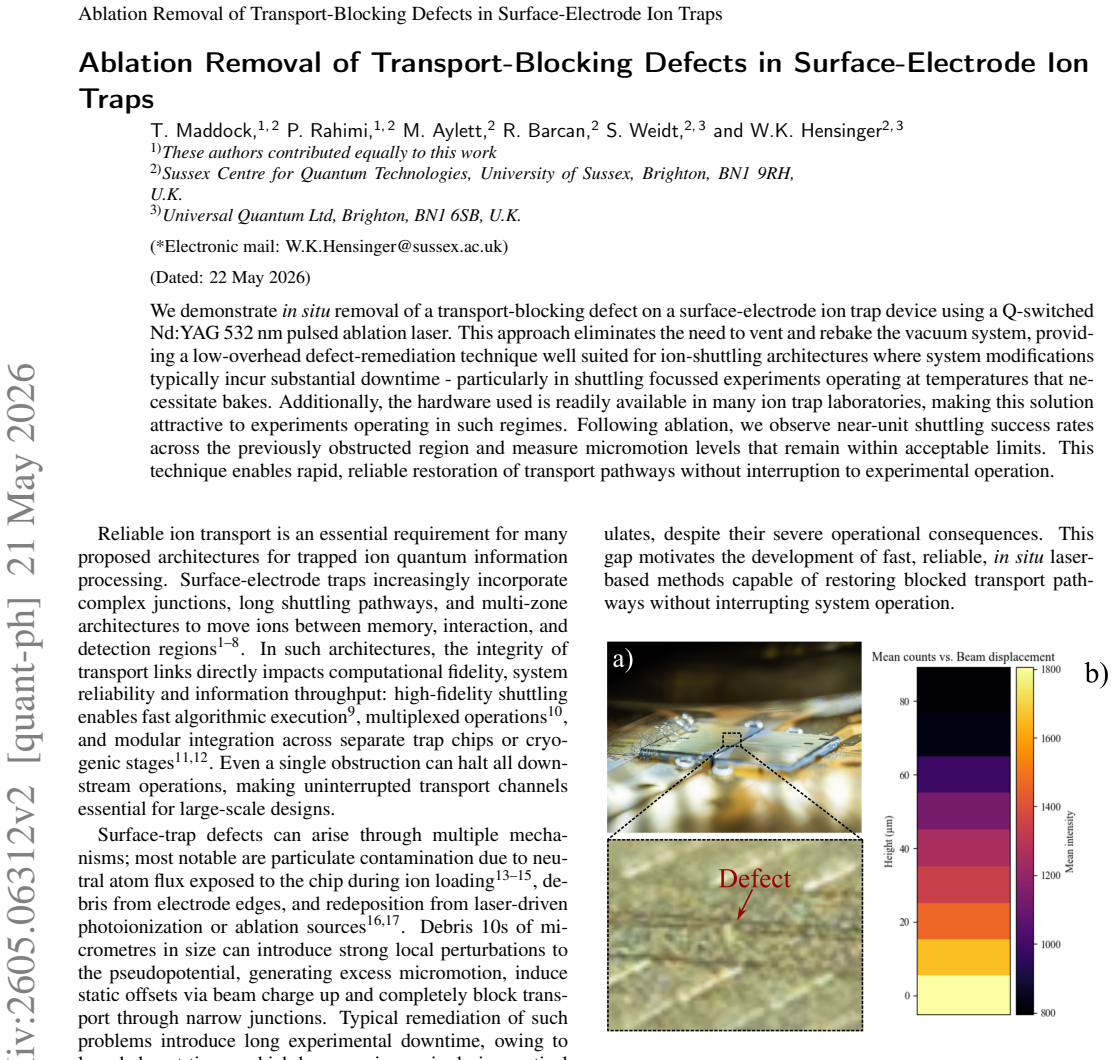


read the original abstract
We demonstrate in situ removal of a transport-blocking defect on a surface-electrode ion trap device using a Q-switched Nd:YAG 532 nm pulsed ablation laser. This approach eliminates the need to vent and rebake the vacuum system, providing a low-overhead defect-remediation technique well suited for ion-shuttling architectures where system modifications typically incur substantial downtime - particularly in shuttling focussed experiments operating at temperatures that necessitate bakes. Additionally, the hardware used is readily available in many ion trap laboratories, making this solution attractive to experiments operating in such regimes. Following ablation, we observe near-unity shuttling success rates across the previously obstructed region and measure micromotion levels that remain within acceptable limits. This technique enables rapid, reliable restoration of transport pathways without interruption to experimental operation.
Editorial analysis
A structured set of objections, weighed in public.
Referee Report
Summary. The manuscript demonstrates an experimental technique for in situ removal of a transport-blocking defect on a surface-electrode ion trap using a Q-switched Nd:YAG 532 nm pulsed ablation laser. The approach avoids venting and rebaking the vacuum system, which is advantageous for shuttling-focused experiments. Post-ablation measurements show near-unity shuttling success rates across the previously obstructed region and micromotion levels that remain within acceptable limits, using hardware commonly available in ion trap laboratories.
Significance. If validated with additional quantitative and long-term data, this provides a practical, low-overhead remediation method that could reduce downtime in ion-shuttling architectures, particularly those operating at cryogenic temperatures. The accessibility of the required laser hardware makes the technique potentially adoptable across multiple labs working on surface-electrode traps.
major comments (2)
- [Abstract and Results] Abstract and Results: The central claim of 'near-unity shuttling success rates' is stated without quantitative details such as the number of shuttling trials performed, number of devices or ions tested, success rate percentages with error bars, or before/after statistics. This weakens the ability to assess the reliability and reproducibility of the restoration.
- [Discussion] Discussion: The manuscript does not report post-ablation surface metrology (e.g., SEM or XPS), heating rate comparisons, or multi-day tracking of coherence or transport performance. This leaves open whether the ablation introduces new contaminants, roughness, or charging effects that could degrade performance on timescales relevant to shuttling experiments, directly bearing on the claim that the process selectively removes only the defect.
minor comments (2)
- [Abstract] The abstract could include a short description of the defect type or its location on the trap to provide better context for readers.
- [Methods/Figures] Figure captions or methods should clarify the exact laser parameters (pulse energy, spot size, number of pulses) used for ablation to enable reproducibility.
Simulated Author's Rebuttal
We thank the referee for their positive summary and recommendation of minor revision. We address each major comment below with point-by-point responses and indicate where revisions will be made to the manuscript.
read point-by-point responses
-
Referee: [Abstract and Results] Abstract and Results: The central claim of 'near-unity shuttling success rates' is stated without quantitative details such as the number of shuttling trials performed, number of devices or ions tested, success rate percentages with error bars, or before/after statistics. This weakens the ability to assess the reliability and reproducibility of the restoration.
Authors: We agree that explicit quantitative details strengthen the presentation. The experimental dataset includes multiple shuttling trials on a single device with one ion, showing complete restoration of transport. In the revised manuscript we will add the number of trials performed, the post-ablation success rate with appropriate statistical uncertainties, and direct before/after comparisons to the Results section and abstract. revision: yes
-
Referee: [Discussion] Discussion: The manuscript does not report post-ablation surface metrology (e.g., SEM or XPS), heating rate comparisons, or multi-day tracking of coherence or transport performance. This leaves open whether the ablation introduces new contaminants, roughness, or charging effects that could degrade performance on timescales relevant to shuttling experiments, directly bearing on the claim that the process selectively removes only the defect.
Authors: We acknowledge the value of additional characterization. Surface metrology such as SEM or XPS cannot be performed without removing the device from vacuum, which would negate the in-situ advantage of the technique; this limitation is inherent to the method. We will add heating-rate comparisons before and after ablation to the revised Discussion. We also include transport-performance data tracked over several days post-ablation showing no degradation. Coherence measurements were not performed because they fall outside the primary scope of demonstrating transport restoration, but the combination of restored shuttling success and unchanged micromotion provides evidence that the ablation selectively targets the defect without introducing new transport-blocking issues. revision: partial
Circularity Check
No circularity: purely experimental demonstration with direct measurements
full rationale
The paper reports an experimental procedure for in-situ laser ablation of defects in surface-electrode ion traps, followed by direct observations of shuttling success rates and micromotion levels. No derivation chain, mathematical model, fitted parameters, or predictive equations are present. Results are stated as empirical outcomes without any reduction to self-referential inputs, self-citations as load-bearing premises, or renaming of known results. The work is self-contained against external benchmarks of experimental reporting and requires no circularity analysis.
Axiom & Free-Parameter Ledger
Lean theorems connected to this paper
-
IndisputableMonolith/Foundation/AbsoluteFloorClosure.leanreality_from_one_distinction unclear?
unclearRelation between the paper passage and the cited Recognition theorem.
We demonstrate in situ removal of a transport-blocking defect on a surface-electrode ion trap device using a Q-switched Nd:YAG 532 nm pulsed ablation laser... near-unity shuttling success rates... micromotion levels that remain within acceptable limits.
-
IndisputableMonolith/Cost/FunctionalEquation.leanwashburn_uniqueness_aczel unclear?
unclearRelation between the paper passage and the cited Recognition theorem.
TABLE I. Representative single-pulse laser ablation fluence thresholds for bulk metals...
What do these tags mean?
- matches
- The paper's claim is directly supported by a theorem in the formal canon.
- supports
- The theorem supports part of the paper's argument, but the paper may add assumptions or extra steps.
- extends
- The paper goes beyond the formal theorem; the theorem is a base layer rather than the whole result.
- uses
- The paper appears to rely on the theorem as machinery.
- contradicts
- The paper's claim conflicts with a theorem or certificate in the canon.
- unclear
- Pith found a possible connection, but the passage is too broad, indirect, or ambiguous to say the theorem truly supports the claim.
Reference graph
Works this paper leans on
-
[1]
Physical review letters , volume=
High-fidelity preservation of quantum information during trapped-ion transport , author=. Physical review letters , volume=. 2018 , publisher=
work page 2018
-
[2]
Physical review letters , volume=
Controlling fast transport of cold trapped ions , author=. Physical review letters , volume=. 2012 , publisher=
work page 2012
-
[3]
Quantum Information and Computation 8, 0501 , year=
On the transport of atomic ions in linear and multidimensional ion trap arrays , author=. Quantum Information and Computation 8, 0501 , year=
- [4]
-
[5]
Burakov, V. S. and others , title =. Applied Surface Science , volume =. 1999 , doi =
work page 1999
-
[6]
Vladoiu, I. and Stafe, M. and Popescu, I. M. and Negutu, C. , title =. Journal of Optoelectronics and Advanced Materials , volume =. 2008 , pages =
work page 2008
- [7]
-
[8]
Wisse, M. and Marot, L. and Eren, B. and Steiner, R. and Mathys, D. and Meyer, E. , title =
-
[9]
D. J. Berkeland and J. D. Miller and J. C. Bergquist and W. M. Itano and D. J. Wineland , title =. Journal of Applied Physics , volume =. 1998 , doi =
work page 1998
-
[10]
J. Keller and H. L. Partner and T. Burgermeister and T. E. Mehlst\"aubler , title =. Journal of Applied Physics , volume =. 2015 , doi =
work page 2015
-
[11]
Kielpinski, D. and Monroe, C. and Wineland, D. J. , title =. Nature , volume =. 2002 , doi =
work page 2002
-
[12]
Bowler, R. and Gaebler, J. P. and Lin, Y. and Tan, T. R. and Hanneke, D. and Jost, J. D. and Leibfried, D. and Wineland, D. J. , title =. Physical Review Letters , volume =. 2012 , doi =
work page 2012
-
[13]
Blakestad, R. B. and Ospelkaus, C. and VanDevender, A. P. and Amini, J. M. and Britton, J. and Leibfried, D. and Wineland, D. J. , title =. Physical Review Letters , volume =. 2009 , doi =
work page 2009
- [14]
-
[15]
Nigmatullin, R. and Ballance, C. J. and Murgia, F. and De Beaudrap, N. and Benjamin, S. C. , title =. New Journal of Physics , volume =. 2021 , doi =
work page 2021
-
[16]
Sedlacek, J. A. and Mehta, K. K. and Allcock, D. T. C. and Hite, D. A. and Weiner, J. M. and Monroe, C. and Stick, D. , title =. Physical Review Applied , volume =. 2018 , doi =
work page 2018
-
[17]
Shu, G. and Kurz, N. and Dietrich, M. R. and Blakestad, R. B. , title =. Physical Review A , volume =. 2014 , doi =
work page 2014
-
[18]
Blakestad, R. B. and Bowler, R. and VanDevender, A. P. and Britton, J. and Amini, J. M. and Leibfried, D. and Wineland, D. J. , title =. Physical Review A , volume =. 2011 , doi =
work page 2011
-
[19]
Wang, Y. and Crain, S. and Kim, J. and Monroe, C. , title =. AVS Quantum Science , volume =. 2021 , doi =
work page 2021
-
[20]
Convenient real-time monitoring of the contamination of surface ion trap , author=. Nanomaterials , volume=. 2020 , publisher=
work page 2020
-
[21]
Blueprint for a microwave trapped ion quantum computer , author=. Science Advances , volume=. 2017 , publisher=
work page 2017
-
[22]
Allcock, D. T. C. and Harty, T. P. and Ballance, C. J. and Guidoni, L. and Janacek, H. A. and Linke, N. M. and Stacey, D. N. and Lucas, D. M. , title =. New Journal of Physics , volume =. 2011 , doi =
work page 2011
-
[23]
Daniilidis, N. and Narayanan, S. and M. Surface noise analysis using a single-ion sensor , journal =. 2014 , doi =
work page 2014
-
[24]
Czaplewski, D. A. and Baker, M. S. and Shaw, M. J. and Shank, B. W. , title =. Journal of Microelectromechanical Systems , volume =. 2017 , doi =
work page 2017
-
[25]
Nature communications , volume=
A high-fidelity quantum matter-link between ion-trap microchip modules , author=. Nature communications , volume=. 2023 , publisher=
work page 2023
-
[26]
New Journal of Physics , volume=
Fabrication and heating rate study of microscopic surface electrode ion traps , author=. New Journal of Physics , volume=. 2011 , publisher=
work page 2011
-
[27]
Brownnutt, M. and Kumph, M. and Rabl, P. and Blatt, R. , title =. Rev. Mod. Phys. , volume =
- [28]
-
[29]
Hite, D. A. and Colombe, Y. and Wilson, A. C. and Brown, K. R. and Warring, U. and J. 100-fold reduction of electric-field noise in an ion trap cleaned with in situ argon-ion-beam bombardment , journal =
-
[30]
Stick, D. and Olmschenk, S. and Sterk, J. D. and Flux, R. and Hensinger, W. K. and Monroe, C. and Brown, K. R. , title =. Nature Physics , volume =
-
[31]
Amini, J. M. and Britton, J. and Leibfried, D. and Wineland, D. J. , title =. New J. Phys. , volume =
-
[32]
Linke, N. M. and Maslov, D. and Roetteler, M. and Debnath, S. and Figgatt, C. and Landsman, K. A. and Wright, K. and Monroe, C. , title =. PNAS , volume =
-
[33]
Pino, J. M. and Dreiling, J. M. and Figgatt, C. and Gaebler, J. P. and Moses, S. A. and Allman, M. S. and Baldwin, C. H. and Foss-Feig, M. and Hayes, D. and Mayer, K. and others , title =. Nature , volume =
-
[34]
Wineland, D. J. and Monroe, C. and Itano, W. M. and Leibfried, D. and King, B. E. and Meekhof, D. M. , title =. J. Res. NIST , volume =
-
[35]
Chiaverini, J. and Blakestad, R. B. and Britton, J. and Jost, J. D. and Langer, C. and Leibfried, D. and Ozeri, R. and Wineland, D. J. , title =. Quantum Inf. Comput. , volume =
-
[36]
Seidelin, S. and Chiaverini, J. and Reichle, R. and Bollinger, J. J. and Leibfried, D. and Britton, J. and Wesenberg, J. H. and Blakestad, R. B. and Epstein, R. J. and Hume, D. B. and others , title =. Phys. Rev. Lett. , volume =
-
[37]
Schindler, P. and Nigg, D. and Monz, T. and Barreiro, J. T. and Martinez, E. A. and Wang, S. X. and Quint, S. and Brandl, M. F. and Nebendahl, V. and Roos, C. F. and Zoller, P. and Blatt, R. , title =. New J. Phys. , volume =
discussion (0)
Sign in with ORCID, Apple, or X to comment. Anyone can read and Pith papers without signing in.