ReasonSTL: Bridging Natural Language and Signal Temporal Logic via Tool-Augmented Process-Rewarded Learning
Pith reviewed 2026-05-11 01:46 UTC · model grok-4.3
The pith
A 4B open-source model trained with ReasonSTL translates natural language into Signal Temporal Logic formulas more accurately than prior methods while keeping costs low and data private.
A machine-rendered reading of the paper's core claim, the machinery that carries it, and where it could break.
Core claim
ReasonSTL decomposes natural-language-to-STL translation into explicit reasoning, deterministic tool calls, and structured formula construction, then uses process-rewarded training to supervise both tool-use trajectories and final formulas on the STL-Bench benchmark, enabling a 4B open-source model to achieve state-of-the-art performance in automatic metrics and human evaluations.
What carries the argument
Decomposition of the translation process into explicit reasoning, deterministic tool calls for formula manipulation, and structured construction, supervised via process-rewarded training on full trajectories and outputs.
If this is right
- Formal specification drafting becomes accessible without specialized temporal-logic expertise.
- Industrial users gain a transparent, low-cost alternative that avoids commercial API token expenses and data exposure.
- Generated formulas come with inspectable reasoning traces that support verification and debugging.
- Bilingual support in the benchmark enables consistent handling of English and Chinese requirements.
Where Pith is reading between the lines
- The same tool-augmented process-reward approach could transfer to other formal languages such as LTL or MTL.
- Integration with runtime monitoring tools might allow end-to-end pipelines from spoken requirements to verified controller synthesis.
- Scaling the training to larger open models or additional real-world signal datasets would likely improve coverage of complex nested temporal operators.
Load-bearing premise
The process-rewarded training on tool-use trajectories produces formulas that generalize to unseen real-world signals and requirements beyond the STL-Bench distribution.
What would settle it
Evaluating the 4B model on a fresh collection of natural-language requirements drawn from a new application domain with corresponding real signals, then verifying whether the generated STL formulas accurately match the intended temporal behaviors under simulation or model checking.
Figures

read the original abstract
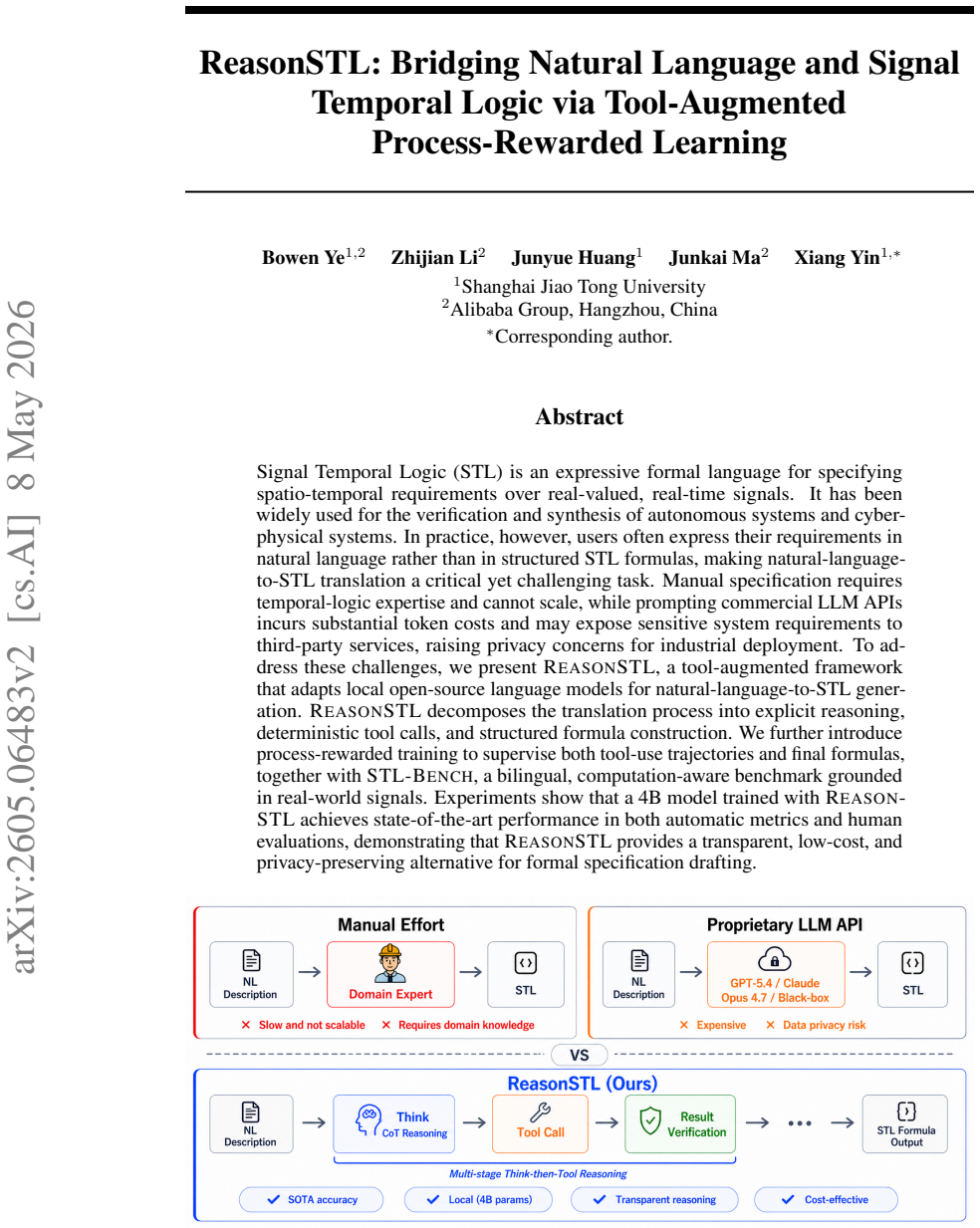
Signal Temporal Logic (STL) is an expressive formal language for specifying spatio-temporal requirements over real-valued, real-time signals. It has been widely used for the verification and synthesis of autonomous systems and cyber-physical systems. In practice, however, users often express their requirements in natural language rather than in structured STL formulas, making natural-language-to-STL translation a critical yet challenging task. Manual specification requires temporal-logic expertise and cannot scale, while prompting commercial LLM APIs incurs substantial token costs and may expose sensitive system requirements to third-party services, raising privacy concerns for industrial deployment. To address these challenges, we present \textsc{ReasonSTL}, a tool-augmented framework that adapts local open-source language models for natural-language-to-STL generation. \textsc{ReasonSTL} decomposes the translation process into explicit reasoning, deterministic tool calls, and structured formula construction. We further introduce process-rewarded training to supervise both tool-use trajectories and final formulas, together with \textsc{STL-Bench}, a bilingual, computation-aware benchmark grounded in real-world signals. Experiments show that a 4B model trained with \textsc{ReasonSTL} achieves state-of-the-art performance in both automatic metrics and human evaluations, demonstrating that \textsc{ReasonSTL} provides a transparent, low-cost, and privacy-preserving alternative for formal specification drafting.
Editorial analysis
A structured set of objections, weighed in public.
Referee Report
Summary. The manuscript presents ReasonSTL, a tool-augmented framework that adapts small open-source LLMs for natural-language-to-STL translation by decomposing the process into explicit reasoning steps, deterministic tool calls, and structured formula construction. It introduces process-rewarded training to supervise both trajectories and final outputs, along with STL-Bench (a bilingual, computation-aware benchmark grounded in real-world signals). The central claim is that a 4B model trained under this regime achieves state-of-the-art results on automatic metrics and human evaluations, providing a transparent, low-cost, and privacy-preserving alternative to commercial LLM APIs for formal specification drafting in autonomous and cyber-physical systems.
Significance. If the empirical claims hold after full experimental details are supplied, the work would be significant for neuro-symbolic AI and formal methods. It demonstrates a practical route to local, reproducible NL-to-STL generation that avoids token costs and data exposure, which is directly relevant to industrial verification and synthesis workflows. The structured use of process rewards on tool-use trajectories is a concrete technical contribution that could be extended to other formal languages.
major comments (2)
- [Abstract] Abstract: the assertion of state-of-the-art performance on automatic metrics and human evaluations provides no information on baseline implementations, exact metric definitions, statistical significance testing, or data-split procedures that would prevent leakage from STL-Bench; without these, the central performance claim cannot be evaluated.
- [Experiments] Experiments section (implied by the abstract's results statement): no out-of-distribution splits, cross-domain signals, or industrial case studies are described to test whether the generated STL formulas and satisfaction rates generalize beyond the STL-Bench distribution to arbitrary real-world signals and requirements.
minor comments (1)
- [Abstract] Abstract: the phrase 'computation-aware benchmark' is used without a one-sentence gloss of which computational aspects (e.g., formula complexity, solver calls) are tracked.
Simulated Author's Rebuttal
We thank the referee for the detailed and constructive comments. We address each major point below, clarifying the content of the full manuscript where relevant and indicating the revisions we will make to improve clarity and strengthen the empirical evaluation.
read point-by-point responses
-
Referee: [Abstract] Abstract: the assertion of state-of-the-art performance on automatic metrics and human evaluations provides no information on baseline implementations, exact metric definitions, statistical significance testing, or data-split procedures that would prevent leakage from STL-Bench; without these, the central performance claim cannot be evaluated.
Authors: We agree that the abstract should be self-contained. The full manuscript (Section 4) specifies all baselines (GPT-4, Claude-3, Llama-3-8B, and prior NL-to-STL methods), exact metrics (formula syntactic accuracy, semantic satisfaction rate on sampled signals, and human preference scores), statistical significance (paired t-tests with p < 0.01 reported), and data splits (80/20 train/test on STL-Bench with no overlap between training trajectories and test formulas). STL-Bench was constructed after model training to avoid leakage. We will revise the abstract to include a concise summary of these elements. revision: yes
-
Referee: [Experiments] Experiments section (implied by the abstract's results statement): no out-of-distribution splits, cross-domain signals, or industrial case studies are described to test whether the generated STL formulas and satisfaction rates generalize beyond the STL-Bench distribution to arbitrary real-world signals and requirements.
Authors: We acknowledge that the current experimental section focuses on in-distribution performance on STL-Bench. While STL-Bench already incorporates signals from multiple real-world domains (autonomous driving, robotics, and sensor networks) and uses computation-aware verification, we agree that explicit OOD testing would better support generalization claims. We will add a new subsection reporting results on held-out OOD splits (different signal distributions and requirement styles) and include two qualitative industrial case studies drawn from published CPS verification benchmarks. These additions will be included in the revised manuscript. revision: yes
Circularity Check
No circularity: framework, training, and benchmark are externally grounded
full rationale
The paper introduces ReasonSTL as a decomposition into reasoning steps, deterministic tool calls, and formula construction, supervised via process-rewarded training on the newly defined STL-Bench benchmark. No equations or claims reduce a derived quantity to a fitted parameter or self-citation by construction; the reported SOTA results on automatic metrics and human evaluations are presented as empirical outcomes of training a 4B model, with no load-bearing self-referential definitions or uniqueness theorems imported from prior author work. The derivation chain remains independent of its inputs.
Axiom & Free-Parameter Ledger
Reference graph
Works this paper leans on
- [1]
-
[2]
E. Bartocci, J. Deshmukh, A. Donzé, G. Fainekos, O. Maler, D. Ni ˇckovi´c, and S. Sankara- narayanan. Specification-based monitoring of cyber-physical systems: a survey on theory, tools and applications. InLectures on Runtime Verification: Introductory and Advanced Topics, pages 135–175. Springer, 2018
work page 2018
-
[3]
C. Belta and S. Sadraddini. Formal methods for control synthesis: An optimization perspective. Annual Review of Control, Robotics, and Autonomous Systems, 2(1):115–140, 2019
work page 2019
-
[4]
A. Brunello, A. Montanari, and M. Reynolds. Synthesis of ltl formulas from natural language texts: State of the art and research directions. In26th International symposium on temporal representation and reasoning (TIME 2019), pages 17–1. Schloss Dagstuhl–Leibniz-Zentrum für Informatik, 2019
work page 2019
-
[5]
M. Charitidou and D. V . Dimarogonas. Distributed mpc with continuous-time stl constraint satisfaction guarantees.IEEE Control Systems Letters, 8:211–216, 2024
work page 2024
-
[6]
Y . Chen, R. Gandhi, Y . Zhang, and C. Fan. Nl2tl: Transforming natural languages to temporal logics using large language models. InProceedings of the 2023 Conference on Empirical Methods in Natural Language Processing, pages 15880–15903, 2023
work page 2023
- [7]
-
[8]
Y . Fang, Z. Jin, J. An, H. Chen, X. Chen, and N. Zhan. Enhancing transformation from natural language to signal temporal logic using llms with diverse external knowledge. InFindings of the Association for Computational Linguistics: ACL 2025, pages 10446–10458, 2025
work page 2025
-
[9]
Y . Fang, Z. Jin, J. An, H. Chen, X. Chen, and N. Zhan. Restl: Reinforcement learning guided by multi-aspect rewards for signal temporal logic transformation. InProceedings of the AAAI Conference on Artificial Intelligence, volume 40, pages 30682–30689, 2026
work page 2026
-
[10]
F. Fuggitti and T. Chakraborti. Nl2ltl–a python package for converting natural language (nl) instructions to linear temporal logic (ltl) formulas. InProceedings of the AAAI Conference on Artificial Intelligence, volume 37, pages 16428–16430, 2023
work page 2023
-
[11]
N. Gopalan, D. Arumugam, L. L. Wong, and S. Tellex. Sequence-to-sequence language grounding of non-markovian task specifications. InRobotics: Science and Systems, volume 2018, 2018
work page 2018
-
[12]
J. He, E. Bartocci, D. Niˇckovi´c, H. Isakovic, and R. Grosu. Deepstl: from english requirements to signal temporal logic. InProceedings of the 44th International Conference on Software Engineering, pages 610–622, 2022
work page 2022
-
[13]
Z. Kong, A. Jones, and C. Belta. Temporal logics for learning and detection of anomalous behavior.IEEE Transactions on Automatic Control, 62(3):1210–1222, 2016
work page 2016
-
[14]
L. Lindemann and D. V . Dimarogonas. Control barrier functions for signal temporal logic tasks. IEEE control systems letters, 3(1):96–101, 2018
work page 2018
- [15]
-
[16]
R. Liu, A. Hou, X. Yu, and X. Yin. Zero-shot trajectory planning for signal temporal logic tasks. InThe Thirty-ninth Annual Conference on Neural Information Processing Systems, 2026
work page 2026
-
[17]
O. Maler and D. Nickovic. Monitoring temporal properties of continuous signals. InInterna- tional symposium on formal techniques in real-time and fault-tolerant systems, pages 152–166. Springer, 2004. 10
work page 2004
-
[18]
Y . Mao, T. Zhang, X. Cao, Z. Chen, X. Liang, B. Xu, and H. Fang. Nl2stl: Transformation from logic natural language to signal temporal logics using llama2. In2024 IEEE International Conference on Cybernetics and Intelligent Systems (CIS) and IEEE International Conference on Robotics, Automation and Mechatronics (RAM), pages 469–474. IEEE, 2024
work page 2024
-
[19]
D. Mendoza, C. Hahn, and C. Trippel. Translating natural language to temporal logics with large language models and model checkers. In2024 Formal Methods in Computer-Aided Design (FMCAD), pages 1–11. IEEE, 2024
work page 2024
- [20]
-
[21]
S. Mohammadinejad, S. Paul, Y . Xia, V . Kudalkar, J. Thomason, and J. V . Deshmukh. Systematic translation from natural language robot task descriptions to stl. InInternational Conference on Bridging the Gap between AI and Reality, pages 259–276. Springer, 2024
work page 2024
- [22]
- [23]
- [24]
- [25]
-
[26]
Y . Yang, S. Xiong, A. Payani, E. Shareghi, and F. Fekri. Harnessing the power of large language models for natural language to first-order logic translation. InProceedings of the 62nd Annual Meeting of the Association for Computational Linguistics (Volume 1: Long Papers), pages 6942–6959, 2024
work page 2024
- [27]
-
[28]
X. Yin, B. Gao, and X. Yu. Formal synthesis of controllers for safety-critical autonomous systems: Developments and challenges.Annual Reviews in Control, 57:100940, 2024
work page 2024
-
[29]
P. Yu, S. Dong, S. Sheng, L. Feng, and M. Kwiatkowska. Trust-aware motion planning for human-robot collaboration under distribution temporal logic specifications. In2024 IEEE International Conference on Robotics and Automation (ICRA), pages 12949–12955. IEEE, 2024. 11 A Related Work A.1 Natural Language to Temporal Logic Natural-language-to-temporal-logic...
work page 2024
discussion (0)
Sign in with ORCID, Apple, or X to comment. Anyone can read and Pith papers without signing in.