Near-field Channel Estimation for XL-RIS-aided mmWave MIMO Systems
Pith reviewed 2026-05-11 00:44 UTC · model grok-4.3
The pith
A two-stage scheme estimates cascaded XL-RIS channels with substantially reduced pilot overhead while matching benchmark accuracy.
A machine-rendered reading of the paper's core claim, the machinery that carries it, and where it could break.
Core claim
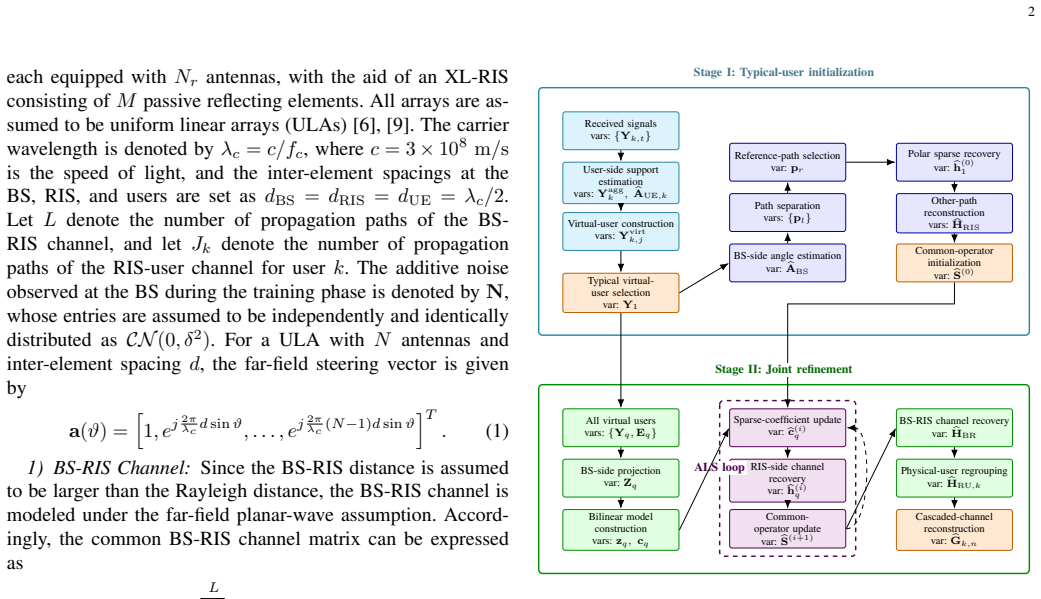
The authors establish that the hybrid-field cascaded channel estimation problem for XL-RIS MU-MIMO can be solved with low pilot overhead by jointly exploiting the common BS-RIS link across users and the polar-domain sparsity of the RIS-user channels. The procedure first decomposes users into virtual single-antenna users, extracts common parameters from a typical user, initializes user channels via compensated polar-domain sparse recovery, and then applies alternating least-squares refinement to jointly improve the common BS-RIS operator and the per-user RIS-side channels.
What carries the argument
The two-stage low-overhead estimation procedure that performs virtual single-antenna user decomposition, compensated polar-domain sparse recovery for initialization, and alternating least-squares joint refinement of the common BS-RIS operator and user-specific channels.
If this is right
- The scheme achieves competitive channel estimation performance with substantially reduced pilot overhead compared with existing near-field benchmarks.
- The method works in the hybrid far-field BS-RIS and near-field RIS-user setting.
- Exploiting the common BS-RIS link benefits all users simultaneously.
- The alternating least-squares step jointly improves both the shared operator and the user-specific channels.
Where Pith is reading between the lines
- Similar compensated-sparsity techniques could apply to other large-aperture systems that mix far-field and near-field links.
- Lower pilot counts may enable more frequent channel updates in time-varying or mobile XL-RIS deployments.
- The hybrid-field modeling choice may simplify hardware and algorithm design if the far-field BS-RIS assumption holds in typical deployments.
Load-bearing premise
The BS-RIS link remains strictly far-field while all RIS-user links are near-field, and the near-field channels remain sufficiently sparse after compensation in the polar domain.
What would settle it
A simulation or measurement in which the proposed scheme requires the same number of pilots as existing near-field benchmarks to reach equivalent estimation accuracy, or in which the compensated polar-domain representation shows no usable sparsity.
Figures


read the original abstract
Extremely large-scale reconfigurable intelligent surfaces (XL-RISs) have emerged as a promising technology for millimeter-wave (mmWave) communications. However, the exceedingly large aperture of XL-RISs renders the RIS-user links likely to operate in the near-field region, where the conventional planar-wave assumption and angular-domain sparse representation become invalid, thus making channel estimation significantly more challenging. In this paper, we investigate cascaded channel estimation for an XL-RIS-aided multi-user multiple-input multiple-output (MU-MIMO) system, in which the BS-RIS channel is modeled in the far field, while the RIS-user channels exhibit near-field spherical-wave characteristics. To tackle the resulting hybrid-field estimation problem, we propose a low-overhead two-stage channel estimation scheme by jointly exploiting the common BS-RIS link shared by all users and the polar-domain sparsity of the RIS-user channels. Specifically, the multi-antenna users are firstly decomposed into multiple virtual single-antenna users, based on which the common BS-RIS parameters are extracted from a typical virtual user and the RIS-user channels are initialized via compensated polar-domain sparse recovery. Then, an alternating least-squares refinement procedure is developed to jointly improve the common BS-RIS operator and the user-specific RIS-side channels. Simulation results show that the proposed scheme achieves competitive channel estimation performance with substantially reduced pilot overhead compared with the existing near-field benchmarks.
Editorial analysis
A structured set of objections, weighed in public.
Referee Report
Summary. The paper proposes a two-stage low-overhead channel estimation scheme for XL-RIS-aided mmWave MU-MIMO systems. The BS-RIS link is modeled as far-field while RIS-user links use near-field spherical-wave propagation. Multi-antenna users are decomposed into virtual single-antenna users to extract the common BS-RIS parameters from one virtual user; RIS-user channels are then initialized via compensated polar-domain sparse recovery and jointly refined with an alternating least-squares procedure. Simulations claim competitive NMSE performance at substantially lower pilot overhead than existing near-field benchmarks.
Significance. If the compensated polar-domain sparsity holds and the alternating refinement reliably improves the estimates, the approach could meaningfully reduce pilot overhead for practical XL-RIS deployments in mmWave MIMO, addressing a key scalability bottleneck. The hybrid-field modeling and exploitation of the shared BS-RIS link are conceptually attractive, but the significance depends on whether the sparsity assumption generalizes beyond the simulated scenarios.
major comments (3)
- [§III] §III (Proposed Scheme), compensated polar-domain sparse recovery step: the manuscript provides no quantitative sparsity metrics (e.g., average number of significant atoms per channel or mutual coherence of the constructed dictionary) nor any coherence bound guaranteeing that the first-stage recovery succeeds at the claimed reduced pilot overhead. This assumption is load-bearing for the headline performance claim.
- [§III.C] §III.C (Alternating least-squares refinement): no convergence analysis or guarantee to a global optimum is supplied for the alternating procedure. Given that the initialization quality depends on the unquantified polar sparsity, the lack of such analysis leaves the reported NMSE gains without theoretical support.
- [§IV] §IV (Simulation Results): the performance curves lack error bars, standard deviations across random seeds, or Monte-Carlo trial counts. Without these, it is impossible to assess whether the claimed gains over near-field benchmarks are statistically reliable or sensitive to particular channel realizations.
minor comments (2)
- [§III.A] The decomposition into virtual single-antenna users is described only in text; a small diagram or explicit matrix notation would clarify how the common BS-RIS operator is isolated.
- [§III.B] Notation for the compensated polar dictionary (e.g., the exact form of the compensation phase term) should be stated as an equation rather than left implicit in the algorithm description.
Simulated Author's Rebuttal
We thank the referee for the constructive comments, which help clarify the presentation and strengthen the theoretical and empirical support for our two-stage channel estimation scheme. We address each major comment below and commit to revisions that incorporate the suggested improvements where feasible.
read point-by-point responses
-
Referee: [§III] §III (Proposed Scheme), compensated polar-domain sparse recovery step: the manuscript provides no quantitative sparsity metrics (e.g., average number of significant atoms per channel or mutual coherence of the constructed dictionary) nor any coherence bound guaranteeing that the first-stage recovery succeeds at the claimed reduced pilot overhead. This assumption is load-bearing for the headline performance claim.
Authors: We agree that explicit quantitative sparsity metrics and coherence analysis would strengthen the justification for the reduced pilot overhead. The compensated polar-domain representation is derived from the spherical-wave model in prior near-field literature, where the effective sparsity level is governed by the number of significant scatterers and the polar grid resolution. In the revision we will add: (i) tabulated average number of significant atoms (above -20 dB) for the RIS-user channels across the simulated SNR and distance ranges, and (ii) the mutual coherence of the compensated dictionary under the chosen polar sampling. A full RIP-style coherence bound for the specific compensated operator is not derived in the current manuscript; we will include a brief discussion of the empirical coherence values and note that the recovery success is validated by the Monte-Carlo results rather than a closed-form guarantee. revision: yes
-
Referee: [§III.C] §III.C (Alternating least-squares refinement): no convergence analysis or guarantee to a global optimum is supplied for the alternating procedure. Given that the initialization quality depends on the unquantified polar sparsity, the lack of such analysis leaves the reported NMSE gains without theoretical support.
Authors: The alternating least-squares (ALS) refinement is a block-coordinate descent procedure on a non-convex objective; each iteration is guaranteed to produce a non-increasing cost, but global optimality is not assured. We will revise §III.C to state this monotonicity property explicitly and to report empirical convergence curves (objective value vs. iteration) averaged over the Monte-Carlo trials. Because a rigorous global-convergence proof for the joint BS-RIS and RIS-user estimation problem is beyond the scope of the present work, we will clarify that the reported NMSE improvements are supported by the simulation campaign rather than by a theoretical guarantee. We believe this empirical evidence, combined with the monotonicity statement, adequately addresses the concern. revision: partial
-
Referee: [§IV] §IV (Simulation Results): the performance curves lack error bars, standard deviations across random seeds, or Monte-Carlo trial counts. Without these, it is impossible to assess whether the claimed gains over near-field benchmarks are statistically reliable or sensitive to particular channel realizations.
Authors: The simulations were conducted with 1000 independent Monte-Carlo realizations for each SNR and overhead point. Error bars and standard-deviation shading were omitted from the figures to avoid visual clutter. In the revised manuscript we will: (i) state the exact number of trials in the simulation-setup paragraph, (ii) add shaded error bars (one standard deviation) to all NMSE curves, and (iii) include a short statistical-reliability discussion in the caption of each figure. These changes will make the reliability of the reported gains transparent. revision: yes
Circularity Check
No circularity: derivation uses independent standard primitives
full rationale
The paper's two-stage scheme extracts the common far-field BS-RIS parameters from a virtual user and initializes RIS-user channels via compensated polar-domain sparse recovery, then refines via alternating least-squares. These steps rest on standard sparse-recovery and LS algorithms whose correctness is independent of the present work. The hybrid-field modeling choice (far-field BS-RIS, near-field RIS-user) and the sparsity assumption are stated as modeling decisions, not derived from the paper's own outputs. No equation reduces a claimed performance metric to a fitted parameter or self-referential definition by construction, and no load-bearing step relies on a self-citation chain that itself lacks external verification.
Axiom & Free-Parameter Ledger
axioms (2)
- domain assumption BS-RIS link operates under far-field planar-wave assumption while RIS-user links obey near-field spherical-wave model
- domain assumption RIS-user channels exhibit polar-domain sparsity after appropriate compensation
Lean theorems connected to this paper
-
IndisputableMonolith/Cost/FunctionalEquation.leanwashburn_uniqueness_aczel unclear?
unclearRelation between the paper passage and the cited Recognition theorem.
the RIS-user channels are initialized via compensated polar-domain sparse recovery... using the near-field polar-domain dictionary Pbm
-
IndisputableMonolith/Foundation/AlexanderDuality.leanalexander_duality_circle_linking unclear?
unclearRelation between the paper passage and the cited Recognition theorem.
near-field steering vector b_M(φ,r) with r_m = sqrt(r^2 + d_m^2 - 2 r d_m sin φ)
What do these tags mean?
- matches
- The paper's claim is directly supported by a theorem in the formal canon.
- supports
- The theorem supports part of the paper's argument, but the paper may add assumptions or extra steps.
- extends
- The paper goes beyond the formal theorem; the theorem is a base layer rather than the whole result.
- uses
- The paper appears to rely on the theorem as machinery.
- contradicts
- The paper's claim conflicts with a theorem or certificate in the canon.
- unclear
- Pith found a possible connection, but the passage is too broad, indirect, or ambiguous to say the theorem truly supports the claim.
Reference graph
Works this paper leans on
-
[1]
K. Zhi, C. Pan, H. Ren, and K. Wang, “Power scaling law analysis and phase shift optimization of RIS-aided massive MIMO systems with statistical CSI,”IEEE Trans. Commun., vol. 70, no. 5, pp. 3558–3574, May 2022
work page 2022
-
[2]
M. D. Renzoet al., “Smart radio environments empowered by reconfig- urable intelligent surfaces: How it works, state of research, and the road ahead,”IEEE J. Sel. Areas Commun., vol. 38, no. 11, pp. 2450–2525, Nov. 2020
work page 2020
-
[3]
C. Panet al., “Reconfigurable intelligent surfaces for 6G systems: Principles, applications, and research directions,”IEEE Commun. Mag., vol. 59, no. 6, pp. 14–20, Jun. 2021
work page 2021
-
[4]
Channel estimation for extremely large-scale MIMO: Far-field or near-field?
M. Cui and L. Dai, “Channel estimation for extremely large-scale MIMO: Far-field or near-field?”IEEE Trans. Commun., vol. 70, no. 4, pp. 2663–2677, Apr. 2022
work page 2022
-
[5]
Performance analysis for extremely large-scale MIMO communication systems,
Y . Leet al., “Performance analysis for extremely large-scale MIMO communication systems,”IEEE Commun. Lett., vol. 30, pp. 917–921, 2026
work page 2026
-
[6]
Channel estimation for RIS-aided multiuser millimeter-wave systems,
G. Zhou, C. Pan, H. Ren, P. Popovski, and A. L. Swindlehurst, “Channel estimation for RIS-aided multiuser millimeter-wave systems,”IEEE Trans. Signal Process., vol. 70, pp. 1478–1492, Mar. 2022
work page 2022
-
[7]
Channel estimation for RIS-aided multi-user mmwave systems with uniform planar arrays,
Z. Penget al., “Channel estimation for RIS-aided multi-user mmwave systems with uniform planar arrays,”IEEE Trans. Commun., vol. 70, no. 12, pp. 8105–8122, Dec. 2022
work page 2022
-
[8]
Three-phase channel estimation for RIS-aided MIMO mmwave systems with direct channels,
T. Zhang, C. Pan, H. Ren, and J. Wang, “Three-phase channel estimation for RIS-aided MIMO mmwave systems with direct channels,” inProc. IEEE Int. Conf. Commun. (ICC), Montreal, QC, Canada, 2025, pp. 6850–6855
work page 2025
-
[9]
Channel estimation for near-field XL-RIS-aided mmwave hybrid beamforming architectures,
S. Yang, W. Lyu, Z. Hu, Z. pei Zhang, and C. Yuen, “Channel estimation for near-field XL-RIS-aided mmwave hybrid beamforming architectures,”IEEE Trans. Veh. Technol., vol. 72, no. 8, pp. 11 029– 11 034, Aug. 2023
work page 2023
-
[10]
Asymmetric jittering effects in AIRS-assisted systems: Channel modeling and performance analysis,
Y . Leet al., “Asymmetric jittering effects in AIRS-assisted systems: Channel modeling and performance analysis,”IEEE Internet Things J., 2026, early access
work page 2026
discussion (0)
Sign in with ORCID, Apple, or X to comment. Anyone can read and Pith papers without signing in.