Hybrid Multiport Receivers for Slow Fluid Antenna Multiple Access
Pith reviewed 2026-05-25 06:45 UTC · model grok-4.3
The pith
Fluid-antenna hybrid receiver with two RF chains matches the performance of full multiport selection in slow FAMA.
A machine-rendered reading of the paper's core claim, the machinery that carries it, and where it could break.
Core claim
The FAHM receiver decouples port selection from signal combining through a low-complexity analog network; when only two RF chains are available the resulting architecture attains performance comparable to a fully digital conventional multiport scheme that employs a much larger number of RF chains, together with a greater than 60 percent reduction in computational cost under an efficient implementation of generalized-eigenvector port selection.
What carries the argument
Low-complexity analog combining network that decouples port selection from signal combining while preserving most of the multiport-selection benefit.
If this is right
- Hardware cost and power consumption drop sharply because only two RF chains are needed instead of one per selected port.
- The stopping criterion limits the number of active ports, thereby capping the performance loss from port selection.
- The same analog network structure can be reused across different fluid-antenna port counts without redesigning the digital part.
- Computational load falls by more than 60 percent when the port-selection step is implemented with the proposed efficient routine.
Where Pith is reading between the lines
- The architecture could be tested in channels with moderate mobility to see whether the slow-FAMA assumption can be relaxed without redesign.
- Because the analog network is low-complexity, the same decoupling idea might apply to other reconfigurable-antenna systems that currently rely on full digital processing.
- An open question left by the work is how the RF-chain budget should scale when the number of users or the port density increases.
Load-bearing premise
The analog combining network can separate port selection from signal combining without erasing most of the performance advantage that full multiport selection would otherwise provide.
What would settle it
A direct comparison, under the same slow-FAMA multiuser channel realizations, of bit-error rate or sum-rate curves for the two-RF-chain FAHM design versus a fully digital multiport receiver using the same total number of fluid-antenna ports; any sustained gap larger than the paper's reported loss would falsify the claim.
Figures






read the original abstract
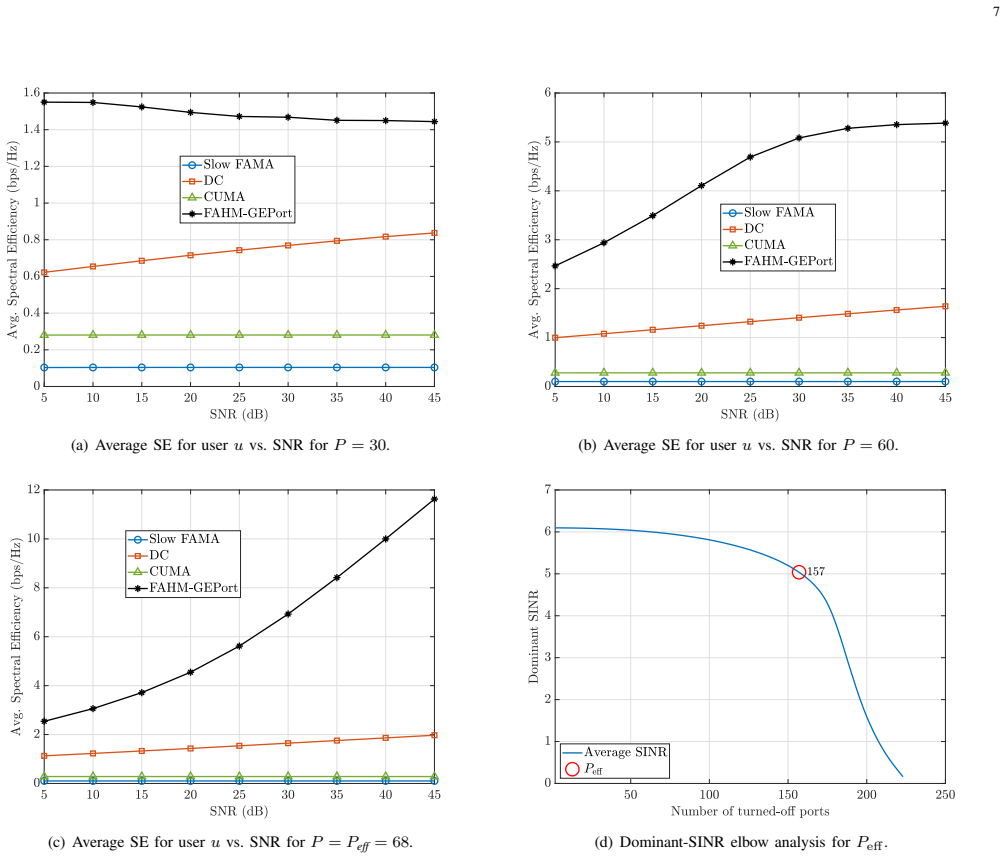
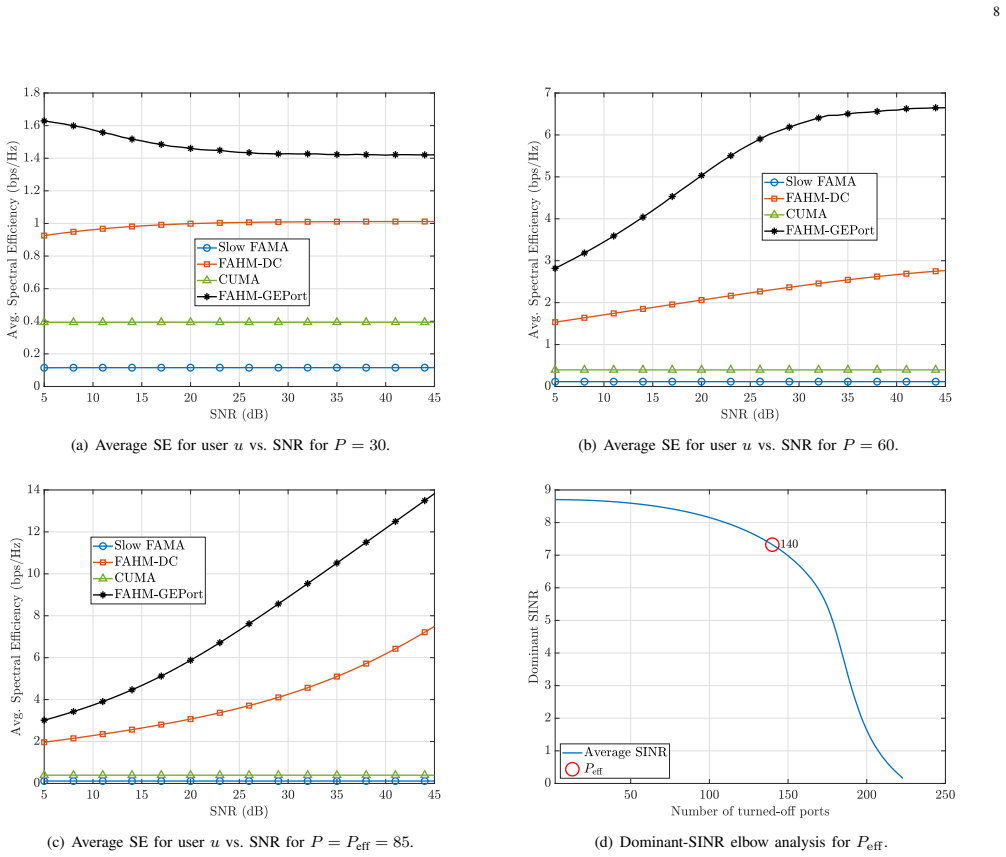
We propose a novel receiver architecture that preserves the performance benefits of multiport selection in fluid-antenna systems while requiring only a very small number of radio-frequency (RF) chains. The resulting fluid-antenna hybrid multiport (FAHM) receiver effectively decouples port selection from signal combining by integrating a low-complexity analog combining network similar to those used in conventional hybrid multiantenna designs. We develop a stopping criterion to determine the number of selected ports, which limits the performance loss associated with port selection, and then design the hybrid combiner for a given RF-chain budget. The FAHM architecture is evaluated in a multiuser set-up operating under slow fluid-antenna multiple access (FAMA). In this scenario, a FAHM implementation with only 2 RF chains showcases a performance comparable to a fully-digital conventional multiport scheme with a much larger number of RF chains. Additionally, the proposed receiver architecture attains over 60% reduction in computational burden when integrated with a novel efficient implementation of the state-of-the-art generalized-eigenvector port-selection method.
Editorial analysis
A structured set of objections, weighed in public.
Referee Report
Summary. The paper proposes a fluid-antenna hybrid multiport (FAHM) receiver for slow fluid-antenna multiple access (FAMA) that integrates a low-complexity analog combining network to decouple port selection from signal combining. It introduces a stopping criterion to limit performance loss from port selection and designs a hybrid combiner under a fixed RF-chain budget. In multiuser evaluations under the slow FAMA model, a 2-RF-chain FAHM implementation is claimed to achieve performance comparable to a fully-digital conventional multiport scheme using many more RF chains, while also attaining over 60% computational reduction via an efficient implementation of the generalized-eigenvector port-selection method.
Significance. If the reported comparability holds under the stated channel and multiuser assumptions, the architecture would demonstrate a practical route to realizing multiport selection gains in fluid-antenna systems with drastically reduced RF hardware and complexity. This could matter for hardware-limited deployments of fluid-antenna multiple access, provided the analog network preserves the essential decoupling without introducing unmodeled impairments.
minor comments (1)
- The abstract states performance comparability and a 60% computational reduction but supplies no quantitative metrics, error bars, channel parameters, or evaluation setup details; adding a brief results summary (e.g., BER or sum-rate curves at specific SNR) would strengthen the claim without altering the manuscript scope.
Simulated Author's Rebuttal
We thank the referee for the positive summary of our proposed FAHM receiver architecture, the recognition of its potential significance for hardware-limited FAMA deployments, and the recommendation of minor revision. No specific major comments were listed in the report, so we have no points to address point-by-point at this stage. We will make any minor revisions required by the editor or additional comments that may arise.
Circularity Check
No significant circularity
full rationale
The paper proposes a hybrid receiver architecture for fluid-antenna systems, develops a stopping criterion and hybrid combiner design, and reports empirical performance comparability in a slow FAMA multiuser setup. No equations, derivations, or modeling steps are shown that reduce any claimed result to a fitted parameter, self-definition, or self-citation chain. The performance claims are presented as evaluation outcomes of the described construction rather than predictions forced by the inputs themselves. The architecture and methods are self-contained against external benchmarks with no load-bearing self-referential steps.
Axiom & Free-Parameter Ledger
Lean theorems connected to this paper
-
IndisputableMonolith/Cost/FunctionalEquation.leanwashburn_uniqueness_aczel unclear?
unclearRelation between the paper passage and the cited Recognition theorem.
FAHM architecture... decouples port selection from signal combining... L=2 RF chains... Peff = 1/∑|vi|^4
-
IndisputableMonolith/Foundation/AbsoluteFloorClosure.leanreality_from_one_distinction unclear?
unclearRelation between the paper passage and the cited Recognition theorem.
slow fluid-antenna multiple access (FAMA)... spectral efficiency and outage probability
What do these tags mean?
- matches
- The paper's claim is directly supported by a theorem in the formal canon.
- supports
- The theorem supports part of the paper's argument, but the paper may add assumptions or extra steps.
- extends
- The paper goes beyond the formal theorem; the theorem is a base layer rather than the whole result.
- uses
- The paper appears to rely on the theorem as machinery.
- contradicts
- The paper's claim conflicts with a theorem or certificate in the canon.
- unclear
- Pith found a possible connection, but the passage is too broad, indirect, or ambiguous to say the theorem truly supports the claim.
Reference graph
Works this paper leans on
-
[1]
Multiple Access Techn iques for Intelligent and Multifunctional 6G: Tutorial, Survey, and Outlook,
B. Clerckx, Y . Mao, Z. Y ang, M. Chen, A. Alkhateeb, L. Liu, M. Qiu, J. Y uan, V . W. S. Wong, and J. Montojo, “Multiple Access Techn iques for Intelligent and Multifunctional 6G: Tutorial, Survey, and Outlook,” Proc. IEEE , vol. 112, no. 7, pp. 832–879, 2024
work page 2024
-
[2]
Extremely Large-Scale MIMO: Fundamentals, Cha llenges, Solutions, and Future Directions,
Z. Wang, J. Zhang, H. Du, W. E. I. Sha, B. Ai, D. Niyato, and M. Debbah, “Extremely Large-Scale MIMO: Fundamentals, Cha llenges, Solutions, and Future Directions,” IEEE Wireless Commun. , vol. 31, no. 3, pp. 117–124, 2024
work page 2024
-
[3]
K.-K. Wong, A. Shojaeifard, K.-F. Tong, and Y . Zhang, “Fl uid antenna systems,” IEEE Trans. Wireless Commun., vol. 20, no. 3, pp. 1950–1962, 2021
work page 1950
-
[4]
Fluid Antenna System for 6G: When Bruce Lee Inspires Wireless Communications,
K.-K. Wong, K.-F. Tong, Y . Zhang, and Z. Zhong- bin, “Fluid Antenna System for 6G: When Bruce Lee Inspires Wireless Communications,” Electron. Lett. , vol. 56, no. 24, pp. 1288–1290, 2020. [Online]. Available: https://ietresearch.onlinelibrary.wiley.com/doi/abs/10.1049/el.2020.2788
-
[5]
W.-J. Lu, C.-X. He, Y . Zhu, K.-F. Tong, K.-K. Wong, H. Shin , and T.-J. Cui, “Fluid antennas: Reshaping intrinsic properties for fl exible radiation characteristics in intelligent wireless networks,” IEEE Commun. Mag. , vol. 63, no. 5, pp. 40–45, 2025
work page 2025
-
[6]
A contempora ry survey on fluid antenna systems: Fundamentals and networkin g perspec- tives,
H. Hong, K.-K. Wong, C.-B. Chae, H. Xu, X. Guo, F. Rostami G hadi, Y . Chen, Y . Xu, B. Liu, K.-F. Tong, and Y . Zhang, “A contempora ry survey on fluid antenna systems: Fundamentals and networkin g perspec- tives,” IEEE Trans. Netw. Sci. Eng. , vol. 13, pp. 2305–2328, 2026
work page 2026
-
[7]
Fluid Antenna Multiple Acces s,
K.-K. Wong and K.-F. Tong, “Fluid Antenna Multiple Acces s,” IEEE Trans. Wireless Commun. , vol. 21, no. 7, pp. 4801–4815, 2022
work page 2022
-
[8]
Fast fluid a ntenna multiple access enabling massive connectivity,
K.-K. Wong, K.-F. Tong, Y . Chen, and Y . Zhang, “Fast fluid a ntenna multiple access enabling massive connectivity,” IEEE Commun. Lett. , vol. 27, no. 2, pp. 711–715, 2023
work page 2023
-
[9]
Slow Fluid Antenna Multiple Access,
K.-K. Wong, D. Morales-Jimenez, K.-F. Tong, and C.-B. Ch ae, “Slow Fluid Antenna Multiple Access,” IEEE Trans. Commun. , vol. 71, no. 5, pp. 2831–2846, 2023
work page 2023
-
[10]
Revisiting outage probability analysis for two-use r fluid antenna multiple access system,
H. Xu, K.-K. Wong, W. K. New, K.-F. Tong, Y . Zhang, and C.- B. Chae, “Revisiting outage probability analysis for two-use r fluid antenna multiple access system,” IEEE Trans. Wireless Commun. , vol. 23, no. 8, pp. 9534–9548, 2024
work page 2024
-
[11]
Deep learning enabled slow fluid antenna multiple access,
N. Waqar, K.-K. Wong, K.-F. Tong, A. Sharples, and Y . Zha ng, “Deep learning enabled slow fluid antenna multiple access,” IEEE Commun. Lett., vol. 27, no. 3, pp. 861–865, 2023
work page 2023
-
[12]
5G-Cod ed Fluid Antenna Multiple Access over Block Fading Channels,
H. Hong, K.-K. Wong, K.-F. Tong, H. Xu, and H. Li, “5G-Cod ed Fluid Antenna Multiple Access over Block Fading Channels,” Electron. Lett., vol. 61, no. 1, p. e70166, 2025
work page 2025
-
[13]
C oded fluid antenna multiple access over fast fading channels,
H. Hong, K.-K. Wong, K.-F. Tong, H. Shin, and Y . Zhang, “C oded fluid antenna multiple access over fast fading channels,” IEEE Wireless Commun. Lett. , vol. 14, no. 4, pp. 1249–1253, 2025
work page 2025
-
[14]
Turboch arging fluid antenna multiple access,
N. Waqar, K.-K. Wong, C.-B. Chae, and R. Murch, “Turboch arging fluid antenna multiple access,” IEEE Trans. Wireless Commun. , 2025, early Access
work page 2025
-
[15]
Compact ultra m assive antenna array: A simple open-loop massive connectivity sch eme,
K.-K. Wong, C.-B. Chae, and K.-F. Tong, “Compact ultra m assive antenna array: A simple open-loop massive connectivity sch eme,” IEEE Trans. Wireless Commun. , vol. 23, no. 6, pp. 6279–6294, 2024
work page 2024
-
[16]
Compact Ultra Massive Array (CUMA) with 4 R F Chains for Massive Connectivity,
K.-K. Wong, “Compact Ultra Massive Array (CUMA) with 4 R F Chains for Massive Connectivity,” in Proc. IEEE W orkshop Signal Process. Adv. Wirel. Commun. (SPAWC), 2024, pp. 286–290
work page 2024
-
[17]
Downlink OFDM-FAMA in 5G-NR Systems,
H. Hong, K.-K. Wong, H. Xu, Y . Xu, H. Shin, R. Murch, D. He, and W. Zhang, “Downlink OFDM-FAMA in 5G-NR Systems,” IEEE Trans. Wireless Commun., vol. 24, no. 12, pp. 10 116–10 132, 2025
work page 2025
-
[18]
Slow Flu id Antenna Multiple Access With Multiport Receivers,
J. P . González-Coma and F. J. López-Martínez, “Slow Flu id Antenna Multiple Access With Multiport Receivers,” IEEE Wireless Commun. Lett., vol. 15, pp. 1280–1284, 2026. 12
work page 2026
-
[19]
Multi-Port Selection for FAMA: Massive Connectiv ity with Fewer RF Chains than Users,
H. Hong, K.-K. Wong, X. Zhu, H. Xu, H. Xiao, F. Rostami Gha di, and H. Shin, “Multi-Port Selection for FAMA: Massive Connectiv ity with Fewer RF Chains than Users,” arXiv preprint arXiv:2511.17897 , 2025. [Online]. Available: https://arxiv.org/abs/2511.17897
-
[20]
Greedy and Transformer-Based Multi-Port Selection for Slow Fluid Antenna Multiple Access
D. Perez-Adan, J. P . Gonzalez-Coma, F. J. López-Martín ez, and L. Castedo, “Greedy and transformer-based multi-port sele ction for slow fluid antenna multiple access,” arXiv preprint arXiv:2604.04589 ,
work page internal anchor Pith review Pith/arXiv arXiv
-
[21]
Available: https://arxiv.org/abs/2604
[Online]. Available: https://arxiv.org/abs/2604. 04589
-
[22]
V ariable-phas e-shift-based RF-baseband codesign for MIMO antenna selection,
X. Zhang, A. F. Molisch, and S.-Y . Kung, “V ariable-phas e-shift-based RF-baseband codesign for MIMO antenna selection,” IEEE Trans. Signal Process., vol. 53, no. 11, pp. 4091–4103, November 2005
work page 2005
-
[23]
T. S. Rappaport, G. R. MacCartney, M. K. Samimi, and S. Su n, “Wide- band millimeter-wave propagation measurements and channel models for future wireless communication system design,” IEEE Trans. Commun. , vol. 63, no. 9, pp. 3029–3056, 2015
work page 2015
-
[24]
Toward a Circuit Theory of Commu- nication,
M. T. Ivrla ˇc and J. A. Nossek, “Toward a Circuit Theory of Commu- nication,” IEEE Trans. Circuits Syst. I Regul. Pap. , vol. 57, no. 7, pp. 1663–1683, 2010
work page 2010
-
[25]
Movable-antenna en hanced multiuser communication via antenna position optimizatio n,
L. Zhu, W. Ma, B. Ning, and R. Zhang, “Movable-antenna en hanced multiuser communication via antenna position optimizatio n,” IEEE Trans. Wireless Commun. , vol. 23, no. 7, pp. 7214–7229, 2024
work page 2024
-
[26]
Y . Shen et al. , “Design and implementation of mmwave surface wave enabled fluid antennas and experimental results for fluid ant enna multi- ple access,” arXiv e-prints, arXiv:2405.09663 [eess] , 2024
-
[27]
A novel pixel-based reconfigurable antenna applied in fluid antenna systems with high switching speed,
J. Zhang et al. , “A novel pixel-based reconfigurable antenna applied in fluid antenna systems with high switching speed,” IEEE Open J. Antennas Propag., vol. 6, no. 1, pp. 212–228, 2025
work page 2025
-
[28]
Scalable pixel-based reconfigurable be amform- ing networks for designing fluid antenna systems,
J. Zhang, J. Rao, T. Kang, Z. Ming, Y . Chen, A. Umirbayev, C.-Y . Chiu, and R. Murch, “Scalable pixel-based reconfigurable be amform- ing networks for designing fluid antenna systems,” arXiv preprints, arXiv:2512.03703 [eess.SP] , 2025
-
[29]
Metasurfac e-based fluid antennas: from electromagnetics to communications model,
P . Ramírez-Espinosa, C. Segura-Gómez, Ángel Palomare s-Caballero, F. J. López-Martínez, and D. Morales-Jiménez, “Metasurfac e-based fluid antennas: from electromagnetics to communications model, ” arXiv e- prints, arXiv:2507.17982 [eess.SP] , 2025
-
[30]
Pro- grammable meta-fluid antenna for spatial multiplexing in fa st fluctuating radio channels,
B. Liu, K.-F. Tong, K.-K. Wong, C.-B. Chae, and H. Wong, “ Pro- grammable meta-fluid antenna for spatial multiplexing in fa st fluctuating radio channels,” Opt. Express , vol. 33, no. 13, pp. 28 898–28 915, Jun 2025
work page 2025
-
[31]
s-FAMA-GP: A Low-Complexity S low FAMA Using Interference Interpolation,
D. Dinis and R. Wichman, “s-FAMA-GP: A Low-Complexity S low FAMA Using Interference Interpolation,” IEEE Wireless Commun. Lett. , vol. 15, pp. 1727–1731, 2026
work page 2026
discussion (0)
Sign in with ORCID, Apple, or X to comment. Anyone can read and Pith papers without signing in.