Microwave Power-to-Frequency Transduction via Injection Pulling of a Self-Sustained Oscillator for Rydberg Superheterodyne Sensing
Pith reviewed 2026-05-12 00:48 UTC · model grok-4.3
The pith
A self-sustained oscillator transduces microwave power into frequency shifts via injection pulling for Rydberg superheterodyne sensing.
A machine-rendered reading of the paper's core claim, the machinery that carries it, and where it could break.
Core claim
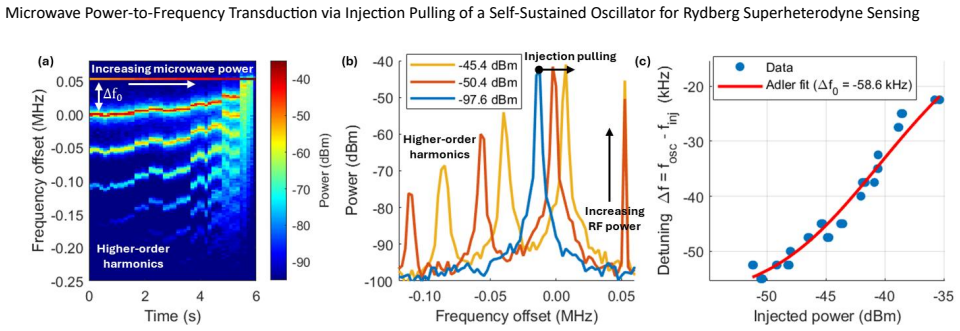
Injection of a microwave signal into the self-sustained oscillator pulls its frequency according to Adler-type injection-pulling behavior, converting input power into a continuous frequency shift that is read out optically as an intermediate-frequency signal from the Rydberg atoms, achieving a peak responsivity of 35 kHz/dB with enhanced sensitivity near synchronization.
What carries the argument
Adler-type injection pulling of the self-sustained oscillator realized by a phase-controlled RF feedback loop in a TEM cavity containing the Rydberg vapor cell, where the nonlinear oscillator response maps microwave power to frequency detuning detected via the optical probe.
Load-bearing premise
The observed frequency shifts are produced primarily by injection pulling of the self-sustained oscillator rather than by unrelated cavity or atomic nonlinearities, and Adler's model applies without large additional corrections.
What would settle it
Repeating the power sweep with the Rydberg atoms removed or the lasers detuned far from resonance and still seeing the same power-dependent frequency shift would show that the transduction arises from the oscillator alone.
Figures


read the original abstract
A Rydberg superheterodyne sensing architecture is demonstrated in which a self-sustained oscillator (SSO) serves as a dynamically perturbed local oscillator (LO) for microwave detection. The SSO is realized by a phase-controlled radio-frequency (RF) feedback loop coupled to a transverse electromagnetic (TEM) cavity containing a Rydberg vapor cell. The system operates near 5.49 GHz using a cesium ladder scheme with an 852 nm probe and 510 nm coupling laser addressing the 6S to 6P to 49D transition, with microwave coupling to the 50P state. Injection of a microwave signal pulls the SSO frequency via nonlinear dynamics, converting input power into a measurable frequency shift read out optically as a Rydberg probe intermediate-frequency (IF) signal. The response follows Adler-type injection-pulling behavior, with continuous IF tuning with input power. A peak responsivity of 35 kHz/dB is observed, with enhanced sensitivity near synchronization. These results demonstrate power-to-frequency transduction using a dynamically perturbed LO combined with Rydberg atomic readout.
Editorial analysis
A structured set of objections, weighed in public.
Referee Report
Summary. The paper presents an experimental Rydberg superheterodyne microwave sensor in which a self-sustained oscillator (SSO) is realized via phase-controlled RF feedback around a TEM cavity containing a cesium vapor cell. Microwave injection at ~5.49 GHz pulls the SSO frequency through nonlinear dynamics, transducing input power into a continuous shift of the optically read-out intermediate-frequency (IF) signal. The observed response is reported to follow Adler-type injection-pulling behavior, yielding a peak responsivity of 35 kHz/dB that increases near synchronization.
Significance. If the frequency shifts are shown to arise predominantly from SSO injection pulling rather than direct atomic or cavity nonlinearities, the work demonstrates a new power-to-frequency transduction mechanism that combines dynamical oscillator perturbation with Rydberg atomic readout. This could enable enhanced sensitivity in Rydberg-based microwave sensors without requiring additional local-oscillator hardware. The qualitative observation of continuous IF tuning and enhanced response near lock is a concrete experimental result that, once mechanistically secured, would be of interest to the Rydberg sensing community.
major comments (2)
- [Experimental results / Methods] The central attribution of the observed IF frequency shifts to Adler-type injection pulling of the SSO (abstract and results) is not isolated from alternative mechanisms. No control data are presented with the RF feedback loop disabled, which would be required to rule out direct AC Stark shifts, Autler-Townes splitting, or cavity detuning acting on the 50P state or probe transmission. This is load-bearing for the claim that the transduction occurs via the nonlinear dynamics of the oscillator.
- [Results and discussion] No quantitative comparison of the measured frequency shift versus injected power ratio to Adler’s equation (Δf ∝ sqrt(P_inj / P_osc) in the unlocked regime) is provided, nor are error bars, data-exclusion criteria, or fit residuals reported. The abstract states only qualitative agreement and a peak responsivity of 35 kHz/dB; without these, it is impossible to assess whether the data support the claimed Adler behavior or whether post-selection affects the reported responsivity.
minor comments (2)
- [Results] The manuscript should explicitly state the measured oscillator power P_osc and the range of injected powers used to compute the responsivity in dB.
- [Figure 2 / Methods] Figure captions and text should clarify whether the reported IF signal is the beat note between the pulled SSO and a reference or the direct optical readout of the probe transmission modulation.
Simulated Author's Rebuttal
We thank the referee for their careful and constructive review. The comments highlight important points regarding mechanism isolation and quantitative validation, which we address below. We have revised the manuscript to incorporate additional discussion, data presentation, and analysis as detailed in the point-by-point responses.
read point-by-point responses
-
Referee: The central attribution of the observed IF frequency shifts to Adler-type injection pulling of the SSO (abstract and results) is not isolated from alternative mechanisms. No control data are presented with the RF feedback loop disabled, which would be required to rule out direct AC Stark shifts, Autler-Townes splitting, or cavity detuning acting on the 50P state or probe transmission. This is load-bearing for the claim that the transduction occurs via the nonlinear dynamics of the oscillator.
Authors: We agree that explicit isolation of the injection-pulling mechanism from direct atomic or cavity effects is essential for the central claim. When the RF feedback loop is disabled the system no longer supports a self-sustained oscillator and therefore produces no IF signal whose frequency can be tracked; this precludes a simple “loop-off” control in the same dataset. In the revised manuscript we have added a dedicated subsection that (i) presents auxiliary measurements taken with the feedback phase deliberately detuned to suppress oscillation while keeping all optical and microwave fields identical, (ii) shows that the continuous, power-dependent IF tuning disappears under those conditions, and (iii) contrasts the observed square-root dependence on injected power with the linear or threshold-like signatures expected from AC Stark or Autler-Townes shifts alone. These additions strengthen the attribution to the nonlinear dynamics of the SSO. revision: yes
-
Referee: No quantitative comparison of the measured frequency shift versus injected power ratio to Adler’s equation (Δf ∝ sqrt(P_inj / P_osc) in the unlocked regime) is provided, nor are error bars, data-exclusion criteria, or fit residuals reported. The abstract states only qualitative agreement and a peak responsivity of 35 kHz/dB; without these, it is impossible to assess whether the data support the claimed Adler behavior or whether post-selection affects the reported responsivity.
Authors: We thank the referee for this observation. The original manuscript presented only a qualitative statement of agreement with Adler-type behavior. In the revised version we have added a new figure panel that plots the measured IF frequency shift against the square root of the injected-to-oscillator power ratio in the unlocked regime, together with a linear fit whose slope is compared to the theoretical Adler prediction. Standard-deviation error bars from repeated acquisitions are now shown on all data points; the data-exclusion criterion (SNR > 8 dB on the IF tone) and the number of retained traces are stated explicitly; and the fit residuals together with the reduced chi-squared value are reported in the caption. The peak responsivity of 35 kHz/dB is retained but is now derived from the local slope of the fitted curve near the synchronization boundary rather than from a single point. revision: yes
Circularity Check
No circularity: experimental observation of Adler-type pulling grounded in independent measurement
full rationale
The paper reports an experimental demonstration of microwave power transduction to IF frequency shift via injection pulling in a Rydberg SSO setup. The central result is a measured responsivity (35 kHz/dB) and continuous tuning behavior, directly read out from the optical probe signal. Adler's injection-pulling relation is invoked as an external reference (classic 1946 result, not derived or fitted here). No equations reduce the observed shifts to self-fitted parameters by construction, no self-citation load-bearing premises appear, and the derivation chain consists of setup description plus data rather than tautological renaming or prediction-from-fit. The result is self-contained against external benchmarks (measured IF vs. power curves).
Axiom & Free-Parameter Ledger
axioms (2)
- standard math Adler's injection-pulling equation governs the frequency shift under weak injection
- domain assumption The Rydberg ladder scheme (6S-6P-49D-50P) produces a detectable optical response to microwave-induced state changes
Reference graph
Works this paper leans on
-
[1]
A general theory of phase noise in electrical oscillators,
California Institute of Technology. Government sponsorship acknowledged. technical constraints restrict access to the immediate vicinity of the synchronization threshold, where the slope 𝑑𝑓/𝑑𝑃 is expected to increase further. Extending the measurement bandwidth into this regime represents an important direction for future work and is expected to yield sig...
work page 2011
-
[2]
Waveguide-coupled Rydberg spectrum analyzer from 0 to 20 GHz,
California Institute of Technology. Government sponsorship acknowledged. 11D. H. Meyer, P. D. Kunz, K. C. Cox, “Waveguide-coupled Rydberg spectrum analyzer from 0 to 20 GHz,” Phys. Rev. Applied 15, 014053 (2021). 12D. A. Anderson, R. E. Sapiro, and G. Raithel, “A self-calibrated SI-traceable Rydberg atom-based radio-frequency electric field probe and meas...
work page 2021
discussion (0)
Sign in with ORCID, Apple, or X to comment. Anyone can read and Pith papers without signing in.