Time-of-flight force sensing below the quantum zero-point fluctuation
Pith reviewed 2026-05-12 05:14 UTC · model grok-4.3
The pith
A levitated nanomechanical oscillator detects static forces of 10 zeptonewtons below the quantum zero-point fluctuation.
A machine-rendered reading of the paper's core claim, the machinery that carries it, and where it could break.
Core claim
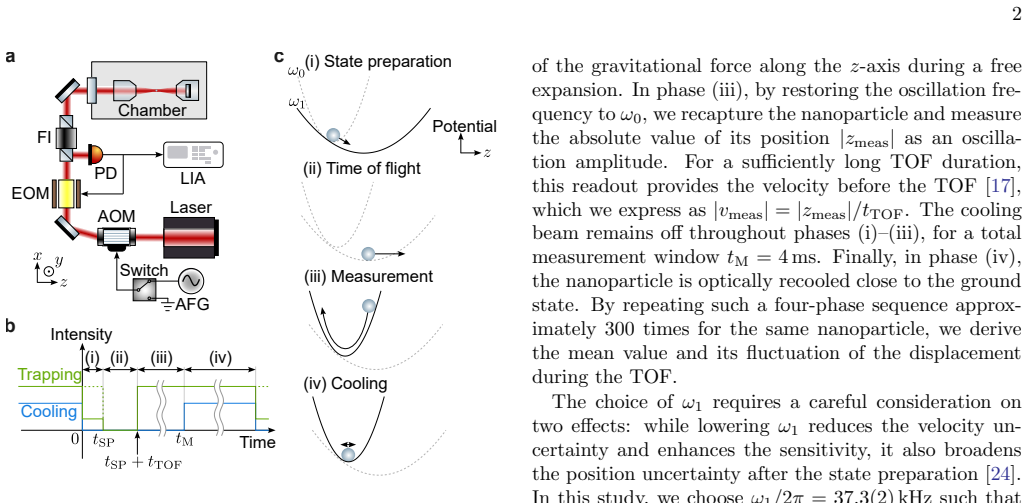
We prepare a squeezed state of a levitated nanomechanical oscillator by abruptly decreasing its confining potential, thereby reducing the velocity uncertainty below the zero-point fluctuation level. We then release the nanoparticle to perform time-of-flight measurements, in which the displacement during free fall directly reports the applied static force. This protocol enables detection of forces on the order of 10 zeptonewtons while the oscillator operates below the quantum zero-point limit. Time-of-flight data further permit full quantum state tomography, yielding the Wigner function and quantifying the force sensitivity via Fisher information.
What carries the argument
Rapid modulation of the confining potential to prepare a velocity-squeezed state, followed by time-of-flight displacement measurement.
If this is right
- Static force sensing enters the quantum regime for free-fall configurations using levitated oscillators.
- Quantum state tomography of squeezed states becomes feasible directly from time-of-flight records.
- Trap stiffness modulation serves as a practical technique for reaching quantum-limited sensitivities.
- The protocol quantifies achievable force sensitivity through the Fisher information of the position measurement.
Where Pith is reading between the lines
- The approach could be extended by increasing free-fall duration to target even weaker forces.
- Similar trap modulation may apply to other levitated systems for enhanced sensing in metrology or fundamental physics tests.
- Fisher information extracted from the Wigner distribution offers a way to optimize measurement parameters for specific force amplitudes.
Load-bearing premise
The abrupt decrease of the confining potential prepares a true squeezed state with velocity uncertainty reduced below the zero-point level, and the subsequent time-of-flight displacement directly and linearly reports the applied static force without significant confounding from trap imperfections, gas collisions, or measurement back-action.
What would settle it
Repeated experiments in which the measured position variance after trap modulation fails to fall below the zero-point fluctuation level, or in which the inferred force does not scale with the observed squeezing as predicted by the Fisher information.
Figures


read the original abstract
Sensing weak forces through observing a mechanical motion near or below its quantum zero-point fluctuation has been desired in diverse areas. While mechanical oscillators have played a crucial role in such studies, their application to free-fall-type sensing has been elusive, in particular in the quantum regime. Here, we demonstrate sensing a static force of the order of 10 zeptonewtons with a levitated nanomechanical oscillator below the zero-point fluctuation through the rapid modulation of its confining potential. We prepare a squeezed state with a reduced velocity uncertainty by abruptly decreasing the potential. Subsequently, we detect the exerted static force through time-of-flight measurements, where we release the nanoparticle from the potential and measure the displacement during a free fall. Furthermore, time-of-flight measurements allow us to perform quantum state tomography of the squeezed state, from which we reconstruct its Wigner quasiprobability distribution and evaluate the Fisher information for the position measurement to quantify the achievable force sensitivity of our protocol. Our results demonstrate that modulating the trap stiffness serves as a crucial technique for quantum-limited force sensing and paves the way to utilize a levitated nanoparticle as a promising sensing platform beyond the quantum limit with a capability of quantum state tomography.
Editorial analysis
A structured set of objections, weighed in public.
Referee Report
Summary. The manuscript claims an experimental demonstration of static force sensing at the level of ~10 zeptonewtons with a levitated nanomechanical oscillator. A squeezed state with velocity uncertainty below the quantum zero-point fluctuation is prepared by abrupt reduction of the confining potential; the force is then read out via time-of-flight displacement after release, and the protocol is characterized by quantum state tomography yielding the Wigner function and Fisher information for position measurements.
Significance. If the central claims were valid, the work would constitute a notable advance in quantum-limited force metrology with levitated nanoparticles, providing both sub-zero-point-fluctuation sensitivity and full tomographic reconstruction in a free-fall geometry. Such capabilities could impact precision sensing platforms in fundamental physics and metrology.
major comments (1)
- [Abstract and state-preparation section] Abstract and state-preparation description: the protocol asserts that an abrupt decrease of trap frequency prepares a state whose velocity (momentum) uncertainty lies below the new zero-point level. For an initial ground state of frequency ω, var(p) = ħ m ω / 2. An instantaneous quench to ω' < ω leaves the wave function (and thus var(p)) unchanged while the new zero-point momentum variance drops to ħ m ω' / 2. The prepared state is therefore momentum-anti-squeezed relative to the new ZPF, directly contradicting the claimed reduction below zero-point fluctuation and the associated quantum advantage for time-of-flight force sensing.
minor comments (1)
- [Abstract] The abstract states that raw data, error bars, and quantitative comparisons to the zero-point level are supplied, yet none appear in the provided summary; the full manuscript should include these in the results and methods sections for verification.
Simulated Author's Rebuttal
We thank the referee for their careful review and for identifying an important inconsistency in the description of the state-preparation protocol. We agree with the analysis and will correct the manuscript accordingly.
read point-by-point responses
-
Referee: [Abstract and state-preparation section] Abstract and state-preparation description: the protocol asserts that an abrupt decrease of trap frequency prepares a state whose velocity (momentum) uncertainty lies below the new zero-point level. For an initial ground state of frequency ω, var(p) = ħ m ω / 2. An instantaneous quench to ω' < ω leaves the wave function (and thus var(p)) unchanged while the new zero-point momentum variance drops to ħ m ω' / 2. The prepared state is therefore momentum-anti-squeezed relative to the new ZPF, directly contradicting the claimed reduction below zero-point fluctuation and the associated quantum advantage for time-of-flight force sensing.
Authors: We agree with the referee's calculation: an instantaneous decrease in trap frequency leaves var(p) unchanged while lowering the zero-point momentum variance, producing anti-squeezing. The experimental protocol actually employs an abrupt increase in trap frequency to prepare the momentum-squeezed state with velocity uncertainty below the new ZPF. The abstract and state-preparation section contain a misstatement that incorrectly describes the change as a decrease rather than an increase. We will revise the manuscript to correct this wording and ensure consistency with the implemented quench. The quantum state tomography, Wigner reconstruction, Fisher information, and force-sensing data remain unaffected, as they reflect the actual protocol performed. revision: yes
Circularity Check
No significant circularity in experimental protocol
full rationale
The paper reports an experimental demonstration of zeptonewton-scale force sensing via time-of-flight displacement of a levitated nanoparticle after abrupt trap modulation and free-fall evolution. Central elements are direct measurements, state tomography from time-of-flight data, Wigner reconstruction, and Fisher-information evaluation from the reconstructed state. No load-bearing derivation reduces by construction to fitted parameters, self-citations, or ansatzes; the protocol is self-contained against external benchmarks (measured displacements and tomography) with no self-definitional or fitted-input-called-prediction steps.
Axiom & Free-Parameter Ledger
Lean theorems connected to this paper
-
IndisputableMonolith/Cost/FunctionalEquation.leanwashburn_uniqueness_aczel (J(x) = ½(x + x⁻¹) − 1 is unique calibrated reciprocal cost) unclear?
unclearRelation between the paper passage and the cited Recognition theorem.
We prepare a squeezed state with a reduced velocity uncertainty by abruptly decreasing the potential... sensitivity below the zero-point fluctuation
-
IndisputableMonolith/Foundation/ArithmeticFromLogic.leanLogicNat ≃ Nat recovery; embed_strictMono_of_one_lt unclear?
unclearRelation between the paper passage and the cited Recognition theorem.
time-of-flight measurements... reconstruct its Wigner quasiprobability distribution and evaluate the Fisher information
What do these tags mean?
- matches
- The paper's claim is directly supported by a theorem in the formal canon.
- supports
- The theorem supports part of the paper's argument, but the paper may add assumptions or extra steps.
- extends
- The paper goes beyond the formal theorem; the theorem is a base layer rather than the whole result.
- uses
- The paper appears to rely on the theorem as machinery.
- contradicts
- The paper's claim conflicts with a theorem or certificate in the canon.
- unclear
- Pith found a possible connection, but the passage is too broad, indirect, or ambiguous to say the theorem truly supports the claim.
Reference graph
Works this paper leans on
-
[1]
H.-J. Butt, B. Cappella, and M. Kappl, Surf. Sci. Rep. 59, 1 (2005)
work page 2005
-
[2]
J. D. Teufel, T. Donner, M. A. Castellanos-Beltran, J. W. Harlow, and K. W. Lehnert, Nat. Nanotechnol. 4, 820 (2009)
work page 2009
-
[3]
M. Aspelmeyer, T. J. Kippenberg, and F. Marquardt, Rev. Mod. Phys. 86, 1391 (2014)
work page 2014
-
[4]
G. L. Klimchitskaya, U. Mohideen, and V. M. Mostepa- nenko, Rev. Mod. Phys. 81, 1827 (2009)
work page 2009
-
[5]
A. D. O’Connell, M. Hofheinz, M. Ansmann, R. C. Bial- czak, M. Lenander, E. Lucero et al. , Nature 464, 697 (2010)
work page 2010
-
[6]
J. Chan, T. P. M. Alegre, A. H. Safavi-Naeini, J. T. Hill, A. Krause, S. Gr¨ oblacher, M. Aspelmeyer, and O. Painter, Nature 478, 89 (2011)
work page 2011
- [7]
-
[8]
C. L. Degen, F. Reinhard, and P. Cappellaro, Rev. Mod. Phys. 89, 035002 (2017)
work page 2017
-
[9]
M. D. LaHaye, O. Buu, B. Camarota, and K. C. Schwab, Science 304, 74 (2004)
work page 2004
-
[10]
U. Deli´ c, M. Reisenbauer, K. Dare, D. Grass, V. Vuleti´ c, N. Kiesel, and M. Aspelmeyer, Science 367, 892 (2020)
work page 2020
-
[11]
L. Magrini, P. Rosenzweig, C. Bach, A. Deutschmann- Olek, S. G. Hofer, S. Hong, N. Kiesel, A. Kugi, and M. Aspelmeyer, Nature 595, 373 (2021)
work page 2021
-
[12]
F. Tebbenjohanns, M. L. Mattana, M. Rossi, M. Frim- mer, and L. Novotny, Nature 595, 378 (2021)
work page 2021
-
[13]
A. Ranfagni, K. Børkje, F. Marino, and F. Marin, Phys. Rev. Res. 4, 033051 (2022)
work page 2022
- [14]
- [15]
- [16]
- [17]
- [18]
- [19]
-
[20]
O. Romero-Isart, A. C. Pflanzer, M. L. Juan, R. Quidant, N. Kiesel, M. Aspelmeyer, and J. I. Cirac, Phys. Rev. A 83, 013803 (2011)
work page 2011
-
[21]
M. O. Brown, S. R. Muleady, W. J. Dworschack, R. J. Lewis-Swan, A. M. Rey, O. Romero-Isart, and C. A. Re- gal, Nat. Phys. 19, 569 (2023)
work page 2023
-
[22]
R. Reimann, M. Doderer, E. Hebestreit, R. Diehl, M. Frimmer, D. Windey, F. Tebbenjohanns, and L. Novotny, Phys. Rev. Lett. 121, 033602 (2018)
work page 2018
-
[23]
J. Ahn, Z. Xu, J. Bang, Y.-H. Deng, T. M. Hoang, Q. Han, R.-M. Ma, and T. Li, Phys. Rev. Lett. 121, 033603 (2018). 7
work page 2018
- [24]
-
[25]
M. L. Mattana, N. C. Zambon, M. Rossi, E. Bonvin, L. Devaud, M. Frimmer, and L. Novotny, Phys. Rev. A 113, 023510 (2026)
work page 2026
-
[26]
B. A. Stickler, B. Papendell, S. Kuhn, B. Schrinski, J. Millen, M. Arndt, and K. Hornberger, New J. Phys. 20, 122001 (2018)
work page 2018
-
[27]
H. M. Wiseman and G. J. Milburn, Quantum Measure- ment and Control (Cambridge University Press, 2009)
work page 2009
- [28]
- [29]
-
[30]
L. Neumeier, M. A. Ciampini, O. Romero-Isart, M. As- pelmeyer, and N. Kiesel, Proc. Natl. Acad. Sci. U.S.A. 121, e2306953121 (2024)
work page 2024
-
[31]
S. Casulleras, P. T. Grochowski, and O. Romero-Isart, Phys. Rev. A 110, 033511 (2024)
work page 2024
-
[32]
R. Muffato, T. S. Georgescu, J. Homans, T. Guerreiro, Q. Wu, D. A. Chisholm, M. Carlesso, M. Paternostro, and H. Ulbricht, Phys. Rev. Res. 7, 013171 (2025)
work page 2025
- [33]
- [34]
- [35]
-
[36]
I. Pikovski, M. Zych, F. Costa, and ˇC. Brukner, Nat. Phys. 11, 668 (2015)
work page 2015
-
[37]
R. Kaltenbaek, M. Arndt, M. Aspelmeyer, P. F. Barker, A. Bassi, J. Bateman et al. , Quantum Sci. Technol. 8, 014006 (2023)
work page 2023
-
[38]
H. Yang, H. Miao, D.-S. Lee, B. Helou, and Y. Chen, Phys. Rev. Lett. 110, 170401 (2013)
work page 2013
-
[39]
A. Großardt, J. Bateman, H. Ulbricht, and A. Bassi, Phys. Rev. D 93, 096003 (2016)
work page 2016
- [40]
- [41]
-
[42]
M. Skrabulis, M. C. Sosa, N. C. Zambon, A. Militaru, M. Rossi, M. Frimmer, and L. Novotny, Nanomechani- cal sensor resolving impulsive forces below its zero-point fluctuations, arXiv:2601.19392
-
[43]
J. Gieseler, B. Deutsch, R. Quidant, and L. Novotny, Phys. Rev. Lett. 109, 103603 (2012)
work page 2012
-
[44]
J. Vovrosh, M. Rashid, D. Hempston, J. Bateman, M. Pa- ternostro, and H. Ulbricht, J. Opt. Soc. Am. B 34, 1421 (2017)
work page 2017
-
[45]
M. Iwasaki, T. Yotsuya, T. Naruki, Y. Matsuda, M. Yoneda, and K. Aikawa, Phys. Rev. A 99, 051401(R) (2019)
work page 2019
-
[46]
E. Hebestreit, R. Reimann, M. Frimmer, and L. Novotny, Phys. Rev. A 97, 043803 (2018)
work page 2018
-
[47]
A. I. Lvovsky, J. Opt. B 6, S556 (2004)
work page 2004
-
[48]
J. ˇReh´ aˇ cek, Z. c. v. Hradil, E. Knill, and A. I. Lvovsky, Phys. Rev. A 75, 042108 (2007)
work page 2007
-
[49]
C. Gardiner and P. Zoller, Quantum Noise: A Handbook of Markovian and Non-Markovian Quantum Stochastic Methods with Applications to Quantum Optics (Springer, 2004)
work page 2004
-
[50]
H. B. Callen and T. A. Welton, Phys. Rev. 83, 34 (1951)
work page 1951
-
[51]
D. A. Williams, Biometrika 63, 33 (1976)
work page 1976
-
[52]
A. Vehtarh, A. Gelman, D. Simpson, B. Carpenter, and P.-C. B¨ urkner, Bayesian Anal.16, 667 (2021)
work page 2021
-
[53]
C. J. Geyer, Stat. Sci. 7, 473 (1992)
work page 1992
-
[54]
S. L. Braunstein and C. M. Caves, Phys. Rev. Lett. 72, 3439 (1994). Acknowledgements We thank M. Kozuma, T. Mukaiyama, K. Funo, K. Kumasaki, I. Layton, T. Sagawa, S. Sugiura, K. Shiraishi, and M. Nakagawa for fruitful discussions. This work is supported by the Murata Science Foundation, the Mitsubishi Foun- dation, the Challenging Research Award, the ’Pla...
work page 1994
discussion (0)
Sign in with ORCID, Apple, or X to comment. Anyone can read and Pith papers without signing in.