Revisiting Privacy Preservation in Brain-Computer Interfaces: Conceptual Boundaries, Risk Pathways, and a Protection-Strength Grading Framework
Pith reviewed 2026-05-13 02:38 UTC · model grok-4.3
The pith
A three-dimensional framework classifies BCI privacy techniques into four protection-strength levels by tracking objects, lifecycle stages, and strength.
A machine-rendered reading of the paper's core claim, the machinery that carries it, and where it could break.
Core claim
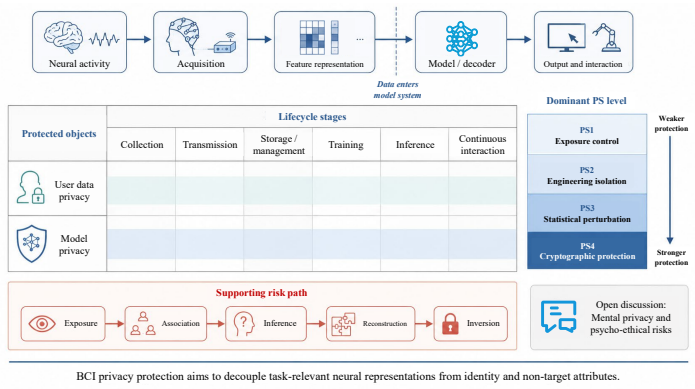
Starting from the general BCI paradigm, the paper defines privacy-protection boundaries and protection objects, shows the relationship between user data privacy and model privacy within a shared risk pathway, and proposes a three-dimensional framework of protection object, lifecycle stage, and dominant protection-strength level that organizes existing techniques into four levels of protection strength, while treating mental privacy and neuroethical risks as open issues that call for disentanglement of task-irrelevant sensitive information without harming utility.
What carries the argument
The three-dimensional protection-strength grading framework, which places each privacy method at the intersection of what object is protected, which lifecycle stage it applies to, and its dominant level of strength to enable consistent classification into four tiers.
If this is right
- Methods can be compared and chosen according to the specific object being protected at each stage of data handling.
- Four levels distinguish basic signal masking from advanced techniques that separate task-relevant from sensitive information.
- Protection choices can balance privacy strength against retained utility in clinical or edge deployments.
- Mental privacy concerns remain outside the current technical grading and require separate neuroethical attention.
Where Pith is reading between the lines
- The grading axes could be tested by applying them to a new set of recently published BCI privacy methods to check for consistent placement.
- If the four levels prove stable, regulators might use the framework to set minimum requirements for different BCI use cases.
- Extending the lifecycle axis to include post-deployment monitoring could reveal whether current protections hold when models are updated with new user data.
Load-bearing premise
BCI privacy techniques can be sorted reliably into four discrete protection-strength levels along the three proposed axes without significant overlap, gaps, or subjective judgment.
What would settle it
A collection of BCI privacy papers where multiple independent reviewers assign the same method to different strength levels or cannot place it on the three axes without disagreement.
Figures

read the original abstract
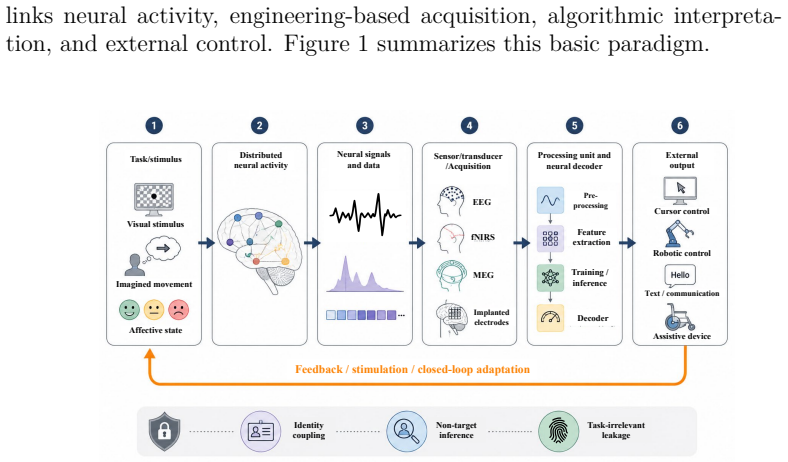
Brain-computer interfaces (BCIs) are moving rapidly from laboratory research into clinical, edge, and real-world settings. Under ISO/IEC 8663:2025, a BCI is a direct communication link between central nervous system activity and external software or hardware systems. This link expands privacy risk beyond raw neural-signal leakage: neural data, derived representations, model assets, and decoded outputs can be re-associated with individuals across collection, transmission, storage, training, inference, and feedback, or used to infer information beyond what a task requires. Starting from the general BCI paradigm, this review deffnes privacy-protection boundaries, protection objects, and the relationship between user data privacy and model privacy within a shared risk pathway. It then proposes a three-dimensional framework - protection object, lifecycle stage, and dominant protection-strength level - to classify existing work into four levels of protection strength. Finally, mental privacy and neuroethical risks are treated as open issues, emphasizing that BCI privacy protection should not only obscure data but also disentangle task-irrelevant sensitive information while preserving downstream utility. Keywords: Brain-computer interface, Neural data privacy, User data privacy, Model privacy, Disentanglement of task-irrelevant sensitive information, Protection-strength grading, Neuroethical risks
Editorial analysis
A structured set of objections, weighed in public.
Referee Report
Summary. This review starts from the general BCI paradigm under ISO/IEC 8663:2025 to define privacy-protection boundaries, protection objects, and the shared risk pathway linking user data privacy and model privacy across collection, transmission, storage, training, inference, and feedback. It proposes a three-dimensional classification framework (protection object, lifecycle stage, and dominant protection-strength level) that sorts existing BCI privacy techniques into four discrete protection-strength levels, while treating mental privacy and neuroethical risks as open issues and stressing the need to disentangle task-irrelevant sensitive information without sacrificing utility.
Significance. If operationalized with reproducible criteria, the framework could usefully organize the BCI privacy literature, surface gaps in current techniques, and inform standards development by distinguishing mere data obfuscation from genuine disentanglement. The conceptual mapping of risk pathways and the emphasis on preserving downstream utility are timely given the shift of BCIs into clinical and edge deployments.
major comments (2)
- [Section proposing the three-dimensional framework] Section proposing the three-dimensional framework: the central claim that existing work can be systematically classified into four protection-strength levels rests on the 'dominant protection-strength level' axis, yet no explicit decision procedure, scoring rubric, or threshold rules are supplied for determining dominance when a technique spans multiple protection objects or lifecycle stages. This is load-bearing; without such criteria, assignments (e.g., a method that partially disentangles sensitive information at inference while leaving raw signals exposed at collection) remain open to subjective judgment and risk non-reproducible or overlapping classifications.
- [Framework application section] Framework application section: the manuscript states that the framework is used to classify existing work but provides no concrete mapping table, worked examples, or inter-rater consistency check showing how specific published methods are assigned to the four levels. This absence leaves the framework's practical utility and the claim of low-overlap partitioning untested.
minor comments (2)
- [Abstract] Abstract: 'deffnes' is a typographical error and should read 'defines'.
- [Framework definition] The four protection-strength levels are introduced conceptually but never given explicit names or short descriptors in the text, which would aid readability when the framework is later referenced.
Simulated Author's Rebuttal
We thank the referee for the constructive feedback, which identifies key areas where the framework's reproducibility and demonstrated utility can be strengthened. We address each major comment in turn and commit to revisions that directly respond to the concerns raised.
read point-by-point responses
-
Referee: [Section proposing the three-dimensional framework] Section proposing the three-dimensional framework: the central claim that existing work can be systematically classified into four protection-strength levels rests on the 'dominant protection-strength level' axis, yet no explicit decision procedure, scoring rubric, or threshold rules are supplied for determining dominance when a technique spans multiple protection objects or lifecycle stages. This is load-bearing; without such criteria, assignments (e.g., a method that partially disentangles sensitive information at inference while leaving raw signals exposed at collection) remain open to subjective judgment and risk non-reproducible or overlapping classifications.
Authors: We agree that an explicit decision procedure is necessary to support reproducible classifications. In the revised manuscript we will insert a new subsection that defines a step-by-step rubric for determining the dominant protection-strength level. The rubric will specify quantitative thresholds (for example, the fraction of risk mitigated at the primary stage versus secondary stages) and tie-breaking rules when a technique affects multiple objects or lifecycle phases. We will apply the procedure to the referee's own example to illustrate how dominance is resolved without ambiguity. revision: yes
-
Referee: [Framework application section] Framework application section: the manuscript states that the framework is used to classify existing work but provides no concrete mapping table, worked examples, or inter-rater consistency check showing how specific published methods are assigned to the four levels. This absence leaves the framework's practical utility and the claim of low-overlap partitioning untested.
Authors: We accept that the current text lacks a concrete mapping and worked examples. The revised version will add a mapping table that classifies at least ten representative BCI privacy methods drawn from the literature, using the newly specified decision procedure. Two detailed worked examples—one involving a multi-stage technique—will be included to show the classification steps and to substantiate the low-overlap claim. A formal inter-rater study lies outside the scope of this conceptual review, but the added documentation will enable such validation by the community. revision: yes
Circularity Check
No circularity; conceptual classification framework is self-contained
full rationale
The paper is a literature review that starts from the standard BCI paradigm, defines privacy boundaries and objects conceptually, and proposes a three-dimensional classification scheme (protection object, lifecycle stage, dominant protection-strength level) to organize existing techniques into four levels. No equations, derivations, fitted parameters, or predictions appear in the provided text. The framework is presented as an organizing proposal grounded in external literature analysis rather than any reduction to self-defined inputs or self-citations. No load-bearing step reduces by construction to the paper's own outputs; the central claim remains an independent conceptual contribution.
Axiom & Free-Parameter Ledger
axioms (1)
- domain assumption A BCI is a direct communication link between central nervous system activity and external software or hardware systems per ISO/IEC 8663:2025
Lean theorems connected to this paper
-
IndisputableMonolith/Foundation/RealityFromDistinction.leanreality_from_one_distinction unclear?
unclearRelation between the paper passage and the cited Recognition theorem.
proposes a three-dimensional framework - protection object, lifecycle stage, and dominant protection-strength level - to classify existing work into four levels of protection strength
-
IndisputableMonolith/Cost/FunctionalEquation.leanwashburn_uniqueness_aczel unclear?
unclearRelation between the paper passage and the cited Recognition theorem.
PS1–PS4 ... Level 1 Strength (PS1) is the basic exposure control level ... Level 4 (PS4) is the cryptographically strong protection level
What do these tags mean?
- matches
- The paper's claim is directly supported by a theorem in the formal canon.
- supports
- The theorem supports part of the paper's argument, but the paper may add assumptions or extra steps.
- extends
- The paper goes beyond the formal theorem; the theorem is a base layer rather than the whole result.
- uses
- The paper appears to rely on the theorem as machinery.
- contradicts
- The paper's claim conflicts with a theorem or certificate in the canon.
- unclear
- Pith found a possible connection, but the passage is too broad, indirect, or ambiguous to say the theorem truly supports the claim.
Reference graph
Works this paper leans on
-
[1]
The state of clinical trials of implantable brain–computer interfaces [J]
PATRICK-KRUEGER K M, BURKHART I, CONTRERAS-VIDAL J L. The state of clinical trials of implantable brain–computer interfaces [J]. Nature Reviews Bioengineering, 2024, 3(1): 50-67. (2024)
work page 2024
-
[2]
Privacy-Preserving Brain–Computer Interfaces: A Systematic Review[J]
XIA K, DUCH W, SUN Y, et al. Privacy-Preserving Brain–Computer Interfaces: A Systematic Review[J]. IEEE Transactions on Computa- tional Social Systems, 2023, 10(5): 2312-2324. (2023)
work page 2023
-
[3]
Semantic reconstruction of con- tinuous language from non-invasive brain recordings[J]
TANG J, LEBEL A, JAIN S, et al. Semantic reconstruction of con- tinuous language from non-invasive brain recordings[J]. Nature Neuro- science, 2023, 26(5): 858-866. (2023)
work page 2023
-
[4]
Towards new human rights in the age of neuroscience and neurotechnology[J]
IENCA M, ANDORNO R. Towards new human rights in the age of neuroscience and neurotechnology[J]. Life Sciences, Society and Policy, 2017, 13(1): 5. (2017)
work page 2017
-
[5]
Decoding speech perception from non-invasive brain recordings[J]
DÉFOSSEZ A, CANDIOTTI L, DEMBINSKI C, et al. Decoding speech perception from non-invasive brain recordings[J]. Nature Machine Intel- ligence, 2023, 5(10): 1097-1107. (2023). 45
work page 2023
-
[6]
Image classification and reconstruction from low-density EEG[J]
GUENTHER N, SCHMITT L M, TONG J, et al. Image classification and reconstruction from low-density EEG[J]. Scientific Reports, 2024, 14: 14498. (2024)
work page 2024
-
[7]
SHOKRI R, STRONATI M, SONG C, et al. Membership Inference At- tacks Against Machine Learning Models[C/OL]//2017 IEEE Sympo- sium on Security and Privacy (SP). San Jose, CA, USA: IEEE, 2017: 3-18[2026-04-02].http://ieeexplore.ieee.org/document/7958568/. (2017)
-
[8]
NASR M, SHOKRI R, HOUMANSADR A. Comprehensive Privacy Analysis of Deep Learning: Passive and Active White-box Inference At- tacks against Centralized and Federated Learning[C/OL]//2019 IEEE Symposium on Security and Privacy (SP). 2019: 739-753[2026-04-02]. http://arxiv.org/abs/1812.00910. (2019)
-
[9]
ZHUL,LIUZ,HANS.DeepLeakagefromGradients[C/OL]//Advances in Neural Information Processing Systems: Vol. 32. Curran Associates, Inc., 2019[2026-04-02].https : / / proceedings . neurips . cc / paper / 2019 / hash / 60a6c4002cc7b29142def8871531281a-Abstract . html. (2019)
work page 2019
-
[10]
GEIPING J, BAUERMEISTER H, DROGE H, et al. Invert- ing Gradients - How easy is it to break privacy in fed- erated learning? [C/OL] // Advances in Neural Informa- tion Processing Systems: Vol. 33. Curran Associates, Inc., 2020: 16937-16947 [2026-04-02].https : / / proceedings . neurips . cc/paper_files/paper/2020/hash/c4ede56bbd98819ae6112b20ac6bf145- Abst...
work page 2020
-
[11]
GANJU K, WANG Q, YANG W, et al. Property Inference Attacks on Fully Connected Neural Networks using Permutation Invariant Rep- resentations[C/OL]//Proceedings of the 2018 ACM SIGSAC Confer- ence on Computer and Communications Security. New York, NY, USA: Association for Computing Machinery, 2018: 619–633 [2026-04-01]. https://dl.acm.org/doi/10.1145/324373...
-
[12]
Exploiting Unintended Feature Leakage in Collaborative Learning[EB/OL]
MELIS L, SONG C, CRISTOFARO E D, et al. Exploiting Unintended Feature Leakage in Collaborative Learning[EB/OL]. arXiv, 2018[2026- 04-02].http://arxiv.org/abs/1805.04049. (2018). 46
-
[13]
FREDRIKSON M, JHA S, RISTENPART T. Model Inversion At- tacks that Exploit Confidence Information and Basic Countermea- sures[C/OL]//Proceedings of the 22nd ACM SIGSAC Conference on Computer and Communications Security. New York, NY, USA: Associ- ation for Computing Machinery, 2015: 1322–1333 [2026-04-01].https: //dl.acm.org/doi/10.1145/2810103.2813677. (2015)
-
[14]
Beyond neural data: Cognitive biometrics and mental privacy[J]
MAGEE P, IENCA M, FARAHANY N. Beyond neural data: Cognitive biometrics and mental privacy[J]. Neuron, 2024, 112(18): 3017-3028. (2024)
work page 2024
-
[15]
Recommendation on the Ethics of Neurotechnology - Legal Af- fairs[EB/OL]. [2026-04-09].https : / / www . unesco . org / en / legal-affairs/recommendation-ethics-neurotechnology. (2026)
work page 2026
-
[16]
SZOSZKIEWICZ Ł, YUSTE R. Mental privacy: navigating risks, rights and regulation: Advances in neuroscience challenge contemporary legal frameworks to protect mental privacy[J]. EMBO Reports, 2025, 26(14): 3469-3473. (2025)
work page 2025
-
[17]
Four ethical priorities for neurotechnologies and AI[J]
YUSTE R, GOERING S, ARCAS B A Y, et al. Four ethical priorities for neurotechnologies and AI[J]. Nature, 2017, 551(7679): 159-163. (2017)
work page 2017
-
[18]
Addressing privacy risk in neuroscience data: from data protection to harm prevention[J]
JWA A S, POLDRACK R A. Addressing privacy risk in neuroscience data: from data protection to harm prevention[J]. Journal of Law and the Biosciences, 2022, 9(2): lsac025. (2022)
work page 2022
-
[19]
Brain–computer interface: trends, challenges, and threats[J]
MAISELI B, ABDALLA A T, MASSAWE L V, et al. Brain–computer interface: trends, challenges, and threats[J]. Brain Informatics, 2023, 10(1): 20-35. (2023)
work page 2023
-
[20]
MCMAHAN B, MOORE E, RAMAGE D, et al. Communication- Efficient Learning of Deep Networks from Decentralized Data[C/OL]//Proceedings of the 20th International Conference on Artificial Intelligence and Statistics. PMLR, 2017: 1273-1282[2026- 04-01].https : / / proceedings . mlr . press / v54 / mcmahan17a . html. (2017)
work page 2017
-
[21]
Advances and Open Problems in Feder- ated Learning[J]
KAIROUZ P, MCMAHAN H B. Advances and Open Problems in Feder- ated Learning[J]. Foundations and Trends®in Machine Learning, 2021, 14(1-2): 1-210. (2021). 47
work page 2021
-
[22]
The Algorithmic Foundations of Differential Pri- vacy[J]
DWORK C, ROTH A. The Algorithmic Foundations of Differential Pri- vacy[J]. Foundations and Trends®in Theoretical Computer Science, 2014, 9(3-4): 211-487. (2014)
work page 2014
-
[23]
Guidelines for Evalu- ating Differential Privacy Guarantees[R]
NEAR J P, ABUHALIMEH H, HAY M, et al. Guidelines for Evalu- ating Differential Privacy Guarantees[R]. Gaithersburg, MD: National Institute of Standards and Technology, 2023: NIST SP 800-226. (2023)
work page 2023
-
[24]
GENTRY C. Fully homomorphic encryption using ideal lattices [C/OL]//Proceedings of the forty-first annual ACM symposium on The- ory of computing. New York, NY, USA: Association for Computing Ma- chinery, 2009: 169–178 [2026-04-09].https://dl.acm.org/doi/10. 1145/1536414.1536440. (2009)
-
[25]
Practical secure aggregation for privacy-preserving machine learning,
BONAWITZ K, IVANOV V, KREUTER B, et al. Practi- cal Secure Aggregation for Privacy-Preserving Machine Learn- ing[C/OL]//Proceedings of the 2017 ACM SIGSAC Conference on Computer and Communications Security. New York, NY, USA: Association for Computing Machinery, 2017: 1175-1191[2026-04-01]. https://dl.acm.org/doi/10.1145/3133956.3133982. (2017)
-
[26]
POPESCU A B, TACA I A, NITA C I, et al. Privacy-Preserving Classification of EEG Data Using Machine Learning and Homomor- phic Encryption [J/OL]. Applied Sciences, 2021, 11 (16)[2026-02-25]. https://www.mdpi.com/2076-3417/11/16/7360. (2021)
work page 2021
-
[27]
Lightweight Privacy-Preserving Fea- ture Extraction for EEG Signals Under Edge Computing[J]
YAN N, CHENG H, LIU X, et al. Lightweight Privacy-Preserving Fea- ture Extraction for EEG Signals Under Edge Computing[J]. IEEE In- ternet of Things Journal, 2024, 11(2): 2520-2533. (2024)
work page 2024
-
[28]
ISO/IEC 8663:2025 Information technology - Brain-computer interfaces - Vocabulary[S]
ISO/IEC. ISO/IEC 8663:2025 Information technology - Brain-computer interfaces - Vocabulary[S]. Geneva: International Organization for Stan- dardization / International Electrotechnical Commission, 2025. (2025)
work page 2025
-
[29]
BUZSÁKI G, DRAGUHN A. Neuronal oscillations in cor- tical networks[J]. Science, 2004, 304(5679): 1926-1929. DOI:10.1126/science.1099745. (2004)
-
[30]
Functional and effective connectivity: A review[J]
FRISTON K J. Functional and effective connectivity: A review[J]. Brain Connectivity, 2011, 1(1): 13-36. DOI:10.1089/brain.2011.0008. (2011). 48
-
[31]
Regulating neural data processing in the age of BCIs: Ethical concerns and legal approaches[J]
YANG H, JIANG L. Regulating neural data processing in the age of BCIs: Ethical concerns and legal approaches[J]. DIGITAL HEALTH, 2025, 11: 20552076251326123. (2025)
work page 2025
-
[32]
Advocating for neurodata privacy and neurotechnology reg- ulation[J]
YUSTE R. Advocating for neurodata privacy and neurotechnology reg- ulation[J]. Nature Protocols, 2023, 18(10): 2869–2875. (2023)
work page 2023
-
[33]
WESTIN A F. Privacy and Freedom[M]. New York: Atheneum, 1967. (1967)
work page 1967
-
[34]
Privacy as contextual integrity[J]
NISSENBAUM H. Privacy as contextual integrity[J]. Washington Law Review, 2004, 79. (2004)
work page 2004
-
[35]
[2026-04-17].https : //legalinstruments.oecd.org/en/instruments/OECD-LEGAL-0188
OECD Legal Instruments[EB/OL]. [2026-04-17].https : //legalinstruments.oecd.org/en/instruments/OECD-LEGAL-0188. (2026)
work page 2026
-
[36]
An introduction to privacy engineering and risk management in federal systems: NIST IR 8062[R/OL]
BROOKS S, GARCIA M, LEFKOVITZ N, et al. An introduction to privacy engineering and risk management in federal systems: NIST IR 8062[R/OL]. Gaithersburg, MD: National Institute of Standards and Technology, 2017: NIST IR 8062[2026-04-17].https://nvlpubs.nist. gov/nistpubs/ir/2017/NIST.IR.8062.pdf. (2017)
work page 2017
-
[37]
WARREN S D, BRANDEIS L D. The Right to Privacy[J]. Harvard Law Review, 1890, 4(5): 193-220. (1890)
-
[38]
ISO/IEC 29100:2011. Information technology – Security techniques – Privacyframework[S].Geneva: InternationalOrganizationforStandard- ization, 2011. (2011)
work page 2011
-
[39]
KAPITONOVA M, KELLMEYER P, VOGT S, et al. A Framework for Preserving Privacy and Cybersecurity in Brain-Computer Interfac- ing Applications[EB/OL]. arXiv, 2022[2026-02-25].http://arxiv.org/ abs/2209.09653. (2022)
-
[40]
Protecting Neural Data Pri- vacy—First, DoNoHarm[J].JAMANeurology, 2025, 82(3): 212.(2025)
PAUZAUSKIE S, GENSER J, YUSTE R. Protecting Neural Data Pri- vacy—First, DoNoHarm[J].JAMANeurology, 2025, 82(3): 212.(2025)
work page 2025
-
[41]
fNIRS-based brain-computer inter- faces: a review[J]
NASEER N, HONG K S. fNIRS-based brain-computer inter- faces: a review[J]. Frontiers in Human Neuroscience, 2015, 9: 3. doi:10.3389/fnhum.2015.00003. (2015). 49
-
[42]
An MEG-based brain-computer interface (BCI)[J]
MELLINGER J, SCHALK G, BRAUN C, et al. An MEG-based brain-computer interface (BCI)[J]. NeuroImage, 2007, 36(3): 581-593. doi:10.1016/j.neuroimage.2007.03.019. (2007)
-
[43]
Brain-computer interfaces using elec- trocorticographic signals[J]
SCHALK G, LEUTHARDT E C. Brain-computer interfaces using elec- trocorticographic signals[J]. IEEE Reviews in Biomedical Engineering, 2011, 4: 140-154. (2011)
work page 2011
-
[44]
ZHANG Z, LI P, AL HAMMADI A Y, et al. Reputation-Based Feder- ated Learning Defense to Mitigate Threats in EEG Signal Classification [C/OL]//202416thInternationalConferenceonComputerandAutoma- tion Engineering (ICCAE). Melbourne, Australia: IEEE, 2024: 173-180 [2026-03-30].https://ieeexplore.ieee.org/document/10569874/. (2024)
-
[45]
R S S, APARAJEETA J, KAIMAL S S. Security Auditing and Mali- cious Client Blocking in Federated EEG Seizure Detection[C/OL]//2026 9th International Conference on Computational Intelligence in Data Sci- ence (ICCIDS). Chennai, India: IEEE, 2026: 1-6[2026-04-01].https: //ieeexplore.ieee.org/document/11407536/. (2026)
-
[46]
JU C, GAO D, MANE R, et al. Federated Transfer Learning for EEG Signal Classification[C/OL]//2020 42nd Annual International Confer- ence of the IEEE Engineering in Medicine & Biology Society (EMBC). 2020: 3040-3045[2026-03-13].http : / / arxiv . org / abs / 2004 . 12321. (2020)
work page 2020
-
[47]
Federated Learning for Training Brain-computer interfaces [M/OL]//BAROLLI L
AMATO A, BELARDO V, SIVO D D, et al. Federated Learning for Training Brain-computer interfaces [M/OL]//BAROLLI L. Advanced Information Networking and Applications: Vol. 250. Cham: Springer Nature Switzerland, 2025: 306-315 [2026-03-30].https : / / link . springer.com/10.1007/978-3-031-87778-0_30. (2025)
-
[48]
JIA T, CHEN X, WU D. SAFE: Secure and Accurate Federated Learn- ing for Privacy-Preserving Brain-computer interfaces [EB/OL]. arXiv preprint, 2026 [2026-03-09].http : / / arxiv . org / abs / 2601 . 05789. (2026)
work page 2026
-
[49]
ABADI M, CHU A, GOODFELLOW I, et al. Deep Learning with Dif- ferential Privacy [C/OL]//Proceedings of the 2016 ACM SIGSAC Con- ference on Computer and Communications Security. New York, NY, 50 USA: Association for Computing Machinery, 2016: 308-318 [2026-04- 01].https://dl.acm.org/doi/10.1145/2976749.2978318. (2016)
-
[50]
EEG-Based Epilepsy Recognition via Federated Learning With Differential Privacy[J]
LUO Y, JIANG B, QIN S, et al. EEG-Based Epilepsy Recognition via Federated Learning With Differential Privacy[J]. Concurrency and Com- putation: Practice and Experience, 2025, 37 (9-11): e70072. (2025)
work page 2025
-
[51]
Sleep Staging Method for Imbalanced EEG Data Based on Differential Privacy Federated Learning[J]
YIN K, DING Z, YANG X, et al. Sleep Staging Method for Imbalanced EEG Data Based on Differential Privacy Federated Learning[J]. Inter- national Journal on Artificial Intelligence Tools, 2022, 31(06): 2240018. (2022)
work page 2022
-
[52]
Differentially private multimodal laplacian dropout (DP-MLD) for EEG representative learning[EB/OL]
FU X, WANG B, GUO X, et al. Differentially private multimodal laplacian dropout (DP-MLD) for EEG representative learning[EB/OL]. SSRN preprint, 2024[2025-06-26].https://www.ssrn.com/abstract= 4990230. (2024)
work page 2024
-
[53]
Securing Secure Aggregation: Mit- igating Multi-Round Privacy Leakage in Federated Learning[EB/OL]
SO J, ALI R E, GULER B, et al. Securing Secure Aggregation: Mit- igating Multi-Round Privacy Leakage in Federated Learning[EB/OL]. arXiv, 2023[2026-04-02].http://arxiv.org/abs/2106.03328. (2023)
-
[54]
PAUL S, BAJWA G. Privacy-Preserving EEG Data Generation: A Fed- erated Split Learning Approach Using Privacy-Adaptive Autoencoders and Secure Aggregation with GFlowNet: [C/OL] // Proceedings of the 22nd International Conference on Security and Cryptography. Bil- bao, Spain: SCITEPRESS - Science and Technology Publications, 2025: 638-643[2026-04-01].https:...
-
[55]
User identity protection in EEG- based brain–computer interfaces[J]
MENG L, JIANG X, HUANG J, et al. User identity protection in EEG- based brain–computer interfaces[J]. IEEE Transactions on Neural Sys- tems and Rehabilitation Engineering, 2023, 31: 3576-3586. (2023)
work page 2023
-
[56]
Protecting Multiple Types of Pri- vacy Simultaneously in EEG-based Brain-computer interfaces[EB/OL]
MENG L, JIANG X, JIA T, et al. Protecting Multiple Types of Pri- vacy Simultaneously in EEG-based Brain-computer interfaces[EB/OL]. arXiv preprint, 2024[2026-02-25].http://arxiv.org/abs/2411.19498. (2024)
-
[57]
CHEN X, JIA T, WU D. A3E: Aligned and Augmented Adversarial Ensemble for Accurate, Robust, and Privacy-Preserving EEG Decoding 51 [EB/OL]. arXiv preprint, 2025 [2025-09-12].http://arxiv.org/abs/ 2412.11390. (2025)
work page internal anchor Pith review Pith/arXiv arXiv 2025
-
[58]
CHEN X, JIA T, WU D. PAT: Privacy-preserving Adversarial Transfer for Accurate, Robust and Privacy-Preserving EEG Decoding[EB/OL]. arXiv preprint, 2025. (2025)
work page 2025
-
[59]
Privacy-Preserving Attention- Weighted Multi-Source Domain Adaptation for EEG Motor Imagery [J]
HUANG Y M, HUNG H N, TSENG V S. Privacy-Preserving Attention- Weighted Multi-Source Domain Adaptation for EEG Motor Imagery [J]. Neural Computing and Applications, 2024. (2024)
work page 2024
-
[60]
Meta-learning for fast and privacy- preserving source knowledge transfer of EEG-based BCIs[J]
LI S, WU H, DING L, et al. Meta-learning for fast and privacy- preserving source knowledge transfer of EEG-based BCIs[J]. IEEE Com- putational Intelligence Magazine, 2022, 17(4): 16-26. (2022)
work page 2022
-
[61]
DEBIE E, MOUSTAFA N, WHITTY M T. A privacy-preserving generative adversarial network method for securing EEG brain sig- nals[C/OL]//2020 International Joint Conference on Neural Networks (IJCNN). Glasgow, United Kingdom: IEEE, 2020: 1-8[2025-09-04]. https://ieeexplore.ieee.org/document/9206683/. (2020)
-
[62]
EpilepsyGAN: Synthetic Epileptic Brain Activities With Privacy Protection[J]
PASCUAL D, AMIRSHAHI A, AMINIFAR A, et al. EpilepsyGAN: Synthetic Epileptic Brain Activities With Privacy Protection[J]. IEEE Transactions on Biomedical Engineering, 2021, 68 (8): 2435–2446. (2021)
work page 2021
-
[63]
EEGCiD: EEG condensation into dif- fusion model[J]
CHEN J, PI D, JIANG X, et al. EEGCiD: EEG condensation into dif- fusion model[J]. IEEE Transactions on Automation Science and Engi- neering, 2025, 22: 8502–8518. (2025)
work page 2025
-
[64]
Nature Communications, 2025, 16: 7914
XIAOQ,FANLH,MAQ,etal.Securewirelesscommunicationofbrain- computer interface and mind control of smart devices enabled by space- time-coding metasurface[J]. Nature Communications, 2025, 16: 7914. DOI:10.1038/s41467-025-63326-0. (2025)
-
[65]
DOWLIN N, GILAD-BACHRACH R, LAINE K, et al. CryptoNets: Applying Neural Networks to Encrypted Data with High Throughput and Accuracy[C]//Proceedings of the 33rd International Conference on Machine Learning Workshops. New York: JMLR, 2016. (2016). 52
work page 2016
-
[66]
JUVEKAR C, VAIDA C, CHANDRAKASAN A. GAZELLE: A Low Latency Framework for Secure Neural Network Inference[C]//27th USENIX Security Symposium. Baltimore, MD: USENIX Association, 2018: 1651-1669. (2018)
work page 2018
-
[67]
Split HE: Fast Secure Inference Combining Split Learning and Homomorphic Encryption[EB/OL]
PERETEANU G L, ALANSARY A, PASSERAT-PALMBACH J. Split HE: Fast Secure Inference Combining Split Learning and Homomorphic Encryption[EB/OL]. arXiv, 2022[2026-04-02].http://arxiv.org/abs/ 2202.13351. (2022)
-
[68]
CHOQUETTE-CHOO C A, TRAMÈR F, CARLINI N, et al. Label- Only Membership Inference Attacks[C]//Proceedings of the 38th In- ternational Conference on Machine Learning. PMLR, 2021: 1964-1974. (2021)
work page 2021
-
[69]
Cancellable Template Design for Privacy- Preserving EEG Biometric Authentication Systems [EB/OL]
WANG M, WANG S, HU J. Cancellable Template Design for Privacy- Preserving EEG Biometric Authentication Systems [EB/OL]. arXiv preprint, 2022 [2026-03-31].http : / / arxiv . org / abs / 2203 . 16730. (2022)
work page 2022
-
[70]
PolyCosGraph: A Privacy-Preserving Can- celable EEG Biometric System[J]
WANG M, WANG S, HU J. PolyCosGraph: A Privacy-Preserving Can- celable EEG Biometric System[J]. IEEE Transactions on Dependable and Secure Computing, 2023, 20(5): 4258-4272. (2023)
work page 2023
-
[71]
ZHANG Y, YI H, KONG W. A Privacy-Preserving Brainprint Recogni- tion System Based on Feature Homomorphic Encryption[C/OL]//2024 International Joint Conference on Neural Networks (IJCNN) . Yoko- hama, Japan: IEEE, 2024: 1-10[2026-04-01].https://ieeexplore. ieee.org/document/10651340/. (2024)
-
[72]
Privacy-Preserving EEG-Based Authentication Using Perceptual Hashing[D/OL]
KOPPIKAR S D. Privacy-Preserving EEG-Based Authentication Using Perceptual Hashing[D/OL]. Denton, Texas: University of North Texas, 2016[2026-04-01].https://digital.library.unt.edu/ark:/67531/ metadc955127/. (2016)
work page 2016
-
[73]
MOHASSEL P, ZHANG Y. SecureML: A System for Scalable Privacy- Preserving Machine Learning [C/OL]//2017 IEEE Symposium on Secu- rity and Privacy (SP). San Jose, CA, USA: IEEE, 2017: 19-38 [2026-03- 03].http://ieeexplore.ieee.org/document/7958569/. (2017). 53
-
[74]
SecureNN: 3-Party Secure Com- putation for Neural Network Training[J]
WAGH S, GUPTA D, CHANDRAN N. SecureNN: 3-Party Secure Com- putation for Neural Network Training[J]. Proceedings on Privacy En- hancing Technologies, 2019, 2019(3): 26-49. (2019)
work page 2019
-
[75]
Secure multiparty computation (MPC)[EB/OL]
LINDELL Y. Secure multiparty computation (MPC)[EB/OL]. Cryp- tology ePrint Archive, 2020[2026-04-10].https://eprint.iacr.org/ 2020/300. (2020)
work page 2020
-
[76]
PARK J, KIM D, KIM J, et al. Toward Practical Privacy-Preserving Convolutional Neural Networks Exploiting Fully Homomorphic Encryp- tion [EB/OL]. arXiv, 2023 [2026-04-02].http://arxiv.org/abs/2310. 16530. (2023)
work page 2023
-
[77]
DONG H, WU J, BASHIR A K, et al. Privacy-Preserving EEG Signal Analysis with Electrode Attention for Depression Diagnosis: Joint FHE and CNN Approach [C/OL]//GLOBECOM 2023 - 2023 IEEE Global Communications Conference. Kuala Lumpur, Malaysia: IEEE, 2023: 4265-4270 [2026-03-31].https://ieeexplore.ieee.org/document/ 10436783/. (2023)
work page 2023
-
[78]
THOR: Secure Transformer Inference with Homomorphic Encryption[EB/OL]
MOON J, YOO D, JIANG X, et al. THOR: Secure Transformer Inference with Homomorphic Encryption[EB/OL]. Cryptology ePrint Archive, 2024[2026-04-02].https : / / eprint . iacr . org / 2024 / 1881. (2024)
work page 2024
-
[79]
A guide to fully homomor- phic encryption[EB/OL]
ARMKNECHT F, BOYD C, CARR C, et al. A guide to fully homomor- phic encryption[EB/OL]. Cryptology ePrint Archive, 2015[2026-04-10]. https://eprint.iacr.org/2015/1192. (2015)
work page 2015
-
[80]
Stealing Machine Learning Models via Prediction APIs [C]//25th USENIX Security Symposium
TRAMÈR F, ZHANG F, JUELS A, et al. Stealing Machine Learning Models via Prediction APIs [C]//25th USENIX Security Symposium. Austin, TX: USENIX Association, 2016: 601–618. (2016)
work page 2016
discussion (0)
Sign in with ORCID, Apple, or X to comment. Anyone can read and Pith papers without signing in.