Recognition: 2 theorem links
· Lean TheoremStudy of φto Kbar{K} in the amplitude analysis of D⁺to K_{S}⁰K_{L}⁰π⁺
Pith reviewed 2026-05-13 02:30 UTC · model grok-4.3
The pith
The relative branching fraction of phi to neutral versus charged kaon pairs is measured at 0.628, lower than the prior world average but matching isospin expectations.
A machine-rendered reading of the paper's core claim, the machinery that carries it, and where it could break.
Core claim
Using an amplitude analysis of D+ → KS0 KL0 π+ with 20.3 fb^{-1} of data, the branching fraction B(D+ → KS0 KL0 π+) is measured to be (5.780 ± 0.085 ± 0.052) × 10^{-3}. From this the relative branching fraction B(D+ → φπ+, φ → KS0 KL0) / B(D+ → φπ+, φ → K+ K-) is determined to be 0.628 ± 0.022 ± 0.015 ± 0.017, which is lower than the previous world average and consistent with the isospin expectation for the φ meson's coupling to charged and neutral kaon pairs.
What carries the argument
The amplitude analysis of the Dalitz plot for the three-body D+ decay, which models all resonant and non-resonant contributions to isolate the φ → KS0 KL0 signal.
If this is right
- The phi meson decay to neutral and charged kaon pairs follows the ratio expected from isospin symmetry.
- Previous world-average values for this ratio require downward revision.
- The branching fraction of D+ → KS0 KL0 π+ is now known with roughly 1.5 percent total uncertainty.
- Analyses that use phi as an intermediate state in other decays can adopt this updated ratio for improved accuracy.
Where Pith is reading between the lines
- Global fits of vector-meson decay parameters will likely shift once this measurement is incorporated.
- The same amplitude-analysis approach could be applied to other three-body D decays to check consistency of resonance couplings.
- If the lower ratio holds, it may reduce theoretical uncertainties in predictions of phi production rates at colliders.
Load-bearing premise
The amplitude model correctly accounts for all relevant resonances and interference effects so that the extracted phi contribution is not biased by unmodeled amplitudes.
What would settle it
An independent determination of B(φ → KS0 KL0) / B(φ → K+ K-) from direct φ production in e+e- collisions that yields a value significantly different from 0.628.
Figures
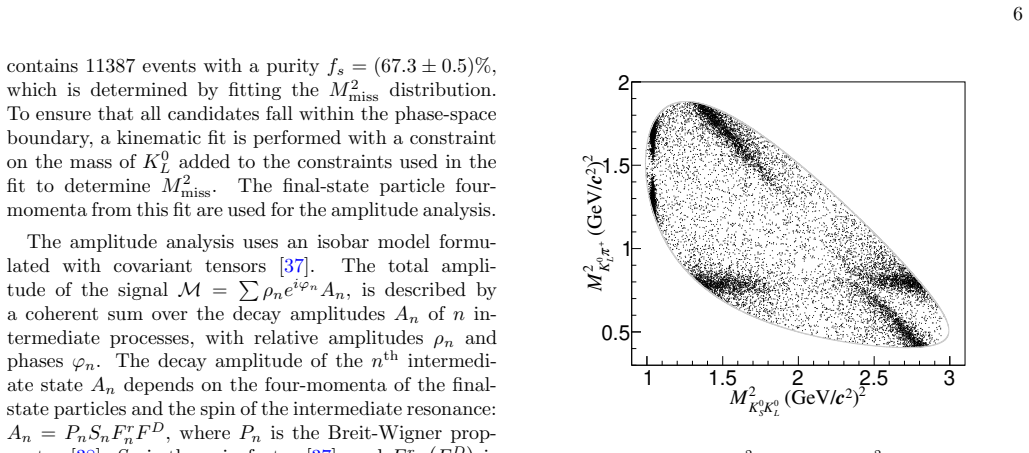


read the original abstract
We present the first amplitude analysis and branching fraction measurement of $D^{+} \rightarrow K_{S}^{0}K_{L}^{0}\pi^{+}$ decay. The analysis uses a dataset corresponding to an integrated luminosity of 20.3~$\rm fb^{-1}$, which was recorded at a center-of-mass energy 3.773~GeV by the BESIII detector. The measured branching fraction is $\mathcal{B}(D^{+} \rightarrow K_{S}^{0}K_{L}^{0}\pi^{+})=(5.780\pm0.085\pm 0.052)\times10^{-3}$, where the first uncertainty is statistical and the second is systematic. Using the known value of ${\cal B}(D^+ \to \phi \pi^+,\,\phi \to K^+K^-)$, we determine the relative branching fraction between $\phi \to K_{S}^0K_{L}^0$ and $\phi \to K^+K^-$ to be $\mathcal{B}(D^{+} \to \phi \pi^{+}, \phi \to K_{S}^0K_{L}^0)/\mathcal{B}(D^{+} \to \phi \pi^{+}, \phi \to K^+K^-)= 0.628\pm0.022\pm 0.015\pm0.017$, where the third uncertainty is related to $\mathcal{B}(D^{+} \to \phi \pi^{+}, \phi \to K^+K^-)$. This result is significantly lower than the previous world average and is consistent with the isospin expectation for the $\phi$ meson's coupling to charged and neutral kaon pairs.
Editorial analysis
A structured set of objections, weighed in public.
Referee Report
Summary. The paper reports the first amplitude analysis of the decay D⁺ → K_S⁰ K_L⁰ π⁺ using 20.3 fb⁻¹ of e⁺e⁻ collision data at √s = 3.773 GeV collected with the BESIII detector. It measures the absolute branching fraction B(D⁺ → K_S⁰ K_L⁰ π⁺) = (5.780 ± 0.085 ± 0.052) × 10^{-3}. Combining this with the external reference B(D⁺ → φ π⁺, φ → K⁺K⁻), the authors extract the relative branching fraction B(φ → K_S⁰ K_L⁰)/B(φ → K⁺K⁻) = 0.628 ± 0.022 ± 0.015 ± 0.017. The result is stated to be significantly lower than the previous world average and consistent with isospin expectations for φ → KK̄ couplings.
Significance. If the amplitude analysis reliably isolates the narrow φ contribution, the measurement supplies an independent test of isospin symmetry in vector-meson decays and resolves a long-standing discrepancy with earlier world-average values. The use of a full Dalitz-plot amplitude fit rather than a simple mass-window selection is a methodological improvement for a three-body final state containing both narrow and broad structures. The result, if robust, would tighten constraints on φ–KK̄ couplings and serve as input for future precision studies of light-meson spectroscopy.
major comments (1)
- The central relative branching fraction (0.628) is obtained by attributing a fraction of the three-body intensity to the narrow φ → K_S⁰ K_L⁰ component inside a global amplitude fit. The manuscript does not demonstrate that this fraction remains stable (within the quoted uncertainties) when the model is varied by adding or removing resonances (e.g., K*(892), a₀(980), or additional scalar terms) or by altering the parametrization of non-resonant contributions and their interference phases. Because cross terms in the intensity can shift the fitted φ normalization, the absence of such stability tests leaves the quoted total uncertainty potentially underestimated and directly affects the claim that the result is significantly lower than the prior average.
minor comments (2)
- The abstract states that the result is “significantly lower than the previous world average” but does not quote the numerical value or reference of that average; a direct comparison would improve clarity.
- The third uncertainty on the relative branching fraction is attributed to the external B(D⁺ → φ π⁺, φ → K⁺K⁻); the manuscript should explicitly state how this external uncertainty is propagated and whether it is treated as fully correlated or uncorrelated with the present data.
Simulated Author's Rebuttal
We thank the referee for the thorough review and valuable feedback on our manuscript. The concern regarding the stability of the extracted φ fraction under amplitude model variations is well taken, and we have addressed it by performing the requested checks. Our responses to the major comment are provided below, and the revised manuscript incorporates the additional material.
read point-by-point responses
-
Referee: The central relative branching fraction (0.628) is obtained by attributing a fraction of the three-body intensity to the narrow φ → K_S⁰ K_L⁰ component inside a global amplitude fit. The manuscript does not demonstrate that this fraction remains stable (within the quoted uncertainties) when the model is varied by adding or removing resonances (e.g., K*(892), a₀(980), or additional scalar terms) or by altering the parametrization of non-resonant contributions and their interference phases. Because cross terms in the intensity can shift the fitted φ normalization, the absence of such stability tests leaves the quoted total uncertainty potentially underestimated and directly affects the claim that the result is significantly lower than the prior average.
Authors: We agree that explicit tests of model stability are essential for amplitude analyses of three-body decays to ensure that interference effects do not bias the narrow resonance normalization. The baseline model in our analysis includes the φ(1020), K*(892), a₀(980), and a non-resonant component with floating magnitudes and phases, chosen to describe the observed Dalitz-plot structures. The φ contribution is localized due to its narrow width, and the fit accounts for all interference terms in the intensity. To directly address the referee's point, we have now performed a series of alternative fits: (i) removing the a₀(980) or K*(892) one at a time, (ii) adding an additional scalar resonance, and (iii) varying the non-resonant parametrization (e.g., different polynomial orders or constant vs. linear terms). In all cases the extracted relative branching fraction B(φ → K_S⁰ K_L⁰)/B(φ → K⁺ K⁻) remains consistent with 0.628 within the quoted total uncertainty. These results, together with a new table summarizing the variations, will be added to the revised manuscript (new Section 5.3 and Appendix). We therefore maintain that the total uncertainty is not underestimated and that the comparison to the previous world average remains valid. revision: yes
Circularity Check
No significant circularity in the derivation chain
full rationale
The paper reports a data-driven amplitude analysis of D+ → KS0 KL0 π+ decays using BESIII collision data. The total branching fraction is extracted directly from the fit to the Dalitz plot. The relative branching fraction for the φ modes is obtained by dividing the fitted φ → KS0 KL0 yield by an external, previously published branching fraction for φ → K+K−; this external input is independent of the present dataset and equations. The comparison to the world average and to isospin expectations is a post-hoc consistency check, not part of the derivation. No self-definitional relations, fitted inputs renamed as predictions, load-bearing self-citations, or ansatz smuggling appear in the reported chain. The result remains falsifiable against external data and is self-contained against benchmarks.
Axiom & Free-Parameter Ledger
free parameters (1)
- amplitude fit parameters
axioms (1)
- domain assumption Isospin symmetry holds for phi → KK decays up to small electromagnetic and mass-difference corrections
Lean theorems connected to this paper
-
IndisputableMonolith/Cost/FunctionalEquation.leanwashburn_uniqueness_aczel unclear?
unclearRelation between the paper passage and the cited Recognition theorem.
The amplitude analysis uses an isobar model formulated with covariant tensors... total amplitude M = Σ ρ_n e^{i φ_n} A_n ... Breit-Wigner propagator, spin factor, Blatt-Weisskopf barrier factor.
-
IndisputableMonolith/Foundation/RealityFromDistinction.leanreality_from_one_distinction unclear?
unclearRelation between the paper passage and the cited Recognition theorem.
We determine the relative branching fraction ... R_φ_KK = 0.628 ... consistent with the isospin expectation
What do these tags mean?
- matches
- The paper's claim is directly supported by a theorem in the formal canon.
- supports
- The theorem supports part of the paper's argument, but the paper may add assumptions or extra steps.
- extends
- The paper goes beyond the formal theorem; the theorem is a base layer rather than the whole result.
- uses
- The paper appears to rely on the theorem as machinery.
- contradicts
- The paper's claim conflicts with a theorem or certificate in the canon.
- unclear
- Pith found a possible connection, but the passage is too broad, indirect, or ambiguous to say the theorem truly supports the claim.
Reference graph
Works this paper leans on
-
[1]
Navaset al.(Particle Data Group), Phys
S. Navaset al.(Particle Data Group), Phys. Rev. D110, 030001 (2024)
work page 2024
- [2]
- [3]
-
[4]
F. V. Flores-Baez and G. Lopez Castro, Phys. Rev. D 78, 077301 (2008)
work page 2008
-
[5]
E. Fischbach, A. W. Overhauser and B. Woodahl, Phys. Lett. B526, 355 (2002)
work page 2002
-
[6]
M. Benayoun, P. David, L. DelBuono and F. Jegerlehner, Eur. Phys. J . C72, 1848 (2012)
work page 2012
-
[7]
A. D. Bukin, L. M. Kurdadze, S. I. Serednyakov, V. A. Sidorovet al., Sov. J. Nucl. Phys.27, 516 (1978)
work page 1978
-
[8]
M. A. Benitez, S. U. Chung, R. L. Eisner and N. P. Samios, Phys. Rev. D6, 29 (1972)
work page 1972
-
[9]
Lavenet al.(Aachen-Berlin-CERN-London-Vienna Collaboration), Nucl
H. Lavenet al.(Aachen-Berlin-CERN-London-Vienna Collaboration), Nucl. Phys. B127, 43 (1977)
work page 1977
-
[10]
M. J. Lostyet al.(Amsterdam-CERN-Nijmegen-Oxford Collaboration), Nucl. Phys. B133, 38 (1978)
work page 1978
-
[11]
R. R. Akhmetshinet al., Phys. Lett. B364, 199 (1995)
work page 1995
-
[12]
E. A. Kozyrevet al., Phys. Lett. B779, 64 (2018)
work page 2018
-
[13]
G. Parrour, G. Cosme, A. Courau, B. Dudelzaket al., Phys. Lett. B63, 357 (1976)
work page 1976
-
[14]
A. D. Bukin, L. M. Kurdadze, S. I. Serednyakov, V. A. Sidorovet al., Yad. Fiz.27, 976 (1978)
work page 1978
-
[15]
M. Mattiuzzi, A. Bracco, F. Camera, B. Millionet al., Phys. Lett. B364, 13 (1995)
work page 1995
-
[16]
S. I. Dolinsky, V. P. Druzhinin, M. S. Dubrovin, V. B. Golubevet al., Phys. Rept.202, 99 (1991)
work page 1991
-
[17]
S. Dubniˇ cka, A. Z. Dubniˇ ckov´ a, L. Holka and A. Liptaj, Phys. Rev. D110, 054019 (2024)
work page 2024
-
[18]
Ablikimet al.(BESIII Collaboration), Phys
M. Ablikimet al.(BESIII Collaboration), Phys. Rev. Lett.134, 011904 (2025)
work page 2025
-
[19]
Ablikimet al.(BESIII Collaboration), Phys
M. Ablikimet al.(BESIII Collaboration), Phys. Rev. Lett.134, 201902 (2025)
work page 2025
-
[20]
Ablikimet al.(BESIII Collaboration), Phys
M. Ablikimet al.(BESIII Collaboration), Phys. Rev. 10 Lett.135, 161902 (2025)
work page 2025
-
[21]
Ablikimet al.(BESIII Collaboration), Chin
M. Ablikimet al.(BESIII Collaboration), Chin. Phys. C 48, 123001 (2024)
work page 2024
-
[22]
Ablikimet al.(BESIII Collaboration), Phys
M. Ablikimet al.(BESIII Collaboration), Phys. Rev. D 99, 032002 (2019)
work page 2019
-
[23]
Ablikimet al.(BESIII Collaboration), Phys
M. Ablikimet al.(BESIII Collaboration), Phys. Rev. D 104, 012006 (2021)
work page 2021
-
[24]
D. Wang, F. S. Yu, P. F. Guo and H. Y. Jiang, Phys. Rev. D95, 073007 (2017)
work page 2017
-
[25]
H. Y. Cheng and C. W. Chiang, Phys. Rev. D109, 073008 (2024)
work page 2024
-
[26]
Q. Qin, H. N. Li, C. D. Lyu and F. S. Yu, Phys. Rev. D 89, 054006 (2014)
work page 2014
-
[27]
K. X. Huanget al., Nucl. Sci. Tech.33, 142 (2022)
work page 2022
-
[28]
Ablikimet al.(BESIII Collaboration), Nucl
M. Ablikimet al.(BESIII Collaboration), Nucl. Instrum. Meth. Phys. Res. Sect. A614, 345 (2010)
work page 2010
- [29]
-
[30]
Agostinelliet al.(GEANT4 Collaboration), Nucl
S. Agostinelliet al.(GEANT4 Collaboration), Nucl. In- strum. Meth. A506, 250 (2003)
work page 2003
- [31]
-
[32]
D. J. Lange, Nucl. Instrum. Meth. A462, 152 (2001); R. G. Ping, Chin. Phys. C32, 599 (2008)
work page 2001
-
[33]
J. C. Chen, G. S. Huang, X. R. Qi, D. H. Zhanget al. Phys. Rev. D62, 034003 (2000); R. L. Yang, R. G. Ping and H. Chen, Chin. Phys. Lett.31, 061301 (2014)
work page 2000
-
[34]
Adleret al.(MARK-III Collaboration), Phys
J. Adleret al.(MARK-III Collaboration), Phys. Rev. Lett.62, 1821 (1989)
work page 1989
-
[35]
Ablikimet al.(BESIII Collaboration), Phys
M. Ablikimet al.(BESIII Collaboration), Phys. Rev. D 110, 092006 (2024)
work page 2024
-
[36]
Ablikimet al.(BESIII Collaboration), Phys
M. Ablikimet al.(BESIII Collaboration), Phys. Rev. Lett.132, 131903 (2024)
work page 2024
-
[37]
B. S. Zou and D. V. Bugg, Eur. Phys. J. A16, 537 (2003)
work page 2003
-
[38]
J. D. Jackson, N. Cimento34, 1644 (1964)
work page 1964
-
[39]
J. M. Blatt and V. F. Weisskopf,Theoretical Nuclear Physics(John Wiley & Sons, New York, 1973)
work page 1973
- [40]
-
[41]
B. Liu, X. Xiong, G. Hou, S. Song and L. Shen, EPJ Web Conf.214, 06033 (2019)
work page 2019
-
[42]
Ablikimet al.(BESIII Collaboration), arXiv:2510.25111 [hep-ex]
M. Ablikimet al.(BESIII Collaboration), arXiv:2510.25111 [hep-ex]
-
[43]
Ablikimet al.(BESIII Collaboration), J
M. Ablikimet al.(BESIII Collaboration), J. High Energ. Phys.06, 181 (2021)
work page 2021
-
[44]
Ablikimet al.(BESIII Collaboration), Phys
M. Ablikimet al.(BESIII Collaboration), Phys. Rev. D 103, 092006 (2021)
work page 2021
-
[45]
Ablikimet al.(BESIII Collaboration), Phys
M. Ablikimet al.(BESIII Collaboration), Phys. Rev. Lett.129, 182001 (2022)
work page 2022
-
[46]
Ablikimet al.(BESIII Collaboration), Phys
M. Ablikimet al.(BESIII Collaboration), Phys. Rev. D 76, 122002 (2007)
work page 2007
-
[47]
Ablikimet al.(BESIII Collaboration), Phys
M. Ablikimet al.(BESIII Collaboration), Phys. Rev. D 100, 072008 (2019)
work page 2019
-
[48]
In the decay process under consideration, a pair ofK 0 ¯K 0 is produced. (Here,K 0 and ¯K 0 includes their excited states, such asK ∗0 and ¯K ∗0, without losing generality.) Since one ofK 0 and ¯K 0 is the superposition ofK 0 S and K 0 L with same phase while the other has an opposite phase,K 0(→K 0 S) ¯K 0(→K 0 L) andK 0(→K 0 L) ¯K 0(→K 0 S) exhibits a p...
discussion (0)
Sign in with ORCID, Apple, or X to comment. Anyone can read and Pith papers without signing in.