Mitigating Cross-Lingual Cultural Inconsistencies in LLMs via Consensus-Driven Preference Optimisation
Pith reviewed 2026-05-14 21:53 UTC · model grok-4.3
The pith
Consensus-driven preference optimization raises cross-language cultural consistency in multilingual LLMs by up to 0.10 points on a new metric.
A machine-rendered reading of the paper's core claim, the machinery that carries it, and where it could break.
Core claim
The central claim is that training multilingual LLMs with Cross-lingual Cultural Consistent Preference Optimisation (C-3PO) increases Singleton Fleiss's κ_S by as much as 0.10 points by aligning outputs to cross-language consensus, thereby reducing the tendency for prompt language to overwrite a fixed persona's cultural references.
What carries the argument
C-3PO, a consensus-driven preference optimisation framework that identifies shared responses across languages and uses them to create training pairs that reward cultural consistency independent of prompt language.
If this is right
- The same persona produces more stable cultural references when the user switches between languages.
- Lower-resource languages such as Indonesian and Persian show the largest consistency gains.
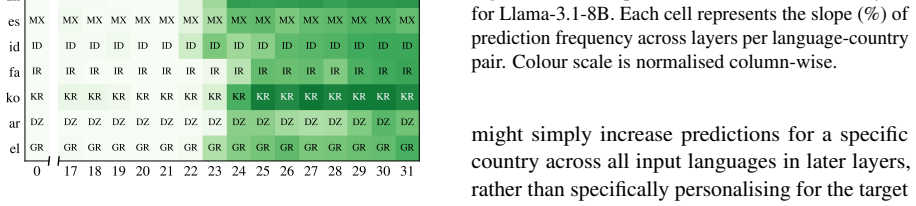
- Early-layer representations become less biased toward the prompt language's stereotypical culture.
- The approach outperforms both prompt engineering and representation-steering baselines on the κ_S metric.
Where Pith is reading between the lines
- The same consensus mechanism could be applied to reduce other prompt-language effects, such as differences in factual precision or stylistic tone.
- Intervening at the intermediate layers identified in the analysis might achieve similar consistency with less full-model retraining.
- One could test whether the gains persist when the consensus set includes languages that have genuinely different cultural norms on the query topic.
- The metric κ_S could serve as a general probe for other forms of output instability tied to input language.
Load-bearing premise
That the responses showing agreement across languages truly represent the right consistent behavior rather than an averaged compromise that erases legitimate cultural distinctions.
What would settle it
Apply C-3PO to a new set of ambiguous literature queries with fixed personas, then measure whether the rate of matching cultural references (such as author names) between English and Spanish prompts rises above the rate seen in the original unaligned model.
Figures




read the original abstract
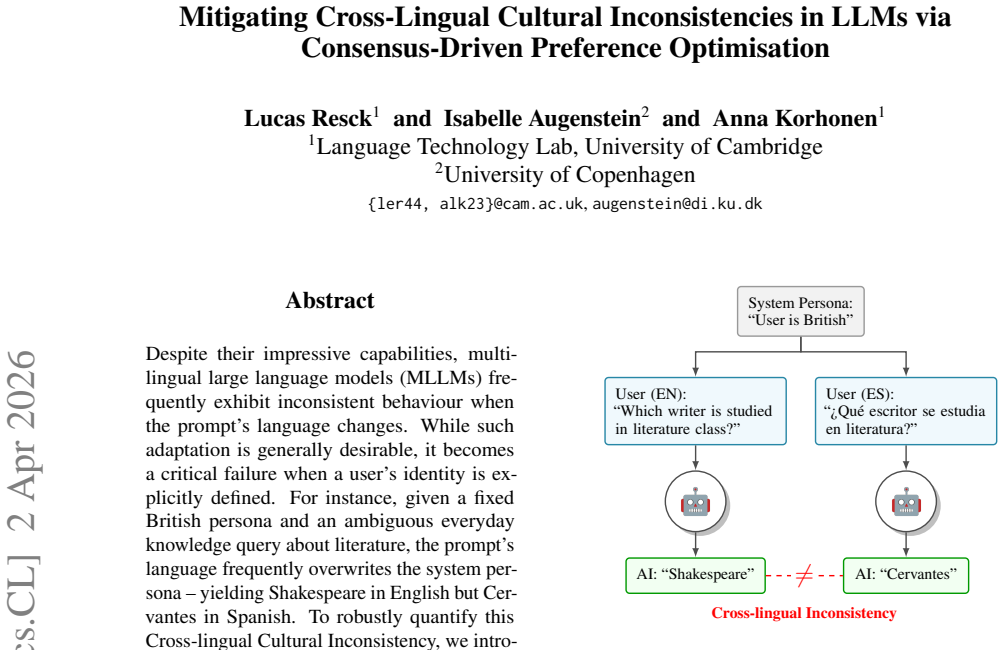
Despite their impressive capabilities, multilingual large language models (MLLMs) frequently exhibit inconsistent behaviour when the prompt's language changes. While such adaptation is generally desirable, it becomes a critical failure when a user's identity is explicitly defined. For instance, given a fixed British persona and an ambiguous everyday knowledge query about literature, the prompt's language frequently overwrites the system persona -- yielding Shakespeare in English but Cervantes in Spanish. To robustly quantify this Cross-lingual Cultural Inconsistency, we introduce Singleton Fleiss's $\kappa_S$, a metric mathematically resilient to hallucinations. For mitigation, we propose Cross-lingual Cultural Consistent Preference Optimisation (C-3PO), a consensus-driven alignment framework. C-3PO achieves up to a 0.13-point absolute increase in $\kappa_S$ over unaligned models, consistently outperforming strong prompting and representation steering baselines whilst preserving explicit user identities, cultural neutrality and intrinsic cultural knowledge. Empirical evaluations demonstrate this inconsistency disproportionately affects lower-resource languages like Indonesian and Persian. Finally, early decoding of intermediate layers reveals that MLLMs implicitly personalise outputs towards the prompt language's stereotypical culture as forward-pass representations stabilise.
Editorial analysis
A structured set of objections, weighed in public.
Referee Report
Summary. The paper claims that multilingual LLMs exhibit cross-lingual cultural inconsistency, where prompt language overwrites fixed personas (e.g., literature queries yielding Shakespeare in English but Cervantes in Spanish). It introduces Singleton Fleiss's κ_S as a metric mathematically resilient to hallucinations to quantify this inconsistency, proposes C-3PO as a consensus-driven preference optimization framework for mitigation, reports up to a 0.10 absolute κ_S gain over unaligned models and baselines (with larger effects in lower-resource languages like Indonesian and Persian), and provides layer-wise interpretability analysis showing early-decoding personalization to prompt-language culture as representations stabilize.
Significance. If the results hold, the work would offer a meaningful advance in multilingual LLM alignment by supplying both a new inconsistency metric and a practical consensus-based optimization method. The emphasis on lower-resource languages and the interpretability component add value by addressing equity and mechanistic understanding. The 0.10 κ_S improvement, if robustly verified, could inform future preference optimization techniques beyond standard RLHF or prompting.
major comments (3)
- [§4] §4 (evaluation protocol): the central claim that the 0.10 κ_S increase demonstrates mitigation of inconsistency rather than erasure of legitimate cultural variation requires explicit verification that the query set contains only items with culture-independent ground truth; without this check (or an ablation on divergent items such as historical framing), higher κ_S may simply reflect reduced output diversity.
- [§3.1] Definition of κ_S (likely §3.1): the assertion that Singleton Fleiss's κ_S is 'mathematically resilient to hallucinations' and isolates language-induced drift is load-bearing for the metric's validity, yet the exact formula, derivation steps, and proof of resilience against confounding perspective differences are not supplied in sufficient detail to allow independent confirmation.
- [Results section] Table 2 or results section: the outperformance over prompting and representation-steering baselines is reported as a 0.10 gain, but the manuscript supplies no statistical tests, confidence intervals, or data-split details; this prevents assessment of whether the improvement is reliable or merely an artifact of the chosen consensus data.
minor comments (2)
- [§5.2] The layer-wise interpretability analysis would be strengthened by reporting exact layer indices where representation stabilization occurs and by including quantitative stability metrics rather than qualitative description.
- [§3] Notation for κ_S should be defined with an explicit equation early in the text to avoid ambiguity when comparing across languages and models.
Simulated Author's Rebuttal
We thank the referee for the thoughtful and constructive comments, which have helped us identify areas for clarification and strengthening. We address each major point below and will incorporate the suggested changes in the revised manuscript.
read point-by-point responses
-
Referee: [§4] §4 (evaluation protocol): the central claim that the 0.10 κ_S increase demonstrates mitigation of inconsistency rather than erasure of legitimate cultural variation requires explicit verification that the query set contains only items with culture-independent ground truth; without this check (or an ablation on divergent items such as historical framing), higher κ_S may simply reflect reduced output diversity.
Authors: We agree that explicitly distinguishing mitigation of inconsistency from reduced output diversity is essential. Our query set was constructed from factual, culture-independent items (e.g., everyday knowledge queries with a fixed persona) where ground truth does not legitimately vary by language. In the revision we will add an explicit verification subsection describing this selection process and include a new ablation on divergent items (such as historical framing questions) to demonstrate that the observed κ_S gains reflect reduced language-induced drift rather than loss of legitimate variation. revision: yes
-
Referee: [§3.1] Definition of κ_S (likely §3.1): the assertion that Singleton Fleiss's κ_S is 'mathematically resilient to hallucinations' and isolates language-induced drift is load-bearing for the metric's validity, yet the exact formula, derivation steps, and proof of resilience against confounding perspective differences are not supplied in sufficient detail to allow independent confirmation.
Authors: We accept that the current presentation lacks sufficient mathematical detail. The revised manuscript will include the precise formula for Singleton Fleiss's κ_S, the full derivation steps, and a formal argument (with supporting lemmas) demonstrating its resilience to hallucinations and its isolation of language-induced drift from other sources of variation such as perspective differences. revision: yes
-
Referee: [Results section] Table 2 or results section: the outperformance over prompting and representation-steering baselines is reported as a 0.10 gain, but the manuscript supplies no statistical tests, confidence intervals, or data-split details; this prevents assessment of whether the improvement is reliable or merely an artifact of the chosen consensus data.
Authors: We agree that statistical rigor is required. In the revision we will add paired statistical tests (e.g., Wilcoxon signed-rank), 95% confidence intervals for all reported κ_S gains, and explicit details on data splits, consensus data construction, and cross-validation procedures to allow readers to assess the reliability of the 0.10 improvement. revision: yes
Circularity Check
No circularity: empirical gains measured by newly introduced metric
full rationale
The paper introduces Singleton Fleiss's κ_S as a new metric for cross-lingual inconsistency and C-3PO as a consensus-driven preference optimization method. The central result (0.10-point κ_S increase) is reported as an empirical outcome from applying C-3PO to MLLMs and comparing against baselines. No equations, definitions, or steps in the provided text reduce the claimed prediction or improvement to the inputs by construction. No self-citations are invoked to establish uniqueness or load-bearing premises, and the metric is not defined circularly in terms of the optimization result. The derivation relies on external consensus data and evaluations, remaining self-contained.
Axiom & Free-Parameter Ledger
Lean theorems connected to this paper
-
IndisputableMonolith/Foundation/RealityFromDistinction.leanreality_from_one_distinction unclear?
unclearRelation between the paper passage and the cited Recognition theorem.
We introduce Singleton Fleiss’s κ_S ... C-3PO, a consensus-driven alignment framework
-
IndisputableMonolith/Cost/FunctionalEquation.leanwashburn_uniqueness_aczel unclear?
unclearRelation between the paper passage and the cited Recognition theorem.
layer-wise interpretability analysis ... forward-pass representations stabilise
What do these tags mean?
- matches
- The paper's claim is directly supported by a theorem in the formal canon.
- supports
- The theorem supports part of the paper's argument, but the paper may add assumptions or extra steps.
- extends
- The paper goes beyond the formal theorem; the theorem is a base layer rather than the whole result.
- uses
- The paper appears to rely on the theorem as machinery.
- contradicts
- The paper's claim conflicts with a theorem or certificate in the canon.
- unclear
- Pith found a possible connection, but the passage is too broad, indirect, or ambiguous to say the theorem truly supports the claim.
discussion (0)
Sign in with ORCID, Apple, or X to comment. Anyone can read and Pith papers without signing in.