Recognition: 2 theorem links
· Lean TheoremDepth of Maximum of Air-Shower Profiles above 10¹7.7 eV Measured with the Fluorescence Detector of the Pierre Auger Observatory
Pith reviewed 2026-05-14 20:33 UTC · model grok-4.3
The pith
Air-shower maximum depth shows a clear break at 10^18.4 eV where the average cosmic-ray mass begins to rise.
A machine-rendered reading of the paper's core claim, the machinery that carries it, and where it could break.
Core claim
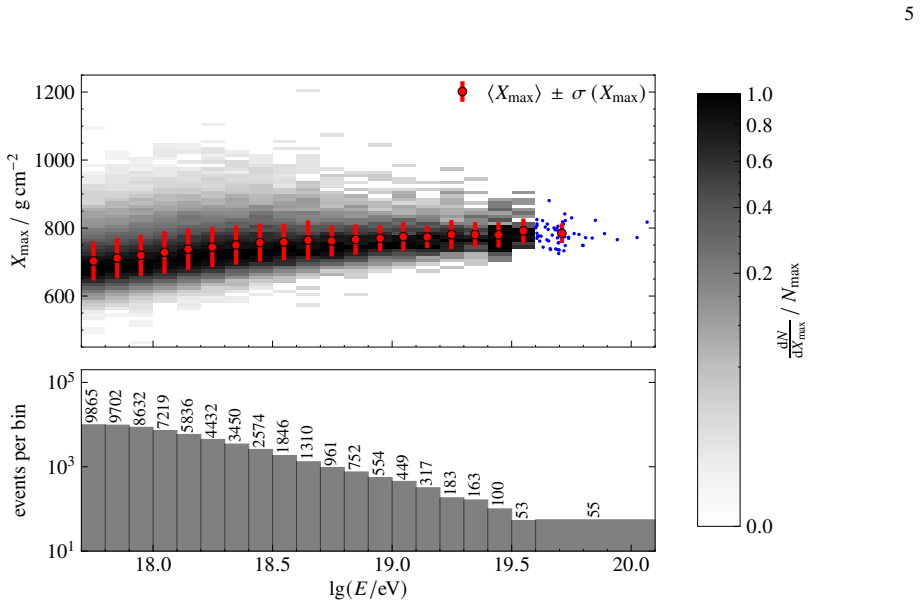
The energy evolution of the mean Xmax exhibits a pronounced break at around 10^18.4 eV, providing direct, model-independent evidence for a change in the evolution of the mass composition. Independently, the observed decrease of the Xmax fluctuations with energy indicates a transition toward a heavier and less diverse primary mass composition. No statistically significant declination dependence of the Xmax distributions is observed, indicating an isotropic mass composition.
What carries the argument
Depth of shower maximum Xmax, the atmospheric column depth at which the number of particles in the extensive air shower reaches its peak value.
If this is right
- Above 10^18.4 eV the average logarithmic mass of arriving cosmic rays increases steadily.
- The variance of the mass distribution decreases, implying fewer distinct nuclear species dominate the flux.
- Fitting the Xmax distributions in each energy bin yields rising fractions of CNO and iron-group nuclei and falling proton and helium fractions.
- The absence of declination dependence in Xmax implies the mass composition is the same in all directions within the Observatory's field of view.
Where Pith is reading between the lines
- A heavier composition at the highest energies would reduce the expected flux of cosmogenic neutrinos and gamma rays produced in interactions with the cosmic microwave background.
- The observed break energy roughly coincides with the ankle feature in the all-particle spectrum, suggesting a possible link between composition change and the transition from galactic to extragalactic sources.
- Future observatories with larger statistics could test whether the composition continues to evolve or stabilizes above 10^19.5 eV.
Load-bearing premise
Converting the measured Xmax distributions into statements about primary particle mass requires air-shower simulations whose hadronic interaction models remain uncertain.
What would settle it
An independent data set that shows the mean Xmax continuing its previous slope past 10^18.4 eV with no flattening or that finds proton fractions remaining above 50 percent at 10^19 eV would falsify the claimed break and mass increase.
Figures






read the original abstract
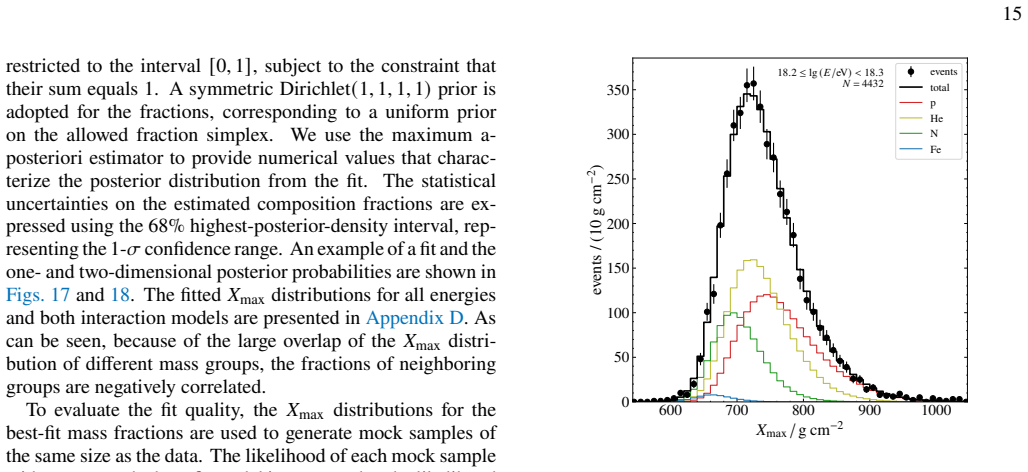
We present measurements of the depth of shower maximum, Xmax, for cosmic-ray-induced extensive air showers recorded by the fluorescence detector of the Pierre Auger Observatory over 17 years. The data set covers primary energies from 10^17.7 eV to beyond 10^19.6 eV. With improved event reconstruction and an exposure 2.4 times larger than in our previous analysis, this work confirms and refines our conclusions on the mass composition at ultra-high energies. The energy evolution of the mean Xmax exhibits a pronounced break at around 10^18.4 eV, providing direct, model-independent evidence for a change in the evolution of the mass composition. Independently, the observed decrease of the Xmax fluctuations with energy indicates a transition toward a heavier and less diverse primary mass composition. No statistically significant declination dependence of the Xmax distributions is observed within the exposure of the Observatory, indicating an isotropic mass composition. The mean and standard deviation of the Xmax distributions, interpreted with air-shower simulations, yield the energy dependence of the average and variance of the logarithmic mass of cosmic rays arriving at Earth. Furthermore, energy-dependent fractional abundances of four representative primary-mass groups (p, He, CNO, Fe) are obtained by fitting the observed Xmax distributions in each energy bin with a weighted sum of elemental templates. These results provide strong evidence against a long-standing assumption that ultra-high-energy cosmic rays are predominantly protons: above ~10^18.4 eV, the average cosmic-ray mass increases, accompanied by a steadily decreasing diversity in the elemental composition.
Editorial analysis
A structured set of objections, weighed in public.
Referee Report
Summary. The paper presents updated measurements of the depth of shower maximum (Xmax) for cosmic-ray air showers recorded by the fluorescence detector of the Pierre Auger Observatory over 17 years, covering energies from 10^17.7 eV to beyond 10^19.6 eV. With 2.4 times larger exposure and improved reconstruction, it reports a pronounced break in the energy evolution of mean Xmax at ~10^18.4 eV as model-independent evidence for a change in mass composition, a decrease in Xmax fluctuations indicating a transition to heavier and less diverse primaries, no significant declination dependence, and derived energy-dependent mass fractions (p, He, CNO, Fe) from fits to Xmax distributions using air-shower simulations.
Significance. If the results hold, the work delivers high-statistics, direct observational confirmation of a break in mean Xmax at ~10^18.4 eV, strengthening constraints on ultra-high-energy cosmic-ray mass composition evolution without relying on hadronic models for the primary claim. The separation of the model-independent Xmax trend from the simulation-dependent mass interpretation, combined with the large exposure increase, provides robust, falsifiable input for source and propagation models.
minor comments (2)
- [§3.2] §3.2: The description of the improved event reconstruction could include a brief quantitative comparison of the resolution improvement relative to the previous analysis to aid readers in assessing the impact on the reported break position.
- [Figure 5] Figure 5: The legend for the four mass-group templates should explicitly note the hadronic interaction model used for each template to avoid ambiguity in the fitting procedure.
Simulated Author's Rebuttal
We thank the referee for the positive review, accurate summary of our results, and recommendation to accept the manuscript. No major comments were raised requiring specific responses or revisions.
Circularity Check
No significant circularity detected
full rationale
The paper reports direct observational measurements of Xmax from fluorescence detector data over 17 years, with the pronounced break in mean Xmax at ~10^18.4 eV presented as a model-independent feature of the data itself. Subsequent mapping to mass composition uses external air-shower simulations and template fitting, which do not reduce by the paper's equations to quantities fitted from the same dataset. References to prior Auger publications are confirmatory updates with larger exposure rather than load-bearing justifications for the new result. No self-definitional loops, fitted inputs renamed as predictions, or ansatz smuggling via self-citation appear in the derivation chain.
Axiom & Free-Parameter Ledger
axioms (1)
- domain assumption Air-shower development is accurately modeled by current hadronic interaction simulations
Lean theorems connected to this paper
-
IndisputableMonolith/Foundation/RealityFromDistinction.leanreality_from_one_distinction unclear?
unclearRelation between the paper passage and the cited Recognition theorem.
The energy evolution of the mean Xmax exhibits a pronounced break at around 10^18.4 eV, providing direct, model-independent evidence for a change in the evolution of the mass composition.
-
IndisputableMonolith/Cost/FunctionalEquation.leanwashburn_uniqueness_aczel unclear?
unclearRelation between the paper passage and the cited Recognition theorem.
The observed decrease of the Xmax fluctuations with energy indicates a transition toward a heavier and less diverse primary mass composition.
What do these tags mean?
- matches
- The paper's claim is directly supported by a theorem in the formal canon.
- supports
- The theorem supports part of the paper's argument, but the paper may add assumptions or extra steps.
- extends
- The paper goes beyond the formal theorem; the theorem is a base layer rather than the whole result.
- uses
- The paper appears to rely on the theorem as machinery.
- contradicts
- The paper's claim conflicts with a theorem or certificate in the canon.
- unclear
- Pith found a possible connection, but the passage is too broad, indirect, or ambiguous to say the theorem truly supports the claim.
Reference graph
Works this paper leans on
-
[1]
N. Globus and R. D. Blandford, Ultrahigh-Energy Cosmic Rays, ARAA63, 339 (2025)
work page 2025
-
[2]
Greisen, Cosmic Ray Showers, Ann
K. Greisen, Cosmic Ray Showers, Ann. Rev. of Nucl. Part. Sci. 10, 63 (1960)
work page 1960
-
[3]
J. Linsley and A. A. Watson, Validity of scaling to 10 20 eV and high-energy cosmic-ray composition, Phys. Rev. Lett.46, 459 (1981)
work page 1981
-
[4]
Engelet al., Nucleus-nucleus collisions and interpretation of cosmic-ray cascades, Phys
J. Engelet al., Nucleus-nucleus collisions and interpretation of cosmic-ray cascades, Phys. Rev. D46, 5013 (1992)
work page 1992
-
[5]
Matthews, A Heitler model of extensive air showers, Astropart
J. Matthews, A Heitler model of extensive air showers, Astropart. Phys.22, 387 (2005)
work page 2005
-
[6]
K.-H. Kampert and M. Unger, Measurements of the cosmic ray composition with air shower experiments, Astropart. Phys.35, 660 (2012)
work page 2012
-
[7]
P. Abreuet al.(Pierre Auger Collaboration), Interpretation of the Depths of Maximum of Extensive Air Showers Measured by the Pierre Auger Observatory, JCAP02, 026 (2013)
work page 2013
-
[8]
Ostapchenko, Total and diffractive cross sections in enhanced Pomeron scheme, Phys
S. Ostapchenko, Total and diffractive cross sections in enhanced Pomeron scheme, Phys. Rev. D81, 114028 (2010)
work page 2010
-
[9]
T. Pieroget al., EPOS LHC: Test of collective hadronization with data measured at the CERN Large Hadron Collider, Phys. Rev. C92, 034906 (2015)
work page 2015
-
[10]
Riehnet al., Hadronic interaction model Sibyll 2.3d and ex- tensive air showers, Phys
F. Riehnet al., Hadronic interaction model Sibyll 2.3d and ex- tensive air showers, Phys. Rev. D102, 063002 (2020)
work page 2020
-
[11]
Ostapchenko, QGSJET-III model of high energy hadronic interactions
S. Ostapchenko, QGSJET-III model of high energy hadronic interactions. II. Particle production and extensive air shower characteristics, Phys. Rev. D109, 094019 (2024)
work page 2024
-
[12]
T. Pierog and K. Werner, EPOS LHC-R : up-to-date hadronic model for EAS simulations, PoSICRC2023, 230 (2023)
work page 2023
-
[13]
J. Albrechtet al., Global tuning of hadronic interaction models with accelerator-based and astroparticle data, Nature Rev. Phys. 8, 98 (2026), arXiv:2508.21796 [astro-ph.HE]
-
[14]
The Pierre Auger Cosmic Ray Observatory
A. Aabet al.(Pierre Auger Collaboration), The Pierre Auger Cosmic Ray Observatory, Nucl. Instrum. Meth. A798, 172 (2015), arXiv:1502.01323 [astro-ph.IM]
work page internal anchor Pith review Pith/arXiv arXiv 2015
-
[15]
J. Abrahamet al.(Pierre Auger Collaboration), Measurement of the Depth of Maximum of Extensive Air Showers above 1018 eV, Phys. Rev. Lett.104, 091101 (2010)
work page 2010
-
[16]
A. Aabet al.(Pierre Auger Collaboration), Depth of maximum of air-shower profiles at the Pierre Auger Observatory. I. Mea- surements at energies above 1017.8 eV, Phys. Rev. D90, 122005 (2014)
work page 2014
-
[17]
A. Aabet al.(Pierre Auger Collaboration), Depth of maximum of air-shower profiles at the Pierre Auger Observatory. II. Com- position implications, Phys. Rev. D90, 122006 (2014)
work page 2014
-
[18]
The Pierre Auger Observatory Upgrade - Preliminary Design Report
A. Aabet al.(Pierre Auger Collaboration), The Pierre Auger Observatory Upgrade - Preliminary Design Report, arXiv:1604.03637 [astro-ph] (2016)
work page internal anchor Pith review Pith/arXiv arXiv 2016
-
[19]
I. Allekotteet al.(Pierre Auger Collaboration), The Surface Detector System of the Pierre Auger Observatory, Nucl. Instrum. Meth. A586, 409 (2008)
work page 2008
-
[20]
J. Abrahamet al.(Pierre Auger Collaboration), The fluores- cence detector of the Pierre Auger Observatory, Nucl. Instrum. Methods Phys. Res. A620, 227 (2010)
work page 2010
-
[21]
J. Abrahamet al.(Pierre Auger Collaboration), Properties and performance of the prototype instrument for the Pierre Auger Observatory, Nucl. Instrum. Meth. A523, 50 (2004)
work page 2004
-
[22]
Sanchezet al.(Pierre Auger Collaboration), The AMIGA detector of the Pierre Auger Observatory, Proc
F. Sanchezet al.(Pierre Auger Collaboration), The AMIGA detector of the Pierre Auger Observatory, Proc. 32nd ICRC3, 149 (2011)
work page 2011
-
[23]
H.-J. Matheset al.(Pierre Auger Collaboration), The HEAT Telescopes of the Pierre Auger Observatory - Status and First 19 Data, Proc. 32nd ICRC3, 153 (2011)
work page 2011
-
[24]
J. T. Bracket al., Absolute photometric calibration of large aperture optical systems, Astropart. Phys.20, 653 (2004)
work page 2004
-
[25]
A. C. Roveroet al., Multi-wavelength calibration procedure for the Pierre Auger Observatory Fluorescence Detectors, As- tropart. Phys.31, 305 (2009)
work page 2009
-
[26]
J. T. Bracket al., Absolute calibration of a large-diameter light source, JINST8, 05014 (2013)
work page 2013
-
[27]
P. Abreuet al.(Pierre Auger Collaboration), Description of atmospheric conditions at the Pierre Auger Observatory using the Global Data Assimilation System (GDAS), Astropart. Phys. 35, 591 (2012)
work page 2012
-
[28]
Ficket al., The Central Laser Facility at the Pierre Auger Observatory, JINST1, P11003 (2006)
B. Ficket al., The Central Laser Facility at the Pierre Auger Observatory, JINST1, P11003 (2006)
work page 2006
-
[29]
J. Abrahamet al.(Pierre Auger Collaboration), A Study of the Effect of Molecular and Aerosol Conditions in the Atmosphere on Air Fluorescence Measurements at the Pierre Auger Obser- vatory, Astropart. Phys.33, 108 (2010)
work page 2010
-
[30]
V. M. Harveyet al.(Pierre Auger Collaboration), A new cross- check and review of aerosol attenuation measurements at the Pierre Auger Observatory, EPJ Web Conf.444, 300 (2023)
work page 2023
-
[31]
Chirinoset al.(Pierre Auger Collaboration), Cloud Monitor- ing at the Pierre Auger Observatory, Proc
J. Chirinoset al.(Pierre Auger Collaboration), Cloud Monitor- ing at the Pierre Auger Observatory, Proc. 33rd ICRC33, 2244 (2013)
work page 2013
-
[32]
P. Abreuet al.(Pierre Auger Collaboration), Identifying clouds over the Pierre Auger Observatory using infrared satellite data, Astropart. Phys.50-52, 92 (2013)
work page 2013
-
[33]
Sommers, Capabilities of a giant hybrid air shower detector, Astropart
P. Sommers, Capabilities of a giant hybrid air shower detector, Astropart. Phys.3, 349 (1995)
work page 1995
-
[34]
B. R. Dawson, H. Y. Dai, P. Sommers, and S. Yoshida, Simu- lations of a giant hybrid air shower detector, Astropart. Phys.5, 239 (1996)
work page 1996
-
[35]
A. N. Bunner, K. Greisen, and P. B. Landecker, An imaging system for EAS optical emission, Canadian Journal of Physics Supplement46, 266 (1968)
work page 1968
-
[36]
M. Risse and D. Heck, Energy release in air showers, Astropart. Phys.20, 661 (2004)
work page 2004
- [37]
-
[38]
T. K. Gaisser and A. M. Hillas, Reliability of the Method of Constant Intensity Cuts for Reconstructing the Average Devel- opment of Vertical Showers, Proc. 15th ICRC8, 353 (1977)
work page 1977
-
[39]
S. Andringa, R. Conceicao, and M. Pimenta, Mass composition and cross-section from the shape of cosmic ray shower longitu- dinal profiles, Astropart. Phys.34, 360 (2011)
work page 2011
-
[40]
J. Bellidoet al.(Pierre Auger Collaboration), The Fitting Pro- cedure for Longitudinal Shower Profiles Observed with the Fluorescence Detector of the Pierre Auger Observatory, PoS ICRC2023, 211 (2023)
work page 2023
-
[41]
A. Aabet al.(Pierre Auger Collaboration), Data-driven esti- mation of the invisible energy of cosmic ray showers with the Pierre Auger Observatory, Phys. Rev. D100, 082003 (2019)
work page 2019
-
[42]
A. Aabet al.(Pierre Auger Collaboration), Measurement of the cosmic-ray energy spectrum above 2.5×10¹⁸ eV using the Pierre Auger Observatory, Phys. Rev. D102, 062005 (2020)
work page 2020
-
[43]
P. Abreuet al.(Pierre Auger Collaboration), The Lateral Trig- ger Probability function for the Ultra-High Energy Cosmic Ray showers detected by the Pierre Auger Observatory, Astropart. Phys.35, 266 (2011)
work page 2011
-
[44]
V. M. Harveyet al.(Pierre Auger Collaboration), Real-Time Measurements with Atmospheric Instruments at the Pierre Auger Observatory, PoSICRC2019, 283 (2021)
work page 2021
-
[45]
Pierre Auger Collaboration, Supplementary Data and Tables on Zenodo (2026), https://doi.org/10.5281/zenodo.18024023
-
[46]
P. Abreuet al.(Pierre Auger Collaboration), The exposure of the hybrid detector of the Pierre Auger Observatory, Astropart. Phys.34, 368 (2011)
work page 2011
-
[47]
E. Santoset al.(Pierre Auger Collaboration), Update on the Offline Framework for AugerPrime and production of reference simulation libraries using the VO Auger grid resources, PoS ICRC2023, 248 (2023)
work page 2023
-
[48]
One-dimensional Hybrid Approach to Extensive Air Shower Simulation
T. Bergmannet al., One-dimensional Hybrid Approach to Ex- tensive Air Shower Simulation, Astropart. Phys.26, 420 (2007), arXiv:astro-ph/0606564
work page internal anchor Pith review Pith/arXiv arXiv 2007
-
[49]
S. Argiroet al.(Pierre Auger Collaboration), The offline soft- ware framework of the Pierre Auger Observatory, Nucl. Instrum. Methods Phys. Res.580, 1485 (2007)
work page 2007
-
[50]
A. Aabet al.(Pierre Auger Collaboration), Measurement of the average shape of longitudinal profiles of cosmic-ray air showers at the Pierre Auger Observatory, JCAP03, 018 (2019)
work page 2019
-
[51]
O. Tkachenkoet al.(Pierre Auger Collaboration), Measurement of the Inelastic Proton-Proton Cross-Section at √𝑠≥40 TeV Using the Hybrid Data of the Pierre Auger Observatory, PoS ICRC2025, 416 (2025)
work page 2025
-
[52]
P. Abreuet al.(Pierre Auger Collaboration), Techniques for measuring aerosol attenuation using the Central Laser Facility at the Pierre Auger Observatory, JINST8, P04009 (2013)
work page 2013
-
[53]
M. Aveet al.(AIRFLY Collaboration), Precise Measurement of the Absolute Fluorescence Yield of the 337 nm Band in Atmospheric Gases, Astropart. Phys.42, 90 (2013)
work page 2013
-
[54]
K. Louedec and J. Colombi, Atmospheric multiple scattering of fluorescence light from extensive air showers and effect of the aerosol size on the reconstruction of energy and depth of maximum, Astropart. Phys.57-58, 6 (2014)
work page 2014
-
[55]
S. Baker and R. D. Cousins, Clarification of the Use of Chi Square and Likelihood Functions in Fits to Histograms, Nucl. Instrum. Meth.221, 437 (1984)
work page 1984
-
[56]
B. Dawsonet al.(Pierre Auger Collaboration), The Energy Scale of the Pierre Auger Observatory, PoSICRC2019, 231 (2020)
work page 2020
-
[57]
A. Abdul Halimet al.(Pierre Auger Collaboration), Testing hadronic-model predictions of depth of maximum of air-shower profiles and ground-particle signals using hybrid data of the Pierre Auger Observatory, Phys. Rev. D109, 102001 (2024)
work page 2024
-
[58]
C. M. Sch ¨aferet al.(Pierre Auger Collaboration), A Novel Tool for the Absolute End-to-End Calibration of Fluorescence Tele- scopes – The XY-Scanner, EPJ Web Conf.444, 305 (2023)
work page 2023
-
[59]
R. U. Abbasiet al.(Telescope Array Collaboration), Depth of Ultra High Energy Cosmic Ray Induced Air Shower Maxima Measured by the Telescope Array Black Rock and Long Ridge FADC Fluorescence Detectors and Surface Array in Hybrid Mode, Astrophys. J.858, 76 (2018)
work page 2018
-
[60]
F. J. Massey, The Kolmogorov-Smirnov test for goodness of fit, JASA46, 68 (1951)
work page 1951
-
[61]
F. W. Scholz and M. A. Stephens, K-Sample Anderson–Darling tests, JASA82, 918 (1987)
work page 1987
-
[62]
A. Yushkovet al.(Pierre Auger and Telescope Array Collabo- rations), Depth of maximum of air-shower profiles: testing the compatibility of the measurements at the Pierre Auger Obser- vatory and the Telescope Array, PoSICRC2023, 249 (2023)
work page 2023
-
[63]
A. Abdul Halimet al.(Pierre Auger), Energy Spectrum of Ultrahigh-Energy Cosmic Rays across Declinations -90°to +44.8°as Measured at the Pierre Auger Observatory, Phys. Rev. Lett.135, 241002 (2025), arXiv:2506.11688 [astro-ph.HE]
-
[64]
A. Abdul Halimet al.(Pierre Auger Collaboration), Inference of the Mass Composition of Cosmic Rays with Energies from 1018.5 to 1020 eV Using the Pierre Auger Observatory and Deep 20 Learning, Phys. Rev. Lett.134, 021001 (2025)
work page 2025
-
[65]
A. A. Watson, The mass of cosmic rays of ultra-high energy, Astropart. Phys.176, 103200 (2026)
work page 2026
-
[66]
Linsley, Spectra, anisotropies and composition of cosmic rays above 1000 GeV, Proc
J. Linsley, Spectra, anisotropies and composition of cosmic rays above 1000 GeV, Proc. 18th ICRC12, 135 (1983)
work page 1983
- [67]
-
[68]
D. Foreman-Mackey, D. W. Hogg, D. Lang, and J. Goodman, emcee: The MCMC Hammer, Publ. Astron. Soc. Pac.125, 306 (2013)
work page 2013
-
[69]
G. R. Farrar, Particle Physics at Ultrahigh Energies, in18th International Symposium on Very High Energy Cosmic Ray Interactions(2019) arXiv:1902.11271 [hep-ph]
work page internal anchor Pith review Pith/arXiv arXiv 2019
-
[70]
What do the highest-energy cosmic-ray data suggest about possible new physics around 50 TeV?
V. Pavlidou and T. Tomaras, What do the highest-energy cosmic- ray data suggest about possible new physics around 50 TeV?, Phys. Rev. D99, 123016 (2019), arXiv:1802.04806 [astro- ph.HE]
work page internal anchor Pith review Pith/arXiv arXiv 2019
-
[71]
A. Aabet al.(Pierre Auger Collaboration), Evidence for a mixed mass composition at the ‘ankle’ in the cosmic-ray spectrum, Phys. Lett.B762, 288 (2016)
work page 2016
- [72]
- [73]
-
[74]
A. Aabet al.(Pierre Auger Collaboration), Inferences on mass composition and tests of hadronic interactions from 0.3 to 100 EeV using the water-Cherenkov detectors of the Pierre Auger Observatory, Phys. Rev.D 96, 122003 (2017)
work page 2017
-
[75]
A. Abdul Halimet al.(Pierre Auger Collaboration), Measure- ment of the Depth of Maximum of Air-Shower Profiles with energies between 1018.5 and 1020 eV using the Surface Detector of the Pierre Auger Observatory and Deep Learning, Phys. Rev. D111, 022003 (2025)
work page 2025
-
[76]
M. Stadelmaieret al.(Pierre Auger Collaboration), Reconstruct- ing Air-Shower Observables using a Universality-Based Model, PoSUHECR2024, 117 (2025)
work page 2025
- [77]
- [78]
-
[79]
Deepest event in the data sample Event #53725865 is the deepest event observed in this data set. Its image in one of the cameras of the Los Morados site and the corresponding longitudinal profile are shown in Fig. 20. The fit of the longitudinal profile yields𝑋 max,LM = deg / azimuth0 5 10 15 20 25 30 deg / elevation 30 354045505560 Event 53725865 Los Mor...
-
[80]
g cm± = (1206 maxX FIG. 20. Reconstruction of the deep shower event #53725865. Top panel: Camera view of the event. Colors denote the arrival time of photons in the hexagonal photomultipliers, with blue to red corre- sponding to early to late arrival times. The red line indicates the fitted shower–detector plane. Bottom panel: Longitudinal energy-deposit ...
discussion (0)
Sign in with ORCID, Apple, or X to comment. Anyone can read and Pith papers without signing in.