Spectral Analysis of Fake News Propagation
Pith reviewed 2026-05-15 06:34 UTC · model grok-4.3
The pith
Spectral bounds on graph propagation patterns distinguish fake news cascades from real ones and enable classification plus structural interpretation.
A machine-rendered reading of the paper's core claim, the machinery that carries it, and where it could break.
Core claim
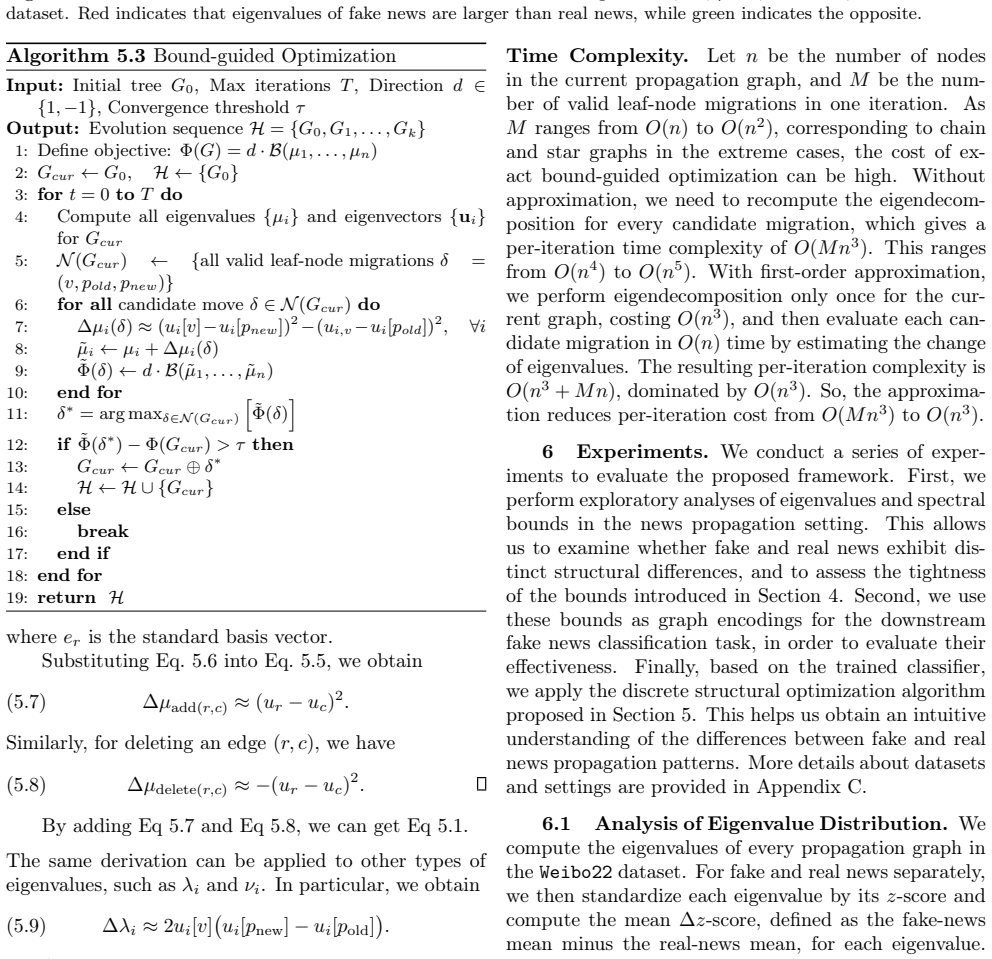
We introduce several new bounds and integrate them with existing ones into a unified spectral representation of information propagation. We then use these spectral bounds for downstream classification and design a discrete structural optimization framework to interpret learned propagation patterns. For efficient optimization we rely on a first-order perturbation approximation and consider both score-guided and bound-guided objectives. Experiments on real-world data reveal meaningful spectral differences between fake and real news, competitive classification performance from spectral bounds, and interpretable evolution trajectories from structural optimization.
What carries the argument
unified spectral representation of information propagation formed by integrating new and existing graph-spectrum bounds on cascade structure
If this is right
- Spectral bounds produce competitive accuracy in distinguishing fake from real news on real data.
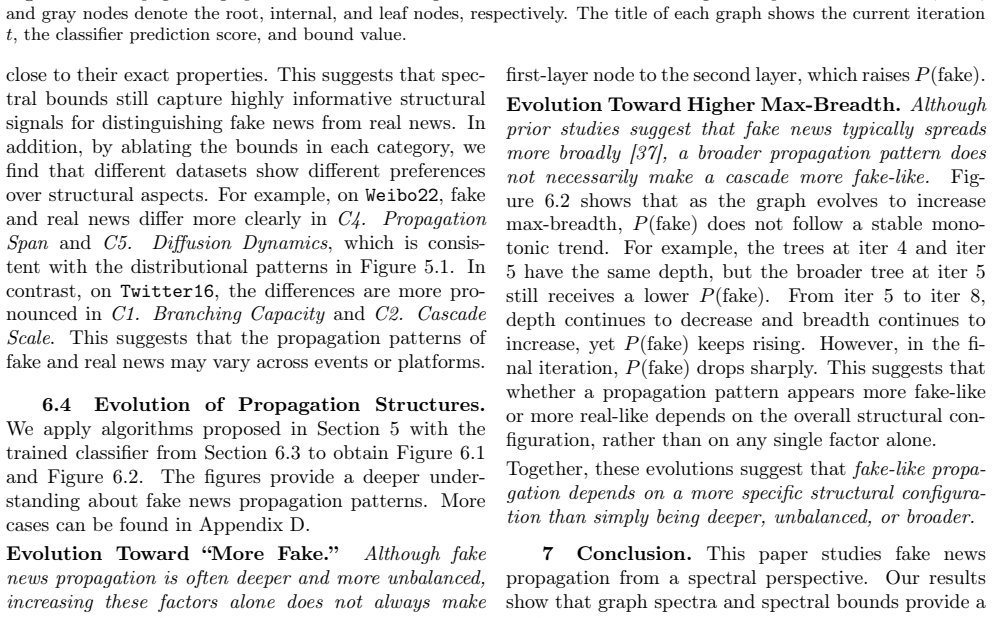
- Discrete structural optimization yields interpretable trajectories showing how propagation patterns evolve.
- Real-world cascades exhibit consistent spectral differences between fake and real news.
- First-order perturbation approximations enable tractable optimization over discrete graph structures.
Where Pith is reading between the lines
- The same spectral bounds could be tested on other diffusion processes such as rumor spreading or product adoption.
- Optimization trajectories might predict future structural changes in new cascades if the approximation remains stable.
- The unified representation offers a route to compare propagation models from different domains under one spectral lens.
Load-bearing premise
The derived spectral bounds together with the first-order perturbation approximation faithfully capture the structural differences between real and fake news cascades without substantial loss of distinguishing information.
What would settle it
Running the spectral bounds as features in a classifier on held-out real-world cascades yields accuracy no better than standard topological baselines, or the optimized structures diverge from observed fake-news trajectories.
Figures
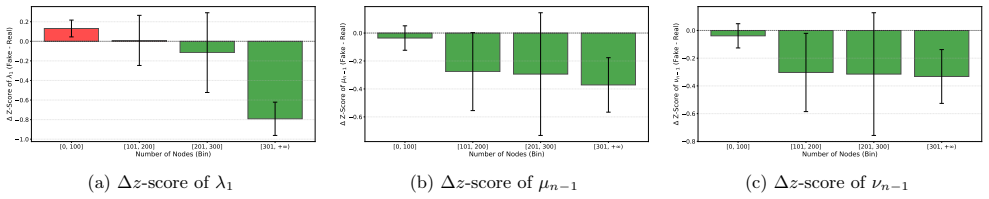


read the original abstract
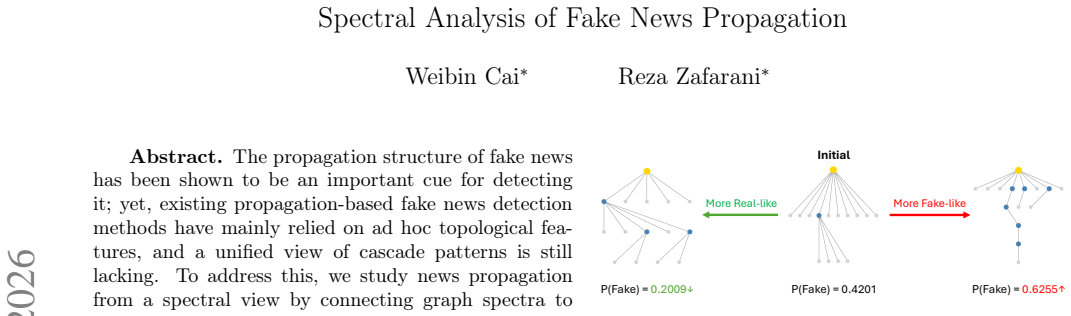
The propagation structure of fake news has been shown to be an important cue for detecting it; yet, existing propagation-based fake news detection methods have mainly relied on ad hoc topological features, and a unified view of cascade patterns is still lacking. To address this, we study news propagation from a spectral view by connecting graph spectra to propagation-related structural properties through rigorous spectral bounds. In particular, we introduce several new bounds and integrate them with existing ones into a unified spectral representation of information propagation. We then use these spectral bounds for downstream classification and design a discrete structural optimization framework to interpret learned propagation patterns. For efficient optimization, we rely on a first-order perturbation approximation and consider both score-guided and bound-guided objectives. Experiments on real-world data reveal meaningful spectral differences between fake and real news, competitive classification performance from spectral bounds, and interpretable evolution trajectories from structural optimization. The findings demonstrate the value of spectral analysis for understanding and modeling news propagation.
Editorial analysis
A structured set of objections, weighed in public.
Referee Report
Summary. The paper claims to advance fake news detection by shifting from ad hoc topological features to a unified spectral representation of propagation cascades. It derives several new rigorous spectral bounds on graph properties, integrates them with existing bounds, applies the resulting spectral features to downstream classification, and introduces a discrete structural optimization framework (using first-order perturbation approximations and both score-guided and bound-guided objectives) to recover interpretable evolution trajectories of cascades. Experiments on real-world data are reported to show meaningful spectral differences between fake and real news, competitive classification performance, and interpretable structural changes.
Significance. If the new bounds are rigorously derived without hidden parameters and the perturbation-based optimization is shown to be accurate in the relevant regime, the work would provide a principled, graph-theoretic foundation for analyzing cascade structure that could improve both detection accuracy and interpretability over existing ad-hoc methods.
major comments (1)
- [discrete structural optimization framework (as described in abstract)] The discrete structural optimization framework relies on a first-order perturbation approximation to model discrete edge additions/deletions. This approximation is accurate only when the perturbation norm is small relative to the eigenvalue gap; however, the abstract provides no explicit error bounds, regime validation, or comparison against exact recomputation for the (potentially large) edits that occur in real cascades. This assumption is load-bearing for the interpretability claims.
minor comments (1)
- [Abstract] The abstract asserts 'rigorous new bounds' and 'competitive classification performance' but does not name the datasets, report quantitative metrics (e.g., F1, AUC), or list the exact existing bounds being unified; adding these details would strengthen the summary.
Simulated Author's Rebuttal
We thank the referee for the constructive feedback on our manuscript. We address the major comment on the discrete structural optimization framework below and describe the planned revisions.
read point-by-point responses
-
Referee: [discrete structural optimization framework (as described in abstract)] The discrete structural optimization framework relies on a first-order perturbation approximation to model discrete edge additions/deletions. This approximation is accurate only when the perturbation norm is small relative to the eigenvalue gap; however, the abstract provides no explicit error bounds, regime validation, or comparison against exact recomputation for the (potentially large) edits that occur in real cascades. This assumption is load-bearing for the interpretability claims.
Authors: We agree that the first-order perturbation approximation is accurate primarily when the perturbation norm is small relative to the eigenvalue gap, and that explicit error bounds, regime validation, and comparisons to exact recomputation are needed to support the interpretability claims for real cascades. The manuscript discusses the approximation in the methods section for modeling small structural changes and reports experimental results on real-world data, but does not include formal error bounds or systematic comparisons across perturbation sizes. In the revised version, we will add a dedicated subsection deriving explicit error bounds using standard perturbation theory results (such as Weyl's inequalities and Davis-Kahan sin-theta bounds) and include new experiments comparing the approximate trajectories to exact recomputation for varying numbers of edge edits. These additions will clarify the regime of applicability and strengthen the claims regarding interpretable evolution trajectories. revision: yes
Circularity Check
No significant circularity; spectral bounds derived independently and applied downstream
full rationale
The paper derives new spectral bounds from graph spectra and propagation properties, integrates them with existing bounds from the literature into a unified representation, then applies the result to classification and a perturbation-based optimization framework. No step reduces by construction to its own inputs: the bounds are presented as rigorous derivations rather than fitted parameters or self-definitions, the first-order perturbation is an explicit efficiency assumption (not a renaming or load-bearing self-citation), and no uniqueness theorem or ansatz is smuggled via self-reference. The derivation chain remains self-contained against external graph-theoretic benchmarks.
Axiom & Free-Parameter Ledger
Reference graph
Works this paper leans on
-
[1]
maximum of out degree
-
[2]
depth of the maximum of out degree node
-
[3]
width entropy: P i p(wi) log(p(wi)),p(w i) = wiP i wi , wherew i is the width of depthi
-
[4]
Category Meaning / Property Bound Equation C1
average of leaf depth; Copyright©2026 by SIAM Unauthorized reproduction of this article is prohibited Table C.2: Spectral bounds categorized by propagation-related structural properties. Category Meaning / Property Bound Equation C1. Branching Capacity Max degree / Mean degree ¯d≤λ 1 ≤∆[4] Maximum sum of degrees of adjacent nodesµ 1 ≤max x∼y(dx +d y)[4] S...
work page 2026
-
[5]
mean branching: P i∈I(T) di |I(T)| , where|I(T)|is the number of internal nodes,di is the degree of nodei
-
[6]
variance of branching
-
[7]
sackin index:S(T) = P v∈L(T) d(v), i.e., the sum of the depths of all leaf nodes, whereT is a tree,L(T)is a leaf node set ofT,d(v)is the depth of nodev
-
[8]
colless index:C(T) = P v∈I(T) |Lv −R v|, whereL v andR v represent number of leaf nodes inv’s left subtree and right subtree
-
[9]
number of internal node
-
[10]
A larger value indicates a more un- even concentration of node degrees
degree gini:G d = Pn i=1 Pn j=1 |di−dj | 2n Pn i=1 di , which quantifies the inequality of the degree distri- bution. A larger value indicates a more un- even concentration of node degrees
-
[11]
chromatic number: it is a constant number2 for trees
-
[12]
approximate independent number
-
[13]
maximum of degrees of a pair of connected nodes
-
[14]
sum of top 30% degree
-
[15]
sum of top 60% degree; 29.e+ t+1 2 , wheret= 0.3∗ ⌊n⌋, which is an upper bound for sum of part laplacian eigenvalues (check bounds of number of edges in Table C.2); 30.e+ t+1 2 , wheret= 0.6∗ ⌊n⌋, which is an upper bound for sum of part laplacian eigenvalues (check bounds of number of edges in Table C.2)
-
[16]
bandwidth:bw(L) = max Lij ̸=0 |i−j|+ 1, whereLis the laplacian matrix of graph, which measures how far the nonzero entries of its matrix representation spread away from the main diagonal under a given node order- ing
-
[17]
wiener index: the sum of the shortest- path distances between all unordered pairs of nodes
-
[18]
number of leaf nodes
-
[19]
number of spanning tree: its a constant num- ber1for trees; D More Structural Optimization Results. In addition to the two cases presented in the main text, we provide more examples of the proposed discrete structural optimization algorithms to further illustrate thedifferencesbetweenfakeandrealnewsdissemination patterns. Copyright©2026 by SIAM Unauthoriz...
work page 2026
discussion (0)
Sign in with ORCID, Apple, or X to comment. Anyone can read and Pith papers without signing in.