Baryon and lepton asymmetry of the Universe in the left-right asymmetry model of weak interaction
Pith reviewed 2026-05-22 10:20 UTC · model grok-4.3
The pith
Lifetime difference between neutrons and antineutrons generates baryon asymmetry during quark-gluon plasma hadronization in the left-right weak interaction model.
A machine-rendered reading of the paper's core claim, the machinery that carries it, and where it could break.
Core claim
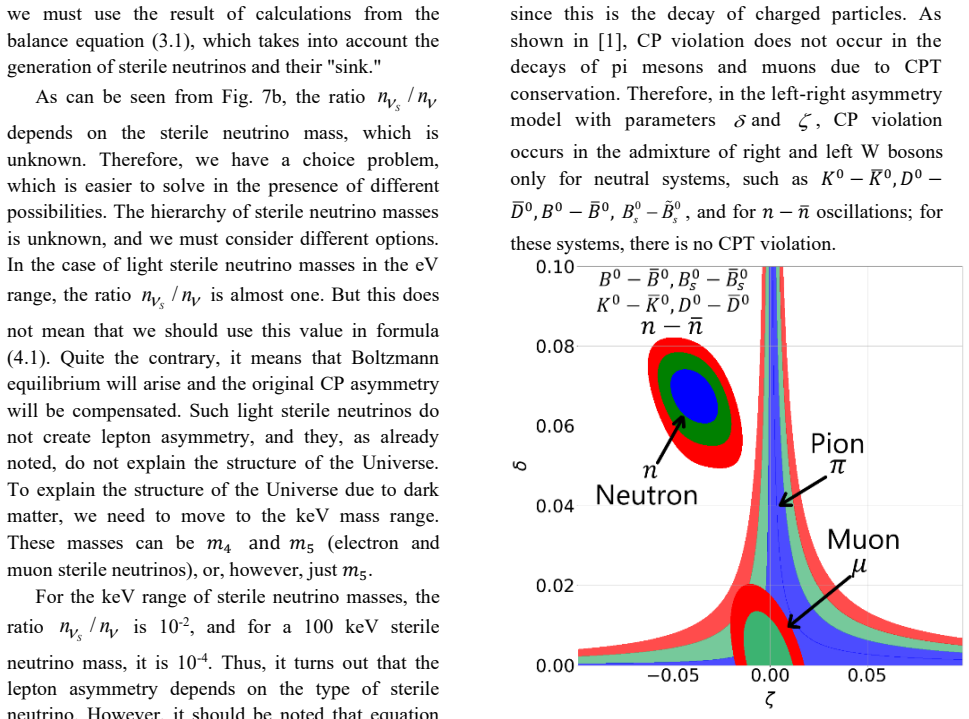
Opposite signs of the mixing angles for W- and W+ in the left-right asymmetry model cause neutrons and antineutrons to possess different decay probabilities. The resulting difference produces baryon asymmetry during hadronization of the quark-gluon plasma at temperatures below 150 MeV. Sterile right-handed neutrinos simultaneously generate lepton asymmetry of opposite sign by leaving the cosmic plasma, so that the overall baryon-lepton asymmetry is preserved.
What carries the argument
Opposite-sign mixing angles for the charged vector bosons W- and W+ that produce CP-violating differences in neutron versus antineutron lifetimes.
If this is right
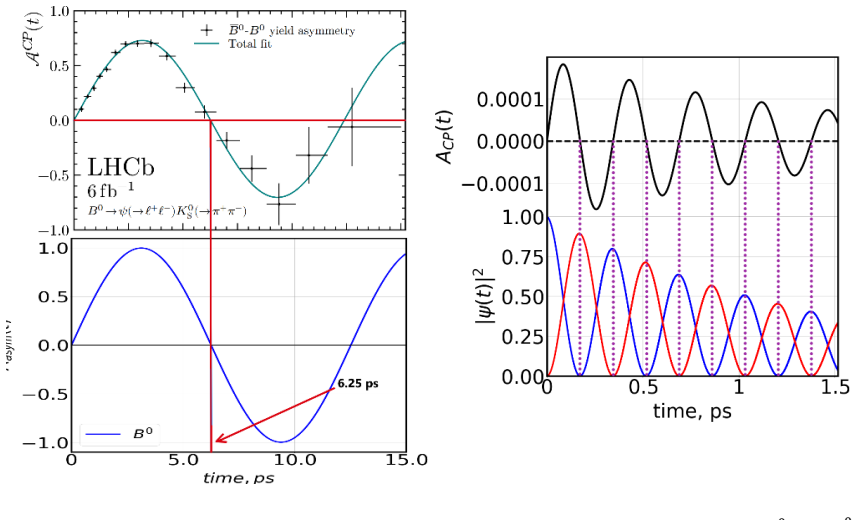
- All three Sakharov conditions are satisfied naturally at the QCD phase transition without requiring higher-temperature processes.
- Lepton asymmetry of opposite sign is carried away by non-thermalizing sterile neutrinos.
- Sterile neutrinos left over from the process can form dark matter.
- Higher-precision measurements of neutron decay asymmetry parameters can test the model directly.
Where Pith is reading between the lines
- Confirmation of a measurable lifetime difference would link a low-energy weak-interaction parameter to the cosmic baryon-to-photon ratio.
- The mechanism predicts that baryon and lepton asymmetries are set at temperatures around 150 MeV, which could influence the timing of early matter clustering.
- Dedicated neutron-antineutron lifetime or oscillation experiments could extract the sign difference of the mixing angles.
Load-bearing premise
The opposite signs chosen for the W- and W+ mixing angles create a lifetime difference large enough to produce the observed baryon asymmetry exactly during the transition from quark-gluon plasma to hadronic matter.
What would settle it
A measurement establishing that neutron and antineutron lifetimes are equal, or that their difference is too small to generate the required asymmetry at temperatures below 150 MeV, would rule out the proposed mechanism.
Figures






read the original abstract
The formation of baryon asymmetry in the Universe is considered in the left-right asymmetry model of weak interaction. In this model, the nature of CP violation is associated with the presence of a right vector boson admixture, with a mixing angle of different signs for W^- and W^+. This leads to the fact that lifetimes of neutrons and antineutrons that decay through W^- and W^+ differ. This difference gives rise to baryon asymmetry during the hadronization of quark-gluon plasma at temperatures below 150 MeV. During the phase transition from quark-gluon plasma to hadronic liquid, all three of A.D. Sakharov's conditions for the generation of baryon asymmetry in the Universe are satisfied: CP violation and process nonstationarity, resulting in baryon number violation due to the difference in the decay probabilities of neutrons and antineutrons. The generation of lepton asymmetry in the Universe in the left-right asymmetry model is associated with the presence of sterile (right) neutrinos, which do not thermalize and leave the cosmic plasma, takes away a lepton asymmetry with a sign opposite to the baryon asymmetry. Generally, baryon-lepton asymmetry arises during the hadronization of quark-gluon plasma, preserving the difference between the baryon and lepton numbers. A mechanism for the formation of dark matter by sterile neutrinos is presented. The possibility of increasing the experimental accuracy of neutron decay asymmetry measurements is noted, increasing the level of confidence in the validity of the left-right asymmetry model of weak interactions.
Editorial analysis
A structured set of objections, weighed in public.
Referee Report
Summary. The paper proposes that in a left-right asymmetry model of weak interactions, CP violation arises from a right-handed vector boson admixture with mixing angles of opposite sign for W^- and W^+. This produces a lifetime difference between neutrons and antineutrons, generating baryon asymmetry during the hadronization of the quark-gluon plasma at T < 150 MeV while satisfying Sakharov's three conditions. Lepton asymmetry is generated by sterile right-handed neutrinos that escape the plasma, and a mechanism for dark matter from these neutrinos is outlined. The model is suggested to be testable via improved neutron decay asymmetry measurements.
Significance. If the central mechanism were shown to produce the observed baryon-to-photon ratio quantitatively and to operate at the claimed epoch, it would constitute a novel baryogenesis scenario tied directly to the QCD phase transition and to measurable properties of neutron decay. It would also link baryon and lepton asymmetries through sterile neutrinos while preserving B - L.
major comments (3)
- Abstract: The manuscript asserts that the lifetime difference between neutrons and antineutrons 'gives rise to baryon asymmetry during the hadronization of quark-gluon plasma at temperatures below 150 MeV' and that all three Sakharov conditions are satisfied during this phase transition, yet supplies no derivation or estimate of the resulting asymmetry value, no integration over the transition duration, and no comparison to the observed η ≈ 6 × 10^{-10}. Without such a calculation the central claim remains unquantified.
- Abstract and main text on the mechanism: The neutron mean lifetime (~880 s) greatly exceeds the Hubble time at T ≈ 150 MeV (~10^{-5} s), so the fraction of neutrons decaying inside the brief transition window is ~10^{-8}. The paper does not address how a net asymmetry can be generated or preserved when essentially all decays occur long after the universe has become hadronic, when inverse processes and scattering can erase any initial difference.
- Abstract paragraph on CP violation: The mixing angle is introduced with opposite signs for W^- and W^+ specifically to produce the required lifetime difference; no independent theoretical or experimental determination of its magnitude is provided, rendering the asymmetry a direct consequence of the parameter choice rather than a prediction.
minor comments (2)
- The abstract refers to 'left-right asymmetry model' without a clear definition or reference to the underlying Lagrangian; a brief statement of the model’s field content and gauge group would improve readability.
- The discussion of sterile neutrinos as dark matter candidates lacks any estimate of their relic density or decay lifetime, which should be added for completeness.
Simulated Author's Rebuttal
We thank the referee for the careful reading and constructive comments on our manuscript. The points raised identify areas where additional clarification and elaboration will improve the presentation. We respond to each major comment below.
read point-by-point responses
-
Referee: Abstract: The manuscript asserts that the lifetime difference between neutrons and antineutrons 'gives rise to baryon asymmetry during the hadronization of quark-gluon plasma at temperatures below 150 MeV' and that all three Sakharov conditions are satisfied during this phase transition, yet supplies no derivation or estimate of the resulting asymmetry value, no integration over the transition duration, and no comparison to the observed η ≈ 6 × 10^{-10}. Without such a calculation the central claim remains unquantified.
Authors: We agree that a quantitative estimate is necessary to substantiate the central claim. In the revised manuscript we will add an order-of-magnitude calculation of the generated baryon asymmetry. This will estimate the effective difference in decay probabilities, integrate over the duration of the QCD phase transition, and compare the result to the observed value η ≈ 6 × 10^{-10}. revision: yes
-
Referee: Abstract and main text on the mechanism: The neutron mean lifetime (~880 s) greatly exceeds the Hubble time at T ≈ 150 MeV (~10^{-5} s), so the fraction of neutrons decaying inside the brief transition window is ~10^{-8}. The paper does not address how a net asymmetry can be generated or preserved when essentially all decays occur long after the universe has become hadronic, when inverse processes and scattering can erase any initial difference.
Authors: The referee correctly identifies the timescale disparity. We will revise the manuscript to clarify that the net asymmetry arises from the non-equilibrium conditions and CP-violating rate difference precisely during the phase transition when Sakharov's conditions are satisfied. Once hadrons form, the generated baryon excess is preserved by baryon-number conservation in the subsequent hadronic era, where inverse processes are kinematically suppressed. A dedicated paragraph explaining this preservation will be added. revision: yes
-
Referee: Abstract paragraph on CP violation: The mixing angle is introduced with opposite signs for W^- and W^+ specifically to produce the required lifetime difference; no independent theoretical or experimental determination of its magnitude is provided, rendering the asymmetry a direct consequence of the parameter choice rather than a prediction.
Authors: The opposite signs of the mixing angles for W^- and W^+ are a structural feature of the left-right asymmetry model that supplies the required CP violation. While the magnitude remains a free parameter, we will expand the discussion to note that improved measurements of neutron-decay asymmetries (as already mentioned in the manuscript) can provide independent constraints, thereby increasing the model's predictive power. revision: partial
Circularity Check
No significant circularity in the model derivation
full rationale
The paper introduces the left-right asymmetry model with a specific mixing angle choice for W^- and W^+ as the foundation for CP violation. The resulting lifetime difference between neutrons and antineutrons is a direct consequence of this model assumption, which then accounts for the baryon asymmetry during the phase transition. This represents a standard theoretical construction rather than a circular derivation where the conclusion is presupposed in the inputs. The chain is self-contained as a proposed mechanism satisfying Sakharov's conditions within the model's parameters, without reducing to self-citation or fitted inputs presented as predictions. The time-scale issue raised by the skeptic pertains to the physical viability of the mechanism, not to logical circularity in the derivation.
Axiom & Free-Parameter Ledger
free parameters (1)
- mixing angle
axioms (1)
- domain assumption Sakharov's three conditions (CP violation, baryon-number violation, and departure from thermal equilibrium) are satisfied by the lifetime difference during the phase transition.
invented entities (1)
-
sterile (right) neutrinos
no independent evidence
Lean theorems connected to this paper
-
IndisputableMonolith/Cost/FunctionalEquation.leanwashburn_uniqueness_aczel unclear?
unclearRelation between the paper passage and the cited Recognition theorem.
lifetimes of neutrons and antineutrons that decay through W− and W+ differ. This difference gives rise to baryon asymmetry during the hadronization of quark-gluon plasma at temperatures below 150 MeV
-
IndisputableMonolith/Foundation/RealityFromDistinction.leanreality_from_one_distinction unclear?
unclearRelation between the paper passage and the cited Recognition theorem.
all three of A.D. Sakharov's conditions ... CP violation and process nonstationarity
What do these tags mean?
- matches
- The paper's claim is directly supported by a theorem in the formal canon.
- supports
- The theorem supports part of the paper's argument, but the paper may add assumptions or extra steps.
- extends
- The paper goes beyond the formal theorem; the theorem is a base layer rather than the whole result.
- uses
- The paper appears to rely on the theorem as machinery.
- contradicts
- The paper's claim conflicts with a theorem or certificate in the canon.
- unclear
- Pith found a possible connection, but the passage is too broad, indirect, or ambiguous to say the theorem truly supports the claim.
Reference graph
Works this paper leans on
-
[1]
Neutron decay has been studied for over half a century
Left-right asymmetry model of weak interaction Precision studies of neutron decay allow us to search for deviations from the Standard Model (SM). Neutron decay has been studied for over half a century. The measurement accuracy has steadily increased and currently stands at 4 10-4 for the neutron lifetime and 10 -3 for the decay asymmetry. This research ...
-
[2]
it was shown that collider experiments do not contradict the results of this analysis, since this is an impurity state of the right vector boson to the left vector boson, and the resonance should be suppressed by more than two orders of magnitude and therefore was not detected. In the scheme of mixing left and right charged vector bosons, the plus sign is...
-
[3]
is devoted to this issue, in which it is shown that the results of calculations within the framework of the left-right asymmetry model with parameters and 𝜁are confirmed by experimental results obtained at colliders. Thus, it is confirmed that the nature of CP violation is associated with the presence of an admixture of the right vector boson. In the le...
-
[4]
II. The difference between particles and antiparticles, manifested in the violation of CP invariance
Baryon asymmetry of the Universe The baryon asymmetry of the Universe is a fundamental question in physics - the main mystery of particle physics. Baryon asymmetry is the observed predominance of matter (baryons) over antimatter (antibaryons) in the Universe. When a particle and antiparticle meet, annihilation occurs - they mutually annihilate with the re...
-
[5]
The process of dark matter formation by sterile neutrinos There must be the same number of sterile neutrinos as active neutrinos (Fig. 5). They can mix with active neutrinos, preferably with preservation of chirality , but the lepton number changes by two units 2L= . This is important for satisfying the lepton number violation condition. Fig. 5. Diagram ...
-
[6]
A sterile neutrino with parameters Δ𝑚14 2 = 7.3 eV2, sin2 2𝜃14 = 0.36 contributes approximately 5% to dark matter, but it is relativistic and does not explain the structure of the Universe
-
[7]
To explain the structure of the Universe, heavy sterile neutrinos with very small mixing angles are needed
-
[8]
The next important issue to discuss is the lifetime of sterile neutrinos
Expanding the neutrino model by introducing two more heavy sterile neutrinos will allow us to explain the structure of the Universe and bring the contribution of sterile neutrinos to the dark matter of the Universe to a level of 27%. The next important issue to discuss is the lifetime of sterile neutrinos. It was shown in [14–16] that right neutrinos can ...
-
[9]
Generation of lepton asymmetry of the Universe Lepton asymmetry is generated during the decay of neutral mesons, also during the hadronization of quark-gluon plasma. This may occur somewhat ahead of nucleon formation, as neutral mesons consist of two quarks , which can be heavier that those contained in nucleons . However, the decay rate of neutral mesons...
-
[10]
demonstrated the absence of CPT violation with an accuracy of 10 -3, it can be assumed that the effect exceeding this value is entirely due to CP violation. (4.4) The experiment measures the effects of CP violation as a function of the decay time, so calculations were made of these effects as a function of the decay time. The results of the integral asymm...
-
[11]
Conclusion This paper examines the formation of baryon and lepton asymmetries in the Universe within the framework of the left -right asymmetry model of weak interaction . In this model, the nature of CP violation is associated with the presence of a right vector boson admixture, with a mixing angle of different signs for 𝑊−and 𝑊+. This leads to the lifet...
work page 1998
-
[12]
N. Severijns, M. Beck and O. Naviliat -Cuncic , Rev. Mod. Phys. 78 , 991 (2006)]
work page 2006
-
[13]
J. C. Hardy and I. S. Towner, Phys. Rev. C 102 , 045501 (2020)
work page 2020
-
[14]
AP Serebrov, OM Zherebtsov, AK Fomin, RM Samoilov, NS Budanov, arXiv:2604.04716 [ 9 ] AD Sakharov, Letter Zh.Eksp.Teor .Fiz , 5, 1, 32–35, (1967) [ 10 ] A. D. Sakharov, Sov. Phys. Usp. 34 (1991) 5, 417–421
work page internal anchor Pith review Pith/arXiv arXiv 1967
-
[15]
AP Serebrov, RM Samoilov, ME Tchaikovsky, and OM Zherebtsov, JETP Letters, 116:10 (2022), 669–682
work page 2022
-
[16]
DS Gorbunov and VA Rubakov, Introduction to the Theory of the Early Universe: Hot Big Bang Theory, 2nd ed., World Scientific, New Jersey (2017); https://doi.org/10.1142/7874
- [17]
-
[18]
Dasgupta and J. Kopp, Phys. Rept. 928 (2021) 1- 63, arXiv:2106.05913v1
- [19]
-
[20]
"Serebrov AP , Samoilov RM, Zherebtsov, OM, Budanov, NS, PoS , ICPPCRubakov2023, 2024, 044 17
work page 2024
-
[21]
M. Aker, K. Altenmueller , A. Beglarian et al. (KATRIN Collaboration), Phys. Rev. Lett. 126, 091803 (2021); arXiv:2011.05087; https://doi.org/10.1103/PhysRevLett.126.091803
-
[22]
M. Aker, A. Beglarian , J. Behrens et al. (The KATRIN Collaboration), Nat. Phys. 18, 160 (2022); https://doi.org/10.1038/s41567-021-01463-1 ; arXiv:2105.08533
-
[23]
VV Barinov, BT Cleveland, SN Danshin et al. (BEST collaboration), Phys. Rev. C 105, 065502 (2022); arXiv:2201.07364; https://doi.org/10.1103/PhysRevC.105.065502
- [24]
- [25]
-
[26]
J. F. Bueno, R. Bayes, Yu. I. Davydov, et al, Phys. Rev. D 84, 032005 (2011)
work page 2011
- [27]
- [28]
-
[29]
LHCb collaboration, JHEP 12 (2021) 141
work page 2021
- [30]
-
[31]
LHCb collaboration, Nature Physics volume 18, pages 1–5 (2022)
work page 2022
- [32]
- [33]
-
[34]
Rudnev, AP Serebrov, preprint LNPI – 1391 (1988)
OB Belomytsev , AV Vasiliev, Yu.P. Rudnev, AP Serebrov, preprint LNPI – 1391 (1988)
work page 1988
-
[35]
A. Serebrov, Yu. Rudnev, A. Murashkin et al., J. Res. Natl. Inst. Stan. 110, 383–387 (2005)
work page 2005
-
[36]
Serebrov AP, Rudnev Yu.P. , Murashkin AN et al., Nucl . Instr. Meth. 545 (2005) p.344-354
work page 2005
-
[37]
Serebrov AP et al., JETP 86, P. 1074. (1998)
work page 1998
-
[38]
A.P. Serebrov, R. Samoilov, N.I. Voropaev, V.V. Fedorov, A.V. Vasil'ev, D.M. Prudnikov, et al., Physics of Particles and Nuclei Letters, 2026, Vol. 23, No. 1, pp. 17–21
work page 2026
-
[39]
A. P. Serebrov, A. K. Fomin, O. M. Zherebtsov, G. N. Klyushnikov, A. O. Koptyukhov, et al., Physics of Particles and Nuclei Letters, 2026, Vol. 23, No. 1, pp. 6–11
work page 2026
discussion (0)
Sign in with ORCID, Apple, or X to comment. Anyone can read and Pith papers without signing in.