Beyond Controlled Noise: Achieving Symmetric FHE through Dynamic Position Shifting
Pith reviewed 2026-05-20 17:44 UTC · model grok-4.3
The pith
Symmetric FHE is achieved by fragmenting plaintext and using regulators to shift fragment positions during multiplication.
A machine-rendered reading of the paper's core claim, the machinery that carries it, and where it could break.
Core claim
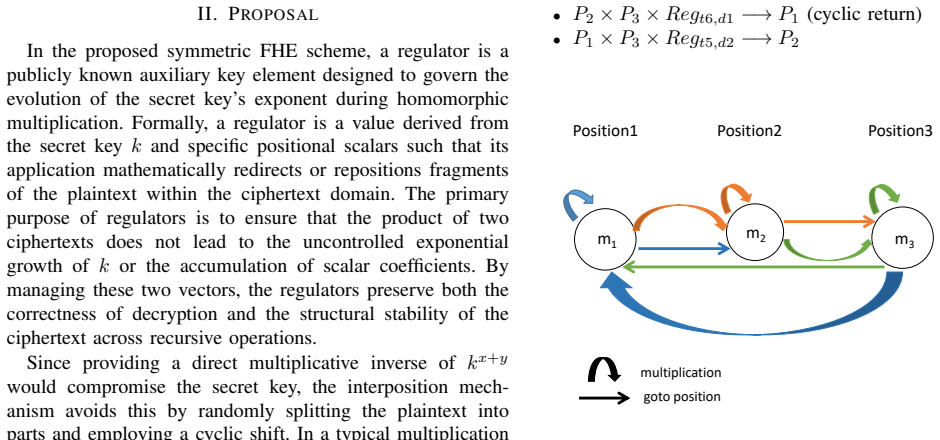
The central claim is that plaintext fragmentation across logical positions, governed by a dual-regulator system, extends the naturally additive property of the base encryption to multiplication. Exponent regulators t_i redirect the product of fragments to a new target position, preventing accumulation of secret key exponents, while coefficient regulators d_i normalize the resulting scalars. Security follows from the mutual dependence of exponents and coefficients, which blocks substitution attacks on the secret key k.
What carries the argument
The interposition framework's dual-regulator system, where exponent regulators t_i redirect fragment products to new positions and coefficient regulators d_i normalize scalars.
If this is right
- Multiplication operations preserve the additive character of the base scheme without exponential noise accumulation.
- The secret key remains protected from direct substitution or algebraic attacks through the exponent-coefficient binding.
- Encryption stays modular while extending homomorphic multiplication via dynamic position redirection.
- Overall scheme complexity may decrease by replacing traditional noise management with position shifting.
Where Pith is reading between the lines
- If regulators can be computed efficiently, the scheme could support longer sequences of multiplications than current noise-limited methods.
- The position-shifting idea might combine with existing lattice-based techniques to address other attack vectors.
- Practical testing on standard benchmark circuits would reveal whether overhead stays below that of noise flooding approaches.
Load-bearing premise
The dual-regulator system can be implemented without introducing new algebraic vulnerabilities or prohibitive overhead.
What would settle it
A concrete algebraic attack that substitutes or extracts the secret key k by manipulating fragment positions and regulators despite their claimed mutual binding, or a multiplication sequence in which noise still grows exponentially.
Figures
read the original abstract
Traditional Fully Homomorphic Encryption (FHE) schemes often suffer from prohibitive computational overhead and complex noise management. In this paper, we propose a novel symmetric FHE through a mechanism of plaintext fragmentation and dynamic interposition. Our approach is built upon a modular encryption foundation, c = mk + rp, which is naturally additive but typically limited by exponential noise growth during multiplication. To resolve this, we introduce an interposition framework where the plaintext is partitioned into multiple fragments across distinct logical positions. We introduce a dual-regulator system to govern the multiplication process; exponent regulators (t_i) redirect the product of fragments to a new target position, preventing the accumulation of secret key exponents, while coefficient regulators (d_i) normalize the resulting scalars. Security is established through a binding mechanism where exponents and coefficients are mutually dependent, shielding the secret key k from algebraic manipulation and substitution attacks.
Editorial analysis
A structured set of objections, weighed in public.
Referee Report
Summary. The manuscript proposes a symmetric FHE construction built on the modular base c = mk + rp. Plaintext is fragmented across logical positions; a dual-regulator system (exponent regulators t_i that redirect fragment products to new target positions and coefficient regulators d_i that normalize scalars) is introduced to prevent exponential noise growth under multiplication. Security is claimed to follow from a binding in which exponents and coefficients become mutually dependent, thereby shielding the secret key k from algebraic manipulation and substitution attacks.
Significance. If the regulators can be shown to bound noise while preserving semantic security without prohibitive overhead or new attack surfaces, the position-shifting approach would constitute a meaningful alternative to conventional noise-control techniques in symmetric FHE. The absence of any concrete algebraic definitions, update rules, noise bounds, or security reductions currently prevents evaluation of whether this potential is realized.
major comments (2)
- Abstract and interposition-framework description: the central security claim rests on the assertion that t_i and d_i create mutual dependence between exponents and coefficients, yet no functional definitions, recurrence relations, or update rules across multiplications are supplied. Without these, it is impossible to verify that the mechanism actually prevents an adversary from solving the resulting system for k after one or more homomorphic multiplications.
- Abstract: no noise-growth analysis, ciphertext-size bounds, or reduction to a hard problem is provided to support the claim that position shifting eliminates the exponential noise growth that normally accompanies multiplication in the base scheme c = mk + rp.
minor comments (1)
- Abstract: the variables m, k, r, p in the base equation c = mk + rp are introduced without a short definitional sentence; adding one would improve readability for readers outside the immediate sub-area.
Simulated Author's Rebuttal
We thank the referee for the constructive and detailed comments. We agree that the current manuscript requires additional formalization to allow verification of the claims. We will revise the paper to supply the missing definitions, relations, and analyses while preserving the core contribution of the position-shifting approach.
read point-by-point responses
-
Referee: Abstract and interposition-framework description: the central security claim rests on the assertion that t_i and d_i create mutual dependence between exponents and coefficients, yet no functional definitions, recurrence relations, or update rules across multiplications are supplied. Without these, it is impossible to verify that the mechanism actually prevents an adversary from solving the resulting system for k after one or more homomorphic multiplications.
Authors: We accept this criticism. The abstract provides only a high-level overview, and the full text does not yet contain explicit functional definitions or recurrence relations for the regulators t_i and d_i. In the revised manuscript we will add a new subsection that defines t_i as a position-mapping function t_i(j) = (j + f(i)) mod m where f encodes fragment index, and d_i as a coefficient normalizer d_i = 1 / (product of selected scalars). We will also supply the update rules that apply these regulators after each multiplication and include a small worked example demonstrating that the resulting system remains underdetermined for k. revision: yes
-
Referee: Abstract: no noise-growth analysis, ciphertext-size bounds, or reduction to a hard problem is provided to support the claim that position shifting eliminates the exponential noise growth that normally accompanies multiplication in the base scheme c = mk + rp.
Authors: The referee correctly identifies the absence of quantitative analysis. We will add a dedicated section deriving noise bounds: after each multiplication the noise term is redirected to a fresh position and scaled by a bounded d_i, yielding linear rather than exponential growth in the number of multiplications. Ciphertext-size growth will be expressed as O(number of fragments + regulator bits). A full reduction to a standard hard problem is not currently available; we will instead provide an informal argument that recovering k requires solving a system whose binding is at least as hard as the original modular equation, and we will explicitly note the lack of a formal reduction as a limitation to be addressed in future work. revision: partial
Circularity Check
No significant circularity detected
full rationale
The paper begins from the modular base scheme c = mk + rp and describes an interposition framework that partitions plaintext into fragments governed by a dual-regulator system (exponent regulators t_i and coefficient regulators d_i). The security claim is presented as following from the resulting mutual dependence in the binding mechanism. No load-bearing step reduces a prediction, uniqueness result, or security property back to its own inputs by construction; the regulators are introduced as new components without self-referential definitions, fitted-parameter renaming, or self-citation chains that carry the central argument. The derivation therefore remains self-contained against the stated inputs.
Axiom & Free-Parameter Ledger
free parameters (2)
- exponent regulators t_i
- coefficient regulators d_i
axioms (1)
- domain assumption The base encryption c = mk + rp is naturally additive.
invented entities (1)
-
dual-regulator system
no independent evidence
Lean theorems connected to this paper
-
IndisputableMonolith/Cost/FunctionalEquation.leanwashburn_uniqueness_aczel unclear?
unclearRelation between the paper passage and the cited Recognition theorem.
dual-regulator system ... exponent regulators (t_i) redirect the product of fragments to a new target position, preventing the accumulation of secret key exponents, while coefficient regulators (d_i) normalize the resulting scalars
-
IndisputableMonolith/Foundation/AlexanderDuality.leanalexander_duality_circle_linking unclear?
unclearRelation between the paper passage and the cited Recognition theorem.
cyclic flow: if i=j, the result moves to l=i+1 (mod P); ... P=3 positions
What do these tags mean?
- matches
- The paper's claim is directly supported by a theorem in the formal canon.
- supports
- The theorem supports part of the paper's argument, but the paper may add assumptions or extra steps.
- extends
- The paper goes beyond the formal theorem; the theorem is a base layer rather than the whole result.
- uses
- The paper appears to rely on the theorem as machinery.
- contradicts
- The paper's claim conflicts with a theorem or certificate in the canon.
- unclear
- Pith found a possible connection, but the passage is too broad, indirect, or ambiguous to say the theorem truly supports the claim.
Reference graph
Works this paper leans on
-
[1]
Fully homomorphic encryption using ideal lattices,
C. Gentry, “Fully homomorphic encryption using ideal lattices,” in Proceedings of the forty-first annual ACM symposium on Theory of computing, 2009, pp. 169–178
work page 2009
-
[2]
(leveled) fully ho- momorphic encryption without bootstrapping,
Z. Brakerski, C. Gentry, and V . Vaikuntanathan, “(leveled) fully ho- momorphic encryption without bootstrapping,”ACM Transactions on Computation Theory (TOCT), vol. 6, no. 3, pp. 1–36, 2014
work page 2014
-
[3]
Somewhat practical fully homomorphic encryption,
J. Fan and F. Vercauteren, “Somewhat practical fully homomorphic encryption,”Cryptology ePrint Archive, 2012
work page 2012
-
[4]
Tfhe: fast fully homomorphic encryption over the torus,
I. Chillotti, N. Gama, M. Georgieva, and M. Izabach `ene, “Tfhe: fast fully homomorphic encryption over the torus,”Journal of Cryptology, vol. 33, no. 1, pp. 34–91, 2020
work page 2020
-
[5]
New secret keys for enhanced performance in (t) fhe,
L. Bergerat, I. Chillotti, D. Ligier, J.-B. Orfila, A. Roux-Langlois, and S. Tap, “New secret keys for enhanced performance in (t) fhe,” in Proceedings of the 2024 on ACM SIGSAC Conference on Computer and Communications Security, 2024, pp. 2547–2561. TABLE II PERFORMANCE ANDFEATURECOMPARISON OFSELECTEDFHE SCHEMES(MS) Scheme / Feature KeyGen Enc Dec Add Ml...
work page 2024
-
[6]
Secure consensus clock synchro- nization in wireless sensor networks,
A. Habib, A. Laouid, and M. Kara, “Secure consensus clock synchro- nization in wireless sensor networks,” in2021 International Conference on Artificial Intelligence for Cyber Security Systems and Privacy (AI- CSP). IEEE, 2021, pp. 1–6
work page 2021
-
[7]
M. Kara, A. Laouid, R. Euler, M. A. Yagoub, A. Bounceur, M. Ham- moudeh, and S. Medileh, “A homomorphic digit fragmentation en- cryption scheme based on the polynomial reconstruction problem,” in Proceedings of the 4th International Conference on Future Networks and Distributed Systems, 2020, pp. 1–6
work page 2020
-
[8]
Integrating homomorphic encryption in iot healthcare blockchain systems,
H. Aissaoua, A. Laouid, M. Kara, A. Bounceur, M. Hammoudeh, and K. Chait, “Integrating homomorphic encryption in iot healthcare blockchain systems,”Ingenierie des Systemes d’Information, vol. 29, no. 5, p. 1667, 2024
work page 2024
-
[9]
Homomorphic encryption for arithmetic of approximate numbers,
J. H. Cheon, A. Kim, M. Kim, and Y . Song, “Homomorphic encryption for arithmetic of approximate numbers,” inInternational conference on the theory and application of cryptology and information security. Springer, 2017, pp. 409–437
work page 2017
-
[10]
A guide to fully homomorphic encryption,
F. Armknecht, C. Boyd, C. Carr, K. Gjøsteen, A. J ¨aschke, C. A. Reuter, and M. Strand, “A guide to fully homomorphic encryption,”Cryptology ePrint Archive, 2015
work page 2015
-
[11]
Anamorphic encryption: New constructions and homomorphic realizations,
D. Catalano, E. Giunta, and F. Migliaro, “Anamorphic encryption: New constructions and homomorphic realizations,” inAnnual International Conference on the Theory and Applications of Cryptographic Tech- niques. Springer, 2024, pp. 33–62
work page 2024
-
[12]
A survey on implementations of homomorphic encryption schemes,
T. V . T. Doan, M.-L. Messai, G. Gavin, and J. Darmont, “A survey on implementations of homomorphic encryption schemes,”The Journal of Supercomputing, vol. 79, pp. 15 098–15 139, 2023
work page 2023
-
[13]
Evaluating homomorphic encryption schemes for privacy and security in healthcare data manage- ment,
H. Jorge, C. Wanzeller, and J. Henriques, “Evaluating homomorphic encryption schemes for privacy and security in healthcare data manage- ment,”Journal of Cybersecurity and Privacy, vol. 25, no. 153, p. 74728, 2025
work page 2025
-
[14]
A survey on homomorphic encryption schemes: Theory and implementation,
A. Acar, H. Aksu, A. S. Uluagac, and M. Conti, “A survey on homomorphic encryption schemes: Theory and implementation,”ACM Computing Surveys (Csur), vol. 51, no. 4, pp. 1–35, 2018
work page 2018
discussion (0)
Sign in with ORCID, Apple, or X to comment. Anyone can read and Pith papers without signing in.