FedEDAuth -- Federated Embedding Distribution Authentication for Counterfeit IC Detection
Pith reviewed 2026-05-20 17:02 UTC · model grok-4.3
The pith
FedEDAuth detects all malicious clients in federated learning for counterfeit IC detection by authenticating embedding distributions against a golden reference.
A machine-rendered reading of the paper's core claim, the machinery that carries it, and where it could break.
Core claim
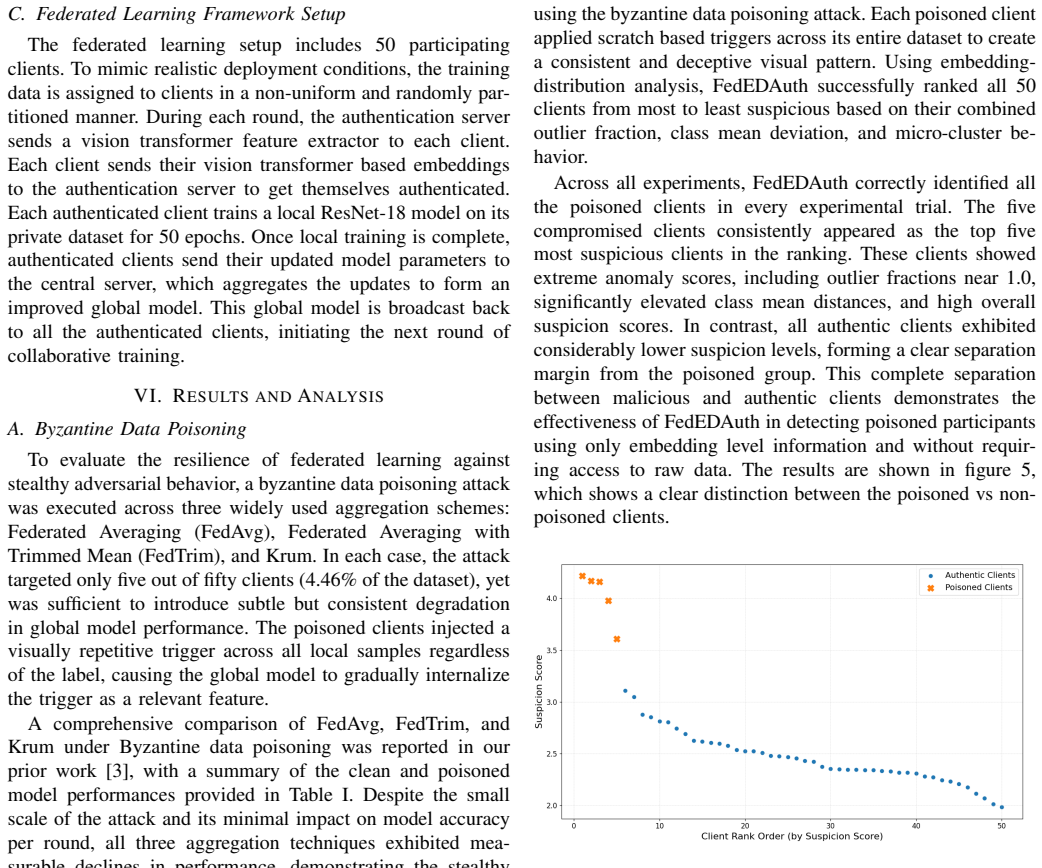
FedEDAuth is a lightweight embedding-level client authentication framework that detects and filters malicious participants before model aggregation in federated learning. It derives reference embedding distributions from a golden dataset and evaluates each client through outlier analysis, mean shift measurements, and micro-cluster behavior. In experimental settings with fifty distributed participants facing Byzantine data poisoning attacks, the framework identifies every poisoned client, producing a 100 percent malicious client detection rate. After the malicious clients are removed, the resulting federated model reaches 94.17 percent accuracy on counterfeit IC classification.
What carries the argument
Reference embedding distributions derived from a golden dataset, combined with outlier analysis, mean shift measurements, and micro-cluster checks to authenticate clients without raw data or gradient access.
If this is right
- Secure collaboration across the semiconductor supply chain becomes feasible without exposing sensitive data or gradients.
- The federated model retains 94.17 percent accuracy on counterfeit IC classification once malicious participants are removed.
- The authentication steps integrate directly into standard federated learning pipelines before the aggregation step.
- Byzantine data poisoning attacks can be mitigated at the embedding level rather than after model updates are combined.
Where Pith is reading between the lines
- Embedding-based checks of this kind could be tested in other federated learning settings that face poisoning risks, such as medical diagnostics or sensor networks.
- If the checks remain reliable when the golden dataset distribution shifts slightly, the approach might reduce the need for fully trusted central coordinators.
- Running the same pipeline on real supply-chain data with natural distribution differences would show whether the detection rate holds outside controlled experiments.
Load-bearing premise
The method assumes that embedding distributions from a golden dataset accurately represent honest client behavior and that the statistical checks can separate malicious updates even under varied attack strategies.
What would settle it
A case in which a malicious client generates embedding distributions that pass all three checks (outlier, mean shift, and micro-cluster) without detection, or a run in which filtering honest clients drops final classification accuracy below 90 percent.
Figures



read the original abstract
The widespread of counterfeit integrated circuits (ICs) poses severe risks to the security, reliability, and trustworthiness of modern electronic systems. Federated learning (FL) offers a privacy-preserving paradigm for collaborative counterfeit detection across the semiconductor supply chain, but its vulnerability to byzantine data poisoning attacks limits practical deployment. This paper presents Federated Embedding Distribution Authentication (FedEDAuth), a lightweight, embedding level client authentication framework that detects and filters malicious participants before model aggregation. FedEDAuth leverages reference embedding distributions derived from a golden dataset and evaluates clients using outlier analysis, mean shift measurements, and micro-cluster behavior without requiring access to raw data or gradients. Integrated into standard FL pipelines, FedEDAuth consistently identifies all poisoned clients in experimental settings with 50 distributed participants under the byzantine data poisoning attack, achieving a 100% malicious client detection rate. After filtering, the federated model achieved a high counterfeit IC classification performance of 94.17% accuracy. These results not only validate FedEDAuth's effectiveness but also underscore the broader potential of secure, trustworthy FL frameworks as a critical advancement for next generation hardware security solutions, enabling robust, collaborative intelligence across the semiconductor supply chain.
Editorial analysis
A structured set of objections, weighed in public.
Referee Report
Summary. The manuscript introduces FedEDAuth, a lightweight client authentication framework integrated into federated learning pipelines for counterfeit IC detection. It derives reference embedding distributions from a golden dataset and applies outlier analysis, mean-shift measurements, and micro-cluster checks to identify and filter malicious clients under byzantine data poisoning attacks, without requiring access to raw data or gradients. The central claims are a 100% malicious client detection rate across 50 distributed participants and a post-filtering counterfeit IC classification accuracy of 94.17%.
Significance. If the experimental results are substantiated with full details, the work could meaningfully advance secure and privacy-preserving federated learning for hardware security applications in the semiconductor supply chain. The embedding-level authentication approach is lightweight and avoids direct data exposure, addressing a practical vulnerability in collaborative counterfeit detection. The provision of reproducible code or parameter-free derivations is not evident from the description, which limits the assessed strength relative to papers that include such elements.
major comments (2)
- [Abstract] Abstract: the claim of 100% malicious client detection and 94.17% accuracy is presented without any description of the experimental setup, including attack model specifics, data distribution across the 50 clients, choice of outlier/mean-shift thresholds, baseline defenses, error bars, or statistical tests; this absence makes the central empirical claim impossible to evaluate for soundness.
- [Methods] Methods/Experimental section: the core assumption that reference distributions from the golden dataset reliably represent honest client behavior under varied attack strategies is load-bearing for the detection guarantees, yet no analysis of distribution shift, mimicry attacks, or sensitivity to threshold choices is provided to support it.
minor comments (2)
- [Introduction] The abstract and introduction would benefit from explicit comparison to prior FL defense techniques (e.g., Krum, Trimmed Mean) to clarify the novelty of the embedding-distribution approach.
- Notation for embedding distributions and the precise definitions of 'outlier analysis' and 'micro-cluster behavior' should be formalized with equations or pseudocode for reproducibility.
Simulated Author's Rebuttal
We thank the referee for the constructive comments on our manuscript. We address each major comment below and indicate where revisions will be made to improve clarity and strengthen the presentation of results.
read point-by-point responses
-
Referee: [Abstract] Abstract: the claim of 100% malicious client detection and 94.17% accuracy is presented without any description of the experimental setup, including attack model specifics, data distribution across the 50 clients, choice of outlier/mean-shift thresholds, baseline defenses, error bars, or statistical tests; this absence makes the central empirical claim impossible to evaluate for soundness.
Authors: We agree that the abstract would benefit from additional context on the experimental conditions to allow immediate evaluation of the reported figures. The full details on attack models, client data distributions, threshold selection, baseline comparisons, and evaluation metrics are provided in the Methods and Experimental Results sections. We will revise the abstract to incorporate a concise summary of the setup, including the number of participants, the byzantine poisoning attack considered, and the conditions under which the 100% detection rate and 94.17% accuracy were obtained. revision: yes
-
Referee: [Methods] Methods/Experimental section: the core assumption that reference distributions from the golden dataset reliably represent honest client behavior under varied attack strategies is load-bearing for the detection guarantees, yet no analysis of distribution shift, mimicry attacks, or sensitivity to threshold choices is provided to support it.
Authors: The reference distributions derived from the golden dataset form the basis of our outlier, mean-shift, and micro-cluster checks, and the experiments with 50 participants under byzantine data poisoning demonstrate consistent detection performance. We acknowledge that explicit sensitivity analysis and evaluation against mimicry or distribution-shift scenarios would provide further support. We will add a new subsection to the Experimental Results section that includes threshold sensitivity studies and additional experiments simulating mimicry attacks to directly address this point. revision: yes
Circularity Check
No significant circularity in derivation chain
full rationale
The FedEDAuth framework derives client authentication from reference embedding distributions sourced from an external golden dataset, applying standard statistical checks (outlier analysis, mean shift, micro-cluster behavior) without requiring raw data access. These components do not reduce to self-definition, fitted inputs renamed as predictions, or self-citation chains; the golden dataset functions as an independent external benchmark for honest client behavior. Experimental claims of 100% malicious client detection and 94.17% post-filter accuracy are presented as empirical outcomes rather than tautological results forced by the method's construction. No load-bearing uniqueness theorems or ansatzes are imported via self-citation. The derivation remains self-contained against external benchmarks.
Axiom & Free-Parameter Ledger
free parameters (1)
- outlier and mean-shift thresholds
axioms (2)
- domain assumption Reference embedding distributions from golden dataset accurately model honest client updates
- domain assumption Byzantine poisoning attacks produce detectable shifts in embedding space without raw data access
Lean theorems connected to this paper
-
IndisputableMonolith/Cost/FunctionalEquation.leanwashburn_uniqueness_aczel unclear?
unclearRelation between the paper passage and the cited Recognition theorem.
FedEDAuth leverages reference embedding distributions derived from a golden dataset and evaluates clients using outlier analysis, mean shift measurements, and micro-cluster behavior
-
IndisputableMonolith/Foundation/AlphaCoordinateFixation.leanJ_uniquely_calibrated_via_higher_derivative unclear?
unclearRelation between the paper passage and the cited Recognition theorem.
Si = wF Fi^p + wM Mi + wC Ci
What do these tags mean?
- matches
- The paper's claim is directly supported by a theorem in the formal canon.
- supports
- The theorem supports part of the paper's argument, but the paper may add assumptions or extra steps.
- extends
- The paper goes beyond the formal theorem; the theorem is a base layer rather than the whole result.
- uses
- The paper appears to rely on the theorem as machinery.
- contradicts
- The paper's claim conflicts with a theorem or certificate in the canon.
- unclear
- Pith found a possible connection, but the passage is too broad, indirect, or ambiguous to say the theorem truly supports the claim.
Reference graph
Works this paper leans on
-
[1]
C. Mouli and W. Carriker, “Future fab,”IEEE Spectrum, vol. 44, no. 3, pp. 38–43, 2007
work page 2007
-
[2]
Communication-efficient learning of deep networks from decentralized data,
B. McMahan, E. Moore, D. Ramage, S. Hampson, and B. A. y Arcas, “Communication-efficient learning of deep networks from decentralized data,” inArtificial intelligence and statistics. PMLR, 2017, pp. 1273– 1282
work page 2017
-
[3]
Counterfeit ic detection via federated learning: Exposure to byzantine data poisoning,
N. Lodge, N. Tambe, D. Aklekar, and F. Saqib, “Counterfeit ic detection via federated learning: Exposure to byzantine data poisoning,” in2025 IEEE Physical Assurance and Inspection of Electronics (PAINE). IEEE, 2025, pp. 1–7
work page 2025
-
[4]
Impacts of machine learning on counterfeit ic detection and avoidance techniques,
O. Aramoon and G. Qu, “Impacts of machine learning on counterfeit ic detection and avoidance techniques,” in2020 21st International Symposium on Quality Electronic Design (ISQED). IEEE, 2020, pp. 352–357
work page 2020
-
[5]
C. Xi, N. Varshney, M. S. M. Khan, H. Dalir, and N. Asadizanjani, “Enhancing counterfeit detection of integrated circuits through machine learning-assisted thz-tds analysis,” inTerahertz, RF , Millimeter, and Submillimeter-Wave Technology and Applications XVII, vol. 12885. SPIE, 2024, pp. 64–72
work page 2024
-
[6]
Autodetect: Novel autoencoding architecture for counterfeit ic detection,
C. Bhure, G. S. Nicholas, S. Ghosh, N. Asadi, and F. Saqib, “Autodetect: Novel autoencoding architecture for counterfeit ic detection,”Journal of Hardware and Systems Security, vol. 8, no. 2, pp. 113–132, 2024
work page 2024
-
[7]
Golden-free robust age estimation to triage recycled ics,
V . R. Surabhi, P. Krishnamurthy, H. Amrouch, J. Henkel, R. Karri, and F. Khorrami, “Golden-free robust age estimation to triage recycled ics,” IEEE Transactions on Computer-Aided Design of Integrated Circuits and Systems, vol. 42, no. 9, pp. 2839–2851, 2023
work page 2023
-
[8]
A. Nechiyil, R. Lee, and G. Chapman, “A rapid, non-destructive method to detect counterfeit integrated circuits using a resonant cavity system.” Instruments (2410-390X), vol. 8, no. 3, 2024
work page 2024
-
[9]
Learning assisted side channel delay test for detection of recycled ics,
A. Vakil, F. Niknia, A. Mirzaeian, A. Sasan, and N. Karimi, “Learning assisted side channel delay test for detection of recycled ics,” in Proceedings of the 26th Asia and South Pacific Design Automation Conference, 2021, pp. 455–462
work page 2021
-
[10]
Federated learning with privacy-preserving and model ip-right-protection,
Q. Yang, A. Huang, L. Fan, C. S. Chan, J. H. Lim, K. W. Ng, D. S. Ong, and B. Li, “Federated learning with privacy-preserving and model ip-right-protection,”Machine Intelligence Research, vol. 20, no. 1, pp. 19–37, 2023
work page 2023
-
[11]
V . P. Chellapandi, L. Yuan, C. G. Brinton, S. H. ˙Zak, and Z. Wang, “Federated learning for connected and automated vehicles: A survey of existing approaches and challenges,”IEEE Transactions on Intelligent Vehicles, vol. 9, no. 1, pp. 119–137, 2023
work page 2023
-
[12]
Federated learning: A survey on enabling technologies, protocols, and applications,
M. Aledhari, R. Razzak, R. M. Parizi, and F. Saeed, “Federated learning: A survey on enabling technologies, protocols, and applications,”IEEE Access, vol. 8, pp. 140 699–140 725, 2020
work page 2020
-
[13]
Federated learning review: Fundamentals, enabling technologies, and future applications,
S. Banabilah, M. Aloqaily, E. Alsayed, N. Malik, and Y . Jararweh, “Federated learning review: Fundamentals, enabling technologies, and future applications,”Information processing & management, vol. 59, no. 6, p. 103061, 2022
work page 2022
-
[14]
Federated Learning for Mobile Keyboard Prediction
A. Hard, K. Rao, R. Mathews, S. Ramaswamy, F. Beaufays, S. Augen- stein, H. Eichner, C. Kiddon, and D. Ramage, “Federated learning for mobile keyboard prediction,”arXiv preprint arXiv:1811.03604, 2018
work page internal anchor Pith review Pith/arXiv arXiv 2018
-
[15]
(2023) 8 applications of federated learning across the globe
OpenSistemas. (2023) 8 applications of federated learning across the globe. Accessed: 2025-02-14. [Online]. Available: https://opensistemas. com/en/8-applications-of-federated-learning/
work page 2023
-
[16]
R. D. Caballar and C. Stryker. (2025) What is federated learning? IBM. Accessed: 2025-11-18. [Online]. Available: https://www.ibm.com/think/ topics/federated-learning
work page 2025
-
[17]
C. He, A. Nevarez, S. Avestimehr, and R. DeFauw. (2024) Federated learning on aws using fedml, amazon eks, and amazon sagemaker. https://aws.amazon.com/blogs/machine-learning/federated-learning-on - aws-using-fedml-amazon-eks-and-amazon-sagemaker/. Amazon Web Services. Accessed: 2025-11-18
work page 2024
-
[18]
Y . Zheng, C.-H. Chang, S.-H. Huang, P.-Y . Chen, and S. Picek, “An overview of trustworthy ai: advances in ip protection, privacy-preserving federated learning, security verification, and gai safety alignment,”IEEE Journal on Emerging and Selected Topics in Circuits and Systems, 2024
work page 2024
-
[19]
Certified robustness to label-flipping attacks via randomized smoothing,
E. Rosenfeld, E. Winston, P. Ravikumar, and Z. Kolter, “Certified robustness to label-flipping attacks via randomized smoothing,” in International Conference on Machine Learning. PMLR, 2020, pp. 8230–8241
work page 2020
-
[20]
Label sanitization against label flipping poisoning attacks,
A. Paudice, L. Mu ˜noz-Gonz´alez, and E. C. Lupu, “Label sanitization against label flipping poisoning attacks,” inJoint European conference on machine learning and knowledge discovery in databases. Springer, 2018, pp. 5–15
work page 2018
-
[21]
Dba: Distributed backdoor attacks against federated learning,
C. Xie, K. Huang, P.-Y . Chen, and B. Li, “Dba: Distributed backdoor attacks against federated learning,” inInternational conference on learn- ing representations, 2019
work page 2019
-
[22]
How to backdoor federated learning,
E. Bagdasaryan, A. Veit, Y . Hua, D. Estrin, and V . Shmatikov, “How to backdoor federated learning,” inInternational conference on artificial intelligence and statistics. PMLR, 2020, pp. 2938–2948
work page 2020
-
[23]
Model poisoning attacks against distributed machine learning systems,
R. Tomsett, K. Chan, and S. Chakraborty, “Model poisoning attacks against distributed machine learning systems,” inArtificial Intelligence and Machine Learning for Multi-Domain Operations Applications, vol. 11006. SPIE, 2019, pp. 481–489
work page 2019
-
[24]
Local model poisoning attacks to{Byzantine-Robust}federated learning,
M. Fang, X. Cao, J. Jia, and N. Gong, “Local model poisoning attacks to{Byzantine-Robust}federated learning,” in29th USENIX security symposium (USENIX Security 20), 2020, pp. 1605–1622
work page 2020
-
[25]
Fall of empires: Breaking byzantine- tolerant sgd by inner product manipulation,
C. Xie, O. Koyejo, and I. Gupta, “Fall of empires: Breaking byzantine- tolerant sgd by inner product manipulation,” inUncertainty in Artificial Intelligence. PMLR, 2020, pp. 261–270
work page 2020
-
[26]
A survey on federated learning: challenges and applications,
J. Wen, Z. Zhang, Y . Lan, Z. Cui, J. Cai, and W. Zhang, “A survey on federated learning: challenges and applications,”International journal of machine learning and cybernetics, vol. 14, no. 2, pp. 513–535, 2023
work page 2023
-
[27]
Challenges and approaches for mitigating byzantine attacks in federated learning,
J. Shi, W. Wan, S. Hu, J. Lu, and L. Y . Zhang, “Challenges and approaches for mitigating byzantine attacks in federated learning,” in 2022 IEEE International Conference on Trust, Security and Privacy in Computing and Communications (TrustCom). IEEE, 2022, pp. 139– 146
work page 2022
-
[28]
Byzantine-robust dis- tributed learning: Towards optimal statistical rates,
D. Yin, Y . Chen, R. Kannan, and P. Bartlett, “Byzantine-robust dis- tributed learning: Towards optimal statistical rates,” inInternational conference on machine learning. Pmlr, 2018, pp. 5650–5659
work page 2018
-
[29]
Ma- chine learning with adversaries: Byzantine tolerant gradient descent,
P. Blanchard, E. M. El Mhamdi, R. Guerraoui, and J. Stainer, “Ma- chine learning with adversaries: Byzantine tolerant gradient descent,” Advances in neural information processing systems, vol. 30, 2017
work page 2017
-
[30]
M. A. Reza and D. J. Crandall, “Ic-chipnet: Deep embedding learning for fine-grained retrieval, recognition, and verification of microelectronic images,” in2020 IEEE Applied Imagery Pattern Recognition Workshop (AIPR). IEEE, 2020, pp. 1–10
work page 2020
discussion (0)
Sign in with ORCID, Apple, or X to comment. Anyone can read and Pith papers without signing in.