Orbital Angular Momentum Textures and Currents in a Discrete Helix: Equilibrium and Linear Response
Pith reviewed 2026-05-20 15:40 UTC · model grok-4.3
The pith
Chirality in a helical chain generates momentum-dependent orbital angular momentum textures through orbital hybridization alone.
A machine-rendered reading of the paper's core claim, the machinery that carries it, and where it could break.
Core claim
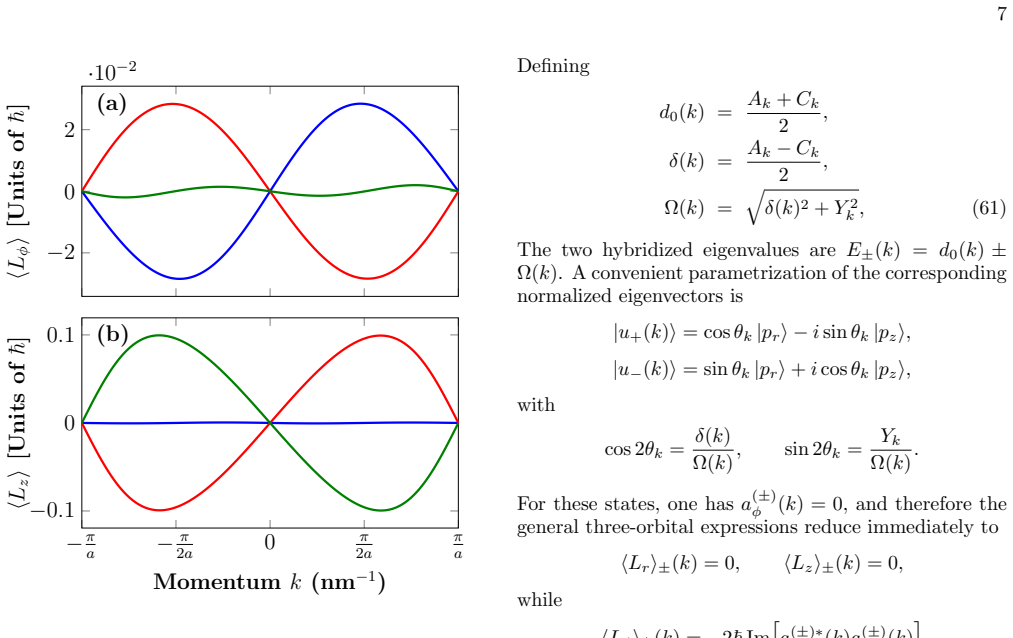
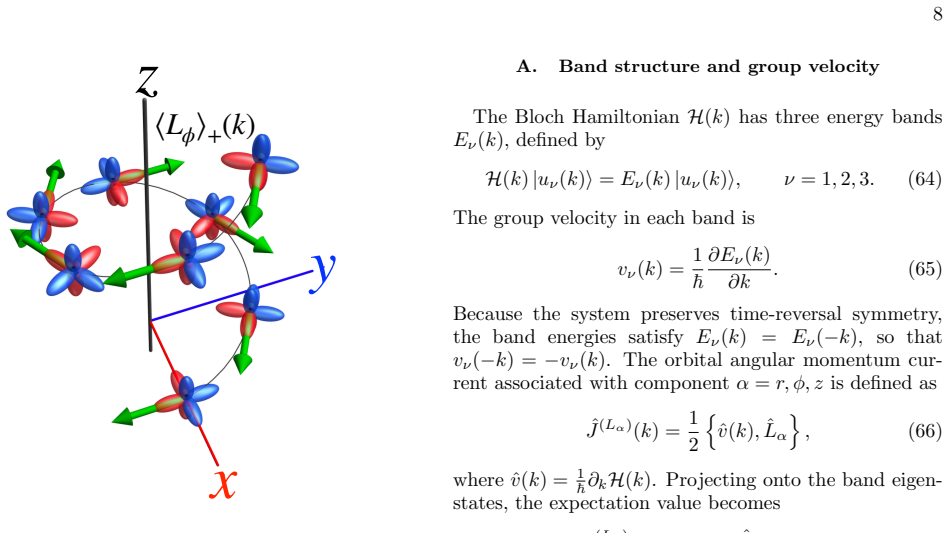
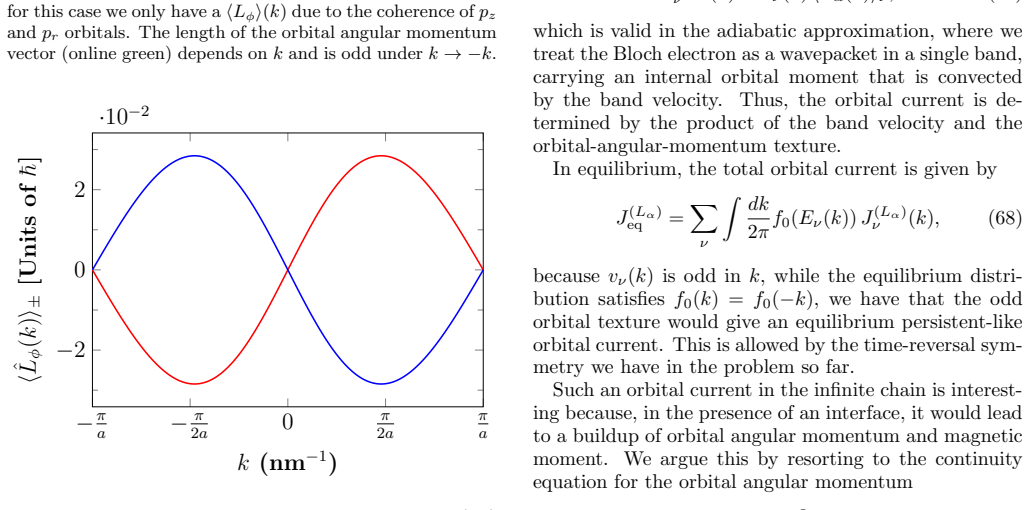
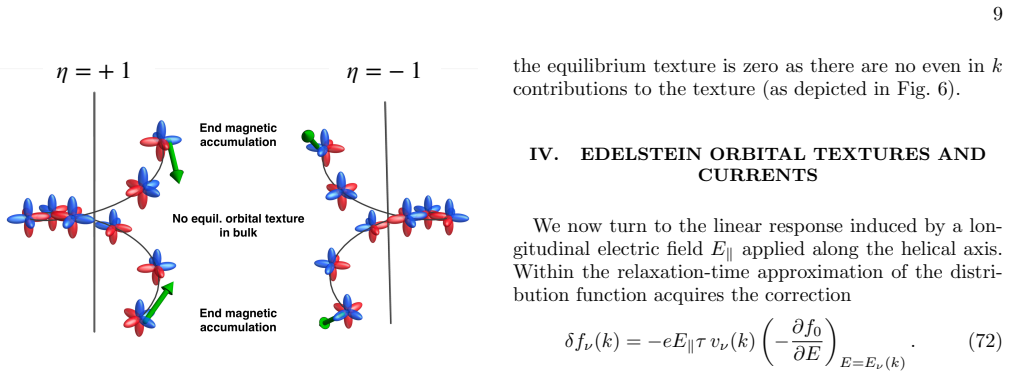
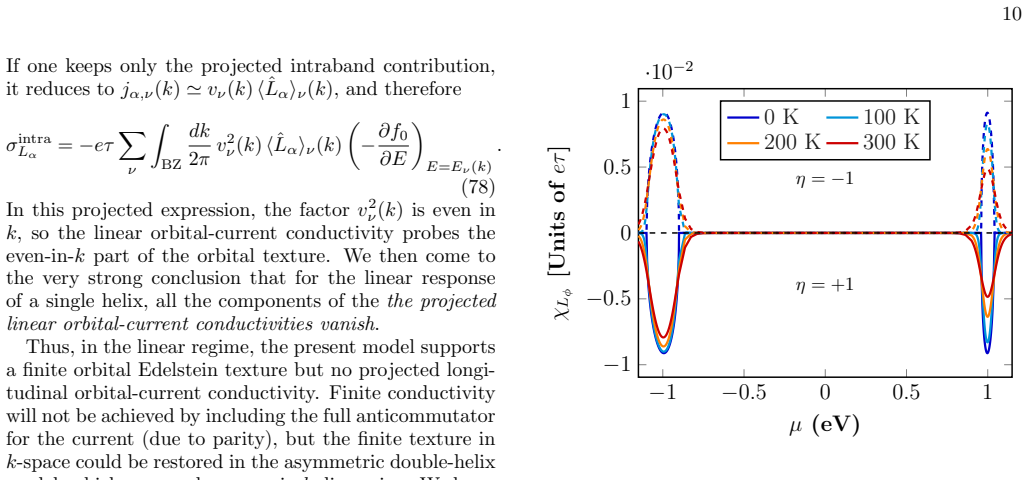
In the single-helix geometry the radial orbital texture vanishes identically while the azimuthal and longitudinal components remain finite and arise from the odd-in-momentum (p_z, p_r) and (p_r, p_φ) sectors. As a result the equilibrium average orbital texture vanishes by parity although persistent-like orbital angular momentum currents may still exist and imply chirality-dependent end magnetization in a finite helix. Under an applied longitudinal electric field the system develops a finite orbital Edelstein response whereas the projected longitudinal orbital-current conductivity vanishes in the linear regime by parity. When spin degrees of freedom are included the orbital texture acts as a源
What carries the argument
Slater-Koster hybridization within the local three-orbital basis (p_r, p_φ, p_z) on the discrete helix, which mixes orbitals according to the helical twist to generate the momentum-odd orbital angular momentum components.
If this is right
- Persistent-like orbital angular momentum currents imply chirality-dependent magnetization at the ends of a finite helix.
- A finite orbital Edelstein response appears under longitudinal electric field while longitudinal orbital conductivity vanishes by parity.
- Orbital texture sources spin polarization with response strength set by orbital overlap scales larger than atomic spin-orbit coupling.
- Chirality is identified as the minimal microscopic ingredient for orbital angular momentum response in one-dimensional systems.
Where Pith is reading between the lines
- The orbital mechanism offers a route to chiral-induced spin selectivity in molecular wires that does not rely on intrinsic atomic spin-orbit strength.
- Similar orbital textures may appear in other chiral one-dimensional structures such as certain carbon nanotubes or DNA segments.
- Transport experiments measuring end magnetization or spin accumulation in helical nanowires could test the predicted currents and responses.
Load-bearing premise
The minimal three-orbital tight-binding model on a single discrete helix with only Slater-Koster hybridization parameters is sufficient to produce the reported textures and responses without disorder, interactions, or higher orbitals.
What would settle it
Momentum-resolved measurement on a single helical chain that finds no azimuthal or longitudinal orbital angular momentum components odd in crystal momentum would falsify the claim that chirality alone generates the texture.
Figures
read the original abstract
Recently, nonequilibrium orbital angular momentum in low-dimensional systems has attracted renewed attention. Here we introduce a minimal three-orbital tight-binding model for a single helical chain and show that chirality alone generates a momentum-dependent orbital-angular-momentum texture through Slater--Koster hybridization in the local basis $(p_r,p_\phi,p_z)$, without requiring atomic spin--orbit coupling. In the single-helix geometry, the radial orbital texture vanishes identically, while the azimuthal and longitudinal components remain finite and arise from the odd-in-momentum $(p_z,p_r)$ and $(p_r,p_\phi)$ sectors. As a result, the equilibrium average orbital texture vanishes by parity, although persistent-like orbital angular momentum currents may still exist and imply chirality-dependent end magnetization in a finite helix. Under an applied longitudinal electric field, the system develops a finite orbital Edelstein response, whereas the projected longitudinal orbital-current conductivity vanishes in the linear regime by parity. When spin degrees of freedom are included, the orbital texture acts as a source of spin polarization through orbital-to-spin transduction. The resulting spin response is controlled by orbital overlap scales much larger than the bare relativistic spin--orbit scale, making it a stronger candidate for spin injection than the conventional spin Edelstein mechanism. These results identify chirality as the minimal microscopic ingredient for generating orbital angular momentum response in one-dimensional systems and support an orbital route to spin selectivity in chiral conductors.
Editorial analysis
A structured set of objections, weighed in public.
Referee Report
Summary. The manuscript introduces a minimal three-orbital tight-binding model on a discrete helix and argues that chirality alone, via Slater-Koster hybridization in the local (p_r, p_φ, p_z) basis, produces a momentum-dependent orbital angular momentum texture without atomic spin-orbit coupling. The radial component vanishes identically by symmetry while the azimuthal and longitudinal components remain finite and arise from the odd-in-momentum (p_z, p_r) and (p_r, p_φ) sectors. Equilibrium averages vanish by parity, yet persistent-like orbital currents may exist. Linear response yields a finite orbital Edelstein effect but vanishing longitudinal orbital-current conductivity by parity. Inclusion of spin converts the orbital texture into an enhanced spin polarization response controlled by orbital overlap scales rather than the weaker relativistic SOC scale.
Significance. If the central claims are confirmed, the work supplies a clean microscopic and symmetry-based route to chirality-induced orbital textures and currents in one-dimensional systems, offering a plausible orbital-mediated mechanism for spin selectivity that operates at larger energy scales than conventional spin-orbit mechanisms. The parity arguments for vanishing radial texture and longitudinal conductivity are particularly transparent and parameter-independent.
major comments (2)
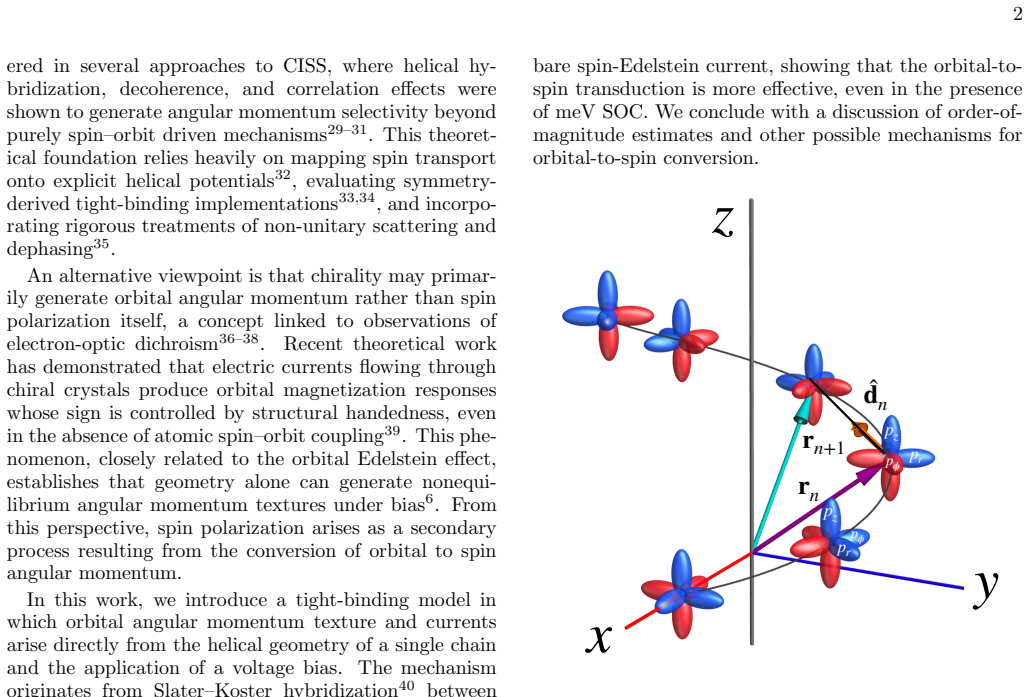
- [Model definition and hopping matrix (likely §2)] The derivation of the 3×3 hopping matrix in the helical Brillouin zone (presumably §2–3) must explicitly demonstrate that the inter-site bond vector and relative local-frame rotation produce k-odd matrix elements in the (p_z, p_r) and (p_r, p_φ) sectors for generic helix radius and pitch angle. The skeptic concern that this structure may hold only for fine-tuned geometry rather than as a direct geometric consequence of chirality is load-bearing for the claim that the texture is generated by chirality alone.
- [Linear response section] The linear-response calculation of the orbital Edelstein response and the vanishing longitudinal orbital-current conductivity (likely §4) should include explicit numerical verification or an analytic proof that the parity selection rule survives for the chosen Slater-Koster parameters; without such checks the parity argument remains plausible but unconfirmed.
minor comments (2)
- [Introduction / Model] Define the local orbital basis (p_r, p_φ, p_z) more explicitly at first use and clarify how the radial, azimuthal, and longitudinal OAM operators are projected onto this basis.
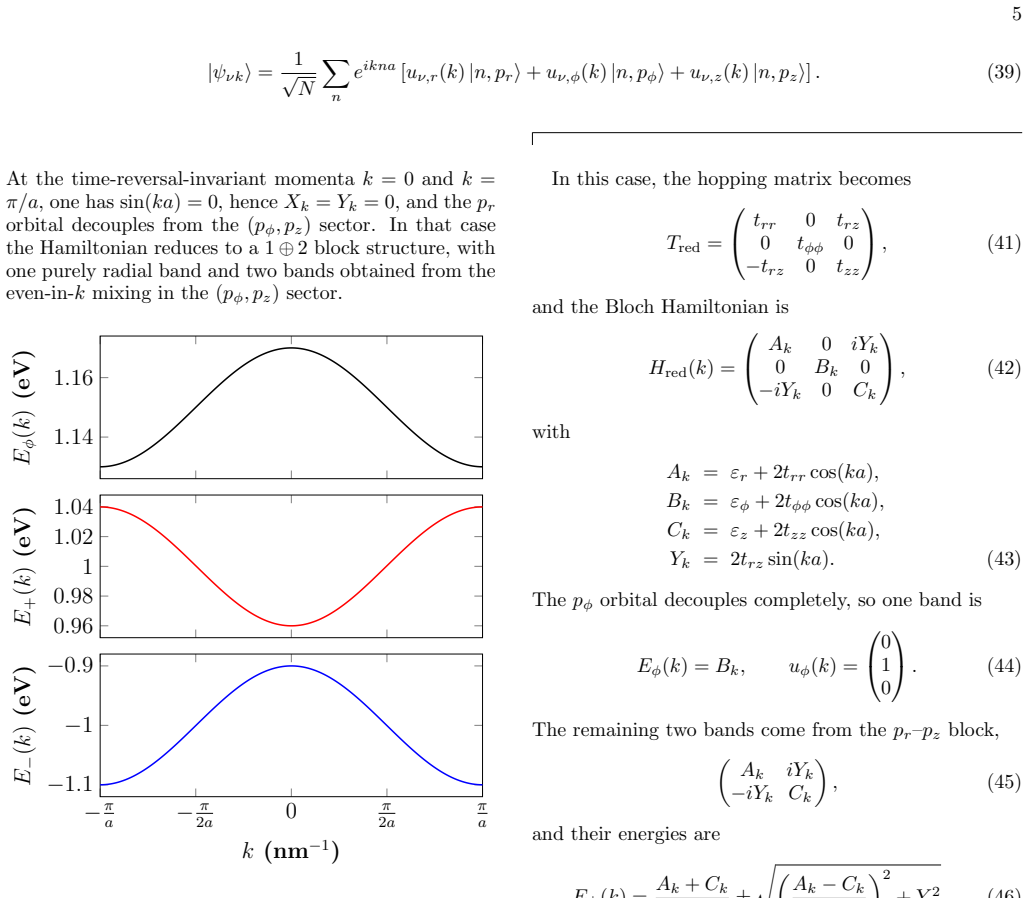
- [Results / Figures] Specify the numerical values or functional form of the Slater-Koster integrals employed in any plots or response functions.
Simulated Author's Rebuttal
We thank the referee for the careful reading, positive assessment of the work's significance, and constructive comments on the model derivation and linear-response calculations. We address each major comment below and have revised the manuscript accordingly to provide the requested explicit demonstrations.
read point-by-point responses
-
Referee: [Model definition and hopping matrix (likely §2)] The derivation of the 3×3 hopping matrix in the helical Brillouin zone (presumably §2–3) must explicitly demonstrate that the inter-site bond vector and relative local-frame rotation produce k-odd matrix elements in the (p_z, p_r) and (p_r, p_φ) sectors for generic helix radius and pitch angle. The skeptic concern that this structure may hold only for fine-tuned geometry rather than as a direct geometric consequence of chirality is load-bearing for the claim that the texture is generated by chirality alone.
Authors: We agree that an explicit, geometry-independent demonstration is essential to support the central claim. In the revised manuscript we have expanded §2 with a full analytic derivation of the 3×3 hopping matrix. Starting from the inter-site bond vector (R, φ, z) and the relative rotation of the local (p_r, p_φ, p_z) frames between neighboring sites, we obtain closed-form expressions for all matrix elements in terms of the helix radius R and pitch angle α. The (p_z, p_r) and (p_r, p_φ) sectors contain terms proportional to sin(k a) and cos(k a) that remain odd under k → −k for any R > 0 and α not equal to an integer multiple of 2π. These odd-in-k contributions arise solely from the chiral geometry and the Slater–Koster angular factors; no parameter fine-tuning is required. We also include a short appendix tabulating the leading-order k-odd coefficients for representative (R, α) values to illustrate the generic character of the result. revision: yes
-
Referee: [Linear response section] The linear-response calculation of the orbital Edelstein response and the vanishing longitudinal orbital-current conductivity (likely §4) should include explicit numerical verification or an analytic proof that the parity selection rule survives for the chosen Slater-Koster parameters; without such checks the parity argument remains plausible but unconfirmed.
Authors: We thank the referee for highlighting the need for explicit confirmation. In the revised §4 we now supply both an analytic symmetry argument and numerical verification. The analytic proof follows from the fact that the orbital-current operators are even under the combined operation k → −k together with an appropriate orbital-basis transformation that leaves the Slater–Koster Hamiltonian invariant; the longitudinal orbital-current conductivity therefore vanishes identically by parity for any choice of Slater–Koster integrals. In addition, we have performed explicit numerical evaluations of the Kubo formula for the specific Slater–Koster parameters used throughout the manuscript. The longitudinal orbital-current conductivity remains zero to machine precision (relative error < 10^{-8}), while the orbital Edelstein response stays finite, confirming that the parity selection rule is robust for the chosen parameters. revision: yes
Circularity Check
No circularity: derivation follows from explicit tight-binding construction on helical geometry
full rationale
The paper constructs a minimal three-orbital tight-binding Hamiltonian on a discrete helix using standard Slater-Koster overlaps in the local (p_r, p_φ, p_z) basis. Orbital textures are obtained by diagonalizing the resulting k-dependent 3x3 matrix whose elements are fixed by the helix bond vectors and frame rotations; parity under k → -k then forces the equilibrium average to vanish while allowing finite currents and linear responses. No parameter is fitted to the target textures inside the paper, no self-citation supplies a uniqueness theorem or ansatz, and the reported odd-in-k components emerge directly from the geometry without reduction to the input definitions. The derivation is therefore self-contained against the stated model assumptions.
Axiom & Free-Parameter Ledger
free parameters (1)
- Slater-Koster hopping integrals
axioms (2)
- domain assumption The single discrete helix with three local p-orbitals and nearest-neighbor Slater-Koster hybridization captures the essential orbital mixing induced by chirality.
- standard math Parity and symmetry arguments in the single-helix geometry cause the equilibrium average orbital texture and the longitudinal orbital-current conductivity to vanish.
Lean theorems connected to this paper
-
IndisputableMonolith/Foundation/AlexanderDuality.leanalexander_duality_circle_linking echoes?
echoesECHOES: this paper passage has the same mathematical shape or conceptual pattern as the Recognition theorem, but is not a direct formal dependency.
In the single-helix geometry, the radial orbital texture vanishes identically, while the azimuthal and longitudinal components remain finite and arise from the odd-in-momentum (pz, pr) and (pr, pϕ) sectors.
-
IndisputableMonolith/Cost/FunctionalEquation.leanwashburn_uniqueness_aczel unclear?
unclearRelation between the paper passage and the cited Recognition theorem.
The mechanism originates from Slater–Koster hybridization between longitudinal and transverse p orbitals enforced by screw symmetry. No atomic spin–orbit interaction is required.
What do these tags mean?
- matches
- The paper's claim is directly supported by a theorem in the formal canon.
- supports
- The theorem supports part of the paper's argument, but the paper may add assumptions or extra steps.
- extends
- The paper goes beyond the formal theorem; the theorem is a base layer rather than the whole result.
- uses
- The paper appears to rely on the theorem as machinery.
- contradicts
- The paper's claim conflicts with a theorem or certificate in the canon.
- unclear
- Pith found a possible connection, but the passage is too broad, indirect, or ambiguous to say the theorem truly supports the claim.
Reference graph
Works this paper leans on
-
[1]
Structure dependent spin selectivity in electron transport through oligopeptides , author=. J. Chem. Phys. , volume=. 2017 , publisher=
work page 2017
-
[2]
Spin–charge transport in chirally induced spin selectivity , author=. J. Chem. Phys. , volume=. 2026 , publisher=
work page 2026
-
[3]
UnconventionalSpintronicsfromChiralPerovskites , author=. Adv. Func. Mat. , volume=. 2025 , publisher=
work page 2025
- [4]
-
[5]
Detecting Chirality-Induced Spin Selectivity in Randomly Oriented Radical Pairs Photogenerated by Hole Transfer , author=. J. Am. Chem. Soc. , volume=. 2024 , publisher=
work page 2024
-
[6]
Magnetoresistive Single-Molecule Junctions: the Role of the Spinterface and the CISS Effect , author=. Isr. J. Chem. , volume=. 2022 , publisher=
work page 2022
-
[7]
Chirality-dependent electron spin filtering by molecular monolayers of helicenes , author=. J. Phys. Chem. Lett. , volume=. 2018 , publisher=
work page 2018
-
[8]
Spin filtering along chiral polymers , author=. Angew. Chem., Int. Ed. , volume=. 2020 , publisher=
work page 2020
-
[9]
Gate-tuneable and chirality-dependent charge-to-spin conversion in tellurium nanowires , author=. Nat. Mater. , volume=. 2022 , publisher=
work page 2022
-
[10]
Mechanism for electrostatically generated magnetoresistance in chiral systems without spin-dependent transport , author=. ACS nano , volume=. 2024 , publisher=
work page 2024
-
[11]
A chirality-based quantum leap , author=. ACS nano , volume=. 2022 , publisher=
work page 2022
-
[12]
Chirality-induced spin-polarized state of a chiral crystal CrNb 3 S 6 , author=. Phys. Rev. Lett. , volume=. 2020 , publisher=
work page 2020
-
[13]
Spin selective electron transmission through helical potentials , author=. Phys. Rev. B. , volume=. 2013 , publisher=
work page 2013
-
[14]
Spin polarization induced by decoherence in a tunneling one-dimensional Rashba model , author=. SciPost Phys. Core , volume=
-
[15]
Modification of weak localization in metallic thin films due to the adsorption of chiral molecules , author=. J. Phys. Chem. Lett. , volume=. 2023 , publisher=
work page 2023
-
[16]
Semirealistic tight-binding model for spin-orbit torques , author =. Phys. Rev. B , volume =. 2020 , month =. doi:10.1103/PhysRevB.101.174423 , url =
-
[17]
Length-dependent electron spin polarization in oligopeptides and DNA , author=. J. Phys. Chem. C. , volume=. 2020 , publisher=
work page 2020
-
[18]
Spin-selective transport of electrons in DNA double helix , author=. Phys. Rev. Lett. , volume=. 2012 , publisher=
work page 2012
-
[19]
Distance-dependent coherent charge transport in DNA: crossover from tunneling to free propagation , author=. J. Biophys. Chem. , volume=
-
[20]
Pastawski, \ Horacio M.\ and Ernesto Medina. 'Tight binding' methods in quantum transport through molecules and small devices: From the coherent to the decoherent description. Rev. Mex. Fís. 2001
work page 2001
-
[21]
Conductance of a disordered linear chain including inelastic scattering events , author=. Phys. Rev. B. , volume=
-
[22]
Relation between conductivity and transmission matrix , author=. Phys. Rev. B. , volume=. 1981 , publisher=
work page 1981
- [23]
-
[24]
Spin selectivity effect in achiral molecular systems , author=. Phys. Rev. B. , volume=. 2016 , publisher=
work page 2016
-
[25]
Spin-dependent electron transport in protein-like single-helical molecules , author=. Proc. Natl. Acad. Science , volume=. 2014 , publisher=
work page 2014
-
[26]
Electronic parameters for charge transfer along DNA , author=. Eur. Phys. J. E , volume=. 2010 , publisher=
work page 2010
-
[27]
Connecting chirality and spin in electronic devices , author=
-
[28]
General Principles for Non-equilibrium Relaxation of Populations in Quantum Materials , author=. Phys. Rev. X. , volume=. 2018 , publisher=
work page 2018
- [29]
-
[30]
Yang, Xu and van der Wal, Caspar H. and van Wees, Bart J. , title =. Nano Lett. , volume =
-
[31]
On the Dirac theory of spin 1/2 particles and its non-relativistic limit , author=. Phys. Rev. , volume=. 1950 , publisher=
work page 1950
-
[32]
Intermediate tunnelling--hopping regime in DNA charge transport , author=. Nat. Chem. , volume=. 2015 , publisher=
work page 2015
-
[33]
Kwant: a software package for quantum transport , author=. New J. Phys. , volume=. 2014 , publisher=
work page 2014
-
[34]
Effective spin-orbit couplings in an analytical tight-binding model of DNA: Spin filtering and chiral spin transport , author=. Phys. Rev. B , volume=. 2016 , publisher=
work page 2016
- [35]
-
[36]
Pastawski, Horacio M. , journal=. Classical and quantum transport from generalized Landauer-B. 1991 , publisher=
work page 1991
-
[37]
Classical and quantum transport from generalized Landauer-Buttiker equations. II. Time-dependent resonant tunneling , author=. Phys. Rev. B , volume=. 1992 , publisher=
work page 1992
-
[38]
Fiori, E. Rufeil and Pastawski, H.M. , year =. Non-Markovian decay beyond the Fermi Golden Rule: Survival collapse of the polarization in spin chains , volume =. Chem. Phys. Lett. , publisher =. doi:10.1016/j.cplett.2005.12.025 , number =
-
[39]
Cattena, Carlos J and Fernández-Alcázar, Lucas J and Bustos-Marún, Raúl A and Nozaki, Daijiro and Pastawski, Horacio M , year =. Generalized multi-terminal decoherent transport: recursive algorithms and applications to SASER and giant magnetoresistance , volume =. J. Phys.: Condens. Matter , publisher =. doi:10.1088/0953-8984/26/34/345304 , number =
-
[40]
A review of progress in the physics of open quantum systems: theory and experiment , volume =
Rotter, I and Bird, J P , year =. A review of progress in the physics of open quantum systems: theory and experiment , volume =. Rep. Prog. Phys , publisher =. doi:10.1088/0034-4885/78/11/114001 , number =
-
[41]
Lozano-Negro, Fabricio S and Ferreyra-Ortega, Marcos A and Bendersky, Denise and Fernández-Alcázar, Lucas and Pastawski, Horacio M , year =. Simulating a catalyst induced quantum dynamical phase transition of a Heyrovsky reaction with different models for the environment , volume =. J. Phys.: Condens. Matter , publisher =. doi:10.1088/1361-648x/ac57d6 , number =
-
[42]
Disorder and dephasing effects on electron transport through conjugated molecular wires in molecular junctions , author=. Phys. Rev. B , volume=. 2012 , publisher=
work page 2012
-
[43]
Dynamics and decoherence in nonideal Thouless quantum motors , author=. Phys. Rev. B , volume=. 2017 , publisher=
work page 2017
-
[44]
Chiral Spin Selectivity and chiroptical activity in helical molecules , author=. J. Chem. Phys. , volume=. 2024 , publisher=
work page 2024
-
[45]
Chiral induced spin selectivity , author=. Chem. Rev. , volume=. 2024 , publisher=
work page 2024
-
[46]
Asymmetric scattering of polarized electrons by organized organic films of chiral molecules , author=. Science , volume=. 1999 , publisher=
work page 1999
-
[47]
Bangruwa, Neeraj and Srivastava, Manish and Mishra, Debabrata , title =. ACS Omega , volume =
-
[48]
Light-Amplified CISS-Based Hybrid QD-DNA Impedimetric Device for DNA Hybridization Detection , author=. Anal. Chem. , volume=. 2023 , publisher=
work page 2023
-
[49]
Spintronics: Fundamentals and applications , author=. Rev. Mod. Phys. , volume=. 2004 , publisher=
work page 2004
-
[50]
The electrical conductivity of transition metals , author=. Proc. R. Soc. Lond. A. Math. Phys. Sci. , volume=. 1936 , publisher=
work page 1936
-
[51]
The resistance and thermoelectric properties of the transition metals , author=. Proc. R. Soc. Lond. A. Math. Phys. Sci. , volume=. 1936 , publisher=
work page 1936
-
[52]
Electron transfer in DNA , author=. Curr. Opin. Chem. Biol. , volume=. 2002 , publisher=
work page 2002
-
[53]
Ubiquitous electron transport in non-electron transfer proteins , author=. Life , volume=. 2020 , publisher=
work page 2020
-
[54]
Spin selectivity in electron transfer in photosystem I , author=. Angew. Chem., Int. Ed. , volume=. 2014 , publisher=
work page 2014
- [55]
-
[56]
Helicenes—A new class of organic spin filter , author=. Adv. Mater. , volume=
-
[57]
Efficient Spin-Selective Electron Transport at Low Voltages of Thia-Bridged Triarylamine Hetero [4] helicenes Chemisorbed Monolayer , author=. ACS nano , volume=. 2023 , publisher=
work page 2023
-
[58]
Mutual monomer orientation to bias the supramolecular polymerization of [6] helicenes and the resulting circularly polarized light and spin filtering properties , author=. J. Am. Chem. Soc. , volume=. 2022 , publisher=
work page 2022
-
[59]
Spin filtering in supramolecular polymers assembled from achiral monomers mediated by chiral solvents , author=. J. Am. Chem. Soc. , volume=. 2021 , publisher=
work page 2021
-
[60]
Efficient spin selectivity in self-assembled superhelical conducting polymer microfibers , author=. ACS nano , volume=. 2020 , publisher=
work page 2020
- [61]
-
[62]
Spin selectivity in electron transmission through self-assembled monolayers of double-stranded DNA , author=. Science , volume=. 2011 , publisher=
work page 2011
-
[63]
Spin filtering in electron transport through chiral oligopeptides , author=. J. Phys. Chem. C. , volume=. 2015 , publisher=
work page 2015
-
[64]
Enantiospecificity of cysteine adsorption on a ferromagnetic surface: Is it kinetically or thermodynamically controlled? , author=. J. Phys. Chem. Lett. , volume=. 2021 , publisher=
work page 2021
-
[65]
Spin-polarized photoemission from chiral CuO catalyst thin films , author=. ACS nano , volume=. 2022 , publisher=
work page 2022
-
[66]
Controlling chemical selectivity in electrocatalysis with chiral CuO-coated electrodes , author=. J. Phys. Chem. C. , volume=. 2019 , publisher=
work page 2019
-
[67]
Chirality-induced spin selectivity in a coarse-grained tight-binding model for helicene , author=. J. Phys. Chem. C. , volume=. 2019 , publisher=
work page 2019
-
[68]
Reinforced room-temperature spin filtering in chiral paramagnetic metallopeptides , author=. J. Am. Chem. Soc. , volume=. 2020 , publisher=
work page 2020
-
[69]
Enhanced magnetoresistance in chiral molecular junctions , author=. J. Phys. Chem. Lett. , volume=. 2018 , publisher=
work page 2018
-
[70]
Thermal decoherence and disorder effects on chiral-induced spin selectivity , author=. J. Phys. Chem. Lett. , volume=. 2018 , publisher=
work page 2018
-
[71]
Chiral electron transport: Scattering through helical potentials , author=. J. Chem. Phys. , volume=. 2009 , publisher=
work page 2009
-
[72]
Inelastic electron scattering from a helical potential: transverse polarization and the structure factor in the single scattering approximation , author=. J. Phys.: Condens. Matter. , volume=. 2013 , publisher=
work page 2013
- [73]
-
[74]
Spin-selective transport through helical molecular systems , author=. Phys. Rev. B. , volume=. 2012 , publisher=
work page 2012
-
[75]
Electrically driven spin currents in DNA , author=. J. Phys. Chem. C. , volume=. 2013 , publisher=
work page 2013
-
[76]
Minimal model for chirally induced spin selectivity: spin-orbit coupling, tunneling and decoherence , author=. J. Stat. Mech.: Theory Exp. , volume=. 2024 , publisher=
work page 2024
-
[77]
Spin-phonon coupling in a double-stranded model of DNA , author=. J. Chem. Phys. , volume=. 2023 , publisher=
work page 2023
-
[78]
Charge transfer via a two-strand superexchange bridge in DNA , author=. Phys. Rev. Lett. , volume=. 2006 , publisher=
work page 2006
-
[79]
, author=. Phys. Rev. Lett. , volume=. 2006 , publisher=
work page 2006
-
[80]
Spin-dependent features of electron scattering from optically active molecules , author=. J. Phys. B: At. Mol. Opt. Phys. , volume=. 1980 , publisher=
work page 1980
discussion (0)
Sign in with ORCID, Apple, or X to comment. Anyone can read and Pith papers without signing in.