The Dangers of Non-Self-Fixed Architecture Technical Debt and Its Impact on Time-to-Fix
Pith reviewed 2026-05-20 16:20 UTC · model grok-4.3
The pith
Non-self-fixed architectural technical debt takes longer to resolve when changes involve many developers.
A machine-rendered reading of the paper's core claim, the machinery that carries it, and where it could break.
Core claim
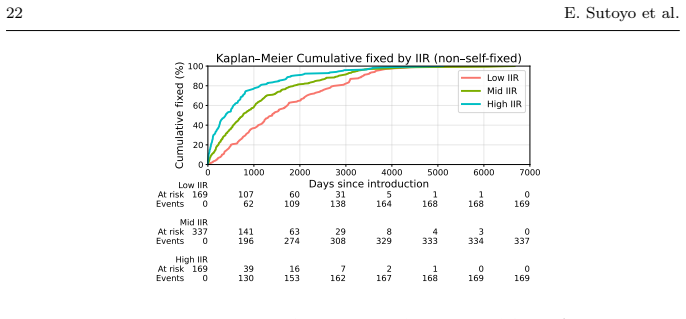
Self-fixed and non-self-fixed ATD exhibit distinct repayment dynamics and differences in how changes are shared on ATD-affected files. In particular, non-self-fixed ATD is more likely to remain unresolved longer when changes are spread across many developers.
What carries the argument
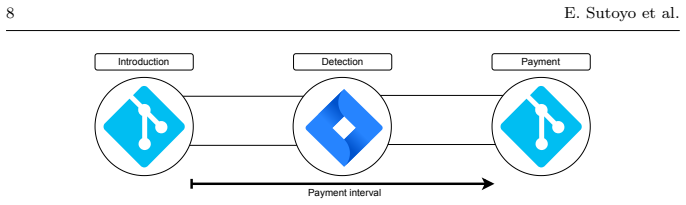
Reconstruction of ATD lifecycles through tracing of Jira artifacts to version-control history, used to identify introduction and repayment points and to classify items as self-fixed or non-self-fixed.
If this is right
- Maintainers can reduce time-to-fix by encouraging the original introducer to handle repayment of ATD when possible.
- ATD items on files changed by many developers warrant closer monitoring because they show slower resolution.
- Documenting design rationale at the time of repayment lowers future handoff costs for non-self-fixed cases.
- Project practices that minimize unnecessary developer turnover on ATD-affected code can shorten repayment times.
Where Pith is reading between the lines
- Similar patterns may appear in closed-source teams where knowledge transfer between developers is limited.
- Tools that track ATD could add alerts when an item shifts from self-fixed to non-self-fixed status.
- Training new contributors on existing architectural decisions might reduce the number of non-self-fixed cases.
Load-bearing premise
Linking Jira artifacts to version-control history accurately attributes which developer introduced each ATD item and which one repaid it, and correctly labels the cases as self-fixed or non-self-fixed.
What would settle it
A manual audit of a random sample of classified ATD items that finds substantial mismatches in developer attribution or in the recorded dates of introduction and repayment.
Figures




read the original abstract
Technical Debt (TD) refers to the long-term costs incurred when developers prioritize short-term delivery over quality-improving work. Architectural Technical Debt (ATD) arises when architectural decisions (e.g., technology choices, patterns, or decomposition) prioritize near-term progress over future maintainability and evolvability. Because ATD affects a system's core structure and propagates through architectural dependencies, it is often more expensive and disruptive to remediate than localized code-level debt. Although ATD has been widely studied, an important but underexplored aspect of repayment is who performs it. Prior work provides limited empirical evidence on repayment responsibility in ATD and its relationship to time-to-fix. We empirically study self-fixed ATD, where the introducer also repays the debt, and contrast it with non-self-fixed ATD in large Apache open-source projects. We reconstruct ATD lifecycles by tracing Jira artifacts to version-control history to identify introduction and repayment points and attribute developer roles. We address three research questions on the prevalence of self-fixed ATD, time-to-fix differences between self-fixed and non--self-fixed items, and how factors related to code change and collaboration metrics relate to repayment speed. Using descriptive statistics, non-parametric tests, and survival analysis, we show that self-fixed and non--self-fixed ATD exhibit distinct repayment dynamics and differences in how changes are shared on ATD-affected files. In particular, non--self-fixed ATD is more likely to remain unresolved longer when changes are spread across many developers. These results provide actionable guidance for maintainers to identify high-risk ATD items and to reduce handoff costs by increasing introducer involvement when possible and documenting the design rationale during repayment.
Editorial analysis
A structured set of objections, weighed in public.
Referee Report
Summary. The manuscript empirically examines self-fixed versus non-self-fixed architectural technical debt (ATD) in large Apache open-source projects. It reconstructs ATD lifecycles by tracing Jira artifacts to version-control history to identify introduction and repayment points and attribute developer roles. Using descriptive statistics, non-parametric tests, and survival analysis, the authors investigate prevalence, time-to-fix differences, and how code-change spread and collaboration metrics relate to repayment speed. The central claim is that non-self-fixed ATD remains unresolved longer when changes are spread across many developers.
Significance. If the ATD identification and developer-role attribution hold, the work offers actionable guidance for maintainers on reducing handoff costs in ATD repayment and highlights the interaction between collaboration patterns and debt persistence. The application of survival analysis to model time-to-fix is a strength, as is the focus on the 'who' dimension of repayment, which has received limited prior attention. The results could inform project practices if the reconstruction method is shown to be robust.
major comments (2)
- [Methodology / Data Reconstruction] The reconstruction of ATD lifecycles relies on linking Jira artifacts to VCS history for introduction/repayment points and self/non-self classification, yet the manuscript provides no detail on ATD identification rules, inter-rater reliability for classification, or explicit handling of confounding factors such as incomplete commit references or rebases. This is load-bearing for the survival-analysis results and the claim about developer-spread effects.
- [Section 4 (Lifecycle Reconstruction)] The skeptic concern about Jira-to-VCS linking accuracy directly affects the weakest assumption: if multi-contributor commits or timestamp misalignments lead to noisy self-fixed/non-self-fixed labels, both the grouping variable and the observed correlations with change-spread metrics become unreliable, undermining the time-to-fix comparisons.
minor comments (2)
- [Section 3.1] Clarify the exact operational definition of 'architectural' debt versus other TD types when selecting Jira issues; this would help readers assess generalizability.
- [Abstract and Results] The abstract states that non-self-fixed ATD is 'more likely to remain unresolved longer' under high developer spread; add a specific hazard-ratio or median time-to-fix value from the survival model to make this quantitative.
Simulated Author's Rebuttal
We thank the referee for the thoughtful and detailed review of our manuscript. The comments highlight important aspects of our methodology that require greater transparency to support the validity of our empirical findings. We address each major comment below and indicate the specific revisions we will incorporate in the next version of the paper.
read point-by-point responses
-
Referee: [Methodology / Data Reconstruction] The reconstruction of ATD lifecycles relies on linking Jira artifacts to VCS history for introduction/repayment points and self/non-self classification, yet the manuscript provides no detail on ATD identification rules, inter-rater reliability for classification, or explicit handling of confounding factors such as incomplete commit references or rebases. This is load-bearing for the survival-analysis results and the claim about developer-spread effects.
Authors: We agree that additional methodological detail is needed to allow readers to fully assess the reconstruction process and its potential impact on the survival analysis. In the revised manuscript we will expand Section 4 with a dedicated subsection that (1) enumerates the precise ATD identification rules applied to Jira issues, (2) reports any inter-rater reliability statistics obtained during classification, and (3) describes our explicit procedures for mitigating confounding factors such as incomplete commit references and rebases. These additions will directly strengthen the grounding of the time-to-fix comparisons and the developer-spread findings. revision: yes
-
Referee: [Section 4 (Lifecycle Reconstruction)] The skeptic concern about Jira-to-VCS linking accuracy directly affects the weakest assumption: if multi-contributor commits or timestamp misalignments lead to noisy self-fixed/non-self-fixed labels, both the grouping variable and the observed correlations with change-spread metrics become unreliable, undermining the time-to-fix comparisons.
Authors: We recognize that linking inaccuracies could introduce noise into the self-fixed versus non-self-fixed labels. In the revision we will add a detailed account of the Jira-to-VCS linking algorithm, including how multi-contributor commits and timestamp discrepancies were resolved. We will also report a sensitivity analysis that quantifies the effect of plausible misclassification rates on the survival curves and on the change-spread correlations. This analysis will demonstrate that the core conclusions remain stable under reasonable levels of label noise. revision: yes
Circularity Check
Empirical reconstruction from external artifacts with standard statistics shows no circularity
full rationale
The paper conducts an empirical study that reconstructs ATD introduction and repayment points by linking Jira artifacts to version-control history in Apache projects, then applies descriptive statistics, non-parametric tests, and survival analysis to compare self-fixed versus non-self-fixed items and their relation to developer spread. No equations, fitted parameters, or predictions are defined in terms of the target outcomes; the self/non-self classification follows directly from observable commit authorship matches rather than any self-referential construction. No load-bearing self-citations, uniqueness theorems, or ansatzes imported from prior author work appear in the provided derivation chain. The central claim on time-to-fix differences therefore rests on independent external data traces and conventional statistical methods, rendering the analysis self-contained against the project artifacts.
Axiom & Free-Parameter Ledger
axioms (1)
- domain assumption Jira issues and linked commits can be used to reliably identify architectural technical debt introduction and repayment events.
Reference graph
Works this paper leans on
-
[1]
Scientific Reports14(1), 21367 (2024)
Al-Fraihat, D., Sharrab, Y., Al-Ghuwairi, A.R., Sbaih, N., Qahmash, A.: Detecting refactoring type of software commit messages based on ensemble machine learning al- gorithms. Scientific Reports14(1), 21367 (2024)
work page 2024
-
[2]
In: Proceedings of the 2018 international conference on technical debt, pp
Alfayez, R., Behnamghader, P., Srisopha, K., Boehm, B.: An exploratory study on the influence of developers in technical debt. In: Proceedings of the 2018 international conference on technical debt, pp. 1–10 (2018) 2 https://github.com/edisutoyo/SELF-FIXED-ATD Title Suppressed Due to Excessive Length 37
work page 2018
-
[3]
In: 2014 sixth international workshop on managing technical debt, pp
Alves, N.S., Ribeiro, L.F., Caires, V., Mendes, T.S., Sp´ ınola, R.O.: Towards an ontology of terms on technical debt. In: 2014 sixth international workshop on managing technical debt, pp. 1–7. IEEE (2014)
work page 2014
-
[4]
Bates, D., Maechler, M., Bolker, B., Walker, S., Christensen, R.H.B., Singmann, H., Dai, B., Grothendieck, G., Green, P., Bolker, M.B.: Package ‘lme4’. convergence12(1), 2 (2015)
work page 2015
-
[5]
In: 2016 42th Euromicro Conference on Software Engineering and Advanced Applications (SEAA), pp
Besker, T., Martini, A., Bosch, J.: A systematic literature review and a unified model of atd. In: 2016 42th Euromicro Conference on Software Engineering and Advanced Applications (SEAA), pp. 189–197. IEEE (2016)
work page 2016
-
[6]
In: 2017 43rd Euromicro Conference on Software Engineering and Advanced Applications (SEAA), pp
Besker, T., Martini, A., Bosch, J.: Impact of architectural technical debt on daily soft- ware development work—a survey of software practitioners. In: 2017 43rd Euromicro Conference on Software Engineering and Advanced Applications (SEAA), pp. 278–287. IEEE (2017)
work page 2017
-
[7]
Journal of Systems and Software135, 1–16 (2018)
Besker, T., Martini, A., Bosch, J.: Managing architectural technical debt: A unified model and systematic literature review. Journal of Systems and Software135, 1–16 (2018)
work page 2018
-
[8]
Bird, C., Nagappan, N., Murphy, B., Gall, H., Devanbu, P.: Don’t touch my code! examining the effects of ownership on software quality. In: Proceedings of the 19th ACM SIGSOFT symposium and the 13th European conference on Foundations of software engineering, pp. 4–14 (2011)
work page 2011
-
[9]
Information and Software Technology112, 68–82 (2019)
Borrego, G., Mor´ an, A.L., Palacio, R.R., Vizca´ ıno, A., Garc´ ıa, F.O.: Towards a reduc- tion in architectural knowledge vaporization during agile global software development. Information and Software Technology112, 68–82 (2019)
work page 2019
-
[10]
In: Proceedings of the 17th International Conference on Mining Software Repositories, pp
Claes, M., M¨ antyl¨ a, M.V.: 20-mad: 20 years of issues and commits of mozilla and apache development. In: Proceedings of the 17th International Conference on Mining Software Repositories, pp. 503–507 (2020)
work page 2020
-
[11]
Psycho- logical bulletin114(3), 494 (1993)
Cliff, N.: Dominance statistics: Ordinal analyses to answer ordinal questions. Psycho- logical bulletin114(3), 494 (1993)
work page 1993
-
[12]
ACM Sigplan Oops Mes- senger4(2), 29–30 (1992)
Cunningham, W.: The wycash portfolio management system. ACM Sigplan Oops Mes- senger4(2), 29–30 (1992)
work page 1992
-
[13]
Psychometrika21(3), 287–290 (1956)
Cureton, E.E.: Rank-biserial correlation. Psychometrika21(3), 287–290 (1956)
work page 1956
-
[14]
Empirical Software Engineering19(4), 1009–1039 (2014)
Eyolfson, J., Tan, L., Lam, P.: Correlations between bugginess and time-based commit characteristics. Empirical Software Engineering19(4), 1009–1039 (2014)
work page 2014
-
[15]
In: 2022 IEEE International Conference on Software Analysis, Evolution and Reengineering (SANER), pp
Forootani, S., Di Sorbo, A., Visaggio, C.A.: An exploratory study on self-fixed software vulnerabilities in oss projects. In: 2022 IEEE International Conference on Software Analysis, Evolution and Reengineering (SANER), pp. 90–100. IEEE (2022)
work page 2022
-
[16]
In: Proceedings of the 2015 10th joint meeting on foundations of software engineering, pp
Foucault, M., Palyart, M., Blanc, X., Murphy, G.C., Falleri, J.R.: Impact of developer turnover on quality in open-source software. In: Proceedings of the 2015 10th joint meeting on foundations of software engineering, pp. 829–841 (2015)
work page 2015
-
[17]
Journal of the american statistical association32(200), 675–701 (1937)
Friedman, M.: The use of ranks to avoid the assumption of normality implicit in the analysis of variance. Journal of the american statistical association32(200), 675–701 (1937)
work page 1937
-
[18]
Empirical Software Engineering28(4), 89 (2023)
Iannone, E., Codabux, Z., Lenarduzzi, V., De Lucia, A., Palomba, F.: Rubbing salt in the wound? a large-scale investigation into the effects of refactoring on security. Empirical Software Engineering28(4), 89 (2023)
work page 2023
-
[19]
International Journal of Open Source Software and Processes (IJOSSP)3(2), 23–42 (2011)
Izquierdo-Cortazar, D., Capiluppi, A., Gonzalez-Barahona, J.M.: Are developers fixing their own bugs?: Tracing bug-fixing and bug-seeding committers. International Journal of Open Source Software and Processes (IJOSSP)3(2), 23–42 (2011)
work page 2011
-
[20]
Jour- nal of the American statistical association53(282), 457–481 (1958)
Kaplan, E.L., Meier, P.: Nonparametric estimation from incomplete observations. Jour- nal of the American statistical association53(282), 457–481 (1958)
work page 1958
-
[21]
Ieee software29(6), 18–21 (2012)
Kruchten, P., Nord, R.L., Ozkaya, I.: Technical debt: From metaphor to theory and practice. Ieee software29(6), 18–21 (2012)
work page 2012
-
[22]
In: 2021 36th IEEE/ACM International Conference on Automated Software Engineering (ASE), pp
Le, T.H.M., Hin, D., Croft, R., Babar, M.A.: Deepcva: Automated commit-level vulnera- bility assessment with deep multi-task learning. In: 2021 36th IEEE/ACM International Conference on Automated Software Engineering (ASE), pp. 717–729. IEEE (2021)
work page 2021
-
[23]
Journal of Systems and Software171, 110827 (2021) 38 E
Lenarduzzi, V., Besker, T., Taibi, D., Martini, A., Fontana, F.A.: A systematic literature review on technical debt prioritization: Strategies, processes, factors, and tools. Journal of Systems and Software171, 110827 (2021) 38 E. Sutoyo et al
work page 2021
-
[24]
Lenarduzzi, V., Lomio, F., Huttunen, H., Taibi, D.: Are sonarqube rules inducing bugs? In: 2020 IEEE 27th international conference on software analysis, evolution and reengi- neering (SANER), pp. 501–511. IEEE (2020)
work page 2020
-
[25]
Journal of Software: Evolution and Process34(3), e2423 (2022)
Li, R., Liang, P., Soliman, M., Avgeriou, P.: Understanding software architecture ero- sion: A systematic mapping study. Journal of Software: Evolution and Process34(3), e2423 (2022)
work page 2022
-
[26]
Empirical Software Engineering28(3), 65 (2023)
Li, Y., Soliman, M., Avgeriou, P.: Automatic identification of self-admitted technical debt from four different sources. Empirical Software Engineering28(3), 65 (2023)
work page 2023
-
[27]
Journal of systems and software101, 193–220 (2015)
Li, Z., Avgeriou, P., Liang, P.: A systematic mapping study on technical debt and its management. Journal of systems and software101, 193–220 (2015)
work page 2015
-
[28]
The annals of mathematical statistics pp
Mann, H.B., Whitney, D.R.: On a test of whether one of two random variables is stochas- tically larger than the other. The annals of mathematical statistics pp. 50–60 (1947)
work page 1947
-
[29]
In: 2014 40th EUROMICRO Conference on Software Engi- neering and Advanced Applications, pp
Martini, A., Bosch, J., Chaudron, M.: Architecture technical debt: Understanding causes and a qualitative model. In: 2014 40th EUROMICRO Conference on Software Engi- neering and Advanced Applications, pp. 85–92. IEEE (2014)
work page 2014
-
[30]
Information and Software Technology67, 237–253 (2015)
Martini, A., Bosch, J., Chaudron, M.: Investigating architectural technical debt accu- mulation and refactoring over time: A multiple-case study. Information and Software Technology67, 237–253 (2015)
work page 2015
-
[31]
Encyclopedia of Biostatistics4(2005)
McCulloch, C.E., Neuhaus, J.M.: Generalized linear mixed models. Encyclopedia of Biostatistics4(2005)
work page 2005
-
[32]
Information and Software Technology158, 107187 (2023)
Ortu, M., Destefanis, G., Hall, T., Bowes, D.: Fault-insertion and fault-fixing be- havioural patterns in apache software foundation projects. Information and Software Technology158, 107187 (2023)
work page 2023
-
[33]
IEEE Transactions on Software Engineering48(12), 5050–5067 (2021)
Prenner, J.A., Robbes, R.: Making the most of small software engineering datasets with modern machine learning. IEEE Transactions on Software Engineering48(12), 5050–5067 (2021)
work page 2021
-
[34]
In: Proceedings of the 33rd international conference on software engineering, pp
Rahman, F., Devanbu, P.: Ownership, experience and defects: a fine-grained study of authorship. In: Proceedings of the 33rd international conference on software engineering, pp. 491–500 (2011)
work page 2011
-
[35]
In: Proceedings of the 1st International Workshop on Software Refactoring, pp
Samarthyam, G., Suryanarayana, G., Sharma, T.: Refactoring for software architecture smells. In: Proceedings of the 1st International Workshop on Software Refactoring, pp. 1–4 (2016)
work page 2016
-
[36]
´Sliwerski, J., Zimmermann, T., Zeller, A.: When do changes induce fixes? ACM sigsoft software engineering notes30(4), 1–5 (2005)
work page 2005
-
[37]
Spadini, D., Aniche, M., Bacchelli, A.: Pydriller: Python framework for mining software repositories. In: Proceedings of the 2018 26th ACM Joint meeting on european software engineering conference and symposium on the foundations of software engineering, pp. 908–911 (2018)
work page 2018
-
[38]
The American journal of psychology (1961)
Spearman, C.: The proof and measurement of association between two things. The American journal of psychology (1961)
work page 1961
-
[39]
Sutoyo, E., Avgeriou, P., Capiluppi, A.: Reducing labeling effort in architecture technical debt detection through active learning and explainable ai (2026). URLhttps://arxiv. org/abs/2603.02944
-
[40]
In: Proceedings of the 3rd International Conference on Technical Debt, pp
Tan, J., Feitosa, D., Avgeriou, P.: An empirical study on self-fixed technical debt. In: Proceedings of the 3rd International Conference on Technical Debt, pp. 11–20 (2020)
work page 2020
-
[41]
Information and Software Technology143, 106738 (2022)
Tan, J., Feitosa, D., Avgeriou, P.: Does it matter who pays back technical debt? an empirical study of self-fixed td. Information and Software Technology143, 106738 (2022)
work page 2022
-
[42]
Information and Software Technology159, 107216 (2023)
Tan, J., Feitosa, D., Avgeriou, P.: The lifecycle of technical debt that manifests in both source code and issue trackers. Information and Software Technology159, 107216 (2023)
work page 2023
-
[43]
In: Proceedings of the 40th international conference on software engineering, pp
Tsantalis, N., Mansouri, M., Eshkevari, L.M., Mazinanian, D., Dig, D.: Accurate and ef- ficient refactoring detection in commit history. In: Proceedings of the 40th international conference on software engineering, pp. 483–494 (2018)
work page 2018
-
[44]
In: European Conference on Software Architecture, pp
Verdecchia, R., Kruchten, P., Lago, P.: Architectural technical debt: A grounded theory. In: European Conference on Software Architecture, pp. 202–219. Springer (2020)
work page 2020
-
[45]
Journal of Systems and Software176, 110925 (2021) Title Suppressed Due to Excessive Length 39
Verdecchia, R., Kruchten, P., Lago, P., Malavolta, I.: Building and evaluating a theory of architectural technical debt in software-intensive systems. Journal of Systems and Software176, 110925 (2021) Title Suppressed Due to Excessive Length 39
work page 2021
-
[46]
In: Proceedings of the 2018 International Conference on Technical Debt, pp
Verdecchia, R., Malavolta, I., Lago, P.: Architectural technical debt identification: The research landscape. In: Proceedings of the 2018 International Conference on Technical Debt, pp. 11–20 (2018)
work page 2018
-
[47]
Wehaibi, S., Shihab, E., Guerrouj, L.: Examining the impact of self-admitted technical debt on software quality. In: 2016 IEEE 23Rd international conference on software analysis, evolution, and reengineering (SANER), vol. 1, pp. 179–188. IEEE (2016)
work page 2016
-
[48]
Empirical software engineering27(1), 14 (2022)
Wen, F., Nagy, C., Lanza, M., Bavota, G.: Quick remedy commits and their impact on mining software repositories. Empirical software engineering27(1), 14 (2022)
work page 2022
-
[49]
Wen, M., Wu, R., Liu, Y., Tian, Y., Xie, X., Cheung, S.C., Su, Z.: Exploring and ex- ploiting the correlations between bug-inducing and bug-fixing commits. In: Proceedings of the 2019 27th ACM Joint Meeting on European Software Engineering Conference and Symposium on the Foundations of Software Engineering, pp. 326–337 (2019)
work page 2019
-
[50]
Biometrics bulletin1(6), 80–83 (1945)
Wilcoxon, F.: Individual comparisons by ranking methods. Biometrics bulletin1(6), 80–83 (1945)
work page 1945
-
[51]
In: 2012 19th Working conference on reverse engineering, pp
Zhang, F., Khomh, F., Zou, Y., Hassan, A.E.: An empirical study on factors impacting bug fixing time. In: 2012 19th Working conference on reverse engineering, pp. 225–234. IEEE (2012)
work page 2012
-
[52]
In: 2021 IEEE/ACM 18th International Conference on Mining Software Repositories (MSR), pp
Zhu, W., Godfrey, M.W.: Mea culpa: How developers fix their own simple bugs differ- ently from other developers. In: 2021 IEEE/ACM 18th International Conference on Mining Software Repositories (MSR), pp. 515–519. IEEE (2021)
work page 2021
discussion (0)
Sign in with ORCID, Apple, or X to comment. Anyone can read and Pith papers without signing in.