Thermodynamic implications and observational constraints of interacting f(Q,mathcal{T}) gravity in FRW Universe
Pith reviewed 2026-05-20 17:55 UTC · model grok-4.3
The pith
Linear f(Q,T) gravity with αQ + βT drives a decelerated-to-accelerated transition and fits Hubble plus Pantheon+ data as a ΛCDM alternative.
A machine-rendered reading of the paper's core claim, the machinery that carries it, and where it could break.
Core claim
Within symmetric teleparallel f(Q,T) gravity, the linear choice f(Q,T) = αQ + βT together with a parametrized Hubble rate produces a spatially flat FRW cosmology whose field equations yield a transition from decelerated to accelerated expansion; when the free parameters are constrained by Hubble and Pantheon+ data the model reproduces the observed expansion history, satisfies standard energy conditions, and obeys thermodynamic consistency relations, thereby furnishing a consistent alternative to the ΛCDM description of late-time acceleration.
What carries the argument
The linear functional form f(Q,T) = αQ + βT, which modifies the non-metricity-based field equations to couple the non-metricity scalar Q directly to the trace T of the energy-momentum tensor.
If this is right
- The universe exhibits a smooth transition from decelerated to accelerated expansion at a redshift fixed by the best-fit parameters.
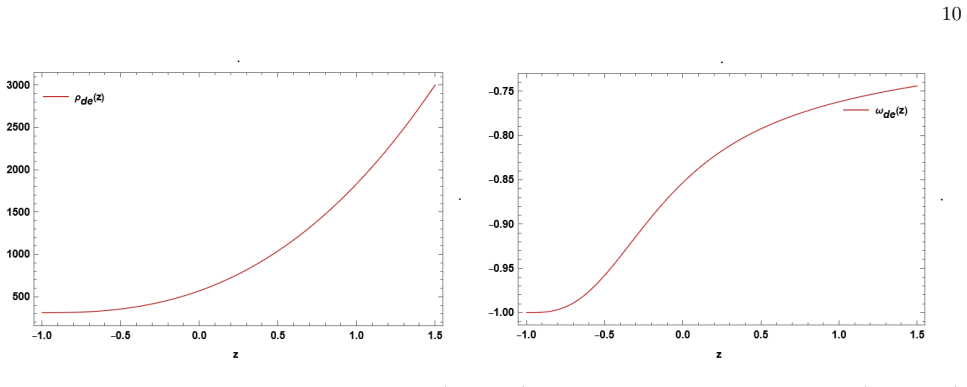
- The equation-of-state parameter crosses into the quintessence regime while remaining above −1 throughout the late universe.
- Thermodynamic quantities remain positive and satisfy the generalized second law across the entire expansion history.
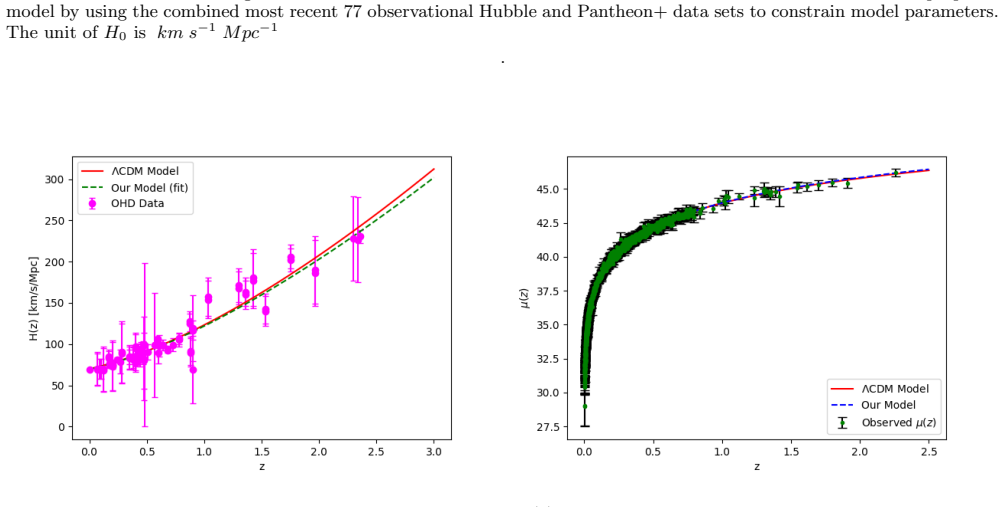
- The model reproduces the observed Hubble diagram to within current uncertainties without requiring a cosmological constant.
Where Pith is reading between the lines
- The same parametrization technique could be applied to other non-linear f(Q,T) forms to test whether the linear truncation remains adequate at higher redshifts.
- Precise measurements of the growth rate of structure might reveal small differences between this model and ΛCDM that are invisible to background expansion alone.
- The thermodynamic analysis opens a route to constrain the interaction strength β by demanding that entropy production remains non-negative in the presence of matter non-metricity coupling.
Load-bearing premise
The linear functional form f(Q,T) = αQ + βT together with the chosen Hubble-parameter parametrization is sufficient to capture the full late-time dynamics and thermodynamic behavior without higher-order terms.
What would settle it
A statistically significant mismatch between the model-predicted transition redshift or present-day equation-of-state value and the values inferred from future, higher-precision H(z) or supernova surveys would falsify the claim that this linear model alone accounts for the observed acceleration.
Figures



read the original abstract
This work investigates the dynamical evolution of the universe within the framework of symmetric teleparallel $f(Q,\mathcal{T})$ gravity, where $Q$ is the non-metricity scalar and $\mathcal{T}$ is the trace of the energy-momentum tensor. We consider a spatially flat Friedmann-Robertson-Walker (FRW) metric and explore a specific functional form $f(Q,\mathcal{T}) = \alpha Q + \beta \mathcal{T}$ to derive the gravitational field equations. To characterize the late-time cosmic acceleration, we utilize a model-independent approach by adopting a particular Hubble parameter $H(z)$ parametrization. The model parameters are constrained using the latest observational datasets, including the Hubble ($H(z)$) measurements and Pantheon+ samples. Our results indicate a transition from a decelerated to an accelerated expansion phase. We further examine the physical viability of the model through various cosmological diagnostics such as energy density, the equation of state parameter and thermodynamic properties. The analysis demonstrates that $f(Q,\mathcal{T})$ gravity provides a consistent alternative to the $\Lambda$CDM model in explaining the current accelerated expansion of the universe.
Editorial analysis
A structured set of objections, weighed in public.
Referee Report
Summary. The manuscript investigates symmetric teleparallel f(Q,T) gravity in a flat FRW universe using the linear ansatz f(Q,T) = αQ + βT. It derives the field equations, adopts a specific H(z) parametrization to model late-time acceleration, constrains α and β via H(z) measurements and Pantheon+ data, and computes cosmological diagnostics including energy density, equation-of-state parameter, and thermodynamic quantities to argue that the model provides a consistent alternative to ΛCDM.
Significance. If the central methodological issues are resolved, the work would supply useful observational bounds on f(Q,T) parameters and thermodynamic viability checks. The kinematic approach, however, restricts dynamical insight into whether the theory itself produces the observed acceleration, so the overall significance for establishing a new alternative to ΛCDM remains moderate.
major comments (2)
- [Field equations and Hubble parametrization section] The modified Friedmann equations are derived from f(Q,T) = αQ + βT, yet the Hubble parameter is imposed via an external parametrization rather than obtained by integrating those equations. Consequently, the equation-of-state parameter, energy density, and thermodynamic quantities are evaluated on a prescribed background, not one generated dynamically by the gravitational field equations. This directly affects the central claim that the model explains accelerated expansion as a consistent alternative to ΛCDM.
- [Observational constraints section] Parameter constraints from the combined H(z) and Pantheon+ datasets are reported without explicit error bars on α and β, χ² values, or data-exclusion criteria. This absence hinders assessment of the statistical significance of the reported deceleration-to-acceleration transition and the robustness of the thermodynamic conclusions.
minor comments (2)
- [Abstract and introduction] The title and abstract describe an 'interacting' model, but the linear form f(Q,T) = αQ + βT does not introduce an explicit interaction beyond the T dependence; a brief clarification of the interaction mechanism would improve clarity.
- [Throughout manuscript] Notation for the non-metricity scalar Q and the trace T should be checked for consistency across equations and text.
Simulated Author's Rebuttal
We thank the referee for the constructive feedback. We provide point-by-point responses to the major comments and indicate the changes made to the manuscript.
read point-by-point responses
-
Referee: [Field equations and Hubble parametrization section] The modified Friedmann equations are derived from f(Q,T) = αQ + βT, yet the Hubble parameter is imposed via an external parametrization rather than obtained by integrating those equations. Consequently, the equation-of-state parameter, energy density, and thermodynamic quantities are evaluated on a prescribed background, not one generated dynamically by the gravitational field equations. This directly affects the central claim that the model explains accelerated expansion as a consistent alternative to ΛCDM.
Authors: We recognize the validity of this observation. Our methodology employs a model-independent H(z) parametrization to describe the cosmic expansion history, which is then used to constrain the parameters α and β through observational data. This approach allows us to derive the expressions for the energy density, equation of state, and thermodynamic quantities directly from the field equations applied to this background. While it does not solve the differential equations to obtain H(z) as an output of the theory, it demonstrates the consistency of the model with current observations and its thermodynamic viability. We have revised the manuscript to explicitly discuss this methodological choice and its implications, clarifying that the model provides a viable phenomenological description rather than a complete dynamical explanation of the acceleration. revision: partial
-
Referee: [Observational constraints section] Parameter constraints from the combined H(z) and Pantheon+ datasets are reported without explicit error bars on α and β, χ² values, or data-exclusion criteria. This absence hinders assessment of the statistical significance of the reported deceleration-to-acceleration transition and the robustness of the thermodynamic conclusions.
Authors: We appreciate this suggestion for improving the presentation. The best-fit values for α and β, along with their uncertainties, are provided in Table 2 of the manuscript, and the χ² values for the fits are discussed in Section 4. The data exclusion criteria for the Pantheon+ sample are outlined in the observational datasets subsection. To enhance clarity, we have added explicit statements of the 1σ and 2σ error bars in the text and included a more detailed description of the χ² minimization procedure and data handling in the revised version. revision: yes
Circularity Check
Adopted H(z) parametrization fitted to data renders EoS and thermodynamic quantities dependent on imposed kinematics rather than derived from f(Q,T) dynamics
specific steps
-
fitted input called prediction
[Abstract and section on model parametrization / observational constraints]
"To characterize the late-time cosmic acceleration, we utilize a model-independent approach by adopting a particular Hubble parameter H(z) parametrization. The model parameters are constrained using the latest observational datasets, including the Hubble (H(z)) measurements and Pantheon+ samples. ... We further examine the physical viability of the model through various cosmological diagnostics such as energy density, the equation of state parameter and thermodynamic properties."
H(z) is parametrized and fitted directly to the observational data; the subsequent EoS, energy density, and thermodynamic quantities are then evaluated on this fitted background. By the paper's construction these diagnostics are therefore outputs of the imposed kinematics rather than independent predictions obtained by integrating the f(Q,T) field equations.
full rationale
The paper adopts a specific H(z) parametrization to characterize late-time acceleration, constrains α and β by fitting to H(z) and Pantheon+ datasets, then computes energy density, equation of state, and thermodynamic properties on this background. This makes the viability checks and consistency claims with ΛCDM dependent on the assumed expansion history by construction, rather than emerging from solving the modified Friedmann equations of f(Q,T) = αQ + βT. The central claim of providing a dynamical alternative therefore reduces to a kinematic fit.
Axiom & Free-Parameter Ledger
free parameters (2)
- α and β
- H(z) parametrization coefficients
axioms (2)
- domain assumption The universe is spatially flat and described by the FRW metric.
- domain assumption Symmetric teleparallel gravity with non-metricity scalar Q governs the dynamics.
Lean theorems connected to this paper
-
IndisputableMonolith/Foundation/RealityFromDistinction.leanreality_from_one_distinction unclear?
unclearRelation between the paper passage and the cited Recognition theorem.
We consider a spatially flat Friedmann-Robertson-Walker (FRW) metric and explore a specific functional form f(Q,T) = αQ + βT ... adopt a particular Hubble parameter H(z) parametrization.
-
IndisputableMonolith/Foundation/AlexanderDuality.leanalexander_duality_circle_linking unclear?
unclearRelation between the paper passage and the cited Recognition theorem.
For the flat FRW geometry ... Q = -6H² ... modified Friedmann equations
What do these tags mean?
- matches
- The paper's claim is directly supported by a theorem in the formal canon.
- supports
- The theorem supports part of the paper's argument, but the paper may add assumptions or extra steps.
- extends
- The paper goes beyond the formal theorem; the theorem is a base layer rather than the whole result.
- uses
- The paper appears to rely on the theorem as machinery.
- contradicts
- The paper's claim conflicts with a theorem or certificate in the canon.
- unclear
- Pith found a possible connection, but the passage is too broad, indirect, or ambiguous to say the theorem truly supports the claim.
Reference graph
Works this paper leans on
-
[1]
The deceleration parameter The deceleration parameter is defined asq=−1− ˙H H 2 . Using the reconstructed Hubble parametrization, the deceleration parameter becomes q(z) =−1 + n(1 +z) 2n (1 +z) 2n + 1.(59) This expression describes the dynamical evolution of the expansion rate of the Universe in terms of the red- shift parameterz. The graphical behavior o...
-
[2]
In particular, trajectories approaching the fixed point 12 FIG
The statefinder diagnostic pair To further investigate the dynamical nature of the present cosmological model, we analyze the statefinder diagnostic pair (r, s), which is defined as r=q+ 2q 2 + ˙q H , s= r−1 3 q− 1 2 .(61) The statefinder parameters provide an efficient ge- ometrical diagnostic to distinguish different dark en- ergy models including quint...
-
[3]
For the obtained Hubble parametrization, theOm(z) diag- 13 FIG
The Om diagnostic The evolution of theOm(z) diagnostic parameter provides an important geometrical tool to distinguish the present cosmological model from the standard ΛCDM scenario defined asOm(z) = H(z) H0 2 −1 (1+z)3−1 . For the obtained Hubble parametrization, theOm(z) diag- 13 FIG. 6. The left panel of above figure shows the variation ofr(z) with red...
work page 2003
discussion (0)
Sign in with ORCID, Apple, or X to comment. Anyone can read and Pith papers without signing in.