One- and two-nucleon transfer in ¹¹⁶Sn+⁶⁰Ni: A coupled reaction channel analysis
Pith reviewed 2026-05-19 21:30 UTC · model grok-4.3
The pith
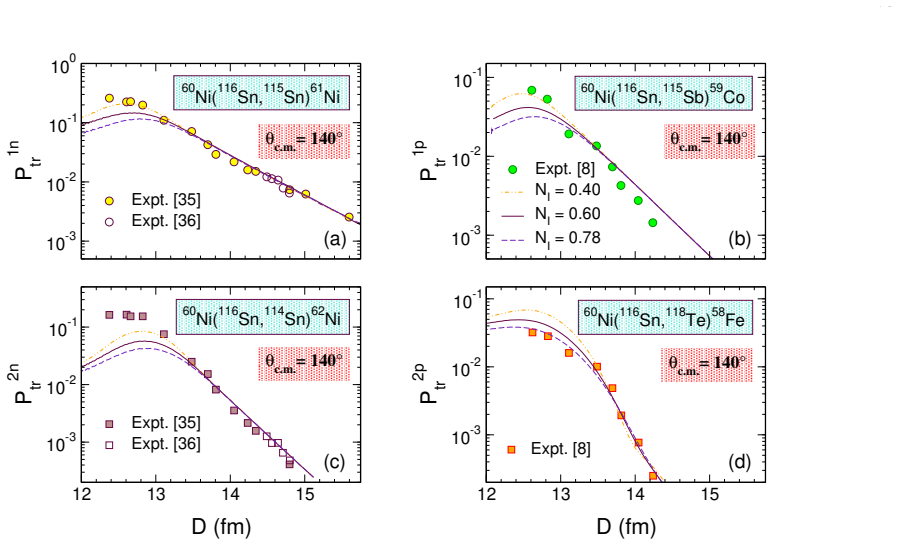
Microscopic coupled reaction channel calculations reproduce one- and two-nucleon transfer data in the 116Sn + 60Ni system without arbitrary normalization of cross sections.
A machine-rendered reading of the paper's core claim, the machinery that carries it, and where it could break.
Core claim
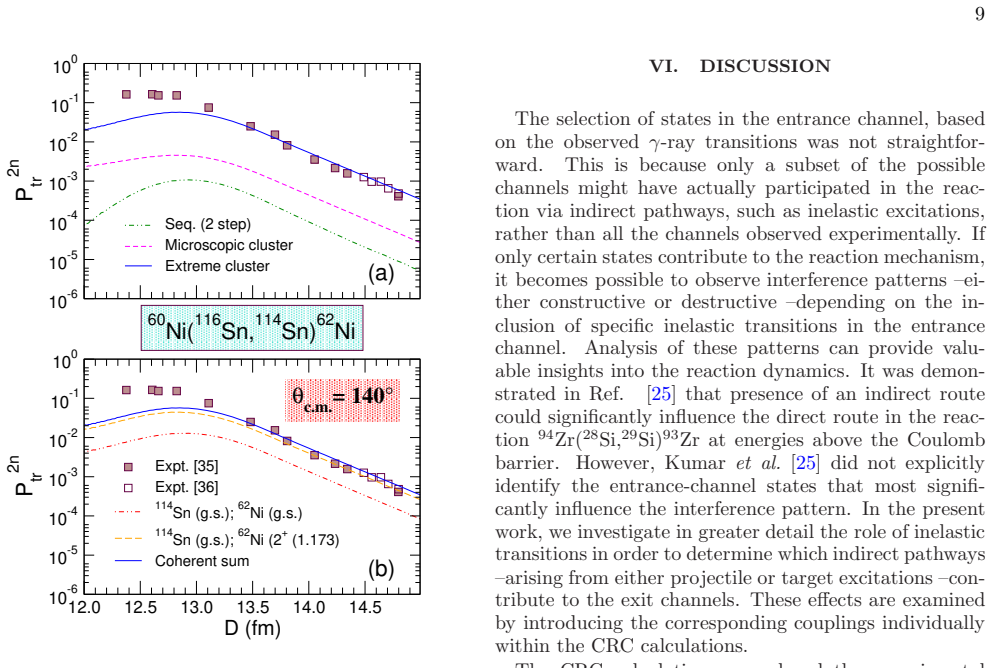
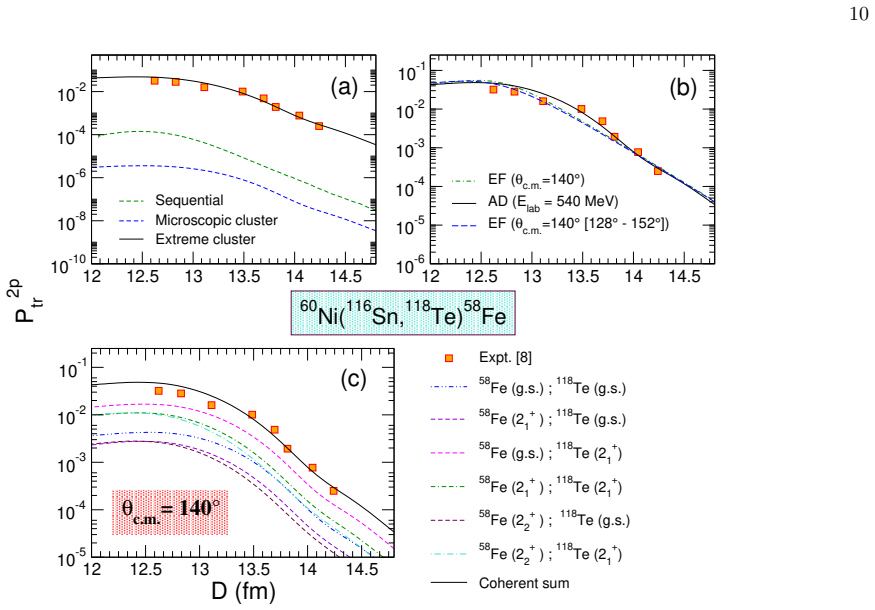
The central claim is that microscopic CRC calculations using double-folding São Paulo potentials, guided by observed γ-ray transitions and shell-model spectroscopic amplitudes, successfully describe quasielastic scattering, one-neutron transfer, one-proton transfer, and two-nucleon transfer in the 116Sn + 60Ni system without any arbitrary scaling of the cross sections, with the extreme cluster mechanism providing the best description of the two-nucleon data.
What carries the argument
Microscopic coupled reaction channel (CRC) framework with double-folding São Paulo potentials and spectroscopic amplitudes obtained from large-scale shell-model calculations.
If this is right
- Quasielastic scattering and one-neutron transfer probabilities match the measured values without adjustment.
- One-proton transfer is best reproduced when experimental spectroscopic amplitudes are used.
- Two-nucleon transfer data are best described by the extreme cluster mechanism.
- Microscopic CRC calculations can be carried out for heavy-ion transfers without recourse to arbitrary normalization factors.
Where Pith is reading between the lines
- The same microscopic approach could be applied to other heavy-ion pairs to generate predictions for unmeasured transfer channels.
- Larger shell-model spaces made possible by increased computing power would allow systematic checks on the sensitivity of the results to truncation.
- Success here suggests that similar CRC treatments may eventually reduce the need for phenomenological scaling in reaction models used for astrophysical nucleosynthesis networks.
Load-bearing premise
All important inelastic and transfer couplings are captured by the observed gamma-ray transitions and the shell-model spectroscopic amplitudes remain sufficiently accurate even with the practical limit on the number of included states.
What would settle it
High-precision measurements of additional transfer or inelastic channels that deviate substantially from the CRC predictions while the same potentials and couplings are retained.
Figures
read the original abstract
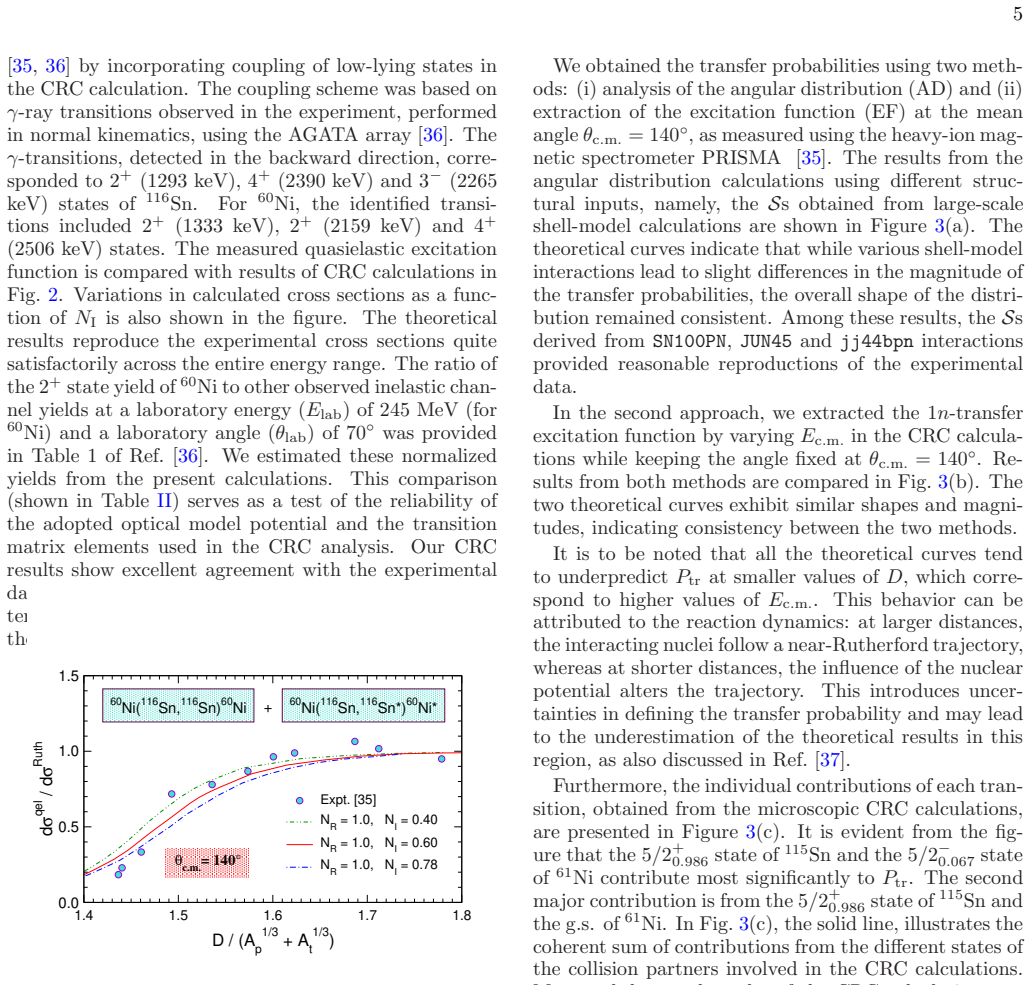
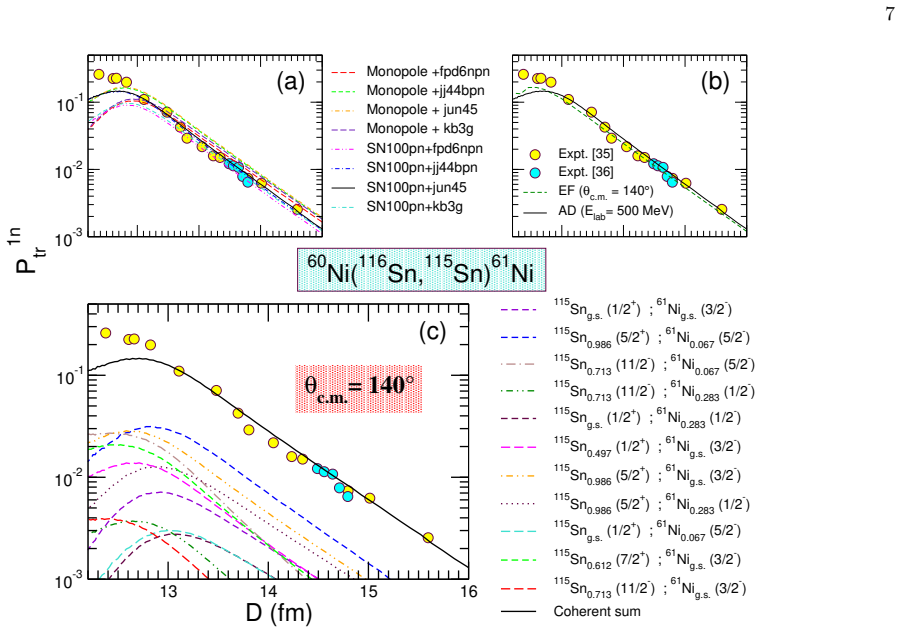
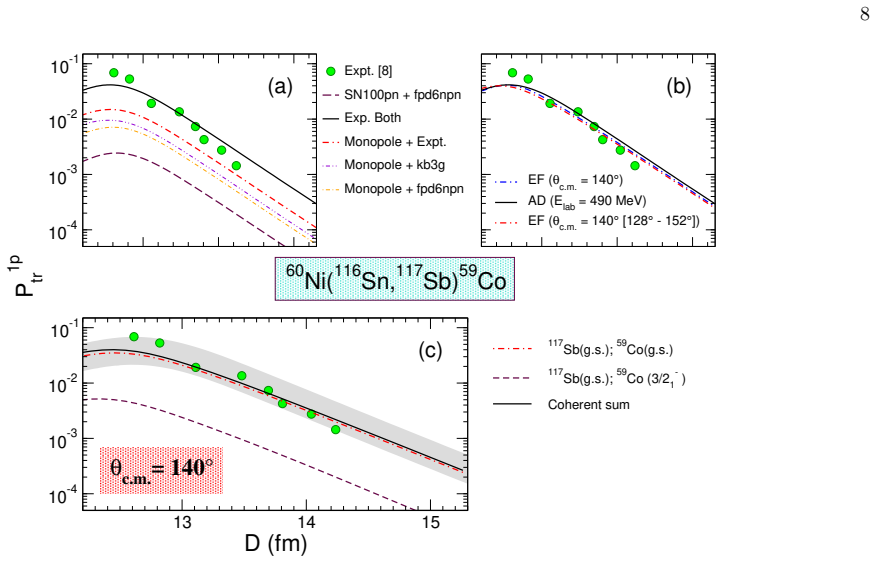
Recent studies of multi-nucleon transfer in heavy ion collisions have employed both macroscopic and microscopic models. Although macroscopic approaches offer useful insights, microscopic analyses of high-precision experimental data provide a more reliable framework for understanding the nucleon transfer mechanisms. The present study aims to carry out a comprehensive theoretical investigation of the $^{116}$Sn+$^{60}$Ni system using microscopic coupled reaction channel (CRC) calculations. The calculations employ microscopic double-folding S$\tilde{a}$o Paulo potentials, incorporating all relevant inelastic and transfer couplings guided by observed $\gamma$-ray transitions, wherever available. For the one-nucleon transfer channels, spectroscopic amplitudes are also obtained from large-scale shell-model calculations. In the case of two-nucleon transfer, sequential, microscopic cluster and extreme cluster mechanisms are considered to reproduce the data. Results for quasielastic scattering and one-neutron ($1n$) transfer show excellent agreement with experimental data. Measured one-proton ($1p$) transfer probabilities are best described by incorporating experimental spectroscopic amplitudes in the CRC calculations. For transfer of two-nucleons, the extreme cluster mechanism is found to best reproduce the data. This study highlights that microscopic description of one- and two-nucleon transfer between two heavy ions in the CRC framework, without taking recourse to arbitrary normalization of the cross sections, is quite feasible. Nonetheless, lack of experimental corroboration for all the transitions included in the calculations and practical limits of computational resources, affecting accuracy of shell-model results and causing a cap on the number of states, leave room for further refinement of the results.
Editorial analysis
A structured set of objections, weighed in public.
Referee Report
Summary. The manuscript presents coupled reaction channel (CRC) calculations for quasielastic scattering and one- and two-nucleon transfer in the 116Sn + 60Ni system using microscopic double-folding São Paulo potentials. Spectroscopic amplitudes for one-nucleon transfers are taken from large-scale shell-model calculations or experiment, while two-nucleon transfers consider sequential, microscopic cluster, and extreme cluster mechanisms. All relevant inelastic and transfer couplings are included based on observed γ-ray transitions. The calculations achieve excellent agreement with data for quasielastic and 1n channels, best describe 1p data with experimental amplitudes, and favor the extreme cluster mechanism for 2n transfer, all without arbitrary overall normalization of cross sections. The authors conclude that fully microscopic CRC descriptions of these processes are feasible, while noting limitations from incomplete experimental data and computational caps on shell-model states.
Significance. If the absolute-scale agreement holds under more complete calculations, the work demonstrates that microscopic inputs (shell-model spectroscopic amplitudes plus São Paulo folding) can yield parameter-free predictions for heavy-ion transfer cross sections in the CRC framework. This is a notable advance over approaches that routinely introduce overall normalization factors, and the identification of the extreme cluster mechanism for 2n transfer provides a concrete, testable preference among competing two-nucleon mechanisms. The explicit inclusion of couplings guided by γ data and the absence of free scaling parameters strengthen the reliability of the extracted physics.
major comments (1)
- [Abstract] Abstract: The central claim that microscopic CRC calculations reproduce the data in absolute scale without arbitrary normalization rests on the accuracy of the truncated shell-model spectroscopic amplitudes. The manuscript itself flags that computational limits cap the number of included states and that not all transitions have experimental corroboration; if omitted higher-lying states carry appreciable strength, the absolute magnitudes would shift and the no-normalization result could require re-examination.
minor comments (1)
- [Abstract] The São Paulo potential is denoted with an unusual tilde in the abstract (S$tilde{a}$o); this should be corrected to the standard São Paulo notation for clarity.
Simulated Author's Rebuttal
We thank the referee for the positive evaluation and the constructive comment on the abstract. We address the point below and will incorporate a revision to strengthen the presentation of our caveats.
read point-by-point responses
-
Referee: [Abstract] Abstract: The central claim that microscopic CRC calculations reproduce the data in absolute scale without arbitrary normalization rests on the accuracy of the truncated shell-model spectroscopic amplitudes. The manuscript itself flags that computational limits cap the number of included states and that not all transitions have experimental corroboration; if omitted higher-lying states carry appreciable strength, the absolute magnitudes would shift and the no-normalization result could require re-examination.
Authors: We agree that the absolute-scale agreement depends on the completeness of the included shell-model states. The manuscript already notes the computational truncation and incomplete experimental corroboration both in the abstract and in the concluding discussion. To make this caveat more prominent in the central claim, we will revise the abstract to state explicitly that the calculations achieve good agreement without normalization using the presently accessible shell-model space, while underscoring that additional higher-lying states could modify the absolute magnitudes. This change will temper the wording without altering the demonstrated feasibility of the microscopic CRC approach. revision: yes
Circularity Check
No circularity: absolute cross sections follow from independent shell-model amplitudes and São Paulo potentials
full rationale
The derivation computes CRC cross sections from microscopic double-folding São Paulo potentials plus spectroscopic amplitudes taken from separate large-scale shell-model calculations (or experiment for 1p). No overall normalization factor is introduced or fitted; the reported agreement with data is therefore an output of those external inputs rather than a quantity defined or adjusted to match the target observables. Selection among sequential, microscopic-cluster, and extreme-cluster mechanisms for 2n transfer is ordinary model comparison, not a reduction of the central claim to its own fitted parameters. Acknowledged limits on basis size and missing experimental corroboration affect predictive robustness but do not create a self-definitional or self-citation loop inside the reported chain.
Axiom & Free-Parameter Ledger
axioms (2)
- domain assumption The microscopic double-folding São Paulo potential accurately describes the core interaction between the nuclei.
- domain assumption Large-scale shell-model calculations supply reliable spectroscopic amplitudes for one-nucleon transfers.
Lean theorems connected to this paper
-
IndisputableMonolith/Cost/FunctionalEquation.leanwashburn_uniqueness_aczel unclear?
unclearRelation between the paper passage and the cited Recognition theorem.
microscopic coupled reaction channel (CRC) calculations... spectroscopic amplitudes... from large-scale shell-model calculations... extreme cluster mechanism
-
IndisputableMonolith/Foundation/RealityFromDistinction.leanreality_from_one_distinction unclear?
unclearRelation between the paper passage and the cited Recognition theorem.
Results for quasielastic scattering and one-neutron (1n) transfer show excellent agreement... without taking recourse to arbitrary normalization
What do these tags mean?
- matches
- The paper's claim is directly supported by a theorem in the formal canon.
- supports
- The theorem supports part of the paper's argument, but the paper may add assumptions or extra steps.
- extends
- The paper goes beyond the formal theorem; the theorem is a base layer rather than the whole result.
- uses
- The paper appears to rely on the theorem as machinery.
- contradicts
- The paper's claim conflicts with a theorem or certificate in the canon.
- unclear
- Pith found a possible connection, but the passage is too broad, indirect, or ambiguous to say the theorem truly supports the claim.
Reference graph
Works this paper leans on
-
[1]
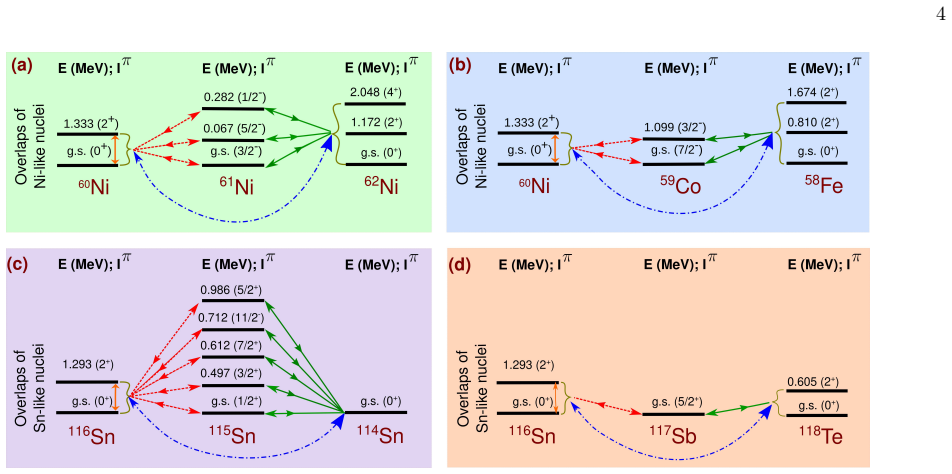
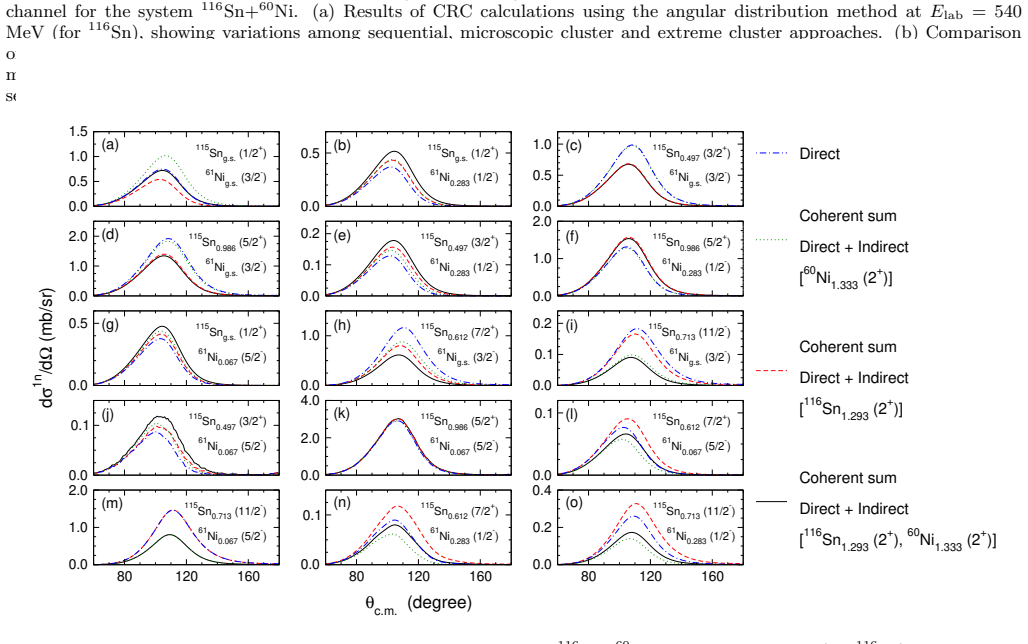
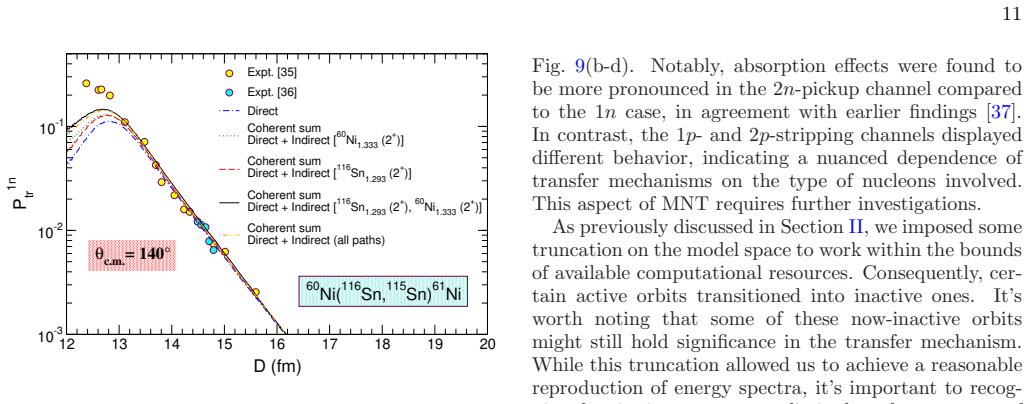
Here two routes for neutron transfer are illustrated: (i) the direct route (denoted by (blue) dash- dotted line) in which the constituents of the entrance channel is in the ground state and (ii) the indirect route in which one or both constituents of the entrance chan- nel is/are in the first excited state (see Fig
-
[2]
prior to neutron transfer. The coherent sum of the angular distri- butions were determined by the interference between the direct and the indirect paths. Fig. 7(a) illustrates the an- gular distribution for the population of both constituents of the exit channel in their ground states. The results in- dicate that the inelastic excitation of 60Ni(2+) inter...
-
[3]
in the CRC calculations by including additional states for which γ-transitions were identified [ 36]. However, the results obtained from this extended CRC analysis in- dicate that the inclusion of these additional multi-step processes does not significantly modify the theoretical transfer probability, as illustrated by the (orange) dash- double-dotted line ...
work page 2019
-
[4]
A. Broglia and A. Winther, Heavy-Ion Reactions, Addison-Wesley, Reading, MA, (1981)
work page 1981
-
[5]
W. von Oertzen and A Vitturi, Pairing correlations of nu- cleons and multi-nucleon transfer between heavy nuclei, Rep. Prog. Phys. 64, 1247 (2001)
work page 2001
- [6]
-
[7]
R. A. Broglia, F. Barranco, G. Potel, and E. Vigezzi, Transient Joule- and (ac) Josephson-like photon emission in one- and two- nucleon tunneling processes between su- perfluid nuclei: Blackbody and coherent spectral func- tions, Phys. Rev. C 105, L061602 (2022)
work page 2022
-
[8]
S. Szilner, L. Corradi, J. Dikli´ c, T. Mijatovi´ c, F. Gal- tarossa, G. Pollarolo, E. Fioretto, A. Goasduff, G. Mon- tagnoli, A. M. Stefanini, G. Colucci, P. ˇColovi´ c, A. Gottardo, J. Grebosz, A. Illana, G. Jaworski, M. Ju- rado Gomez, T. Marchi, D. Mengoni, M. Milin, D. Nurki´ c, M. Siciliano, N. Soi´ c, D. Testov, J. J. Valiente- Dob´ on and N. Vukman...
work page 2024
-
[9]
F. Cappuzzello, H. Lenske, M. Cavallaro, C. Agodi, N. Auerbach, J. I. Bellone, R. Bijker, S. Burrello, S. Cal- abrese, D. Carbone, M. Colonna, G. De Gregorio, J. L. Ferreira, D. Gambacurta, H. Garc ´ ı ´ ıa-Tecocoatzi, A. Gargano, J. A. Lay, R. Linares, J. Lubian, E. San- topinto, O. Sgouros, V. Soukeras, A. Spatafora, on behalf of the NUMEN collaboration...
work page 2023
-
[10]
J. Dikli´ c, S. Szilner, L. Corradi, T. Mijatovi´ c, G. Pol- larolo, P. ´Colovi´ c, G. Colucci, E. Fioretto, F. Gal- tarossa, A. Goasduff, A. Gottardo, J. Grebosz, A. Illana, G. Jaworski, M. Jurado Gomez, T. Marchi, D. Mengoni, G. Montagnoli, D. Nurki´ c, M. Sicil- iano, N. Soi´ c, A. M. Stefanini, D. Testov, J. J. Valiente-Dob´ on, and N. Vukman, Transfer...
work page 2023
-
[11]
L. Corradi, S. Szilner, G. Pollarolo, T. Mijatovi´ c, D. Montanari, E. Fioretto, A. Goasduff, D. Jelavi´ c Malenica, G. Montagnoli, and A.M. Stefanini, Evidence of proton-proton correlations in the 116Sn+60Ni transfer reactions, Phys. Lett. B 834, 137477 (2022)
work page 2022
-
[12]
H. M. Devaraja, S. Heinz, D. Ackermann, T. G¨ obel, F. P. Heßberger, S. Hofmann, J. Maurer, G. M¨ unzenberg, A. G. Popeko, and A. V. Yeremin, New studies and a short review of heavy neutron-rich transfer products, Eur. Phys. J. A 56, 224 (2020)
work page 2020
-
[13]
H. M. Devaraja, A. V. Yeremin, M. L. Chelnokov, V. I. Chepigin, S. Heinz, A. V. Isaev, I. N. Izosimov, Sh. A. Kalandarov, A. V. Karpov, D. E. Katrasev, A. A. Kuznetsova, O. N. Malyshev, R. S. Mukhin, A. G. Popeko, Yu. A. Popov, V. V. Saiko, B. Sailaubekov, E. A. Sokol, A. I. Svirikhin, M. S. Tezekbayeva, U. A. Abitayeva, E. K. Almanbetova, A. A. Almas, A....
work page 2025
-
[14]
Chandra Kumar, Gonika, J. Gehlot, Phurba Sherpa, A. Parihari, K. Kundalia, Ashna B., Amar Das, Rajesh K. Sahoo, Rayees Ahmad Yatoo, Md. Moin Shaikh, Sunil Kalkal, N. Madhavan, and S. Nath, Probing the influence of weak channels on fusion dynamics in 28Si +140, 142 Ce, Phys. Rev. C 111, 034621 (2025)
work page 2025
-
[15]
L. Corradi, G. Pollarolo, and S. Szilner, Mult- inucleon transfer processes in heavy-ion reactions, J. Phys. G: Nucl. Part. Phys. 36, 113101 (2009)
work page 2009
-
[16]
F. Cappuzzello, C. Agodi, D. Carbone1, and M. Caval- laro, The MAGNEX spectrometer: Results and perspec- tives, Eur. Phys. J. A 52, 167 (2016)
work page 2016
-
[17]
Mijatovi´ c, Multinucleon transfer reactions: a mini-review of recent advances, Front. Phys. 10, 965198 (2022)
work page 2022
-
[18]
Mijatovi´ c, S. Szilner, L. Corradi, F. Galtarossa, G. Pollarolo, G. Colucci, E. Fioretto, A. Goasduff, A. Gottardo, D. Jelavi´ c Malenica, M. Milin, G. Montag- noli, D. Montanari, N. Soi´ c, A. M. Stefanini, and J. J. Valiente Dob´ on, Revealing nucleon-nucleon correla- tion effects through sub-Coulomb transfer reactions in 92Mo+54Fe, Phys. Lett. B 872, 14...
work page 2026
-
[19]
R. K¨ unkel, W. Von Oertzen, B. Gebauer, H. G. Bohlen, H. A. B¨ osser, B. Kohlmeyer, F. P¨ uhlhofer, and D. Sch¨ ull, Superconductivity in the proton-pair transfer in the in- teraction of 144Sm+88Sr, Phys. Lett. B 208, 355 (1988)
work page 1988
-
[20]
R. K¨ unkel, W. von Oertzen, H. G. Bohlen, B. Gebauer, H. A. B¨ osser, B. Kohlmeyer, J. Speer, F. P¨ uhlhofer, and D. Sch¨ ull, Pairing effects in nucleon transfer re- actions in the system 144Sm+88Sr at 4.7 MeV/u, Z. Phys. A 336, 71 (1990)
work page 1990
- [21]
-
[22]
M. Wilpert, B. Gebauer, W. von Oertzen, Th. Wilpert, E. Stiliaris, and H. G. Bohlen, Cold multiproton-transfer reactions in the system 86Kr+54Fe below the Coulomb barrier, Phys. Rev. C 44, 1081 (1991)
work page 1991
-
[23]
Winther, Grazing reactions in collisions between heavy nuclei, Nucl
A. Winther, Grazing reactions in collisions between heavy nuclei, Nucl. Phys. A 572, 191 (1994)
work page 1994
-
[24]
A. Winther, Dissipation, polarization and fluctuation in grazing heavy-ion collisions and the boundary to the chaotic regime, Nucl. Phys. A 594, 203 (1995)
work page 1995
-
[25]
http://www.to.infn.it/ nanni/grazing . 14
-
[26]
Thompson, Coupled reaction channels calculations in nuclear physics, Comput
Ian J. Thompson, Coupled reaction channels calculations in nuclear physics, Comput. Phys. Rep. 7, 167 (1988)
work page 1988
-
[27]
http://www.fresco.org.uk
-
[28]
Nath, Coupled reaction channel analy- sis of one- and two-nucleon transfer in 28 Si+90, 94Zr, Eur
Chandra Kumar, Gonika, Yashraj, Rohan Biswas, Sunil Kalkal and S. Nath, Coupled reaction channel analy- sis of one- and two-nucleon transfer in 28 Si+90, 94Zr, Eur. Phys. J. A 59, 277 (2023)
work page 2023
-
[29]
Rohan Biswas, S. Nath, J. Gehlot, Gonika, Chandra Ku- mar, A. Parihari, N. Madhavan, A. Vinayak, Amritraj Mahato, Shoaib Noor, Phurba Sherpa, and Kazuyuki Sekizawa, Determination of 1 p- and 2 p-stripping excita- tion functions for 16O+142Ce using a recoil mass spec- trometer, Eur. Phys. J. A 59, 60 (2023)
work page 2023
-
[30]
E.N. Cardozo, J. Lubian, R. Linares, F. Cappuzzello, D. Carbone, M. Cavallaro, J.L. Ferreira, A. Gargano, B. Paes, and G. Santagati, Competition between direct and sequential two-neutron transfers in the 18O + 28Si collision at 84 MeV, Phys. Rev. C 97, 064611 (2018)
work page 2018
-
[31]
D. Carbone, J.L. Ferreira, F. Cappuzzello, J. Lubian, C. Agodi, M. Cavallaro, A. Foti, A. Gargano, S.M. Lenzi, R. Linares, and G. Santagati, Microscopic cluster model for the description of new experimental results on the 13C(18O, 16O)15C two-neutron transfer at 84 MeV inci- dent energy, Phys. Rev. C 95, 034603 (2017)
work page 2017
-
[32]
M. Cavallaro, F. Cappuzzello, M. Bondi, D. Car- bone, V.N. Garcia, A. Gargano, S.M. Lenzi, J. Lu- bian, C. Agodi, F. Azaiez, M. De Napoli, A. Foti, S. Franchoo, R. Linares, D. Nicolosi, M. Niikura, J.A. Scarpaci and S. Tropea, Quantitative analysis of two- neutron correlations in the 12C(18O, 16O)14C reaction, Phys. Rev. C 88, 054601 (2013)
work page 2013
-
[33]
J. L. Ferreira, D. Carbone, M. Cavallaro, N. N. Deshmukh, C. Agodi, G. A. Brischetto, S. Cal- abrese, F. Cappuzzello, E. N. Cardozo, I. Ciraldo, M. Cutuli, M. Fisichella, A. Foti, L. La Fauci, O. Sgouros, V. Soukeras, A. Spatafora, D. Torresi, and J. Lubian, Analysis of two-proton transfer in the 40Ca(18O, 20Ne)38Ar reaction at 270 MeV incident en- ergy, ...
work page 2021
-
[34]
S. Szilner, C. A. Ur, L. Corradi, N. Marginean, G. Pollarolo, A. M. Stefanini, S. Beghini, B. R. Behera, E. Fioretto, A. Gadea, B. Guiot, A. Latina, P. Ma- son, G. Montagnoli, F. Scarlassara, M. Trotta, G. de Angelis, F. Della Vedova, E. Farnea, F. Haas, S. Lenzi, S. Lunardi, R. Marginean, R. Menegazzo, D. R. Napoli, M. Nespolo, I. V. Pokrovsky, F. Recchi...
work page 2007
-
[35]
L. Corradi, G. de Angelis, A. Gadea, G. Maron, D. R. Napoli, A. M. Stefanini, S. Beghini, D. Bazza- cco, G. Montagnoli, P. Pavan, F. Scarlassara, and C. A. Ur, J. H. He, C. Fahlander, G. Pollarolo and F. Cerutti, Multinucleon transfer reactions in the 40Ca+124Sn system studied via γ− particle coincidences, Phys. Rev. C 61, 024609 (2000)
work page 2000
- [36]
-
[37]
W. von Oertzen, I. Peter, S. Thummerer, H. G. Bohlen, B. Gebauer, J. Gerl, M. Kaspar, I. Kozhoukharov, T. Kr¨ oll, M. Rejmund, and H. J. Wollersheim, Selection of cold transfer and enhanced neutron-pair transfer in the 206Pb+118Sn reaction, Eur. Phys. J. A 20, 153 (2003)
work page 2003
-
[38]
D. Montanari, L. Corradi, S. Szilner, G. Pollarolo, E. Fioretto, G. Montagnoli, F. Scarlassara, A. M. Ste- fanini, S. Courtin, A. Goasduff, F. Haas, D. Jelavic Malenica, C. Michelagnoli, T. Mijatovic, N. Soic, C. A. Ur, and M. Varga Pajtler, Neutron Pair Trans- fer in 60Ni + 116 Sn Far below the Coulomb Barrier, Phys. Rev. Lett. 113, 052501 (2014)
work page 2014
-
[39]
D. Montanari, L. Corradi, S. Szilner, G. Pollarolo, A. Goasduff, T. Mijatovi´ c, D. Bazzacco, B. Birkenbach, A. Bracco, L. Charles, S. Courtin, P. D´ esesquelles, E. Fioretto, A. Gadea, A. G¨ orgen, A. Gottardo, J. Gre- bosz, F. Haas, H. Hess, D. Jelavi´ c Malenica, A. Jung- claus, M. Karolak, S. Leoni, A. Maj, R. Menegazzo, D. Mengoni, C. Michelagnoli, G....
work page 2016
-
[40]
G. Scamps and K. Hagino, Coupled-channels descrip- tion of multinucleon transfer and fusion reactions at energies near and far below the Coulomb barrier, Phys. Rev. C 92, 054614 (2015)
work page 2015
-
[41]
N. Shimizu, T. Mizusaki, T. Utsuno, and Y. Tsunoda, Thick-restart block Lanczos method in nuclear shell-model calculations, Comput. Phys. Commun. 244, 372 (2019)
work page 2019
-
[42]
B. A. Brown, N. J. Stone, J. R. Stone, I. S. Towner, and M. Hjorth-Jensen, Magnetic moments of the 2 + 1 states around 132Sn, Phys. Rev. C 71, 044317 (2004)
work page 2004
-
[43]
R. Machleidt, F. Sammarruca, and Y. Song, Nonlocal nature of the nuclear force and its impact on nuclear structure, Phys. Rev. C 53, R1483 (1996)
work page 1996
-
[44]
Chong Qi and and Z. X. Xu, Monopole- optimized effective interaction for tin isotopes, Phys. Rev. C 86, 044323 (2012)
work page 2012
-
[45]
https://www.nndc.bnl.gov/nudat3/
- [46]
-
[47]
Brown and Lisetskiy, unpublished
- [48]
- [49]
-
[50]
W. A. Richter, M. G. Van Der Merwe, R. E. Julies, and B. A. Brown, New effective interactions for the 0f1p shell Nucl. Phys. A 523, 325 (1991)
work page 1991
-
[51]
D. K. Scott, B. G. Harvey, D. L. Hendrie, U. Jahnke, L. Kraus, C. F. Maguire, J. Mahoney, Y. Terrien, K. Yagi, and N. K. Glendenning, Interference between Direct and Indirect Modes in Two-Nucleon Transfer Reactions with Heavy Ions, Phys. Rev. Lett. 34, 895 (1975)
work page 1975
-
[52]
Marcos Moshinsky, Transformation brackets for har- monic oscillator functions, Nucl. Phys. 13, 104 (1959)
work page 1959
-
[53]
G. R. Satchler, Direct Nuclear Reactions, (Oxford Uni- versity Press, Oxford, 1983). 15
work page 1983
-
[54]
Efros, Calculation of oscilla- tor (Talmi–Moshinsky–Smirnov) brackets, Comput
Victor D. Efros, Calculation of oscilla- tor (Talmi–Moshinsky–Smirnov) brackets, Comput. Phys. Commun. 265, 108005 (2021)
work page 2021
-
[55]
L. C. Chamon, B. V. Carlson, L. R. Gasques, D. Pereira, C. De Conti, M. A. G. Alvarez, M. S. Hussein, M. A. Cˆ andido Ribeiro, E. S. Rossi Jr., and C. P. Silva, Toward a global description of the nucleus-nucleus interaction, Phys. Rev. C, 66, 014610 (2002)
work page 2002
-
[56]
L. C. Chamon, B. V. Carlson, L. R. Gasques, S˜ ao Paulo potential version 2 (SPP2) and Brazilian nuclear potential (BNP), Comput. Phys. Commun. 267, 108061 (2021)
work page 2021
-
[57]
J. L. Ferreira, J. Lubian, F. Cappuzzello, M. Caval- laro, and D. Carbone (NUMEN Collaboration), Mult- inucleon transfer in the 116Cd(20Ne, 20O)116Sn double charge exchange reaction at 306 MeV incident energy, Phys. Rev. C 105, 014630 (2022)
work page 2022
-
[58]
D. Pereira, J. Lubian, J. R. B. Oliveira, D. P. de Souza, and L. C. Chamon, An imaginary potential with univer- sal normalization for dissipative processes in heavy-ion reactions, Phys. Lett. B 670, 330 (2009)
work page 2009
-
[59]
B. Paes, G. Santagati, R.M. Vsevolodovna, F. Cap- puzzello, D. Carbone, E.N. Cardozo, M. Cavallaro, H. Garcia-Tecocoatzi, A. Gargano, J.L. Ferreira, S.M. Lenzi, R. Linares, E. Santopinto, A. Vitturi, and J. Lubian, Long-range versus short-range correlations in the two-neutron transfer reaction 64Ni(18O, 16O)66Ni, Phys. Rev. C 96, 044612 (2017)
work page 2017
- [60]
-
[61]
C. M. Petrache, J.-M. R´ egis, C. Andreoiu, M. Spieker, C. Michelagnoli, P. E. Garrett, A. Astier, E. Dupont, F. Garcia, S. Guo, G. H¨ afner, J. Jolie, F. Kandzia, V. Karayonchev, Y.-H. Kim, L. Knafla, U. K¨ oster, B. F. Lv, N. Marginean, C. Mihai, P. Mutti, K. Ortner, C. Porzio, S. Prill, N. Saed-Samii, W. Urban, J. R. Van- hoy, K. Whitmore, J. Wisniewski...
work page 2019
-
[62]
O. Kenn, K.-H. Speidel, R. Ernst, J. Gerber, P. Maier- Komor, and F. Nowacki, Measurements of g factors and lifetimes of low lying states in 58−− 64Ni and their shell model implications, Phys. Rev. C 63, 064306 (2001)
work page 2001
-
[63]
P. M. S. Lesser, D. Cline, J. D. Purvis, Static quadrupole moments of the first excited states of 58, 60, 62Ni, Nucl. Phys. A 151, 257 (1970)
work page 1970
-
[64]
Chandra Kumar and S. Nath, Coupled reaction channel analysis for proton transfer in 116Sn+60Ni, EPJ Web of Conferences 306, 01043 (2024)
work page 2024
-
[65]
A. G. Blair and D. D. Armstrong, ( t,He4) Reaction on the Even Ni Isotopes, Phys. Rev. 151, 930 (1966)
work page 1966
-
[66]
T. Ishimatsu, K. Yagi, H. Ohmura, Y. Nakajima, T. Nak- agawa, and H. Orihara, The ( 3He, d) reaction on 116Sn, 118Sn and 120Sn, Nucl. Phys. A104, 481 (1967)
work page 1967
-
[67]
H. Esbensen, C. L. Jiang, and K. E. Rehm, Coupled-channels analysis of 58Ni+124Sn reactions, Phys. Rev. C 57, 2401 (1998)
work page 1998
-
[68]
S. Y. Van Der Werf, M. N. Harakeh, L. W. Put, O. Scholten, and R. H. Siemssen, The 116Sn(d, t) 115Sn reac- tion and the investigation of deeply bound hole states in the odd-A tin isotopes, Nucl. Phys. A 289, 141 (1977)
work page 1977
-
[69]
These Ss were then fed as input to the Coupled Reaction Channel (CRC) code, fresco [24]
https://www.nndc.bnl.gov/nudat3/ 16 Appendix Shell model results for 58Fe, 59Co, 60,61,62Ni, 114,115,116Sn, 117Sb and 118Te to extract one- and two-nucleon spectroscopic amplitudes The spectroscopic amplitudes ( Ss) for one and two nucleons were determined using the Large-Scale Shell Model ( LSSM) calculation implemented in the kshell code [ 38] for the 1...
work page 2002
discussion (0)
Sign in with ORCID, Apple, or X to comment. Anyone can read and Pith papers without signing in.