Linear Programming Approach to Deceptive Path Planning Game with Goal Selection
Pith reviewed 2026-05-20 15:47 UTC · model grok-4.3
The pith
Linear programming combined with the double oracle algorithm solves deceptive path planning games where an agent hides its goal from a resource-allocating observer.
A machine-rendered reading of the paper's core claim, the machinery that carries it, and where it could break.
Core claim
For the dynamic asymmetric-information game of deceptive path planning with goal selection, an efficient solution method combines a linear programming formulation with the Double Oracle algorithm, enabling computation of strategies that quantify both the risk and the effectiveness of deception through introduced performance metrics.
What carries the argument
The linear programming formulation of the game equilibrium combined with the Double Oracle algorithm, which iteratively solves restricted subgames to find optimal deceptive paths and resource allocations.
If this is right
- The approach introduces metrics that quantify both the risk and the effectiveness of deception.
- Illustrative numerical examples show how the computed strategies perform in concrete settings.
- Optimal strategies let the agent reach its privately selected goal while reducing the observer's ability to allocate resources correctly.
- The game-theoretic model captures the observer actively deciding on the basis of the observed path.
Where Pith is reading between the lines
- The method could scale to multi-observer scenarios where several adversaries allocate resources jointly.
- Similar linear-programming plus double-oracle structures might apply to cybersecurity settings in which agents must hide intentions from monitoring systems.
- Larger state spaces would test whether the current numerical examples generalize or reveal computational bottlenecks.
Load-bearing premise
The adversarial observer is modeled as a strategic decision-maker who allocates limited defensive resources based on the observed trajectory rather than performing passive inference.
What would settle it
Run the algorithm on a small grid environment, extract the agent's equilibrium path, simulate the observer's best response allocation, and check whether the observer's success rate in identifying and defending the true goal drops below the rate obtained from a direct non-deceptive path.
Figures


read the original abstract
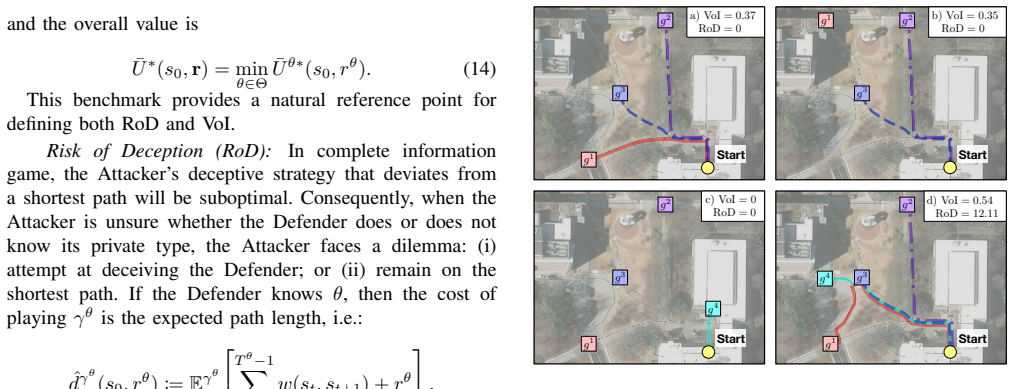
In adversarial settings, a mobile agent may strategically plan its motion to influence an opponent's inference about its intended goal. We study deceptive path planning in a scenario where a mobile agent aims to reach a privately selected goal while an adversarial observer allocates limited defensive resources based on the observed trajectory. Unlike classical path-planning and goal-recognition approaches that model observers as passive inference process, our game-theoretic formulation models them as strategic decision-makers. For the resulting dynamic asymmetric-information game, we develop an efficient solution method that combines a linear programming formulation with the Double Oracle algorithm. To evaluate performance, we introduce metrics that quantify both the risk and the effectiveness of deception and provide illustrative numerical examples.
Editorial analysis
A structured set of objections, weighed in public.
Referee Report
Summary. The paper models a deceptive path planning scenario as a dynamic asymmetric-information game in which a mobile agent selects a private goal and chooses a trajectory to reach it while an adversarial observer with limited resources strategically allocates defenses based on the observed path. Unlike passive inference models, the observer is treated as a strategic player. The authors propose solving the game via a linear programming formulation combined with the Double Oracle algorithm, introduce quantitative metrics for deception risk and effectiveness, and illustrate the approach with numerical examples on (presumably discretized) environments.
Significance. If the LP-Double Oracle method is shown to compute equilibria correctly on the discretized game and the discretization error is controlled, the work would provide a computationally tractable game-theoretic tool for deceptive motion planning that improves upon passive goal-recognition techniques. The explicit modeling of resource-constrained strategic observers and the introduction of dedicated deception metrics are useful contributions for adversarial robotics and security applications.
major comments (2)
- The central efficiency and equilibrium claims rest on the combination of LP and Double Oracle. The manuscript must explicitly define the best-response oracle for the observer (resource allocation maximizing expected defensive utility given any trajectory consistent with the current belief) and for the agent (trajectory selection given the observer's mixed strategy). If the oracle is only exact on a finite grid discretization, the computed solution is an equilibrium only of the discretized game; convergence or approximation guarantees to the original continuous-trajectory game are required to support the stated claims.
- The paper should clarify whether the linear program encodes the full extensive-form game with asymmetric information or relies on an implicit belief-update mechanism. Without a concrete formulation (e.g., variables for trajectory probabilities, observer resource allocations, and payoff matrices), it is impossible to verify that the Double Oracle iterations indeed enlarge strategy sets until no profitable deviation exists.
minor comments (2)
- The abstract and introduction should state the discretization scheme (grid size, path representation) up front so readers immediately understand the scope of the claimed equilibrium.
- Numerical examples would benefit from reporting both the number of Double Oracle iterations and the size of the final strategy sets to substantiate the efficiency claim.
Simulated Author's Rebuttal
We thank the referee for the constructive comments, which highlight important aspects of our LP-Double Oracle approach for the deceptive path planning game. We address each major comment below and indicate the revisions we will make.
read point-by-point responses
-
Referee: The central efficiency and equilibrium claims rest on the combination of LP and Double Oracle. The manuscript must explicitly define the best-response oracle for the observer (resource allocation maximizing expected defensive utility given any trajectory consistent with the current belief) and for the agent (trajectory selection given the observer's mixed strategy). If the oracle is only exact on a finite grid discretization, the computed solution is an equilibrium only of the discretized game; convergence or approximation guarantees to the original continuous-trajectory game are required to support the stated claims.
Authors: We agree that explicit definitions of the oracles are needed for clarity. In the revision we will add precise descriptions: the observer's best-response oracle solves a linear resource-allocation problem that maximizes expected defensive utility, where the expectation is formed over trajectories consistent with the belief induced by the agent's current mixed strategy; the agent's oracle solves for the trajectory (or mixture) that maximizes expected payoff given the observer's mixed strategy. Our numerical results are computed on finite-grid discretizations, which is standard for computational path-planning problems, and the equilibria are exact for those discretized games. We will add a discussion noting that solution quality improves with finer grids but that formal convergence guarantees to a continuous-trajectory game are not derived in the present work. revision: partial
-
Referee: The paper should clarify whether the linear program encodes the full extensive-form game with asymmetric information or relies on an implicit belief-update mechanism. Without a concrete formulation (e.g., variables for trajectory probabilities, observer resource allocations, and payoff matrices), it is impossible to verify that the Double Oracle iterations indeed enlarge strategy sets until no profitable deviation exists.
Authors: We will revise the manuscript to include an explicit LP formulation. The program uses variables for the agent's trajectory probabilities (which encode both goal selection and path choice), the observer's resource-allocation probabilities, and payoff matrices constructed from the deception-risk and effectiveness metrics. The extensive-form structure with asymmetric information is represented through these strategy variables and the resulting expected payoffs; belief updates occur implicitly because each oracle computes best responses against the opponent's current mixed strategy. We will show that the Double Oracle procedure enlarges the restricted strategy sets until the mutual best-response condition is satisfied, thereby verifying equilibrium. revision: yes
Circularity Check
No circularity; standard LP + Double Oracle applied to new game formulation
full rationale
The paper formulates a dynamic asymmetric-information game for deceptive path planning with goal selection and an adversarial observer, then states that it solves this game via a linear programming formulation combined with the Double Oracle algorithm. No equations or steps reduce a claimed result to its own inputs by construction, no parameters are fitted on a subset and renamed as predictions, and no load-bearing claims rest on self-citations whose content is unverified or circular. The approach is presented as a direct, standard-method application to the newly defined game, with performance evaluated via introduced metrics on numerical examples; the derivation chain remains self-contained against external benchmarks.
Axiom & Free-Parameter Ledger
axioms (1)
- domain assumption The observer allocates limited defensive resources strategically based on the observed trajectory.
Lean theorems connected to this paper
-
IndisputableMonolith/Foundation/RealityFromDistinction.leanreality_from_one_distinction unclear?
unclearRelation between the paper passage and the cited Recognition theorem.
we develop an efficient solution method that combines a linear programming formulation with the Double Oracle algorithm
What do these tags mean?
- matches
- The paper's claim is directly supported by a theorem in the formal canon.
- supports
- The theorem supports part of the paper's argument, but the paper may add assumptions or extra steps.
- extends
- The paper goes beyond the formal theorem; the theorem is a base layer rather than the whole result.
- uses
- The paper appears to rely on the theorem as machinery.
- contradicts
- The paper's claim conflicts with a theorem or certificate in the canon.
- unclear
- Pith found a possible connection, but the passage is too broad, indirect, or ambiguous to say the theorem truly supports the claim.
Reference graph
Works this paper leans on
-
[1]
Lloyd,The Art of Military Deception
M. Lloyd,The Art of Military Deception. Pen and Sword, 2003
work page 2003
-
[2]
M. H. Almeshekah and E. H. Spafford, “Cyber security deception,” Cyber Deception: Building the Scientific Foundation, pp. 23–50, 2016
work page 2016
-
[3]
A. Nikitas, S. Parkinson, and M. Vallati, “The deceitful connected and autonomous vehicle: Defining the concept, contextualising its dimensions and proposing mitigation policies,”Transport policy, vol. 122, pp. 1–10, 2022
work page 2022
-
[4]
Goal recognition design with stochastic agent action outcomes,
C. Wayllace, P. Hou, W. G. S. Yeoh, and T. C. Son, “Goal recognition design with stochastic agent action outcomes,” inInt. Joint Conf. on Artif. Intell., 2016, pp. 3279–3285
work page 2016
-
[5]
Landmark-based heuristics for goal recognition,
R. Pereira, N. Oren, and F. Meneguzzi, “Landmark-based heuristics for goal recognition,” inAAAI Conf. Artif. Intell., vol. 31, no. 1, 2017
work page 2017
-
[6]
Goal recognition over POMDPs: Infer- ring the intention of a POMDP agent,
M. Ramırez and H. Geffner, “Goal recognition over POMDPs: Infer- ring the intention of a POMDP agent,” inInt. Joint Conf. on Artif. Intell., 2011, pp. 2009–2014
work page 2011
-
[7]
Deceptive robot motion: synthesis, analysis and experiments,
A. Dragan, R. Holladay, and S. Srinivasa, “Deceptive robot motion: synthesis, analysis and experiments,”Autonomous Robots, vol. 39, pp. 331–345, 2015
work page 2015
-
[8]
P. Masters and S. Sardina, “Deceptive path-planning,” inInt. Joint Conf. on Artif. Intell., 2017, pp. 4368–4375
work page 2017
-
[9]
M. Ornik and U. Topcu, “Deception in optimal control,” in2018 56th Annu. Allerton Conf. on Communication, Control, and Comput., pp. 821–828
-
[10]
Deception in supervisory control,
M. O. Karabag, M. Ornik, and U. Topcu, “Deception in supervisory control,”IEEE Transactions on Automatic Control, vol. 67, no. 2, pp. 738–753, 2021
work page 2021
-
[11]
Deception by motion: The eater and the mover game,
V . Rostobaya, Y . Guan, J. Berneburg, M. Dorothy, and D. Shishika, “Deception by motion: The eater and the mover game,”IEEE Control Systems Letters, vol. 7, pp. 3157–3162, 2023
work page 2023
-
[12]
Deceptive path planning: A Bayesian game approach,
V . Rostobaya, J. Berneburg, Y . Guan, M. Dorothy, and D. Shishika, “Deceptive path planning: A bayesian game approach,”arXiv preprint arXiv:2506.13650, 2025
-
[13]
Efficient computation of equilibria for extensive two-person games,
D. Koller, N. Megiddo, and B. V on Stengel, “Efficient computation of equilibria for extensive two-person games,”Games and economic behavior, vol. 14, no. 2, pp. 247–259, 1996
work page 1996
-
[14]
Strategic concealment of envi- ronment representations in competitive games,
Y . Guan, D. Maity, and P. Tsiotras, “Strategic concealment of envi- ronment representations in competitive games,”IEEE Control Systems Letters, vol. 9, pp. 2609–2614, 2025
work page 2025
-
[15]
LP formulation of asymmetric zero-sum stochastic games,
L. Li and J. Shamma, “LP formulation of asymmetric zero-sum stochastic games,” in53rd IEEE Conf. on Decision and Control, 2014, pp. 1930–1935
work page 2014
-
[16]
XDO: A double oracle algorithm for extensive-form games,
S. McAleer, J. B. Lanier, K. A. Wang, P. Baldi, and R. Fox, “XDO: A double oracle algorithm for extensive-form games,”Advances in Neural Information Processing Systems, vol. 34, pp. 23 128–23 139, 2021
work page 2021
-
[17]
An exact double-oracle algorithm for zero-sum extensive-form games with imperfect information,
B. Bosansky, C. Kiekintveld, V . Lisy, and M. Pechoucek, “An exact double-oracle algorithm for zero-sum extensive-form games with imperfect information,”J. Artif. Intell. Res., vol. 51, pp. 829–866, 2014
work page 2014
-
[18]
J. Filar and K. Vrieze,Competitive Markov decision processes. Springer Science & Business Media, 2012
work page 2012
-
[19]
A formal basis for the heuristic determination of minimum cost paths,
P. E. Hart, N. J. Nilsson, and B. Raphael, “A formal basis for the heuristic determination of minimum cost paths,”IEEE transactions on Systems Science and Cybernetics, vol. 4, no. 2, pp. 100–107, 1968
work page 1968
-
[20]
R. A. Howard, “Information value theory,”IEEE Transactions on Systems Science and Cybernetics, vol. 2, no. 1, pp. 22–26, 1966
work page 1966
discussion (0)
Sign in with ORCID, Apple, or X to comment. Anyone can read and Pith papers without signing in.