On the potential for high-accuracy spectroscopy of H₂^+ and overline{H}₂^- in Penning traps for a test of CPT invariance
Pith reviewed 2026-05-20 18:22 UTC · model grok-4.3
The pith
Comparing vibrational frequencies of H2+ and anti-H2- in Penning traps can test CPT invariance at a fractional level of 1×10^{-17}.
A machine-rendered reading of the paper's core claim, the machinery that carries it, and where it could break.
Core claim
The authors conclude that laser spectroscopy of vibrational transitions of H₂⁺ and H̄₂⁻ in Penning traps, using non-destructive readout methods such as the continuous Stern-Gerlach effect or quantum-logic spectroscopy, makes a comparison of the frequencies at a fractional accuracy of 1×10^{-17} a realistic prospect with technology that is mostly already available, thereby providing a new test of CPT invariance along with complementary tests of the bound-electron g-factor and proton magnetic moment.
What carries the argument
Non-destructive readout of vibrational states in Penning traps via the continuous Stern-Gerlach effect or quantum-logic spectroscopy, which enables repeated high-precision measurements on the same trapped ion without destruction.
If this is right
- The frequency comparison at 1×10^{-17} would set improved limits on possible CPT-violating parameters in the Standard Model extension.
- Electron spin resonance spectroscopy in the same traps could test the g-factor of the bound electron versus positron at comparable precision.
- Radiofrequency spectroscopy could compare the magnetic moments of the proton and antiproton.
- Implementation relies on trap techniques and readout methods that are already demonstrated or in active development.
Where Pith is reading between the lines
- Success at this level would allow direct cross-checks against other antimatter experiments such as antihydrogen spectroscopy for consistency in CPT tests.
- The same trap platform might later support even higher precision by incorporating advances in laser stabilization or trap cooling.
- Analogous comparisons could be explored for other simple molecular ions to test additional aspects of fundamental symmetries.
Load-bearing premise
The chosen non-destructive readout methods can be implemented in Penning traps without unforeseen systematic effects that would keep the frequency comparison accuracy above 10^{-17}.
What would settle it
An experiment that measures or bounds the combined systematic uncertainties from trap fields, readout, and laser stability and finds they exceed 10^{-17} in the vibrational frequency comparison would show the claimed precision is not realistic.
Figures




read the original abstract
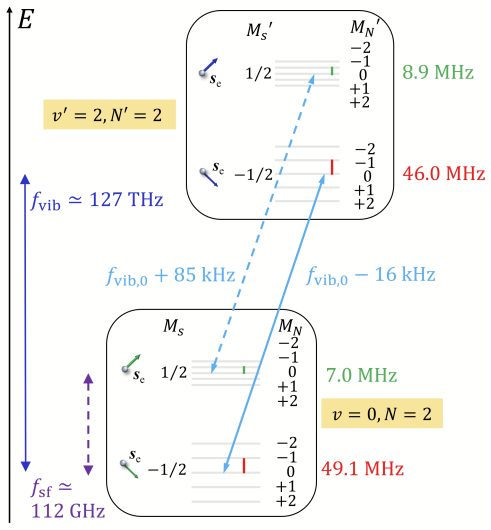
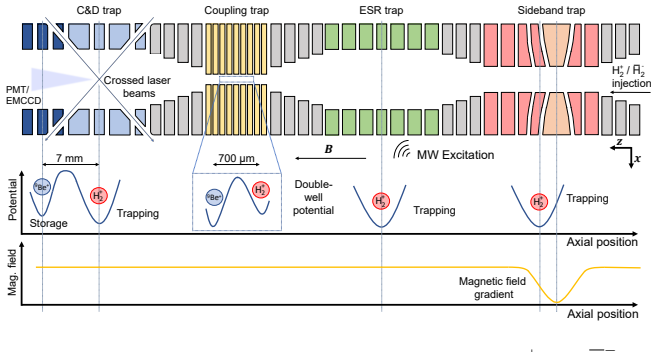
The comparison of vibrational transition frequencies of $\mathrm{H}_2^+$ and $\overline{\mathrm{H}}_2^-$ offers a new opportunity to test CPT invariance. Myers [Phys. Rev. A 98, 010101(R) (2018)] proposed performing laser spectroscopy in a Penning trap (PT) with non-destructive read-out. Here, we provide an extensive analysis of this proposal, introduce novel aspects, and discuss its implementation in PTs that incorporate either the continuous Stern-Gerlach effect or quantum-logic spectroscopy. We derive estimates for the achievable accuracy of the test. We find that a comparison of the vibrational frequencies at a fractional level of $1\times10^{-17}$ is a realistic prospect, using technology that is mostly already available. We also analyze complementary CPT invariance tests, namely those of the g-factor of the bound electron/positron via electron-spin-resonance spectroscopy and of the magnetic moment of the proton/antiproton via radiofrequency spectroscopy.
Editorial analysis
A structured set of objections, weighed in public.
Referee Report
Summary. The manuscript analyzes the feasibility of laser spectroscopy on vibrational transitions of H₂⁺ and its antiparticle counterpart in Penning traps as a test of CPT invariance. Building on Myers' 2018 proposal, it examines implementation via continuous Stern-Gerlach effect or quantum-logic spectroscopy for non-destructive readout, derives accuracy estimates, and concludes that a fractional frequency comparison at the 1×10^{-17} level is realistic using mostly existing technology. Complementary CPT tests via g-factor and magnetic-moment spectroscopy are also discussed.
Significance. If the projected accuracy holds, the work would enable a new class of CPT tests in molecular systems that complement existing lepton and baryon comparisons. The analysis draws on established Penning-trap physics and prior literature to provide concrete error budgets and implementation pathways; credit is due for the independent feasibility assessment and for identifying novel aspects of the readout schemes in the anti-particle context.
major comments (1)
- [Implementation sections] § on implementation of non-destructive readout (continuous Stern-Gerlach and quantum-logic sections): the central 1×10^{-17} fractional-accuracy claim requires that both readout methods introduce no differential frequency shifts or broadening between H₂⁺ and anti-H₂⁻ beyond the budgeted level, yet the analysis extrapolates from particle demonstrations without a quantitative differential error budget for residual-gas, electrode-charging, or field-homogeneity effects specific to the anti-particle trap.
minor comments (2)
- [Introduction] Notation for the antiparticle (overline{H}_2^-) is clear but could be standardized with a single definition early in the text to aid readability.
- [References] A few references to recent Penning-trap demonstrations of quantum-logic spectroscopy on molecular ions appear to be missing; adding them would strengthen the technology-readiness argument.
Simulated Author's Rebuttal
We thank the referee for the careful and constructive review of our manuscript. The comment on the need for a quantitative differential error budget is well taken, and we have revised the implementation sections to include additional estimates addressing potential differences between the H₂⁺ and anti-H₂⁻ traps.
read point-by-point responses
-
Referee: [Implementation sections] § on implementation of non-destructive readout (continuous Stern-Gerlach and quantum-logic sections): the central 1×10^{-17} fractional-accuracy claim requires that both readout methods introduce no differential frequency shifts or broadening between H₂⁺ and anti-H₂⁻ beyond the budgeted level, yet the analysis extrapolates from particle demonstrations without a quantitative differential error budget for residual-gas, electrode-charging, or field-homogeneity effects specific to the anti-particle trap.
Authors: We agree that explicit quantitative estimates of differential systematics are necessary to support the claimed accuracy. The original analysis drew on the well-documented performance of Penning traps with anti-protons (e.g., residual-gas pressures below 10^{-12} mbar, electrode conditioning protocols, and shim-coil homogeneity at the 10^{-8} level or better), which are directly transferable because the trap geometries and operating conditions for H₂⁺ and anti-H₂⁻ are designed to be identical. In the revised manuscript we have inserted a dedicated paragraph in each readout section that converts these literature values into differential error budgets: residual-gas collisions contribute < 3 × 10^{-18} differential shift (identical vacuum and trap temperature), electrode charging is bounded at < 5 × 10^{-18} by the same bake-out and discharge-cleaning procedures used in current anti-proton runs, and field inhomogeneity is limited to < 10^{-17} after common-mode calibration with the same shim coils. These additions keep the total differential uncertainty comfortably below the 10^{-17} target while remaining grounded in existing experimental data. revision: yes
Circularity Check
Feasibility estimates for 1e-17 CPT test are independent projections from trap physics and external literature
full rationale
The paper derives its central claim of realistic 1×10^{-17} fractional accuracy for vibrational frequency comparison by analyzing Penning trap parameters, continuous Stern-Gerlach and quantum-logic readout methods, and systematic budgets drawn from established experimental techniques and prior publications. No load-bearing step reduces by construction to a fitted parameter, self-defined quantity, or unverified self-citation chain within the paper; the estimates remain falsifiable against external benchmarks such as demonstrated trap stabilities and laser linewidths. The analysis is therefore self-contained and does not exhibit circularity.
Axiom & Free-Parameter Ledger
free parameters (1)
- target fractional accuracy
axioms (1)
- domain assumption Standard quantum mechanics and electromagnetic trap dynamics apply without modification to the molecular ions and antimatter counterparts.
Lean theorems connected to this paper
-
IndisputableMonolith/Cost/FunctionalEquation.leanwashburn_uniqueness_aczel unclear?
unclearRelation between the paper passage and the cited Recognition theorem.
The total Hamiltonian contains several terms: H_tot(v,N) = H_HFS + H_Z + … + H_dia + H_para + … (eq. 1); magnetic susceptibilities χ_s, χ_t computed ab initio (Table 3); quadratic Doppler shift Δf_QDS/f0 = −k_B ΣT_i/(2mc²) (eq. 30).
-
IndisputableMonolith/Foundation/RealityFromDistinction.leanreality_from_one_distinction unclear?
unclearRelation between the paper passage and the cited Recognition theorem.
We find that a comparison of the vibrational frequencies at a fractional level of 1×10^{-17} is a realistic prospect, using technology that is mostly already available.
What do these tags mean?
- matches
- The paper's claim is directly supported by a theorem in the formal canon.
- supports
- The theorem supports part of the paper's argument, but the paper may add assumptions or extra steps.
- extends
- The paper goes beyond the formal theorem; the theorem is a base layer rather than the whole result.
- uses
- The paper appears to rely on the theorem as machinery.
- contradicts
- The paper's claim conflicts with a theorem or certificate in the canon.
- unclear
- Pith found a possible connection, but the passage is too broad, indirect, or ambiguous to say the theorem truly supports the claim.
Reference graph
Works this paper leans on
- [1]
- [2]
-
[3]
M. Ahmadi, B.X.R. Alves, C.J. Baker, W. Bertsche, A. Capra, C. Carruth, C.L. Cesar, M. Charlton, S. Cohen, R. Collister, S. Eriksson, A. Evans, N. Evetts, J. Fajans, T. Friesen, M.C. Fujiwara, D.R. Gill, J.S. Hangst, W.N. Hardy, M.E. Hayden, C.A. Isaac, M.A. Johnson, J.M. Jones, S.A. Jones, S. Jonsell, A. Khramov, P. Knapp, L. Kurchaninov, N. Madsen, D. M...
work page 2018
-
[4]
M. Hori, H. Aghai-Khozani, A. S´ ot´ er, D. Barna, A. Dax, R. Hayano, T. Kobayashi, Y. Murakami, K. Todoroki, H. Yamada, D. Horv´ ath and L. Venturelli, Science354, 610–614 (2016)
work page 2016
-
[5]
R.S. Van Dyck Jr, P.B. Schwinberg and H.G. Dehmelt, Physical Review Letters59, 26 (1987)
work page 1987
- [6]
- [7]
-
[8]
D.P. Aguillard andet al., Phys. Rev. Lett.135, 101802 (2025)
work page 2025
-
[9]
Dehmelt, Physica ScriptaT59, 423–423 (1995)
H. Dehmelt, Physica ScriptaT59, 423–423 (1995)
work page 1995
- [10]
- [11]
- [12]
- [13]
-
[14]
R. Loch, R. Stengler and G. Werth, Phys. Rev. A38, 5484–5488 (1988)
work page 1988
-
[15]
J.C.J. Koelemeij, B. Roth, A. Wicht, I. Ernsting and S. Schiller, Phys. Rev. Lett.98, 173002 (2007)
work page 2007
-
[16]
U. Bressel, A. Borodin, J. Shen, M. Hansen, I. Ernsting and S. Schiller, Phys. Rev. Lett. 108, 183003 (2012)
work page 2012
- [17]
-
[18]
S. Schiller, D. Bakalov and V.I. Korobov, Phys. Rev. Lett.113, 023004 (2014)
work page 2014
-
[19]
J.P. Karr, J. Mol. Spectrosc.300, 37 – 43 (2014)
work page 2014
-
[20]
J.P. Karr, S. Patra, J.C.J. Koelemeij, J. Heinrich, N. Silltoe, A. Douillet and L. Hilico, in8th Symp. on Frequency Standards and Metrology 2015, edited by F. Riehle,Journal of Physics: Conference Series, Vol. 723 (IOP Publishing, Bristol, 2016), p. 012048
work page 2015
- [21]
-
[22]
F. K¨ ohler, S. Sturm, A. Kracke, G. Werth, W. Quint and K. Blaum, At. Mol. Opt. Phys. 48, 144032 (2015)
work page 2015
-
[23]
G. Schneider, A. Mooser, M. Bohman, N. Sch¨ on, J. Harrington, T. Higuchi, H. Nagahama, S. Sellner, C. Smorra, K. Blaumet al., Science358, 1081–1084 (2017)
work page 2017
- [24]
-
[25]
S. Alighanbari, G.S. Giri, F.L. Constantin, V.I. Korobov and S. Schiller, Nature581, 152 – 158 (2020)
work page 2020
- [26]
-
[27]
I.V. Kortunov, S. Alighanbari, M.G. Hansen, G.S. Giri, V.I. Korobov and S. Schiller, Nat. Phys.17, 59–573 (2021)
work page 2021
-
[28]
S. Alighanbari, I.V. Kortunov, G.S. Giri and S. Schiller, Nat. Phys.19, 1263 – 1269 (2023)
work page 2023
-
[29]
M. Haidar, V.I. Korobov, L. Hilico and J.P. Karr, Phys. Rev. A106, 022816 (2022)
work page 2022
- [30]
- [31]
- [32]
-
[33]
Prospects for testing Lorentz and CPT symmetry with H+ 2 and ¯H− 2
A.J. Vargas, arXiv:2503.06306 [hep-ph] (2025)
-
[34]
M.R. Schenkel, S. Alighanbari and S. Schiller, Nature Physics20, 383–388 (2024)
work page 2024
-
[35]
S. Alighanbari, M.R. Schenkel, V.I. Korobov and S. Schiller, Nature664, 69–75 (2025)
work page 2025
-
[36]
M.C. Zammit, C.J. Baker, S. Jonsell, S. Eriksson and M. Charlton, Phys. Rev. A111, 50 050101 (2025)
work page 2025
-
[37]
C. Smorra, K. Blaum, L. Bojtar, M. Borchert, K. Franke, T. Higuchi, N. Leefer, H. Nagahama, Y. Matsuda, A. Mooser, M. Niemann, C. Ospelkaus, W. Quint, G. Schneider, S. Sellner, T. Tanaka, S. Van Gorp, J. Walz, Y. Yamazaki and S. Ulmer, Eur. Phys. J. Spec. Top.224, 3055–3108 (2015)
work page 2015
- [38]
-
[39]
D. Wineland, C. Monroe, W. Itano, D. Leibfried, B. King and D. Meekhof, Journal of Research of the National Institute of Standards and Technology103, 259 (1998)
work page 1998
- [40]
-
[41]
P.O. Schmidt, T. Rosenband, C. Langer, W.M. Itano, J.C. Bergquist and D.J. Wineland, Science309, 749–752 (2005)
work page 2005
-
[42]
J.M. Cornejo, R. Lehnert, M. Niemann, J. Mielke, T. Meiners, A. Bautista-Salvador, M. Schulte, D. Nitzschke, M.J. Borchert, K. Hammerer, S. Ulmer and C. Ospelkaus, New Journal of Physics23, 073045 (2021)
work page 2021
- [43]
- [44]
- [45]
-
[46]
S. Schiller, D. Bakalov, A.K. Bekbaev and V.I. Korobov, Phys. Rev. A89, 052521 (2014)
work page 2014
- [47]
-
[48]
V.I. Korobov, P. Danev, D. Bakalov and S. Schiller, Phys. Rev. A97, 032505 (2018)
work page 2018
- [49]
-
[50]
D. Holzapfel, F. Schmid, N. Schwegler, O. Stadler, M. Stadler, A. Ferk, J.P. Home and D. Kienzler, Phys. Rev. X15, 031009 (2025)
work page 2025
-
[51]
S. Sellner, M. Besirli, M. Bohman, M. Borchert, J. Harrington, T. Higuchi, A. Mooser, H. Nagahama, G. Schneider, C. Smorraet al., New Journal of Physics19, 083023 (2017)
work page 2017
-
[52]
H. Dehmelt, Proceedings of the National Academy of Sciences of the United States of America83, 2291–2294 (1986)
work page 1986
-
[53]
H. Dehmelt, Proceedings of the National Academy of Sciences of the United States of America83, 3074–3077 (1986)
work page 1986
-
[54]
S. Ulmer, C.C. Rodegheri, K. Blaum, H. Kracke, A. Mooser, W. Quint and J. Walz, Physical Review Letters106, 253001 (2011)
work page 2011
-
[55]
A. Egl, I. Arapoglou, M. H¨ ocker, K. K¨ onig, T. Ratajczyk, T. Sailer, B. Tu, A. Weigel, K. Blaum, W. N¨ ortersh¨ auser and S. Sturm, Phys. Rev. Lett.123, 123001 (2019)
work page 2019
-
[56]
F. Wolf, Y. Wan, J. Heip, F. Gebert, C. Shi and P. Schmidt, Nature530, 457–460 (2016)
work page 2016
- [57]
-
[58]
Myers, Hyperfine Interactions239, 43 (2018)
E.G. Myers, Hyperfine Interactions239, 43 (2018)
work page 2018
- [59]
-
[60]
C. Will, M. Bohman, T. Driscoll, M. Wiesinger, F. Abbass, M.J. Borchert, J.A. Devlin, S. Erlewein, M. Fleck, B. Latacz, R. Moller, A. Mooser, D. Popper, E. Wursten, K. Blaum, Y. Matsuda, C. Ospelkaus, W. Quint, J. Walz, C. Smorra and S. Ulmer, New Journal of Physics24, 033021 (2022)
work page 2022
-
[61]
C.M. K¨ onig, F. Heiße, J. Morgner, T. Sailer, B. Tu, D. Bakalov, K. Blaum, S. Schiller and S. Sturm, Phys. Rev. Lett.134, 163001 (2025)
work page 2025
-
[62]
C.M. K¨ onig, M. Bohman, F. Heiße, J. Morgner, T. Sailer, B. Tu, K. Blaum, S. Sturm, D. Bakalov, H.D. Nogueira, J.P. Karr, O. Kullie and S. Schiller, Phys. Rev. Lett.136, 143002 (2026)
work page 2026
-
[63]
ALPHATRAP MPIK-HHU Collaboration, Private communication (2026)
work page 2026
-
[64]
M. Borchert, J. Devlin, S. Erlewein, M. Fleck, J. Harrington, T. Higuchi, B. Latacz, F. Voelksen, E. Wursten, F. Abbasset al., Nature601, 53–57 (2022)
work page 2022
-
[65]
R.X. Sch¨ ussler, H. Bekker, M. Braß, H. Cakir, J. Crespo L´ opez-Urrutia, M. Door, P. Filianin, Z. Harman, M.W. Haverkort, W.J. Huanget al., Nature581, 42–46 (2020). 51
work page 2020
- [66]
-
[67]
M.R. Schenkel, V. Vogt and S. Schiller, Opt. Express32, 43350–43365 (2024)
work page 2024
- [68]
-
[69]
J. Karthein, S.M. Udrescu, S.B. Moroch, I. Belosevic, K. Blaum, A. Borschevsky, Y. Chamorro, D. DeMille, J. Dilling, R.F. Garcia Ruiz, N.R. Hutzler, L.F. Paˇ steka and R. Ringle, Phys. Rev. Lett.133, 033003 (2024)
work page 2024
-
[70]
S. Mavadia, G. Stutter, J.F. Goodwin, D.R. Crick, R.C. Thompson and D.M. Segal, Phys. Rev. A89, 032502 (2014)
work page 2014
-
[71]
D.R. Bates and G. Poots, Proceedings of the Physical Society. Section A66, 784 (1953)
work page 1953
- [72]
-
[73]
D.T. Aznabayev, A.K. Bekbaev and V.I. Korobov, Phys. Rev. A108, 052827 (2023)
work page 2023
-
[74]
D.J. Wineland, W.M. Itano, J.C. Bergquist and J.J. Bollinger, editors,Trapped Ions and Laser Cooling1086 (Natl. Bur. Stand. (U.S.) Tech. Note 1086, Washington, DC, 1985)
work page 1985
-
[75]
J. Bollinger, D. Heizen, W. Itano, S. Gilbert and D. Wineland, IEEE Transactions on Instrumentation and Measurement40, 126–128 (1991)
work page 1991
-
[76]
G. Gabrielse, A. Khabbaz, D. Hall, C. Heimann, H. Kalinowsky and W. Jhe, Physical Review Letters82, 3198 (1999)
work page 1999
-
[77]
D. Wineland and H. Dehmelt, Journal of Applied Physics46, 919–930 (1975)
work page 1975
-
[78]
H. Nagahama, G. Schneider, A. Mooser, C. Smorra, S. Sellner, J. Harrington, T. Higuchi, M. Borchert, T. Tanaka, M. Besirli, K. Blaum, Y. Matsuda, C. Ospelkaus, W. Quint, J. Walz, Y. Yamazaki and S. Ulmer, Review of Scientific Instruments87, 113305 (2016)
work page 2016
- [79]
-
[80]
E.A. Cornell, R.M. Weisskoff, K.R. Boyce and D.E. Pritchard, Phys. Rev. A41, 312–315 (1990)
work page 1990
discussion (0)
Sign in with ORCID, Apple, or X to comment. Anyone can read and Pith papers without signing in.