Why Modeling Human Haptic Material Perception with AI Is Difficult
Pith reviewed 2026-05-20 15:50 UTC · model grok-4.3
The pith
AI modeling of human touch perception of materials is blocked by scarce data, missing benchmarks, and limited model interpretability.
A machine-rendered reading of the paper's core claim, the machinery that carries it, and where it could break.
Core claim
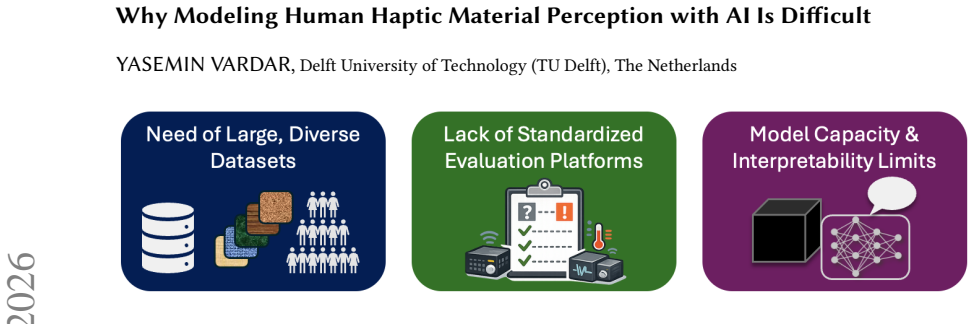
This position paper argues that progress at the intersection of AI and haptics is constrained by three key bottlenecks: the scarcity of large, diverse, and balanced haptic datasets; the lack of standardized evaluation platforms and perceptual benchmarks; and limitations in model capacity and interpretability when applied to tactile perception. These challenges impede generalization, reproducibility, and scientific insight into human touch. The author reviews emerging strategies to address them and highlights opportunities for coordinated, cross-disciplinary efforts to advance AI systems that perform robust haptic perception while also contributing to a deeper understanding of human touch.
What carries the argument
The three bottlenecks of insufficient haptic datasets, absent standardized evaluation platforms with perceptual benchmarks, and restricted model capacity plus interpretability for tactile signals.
If this is right
- Larger and more balanced haptic datasets would support better generalization across materials and interaction conditions.
- Standardized evaluation platforms and perceptual benchmarks would increase reproducibility across studies.
- Improved model capacity and interpretability would generate clearer scientific insight into how tactile signals become perceptual representations.
- Coordinated cross-disciplinary work on these issues would produce AI systems capable of robust haptic perception in interactive applications.
Where Pith is reading between the lines
- Progress on these bottlenecks could also benefit fields such as robotics that rely on realistic touch feedback for object handling.
- The position implies that current AI limitations are largely practical and addressable rather than arising from an inherent gap between statistical learning and human sensory processing.
- Future tests could check whether fixing the three bottlenecks narrows the performance difference between AI and human observers on material recognition tasks.
Load-bearing premise
The three bottlenecks in data, benchmarks, and interpretability are the main and most fixable barriers, and tackling them together will improve both AI performance and scientific knowledge of touch rather than other limits such as sensor hardware or basic mismatches with biological perception.
What would settle it
If researchers release large diverse haptic datasets, adopt shared evaluation platforms with perceptual benchmarks, and train more interpretable models yet still see no gains in generalization or matches to human material judgments, the claim that these three factors are the primary constraints would be weakened.
Figures
read the original abstract
Touch plays a central role in how humans perceive and recognize materials through physical contact. Despite decades of research, the mechanisms by which tactile signals are transformed into meaningful perceptual representations remain poorly understood, limiting the design of interactive systems and intelligent agents with human-like haptic perception. Recent advances in artificial intelligence (AI) offer new opportunities to model and exploit tactile data; however, haptics presents fundamental challenges for contemporary AI due to its interaction-dependent, multimodal nature. This position paper argues that progress at the intersection of AI and haptics is constrained by three key bottlenecks: (1) the scarcity of large, diverse, and balanced haptic datasets; (2) the lack of standardized evaluation platforms and perceptual benchmarks; and (3) limitations in model capacity and interpretability when applied to tactile perception. I discuss how these challenges impede generalization, reproducibility, and scientific insight into human touch and review emerging strategies to address them. This paper highlights opportunities for coordinated, cross-disciplinary efforts to advance AI systems that not only perform robust haptic perception but also contribute to a deeper understanding of human touch.
Editorial analysis
A structured set of objections, weighed in public.
Referee Report
Summary. This position paper argues that progress in modeling human haptic material perception with AI is constrained by three key bottlenecks: (1) scarcity of large, diverse, and balanced haptic datasets; (2) lack of standardized evaluation platforms and perceptual benchmarks; and (3) limitations in model capacity and interpretability for tactile perception. It discusses the implications of these challenges for generalization, reproducibility, and scientific insight into human touch, reviews emerging strategies to address them, and calls for coordinated cross-disciplinary efforts to advance both practical AI systems and fundamental understanding of tactile perception.
Significance. If the three bottlenecks are shown to be primary, the paper could usefully frame research priorities at the AI-haptics intersection by emphasizing data collection, benchmark standardization, and interpretability needs. This framing might encourage collaborative initiatives that simultaneously improve interactive systems and contribute to perceptual science. However, the absence of quantitative evidence, systematic review, or comparative analysis reduces its immediate utility as a definitive roadmap.
major comments (2)
- [Abstract and introduction] The central claim (abstract; opening paragraphs of the main text) that the three bottlenecks are the dominant constraints lacks comparative discussion of why they outweigh other factors such as physical limits of current tactile sensors (spatial/temporal resolution, force range, contact area) or the active, exploratory, context-dependent character of human haptic perception. This is load-bearing for the recommendation of coordinated efforts on data and benchmarks, as the argument treats the listed items as primary without evidence that progress on them would not be gated by unaddressed hardware or sensorimotor-loop mismatches.
- [Discussion of strategies] The review of emerging strategies (later sections) does not include any assessment of their likely effectiveness or references to preliminary results from related work showing that addressing data scarcity, benchmarks, or interpretability would measurably improve modeling of human-like tactile perception; this leaves the proposed path forward somewhat speculative relative to the strength of the bottleneck claims.
minor comments (2)
- Clarify early in the manuscript that this is a position paper rather than an empirical or review study to align reader expectations with the argumentative style and lack of new data.
- Ensure citations to existing haptic datasets and AI-haptics surveys are comprehensive and current; a brief table summarizing key available datasets would improve clarity.
Simulated Author's Rebuttal
We thank the referee for the constructive and detailed feedback on our position paper. The comments help clarify how to better justify the central claims and strengthen the discussion of strategies. We address each major comment below, indicating where revisions will be made.
read point-by-point responses
-
Referee: [Abstract and introduction] The central claim (abstract; opening paragraphs of the main text) that the three bottlenecks are the dominant constraints lacks comparative discussion of why they outweigh other factors such as physical limits of current tactile sensors (spatial/temporal resolution, force range, contact area) or the active, exploratory, context-dependent character of human haptic perception. This is load-bearing for the recommendation of coordinated efforts on data and benchmarks, as the argument treats the listed items as primary without evidence that progress on them would not be gated by unaddressed hardware or sensorimotor-loop mismatches.
Authors: We agree that a comparative discussion would strengthen the argument. The manuscript focuses on bottlenecks that are particularly acute for AI modeling of haptic perception, as sensor hardware advances occur in a parallel track and the active, exploratory nature of touch is already reflected in many existing tactile datasets and interaction protocols. Nevertheless, we will add a concise paragraph in the introduction that acknowledges sensor limitations and sensorimotor-loop considerations, then explains why the three listed bottlenecks remain primary for AI progress: they directly constrain generalization, reproducibility, and the ability to derive scientific insight from models, even as hardware improves. This revision will make the load-bearing claim more robust without altering the paper's core position. revision: yes
-
Referee: [Discussion of strategies] The review of emerging strategies (later sections) does not include any assessment of their likely effectiveness or references to preliminary results from related work showing that addressing data scarcity, benchmarks, or interpretability would measurably improve modeling of human-like tactile perception; this leaves the proposed path forward somewhat speculative relative to the strength of the bottleneck claims.
Authors: We accept that the strategies section would benefit from greater specificity. As a position paper our goal is to identify opportunities rather than perform a systematic evaluation, yet we can still reference existing preliminary results (for example, performance gains reported in tactile classification tasks when dataset size or diversity increases, or early benchmark-driven improvements in cross-material generalization). In the revision we will expand the discussion to include brief assessments of likely effectiveness drawn from cited related work, along with caveats where evidence remains limited. This will reduce speculation while preserving the forward-looking character of the paper. revision: yes
Circularity Check
No circularity; position paper lacks derivations, equations, or self-referential reductions
full rationale
This is a position paper that enumerates three bottlenecks in AI-haptics research based on stated observations about data scarcity, missing benchmarks, and model limitations. No equations, first-principles derivations, fitted parameters, or predictions appear in the provided text or abstract. The central claims rest on external literature and qualitative assessment rather than any self-definitional loop, fitted-input-as-prediction, or load-bearing self-citation chain that reduces the argument to its own inputs by construction. The paper is therefore self-contained as a discussion of challenges and does not exhibit any of the enumerated circularity patterns.
Axiom & Free-Parameter Ledger
Reference graph
Works this paper leans on
-
[1]
Jagan K. Balasubramanian, Bence L. Kodak, and Yasemin Vardar. 2025. SENS3: Multisensory Database of Finger-Surface Interactions and Corre- sponding Sensations. InHaptics (Lecture Notes in Computer Science (including subseries Lecture Notes in Artificial Intelligence and Lecture Notes in Bioinformatics), Vol. 1), Hiroyuki Kajimoto, Pedro Lopes, Claudio Pac...
-
[2]
Jagan K. Balasubramanian, Daan M. Pool, and Yasemin Vardar. 2026. Sliding speed influences electrovibration-induced finger friction dynamics on touchscreens.Tribology International213 (2026), 111054. doi:10.1016/j.triboint.2025.111054
-
[3]
Quinn Begelinger and Yasemin Vardar. 2026. Generating Tactile Textures from Perceptual Descriptors with Diffusion Models: A Feasibility Study. InExtended Abstracts of the 2026 CHI Conference on Human Factors in Computing Systems (CHI EA ’26), April 13–17, 2026, Barcelona, Spain. doi:10.1145/3772363.3799381
-
[4]
Shaoyu Cai, Lu Zhao, Yuki Ban, Takuji Narumi, Yue Liu, and Kening Zhu. 2022. GAN-based image-to-friction generation for tactile simulation of fabric material.Computers & Graphics102 (2022), 460–473. doi:10.1016/j.cag.2021.09.007
-
[5]
Heather Culbertson, Juan José López Delgado, and Katherine J Kuchenbecker. 2014. One hundred data-driven haptic texture models and open-source methods for rendering on 3D objects. In2014 IEEE Haptics Symposium (HAPTICS). IEEE, 319–325
work page 2014
-
[6]
Alexis W. M. Devillard, Aruna Ramasamy, Xiaoxiao Cheng, Damien Faux, and Etienne Burdet. 2025. Tactile, Audio, and Visual Dataset During Bare Finger Interaction with Textured Surfaces.Scientific Data12 (2025), 484. doi:10.1038/s41597-025-04670-0
-
[7]
Faraz Faruqi, Maxine Perroni-Scharf, Jaskaran Singh Walia, Yunyi Zhu, Shuyue Feng, Donald Degraen, and Stefanie Mueller. 2025. TactStyle: Generating Tactile Textures with Generative AI for Digital Fabrication. InProceedings of the 2025 CHI Conference on Human Factors in Computing Systems (CHI ’25). Association for Computing Machinery, New York, NY, USA, A...
-
[8]
Waseem Hassan, Arsen Abdulali, and Seokhee Jeon. 2020. Authoring New Haptic Textures Based on Interpolation of Real Textures in Affective Space.IEEE Transactions on Industrial Electronics67, 1 (2020), 667–676. doi:10.1109/TIE.2019.2914572
-
[9]
Negin Heravi, Heather Culbertson, Allison M. Okamura, and Jeannette Bohg. 2024. Development and Evaluation of a Learning-Based Model for Real-Time Haptic Texture Rendering.IEEE Transactions on Haptics17, 4 (2024), 705–716. doi:10.1109/TOH.2024.3382258
- [10]
-
[11]
Roland S. Johansson and J. Randall Flanagan. 2009. Coding and use of tactile signals from the fingertips in object manipulation tasks.Nature Reviews Neuroscience10, 5 (2009), 345–359
work page 2009
-
[12]
Fontaine, Stefanos Nikolaidis, and Heather Culbertson
Shihan Lu, Mianlun Zheng, Matthew C. Fontaine, Stefanos Nikolaidis, and Heather Culbertson. 2022. Preference-Driven Texture Modeling Through Interactive Generation and Search.IEEE Transactions on Haptics15, 3 (2022), 508–520. doi:10.1109/TOH.2022.3173935
-
[13]
Ratschat, Laura Marchal-Crespo, and Yasemin Vardar
Rubén Martín-Rodríguez, Alexandre L. Ratschat, Laura Marchal-Crespo, and Yasemin Vardar. 2025. Tactile Weight Rendering: A Review for Researchers and Developers.IEEE Transactions on Haptics18, 1 (Jan. 2025), 93–109. doi:10.1109/toh.2024.3453894
-
[14]
Shogo Okamoto, Hikaru Nagano, and Yoji Yamada. 2013. Psychophysical Dimensions of Tactile Perception of Textures.IEEE Transactions on Haptics 6, 1 (2013), 81–93. doi:10.1109/TOH.2012.32
-
[15]
IEEE Transactions on Haptics 15, 705–717
Benjamin A. Richardson, Yasemin Vardar, Christian Wallraven, and Katherine J. Kuchenbecker. 2022. Learning to Feel Textures: Predicting Perceptual Similarities From Unconstrained Finger-Surface Interactions.IEEE Transactions on Haptics15, 4 (2022), 705–717. doi:10.1109/TOH.2022.3212701 Why Modeling Human Haptic Material Perception with AI Is Difficult 5
-
[16]
Oliver Schneider, Bruno Fruchard, Dennis Wittchen, Bibhushan Raj Joshi, Georg Freitag, Donald Degraen, and Paul Strohmeier. 2022. Sustainable Haptic Design: Improving Collaboration, Sharing, and Reuse in Haptic Design Research. InExtended Abstracts of the 2022 CHI Conference on Human Factors in Computing Systems(New Orleans, LA, USA)(CHI EA ’22). Associat...
-
[17]
Matti Strese, Yannik Boeck, and Eckehard Steinbach. 2017. Content-based surface material retrieval. In2017 IEEE World Haptics Conference (WHC). IEEE, 352–357
work page 2017
-
[18]
Maciej Stroinski, Kamil Kwarciak, Mateusz Kowalewski, Daria Hemmerling, William Frier, and Orestis Georgiou. 2025. Text-to-Haptics: Enhancing Multisensory Storytelling through Emotionally Congruent Midair Haptics.Advanced Intelligent Systems7, 4 (2025), 2400758. arXiv:https://advanced.onlinelibrary.wiley.com/doi/pdf/10.1002/aisy.202400758 doi:10.1002/aisy...
-
[19]
Youjin Sung, Kevin John, Sang Ho Yoon, and Hasti Seifi. 2025. HapticGen: Generative Text-to-Vibration Model for Streamlining Haptic Design. In Proceedings of the 2025 CHI Conference on Human Factors in Computing Systems (CHI ’25). Association for Computing Machinery, New York, NY, USA, Article 495, 24 pages. doi:10.1145/3706598.3713609
-
[20]
Matteo Toscani and Anna Metzger. 2022. A Database of Vibratory Signals from Free Haptic Exploration of Natural Material Textures and Perceptual Judgments (ViPer): Analysis of Spectral Statistics. InHaptics: Science, Technology, Applications, Hasti Seifi, Astrid M. L. Kappers, Oliver Schneider, Knut Drewing, Claudio Pacchierotti, Alireza Abbasimoshaei, Gij...
work page 2022
-
[21]
Yusuke Ujitoko and Yuki Ban. 2018. Vibrotactile Signal Generation from Texture Images or Attributes Using Generative Adversarial Network. In Haptics: Science, Technology, and Applications, Domenico Prattichizzo, Hiroyuki Shinoda, Hong Z. Tan, Emanuele Ruffaldi, and Antonio Frisoli (Eds.). Springer International Publishing, Cham, 25–36
work page 2018
-
[22]
Michael Wiertlewski and Vincent Hayward. 2012. Mechanical behavior of the fingertip in the range of frequencies and displacements relevant to touch.Journal of Biomechanics45, 11 (2012), 1869–1874. doi:10.1016/j.jbiomech.2012.05.045
-
[23]
Mingxin Zhang, Shun Terui, Yasutoshi Makino, and Hiroyuki Shinoda. 2025. TexSenseGAN: A User-Guided System for Optimizing Texture-Related Vibrotactile Feedback Using Generative Adversarial Network.IEEE Transactions on Haptics18, 2 (2025), 325–339. doi:10.1109/TOH.2025.3542424
-
[24]
Li Zou and Yasemin Vardar. [n. d.]. Learning to Feel Materials from Multisensory Tactile Data via Interpretable Models. The Author Yasemin Vardar is an Associate Professor in the Department of Cognitive Robotics at TU Delft, The Netherlands, where she leads the Haptic Interface Technology Lab. She received her Ph.D. in Mechanical Engineering from Koç Univ...
work page 2018
discussion (0)
Sign in with ORCID, Apple, or X to comment. Anyone can read and Pith papers without signing in.