Reprogrammable magnonic logic in a multiferroic heterostructure via magnetoelectric coupling
Pith reviewed 2026-05-19 19:39 UTC · model grok-4.3
The pith
Ferroelectric domain patterns in BiFeO3 tune magnon frequencies in adjacent La0.67Sr0.33MnO3 by up to 150 MHz through magnetoelectric coupling.
A machine-rendered reading of the paper's core claim, the machinery that carries it, and where it could break.
Core claim
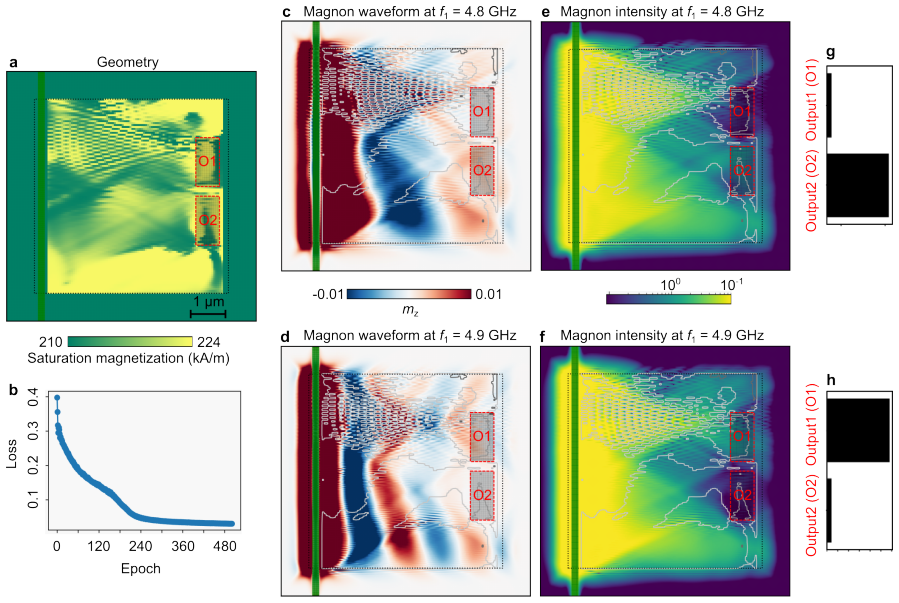
The authors establish that ferroelectric domain engineering in BiFeO3 within a BiFeO3/La0.67Sr0.33MnO3 heterostructure enables deterministic tuning of the magnon dispersion in La0.67Sr0.33MnO3 via magnetoelectric coupling at the interface. This produces frequency shifts of up to approximately 150 MHz and permits electrically defined, reconfigurable magnonic waveguides. Micro-focused Brillouin light scattering directly images the resulting spatial control, while inverse-design simulations demonstrate that the platform supports advanced functions such as frequency demultiplexing.
What carries the argument
Magnetoelectric coupling at the BiFeO3/La0.67Sr0.33MnO3 interface, which maps chosen ferroelectric domain patterns onto local changes in magnon dispersion.
If this is right
- Voltage-defined magnonic waveguides become non-volatile and reversible without continuous drive current.
- Frequency shifts of 150 MHz enable programmable dispersion for on-chip signal routing.
- Inverse-design simulations confirm the heterostructure can perform frequency demultiplexing.
- The platform extends directly to magnonic logic, reservoir computing, and neuromorphic applications.
Where Pith is reading between the lines
- The same domain-engineering approach could be combined with existing ferroelectric memory fabrication to create hybrid magnonic circuits at wafer scale.
- Testing other multiferroic material pairs might increase the frequency shift range or lower the required voltage.
- Embedding inverse-design tools with the heterostructure could allow automated layout of complex magnonic functions without manual waveguide design.
Load-bearing premise
The magnetoelectric coupling at the interface must be strong enough, uniform, and stable to convert any chosen ferroelectric domain pattern into consistent and repeatable shifts in magnon dispersion.
What would settle it
Repeatedly writing the same ferroelectric domain pattern and measuring no reproducible frequency shift or waveguide formation in the La0.67Sr0.33MnO3 layer would falsify the deterministic tuning claim.
Figures




read the original abstract
The realization of fully reconfigurable, voltage-controlled, and programmable on-chip magnonic devices is essential to fully harness the potential of spin waves for signal processing, logic and neuromorphic computing. Yet, existing demonstrations of electrical tuning of magnonic responses are either volatile, current-driven and thus energy-inefficient, or rely on local strain modification limiting their scalability for wafer-scale integration. Here, we address this challenge using a BiFeO3/La0.67Sr0.33MnO3 multiferroic thin film heterostructure. We show that ferroelectric domain engineering in BiFeO3 enables deterministic tuning of the magnon dispersion of La0.67Sr0.33MnO3, producing frequency shifts up to $\sim 150 MHz$ and allowing reconfigurable waveguiding. Micro-focused Brillouin light scattering directly images these effects, revealing electrically defined magnonic waveguides and spatially programmable dispersion. Compared to conventional approaches, this method provides non-volatile and reversible control. Furthermore, using an inverse-design simulation code, we demonstrate the capability of our platform to perform advanced magnonic functions such as frequency demultiplexing. Our results open a new avenue for using magnetoelectric heterostructures for magnonic logic, with further applicability to reservoir and neuromorphic computing and AI driven magnonic devices.
Editorial analysis
A structured set of objections, weighed in public.
Referee Report
Summary. The manuscript demonstrates that ferroelectric domain engineering in a BiFeO3/La0.67Sr0.33MnO3 multiferroic heterostructure enables deterministic, non-volatile, and reversible tuning of the magnon dispersion in the LSMO layer via magnetoelectric coupling. This produces frequency shifts up to ~150 MHz, allows electrically defined reconfigurable magnonic waveguides, and supports advanced functions such as frequency demultiplexing, as shown by micro-focused Brillouin light scattering (BLS) imaging and inverse-design simulations.
Significance. If the central claims hold, the work offers a promising route toward scalable, voltage-controlled magnonic logic with non-volatile programmability, addressing limitations of current-driven or strain-based tuning methods. The direct BLS imaging of dispersion shifts and waveguiding, together with the inverse-design simulations demonstrating demultiplexing, provides concrete evidence of functionality and strengthens applicability to neuromorphic and reservoir computing.
major comments (2)
- [§3] §3 (BLS imaging results): The reported frequency shifts of up to ~150 MHz are presented without visible error bars, standard deviations from repeated measurements, or full raw datasets, which weakens the claim of deterministic and repeatable domain-to-magnon mapping.
- [§4] §4 (magnetoelectric coupling analysis): The manuscript does not include quantitative controls or separate measurements to isolate the magnetoelectric contribution from possible strain or defect effects at the interface, leaving the weakest assumption (uniform and stable coupling) insufficiently tested.
minor comments (2)
- [Figure 2] Figure 2 and associated text: The domain patterns and corresponding BLS intensity maps would benefit from explicit scale bars and clearer labeling of the voltage polarity used for writing.
- [Methods] Methods section: The inverse-design simulation parameters and the procedure for validating simulated dispersion against experimental BLS data should be described in more detail to support reproducibility.
Simulated Author's Rebuttal
We thank the referee for their constructive review and recommendation for minor revision. We address each major comment point by point below, providing clarifications and indicating revisions to the manuscript where appropriate.
read point-by-point responses
-
Referee: [§3] §3 (BLS imaging results): The reported frequency shifts of up to ~150 MHz are presented without visible error bars, standard deviations from repeated measurements, or full raw datasets, which weakens the claim of deterministic and repeatable domain-to-magnon mapping.
Authors: We agree that statistical presentation strengthens the claims of determinism and repeatability. In the revised manuscript, error bars derived from the standard deviation across five repeated BLS measurements at each position and domain configuration have been added to the frequency-shift data in Figure 3. A new supplementary section now includes representative raw BLS spectra together with the tabulated frequency values from all repeated scans, confirming that the shifts remain consistent within the reported range. revision: yes
-
Referee: [§4] §4 (magnetoelectric coupling analysis): The manuscript does not include quantitative controls or separate measurements to isolate the magnetoelectric contribution from possible strain or defect effects at the interface, leaving the weakest assumption (uniform and stable coupling) insufficiently tested.
Authors: We acknowledge that a fully quantitative separation of magnetoelectric coupling from interfacial strain or defect contributions would require additional control experiments. The original analysis correlates the observed non-volatile frequency shifts directly with the ferroelectric domain patterns imaged by PFM and shows consistency with established magnetoelectric coefficients for the BiFeO3/LSMO system. In the revision we have expanded the discussion in Section 4 to include a back-of-the-envelope estimate demonstrating that the magnitude and sign of the shifts exceed those expected from residual strain under substrate clamping alone. We have also noted that the observed reversibility and spatial programmability are more readily explained by magnetoelectric coupling than by static strain or defects. Complete isolation would necessitate new sample series (e.g., temperature-dependent or non-ferroelectric control layers) that lie outside the present scope. revision: partial
Circularity Check
No significant circularity in derivation or claims
full rationale
The manuscript is primarily experimental, relying on direct micro-focused Brillouin light scattering measurements of magnon dispersion shifts, voltage-dependent spectra, and domain imaging in the BiFeO3/LSMO heterostructure. These observations provide independent empirical grounding for the reported frequency shifts (~150 MHz) and reconfigurable waveguiding. The inverse-design simulations are presented as a demonstration tool applied to the measured platform parameters rather than a self-referential derivation. No load-bearing steps reduce by construction to fitted inputs, self-citations, or ansatzes from the authors' prior work; the central mapping from ferroelectric domains to magnon dispersion is supported by external data acquisition and does not loop back to quantities defined within the paper itself.
Axiom & Free-Parameter Ledger
axioms (1)
- domain assumption Magnetoelectric coupling at the BiFeO3/LSMO interface is sufficient to produce deterministic, spatially programmable changes in magnon dispersion from ferroelectric domain patterns.
Reference graph
Works this paper leans on
-
[1]
Reconfigurable magnonics heats up.Nat
Grundler, D. Reconfigurable magnonics heats up.Nat. Phys.11, 438–441 (2015)
work page 2015
-
[2]
Chumak, A. V. et al. Advances in magnetics roadmap on spin-wave computing.IEEE Trans. Magn.58, 1–72 (2022)
work page 2022
-
[3]
Flebus, B. et al. The 2024 magnonics roadmap.J. Phys.: Condens. Matter36, 363501 (2025)
work page 2024
-
[4]
Haldar, A., Kumar, D. & Adeyeye, A. O. A reconfigurable waveguide for energy-efficient trans- mission and local manipulation of information in a nanomagnetic device.Nat. Nanotechnol. 11, 437-443 (2016)
work page 2016
-
[5]
Yi, D., Yu, P., Chen, Y., Lee, H., He, Q., Chu, Y. and Ramesh, R. , Tailoring Magnetoelectric Coupling in BiFeO3/La0.7Sr0.3MnO3 Heterostructure through the Interface EngineeringAdv. Mat.31, 1806335 (2019)
work page 2019
-
[6]
Ji, H., Li, M., Zhou, G., Guo, Y., Gao, X., Zhou, X. and Liu, L., Recent Progress On Low- Power Electrical Control of Magnetization in Transition Metal Oxide Heterostructures.Adv. Funct. Mat., 35. (2025)
work page 2025
-
[7]
Wang, Q., Pirro, P., Verba, R., Slavin, A., Hillebrands, B. & Chumak, A. V. Reconfigurable nanoscale spin-wave directional coupler.Sci. Adv.4, e1701517 (2018)
work page 2018
-
[8]
Merbouche, H., Boventer, I., Haspot, V., Fusil, S., Garcia, V., Gou´ er´ e, D., Carr´ et´ ero, C., Vecchiola, A., Lebrun, R., Bortolotti, P. et al. Voltage-Controlled Reconfigurable Magnonic Crystal at the Sub-micrometer Scale.ACS Nano15, 9775–9781 (2021)
work page 2021
-
[9]
Chai, Y., Liang, Y., Xiao, C., Wang, Y., Li, B., Jiang, D., Pal, P., Tang, Y., Chen, H., Zhang, Y. et al. Voltage control of multiferroic magnon torque for reconfigurable logic-in-memory. Nat. Commun.15, 5975 (2024)
work page 2024
-
[10]
O., Knauer, S., Wang, Q., Schrefl, T., Suess, D
Zenbaa, N., Abert, C., Majcen, F., Kerber, M., Serha, R. O., Knauer, S., Wang, Q., Schrefl, T., Suess, D. & Chumak, A. V. A universal inverse-design magnonic device.Nat. Electron.8, 106–115 (2025)
work page 2025
-
[11]
Gurevich, A. G. & Melkov, G. A. Magnetization Oscillations and Waves. CRC Press (1996). 16
work page 1996
-
[12]
Kruglyak, V. V., Demokritov, S. O. & Grundler, D. Magnonics.J. Phys. D: Appl. Phys.43, 264001 (2010)
work page 2010
-
[13]
Chumak, A. V., Vasyuchka, V. I., Serga, A. A. & Hillebrands, B. Magnon spintronics.Nat. Phys.11, 453–461 (2015)
work page 2015
-
[14]
Csaba, G., Papp, ´A. & Porod, W. Perspectives of using spin waves for computing and signal processing.Phys. Lett. A381, 1471–1476 (2017)
work page 2017
-
[15]
Bensmann, J. et al. Dispersion-tunable low-loss implanted spin-wave waveguides for large magnonic networks.Nat. Mater.24, 1045–1052 (2025)
work page 2025
-
[16]
An, K., Litvinenko, A. N., Kohno, R., Fuad, A. A., Naletov, V. V., Vila, L., Ebels, U., de Loubens, G., Hurdequint, H., Beaulieu, N. et al. Coherent long-range transfer of angular momentum between magnon Kittel modes by phonons.Phys. Rev. B101, 060407 (2020)
work page 2020
-
[17]
Guo, Er-Jia and Roldan, Manuel A. and Sang, Xiahan and Okamoto, Satoshi and Charl- ton, Timothy and Ambaye, Haile and Lee, Ho Nyung and Fitzsimmons, Michael R., Influ- ence of chemical composition and crystallographic orientation on the interfacial magnetism in BiFeO3/La1−xSrxMnO3 superlattices.Phys. Rev. Mat.2, 114404 (2018)
work page 2018
-
[18]
Xu, M., Yamamoto, K., Puebla, J., Baumgaertl, K., Rana, B., Miura, K., Takahashi, H., Grundler, D., Maekawa, S., Otani, Y. et al. Nonreciprocal surface acoustic wave propagation via magneto-rotation coupling.Sci. Adv.6, eabb1724 (2020)
work page 2020
-
[19]
Tabuchi, Y., Ishino, S., Ishikawa, T., Yamazaki, R., Usami, K. & Nakamura, Y. Hybridizing ferromagnetic magnons and microwave photons in the quantum limit.Phys. Rev. Lett.113, 083603 (2014)
work page 2014
- [20]
-
[21]
Tabuchi, Y., Ishino, S., Noguchi, A., Ishikawa, T., Yamazaki, R., Usami, K. & Nakamura, Y. Coherent coupling between a ferromagnetic magnon and a superconducting qubit.Science 349, 405–408 (2015)
work page 2015
-
[22]
P., Tabuchi, Y., Kono, S., Usami, K
Lachance-Quirion, D., Wolski, S. P., Tabuchi, Y., Kono, S., Usami, K. & Nakamura, Y. Entanglement-based single-shot detection of a single magnon with a superconducting qubit. Science367, 425–428 (2020)
work page 2020
-
[23]
Lan, J., Yu, W., Wu, R., & Xiao, J. Spin-wave diode.Phys. Rev. X5, 041049 (2015). 17
work page 2015
-
[24]
Wang, Q. et al. A magnonic directional coupler for integrated magnonic half-adders.Nat. Electron.3, 765–774 (2020)
work page 2020
-
[25]
Heussner, F. et al. Experimental Realization of a Passive Gigahertz Frequency-Division De- multiplexer for Magnonic Logic Networks.Phys. status solidi – Rapid Res. Lett.14, 1900695 (2020)
work page 2020
-
[26]
Heinz, B. et al. Propagation of Spin-Wave Packets in Individual Nanosized Yttrium Iron Garnet Magnonic Conduits.Nano Lett.20, 4220–4227 (2020)
work page 2020
-
[27]
Fischer, T. et al. Experimental prototype of a spin-wave majority gate.Appl. Phys. Lett.110, 152401 (2017)
work page 2017
-
[28]
Talmelli, G. et al. Reconfigurable submicrometer spin-wave majority gate with electrical trans- ducers.Sci. Adv.6, eabb4042 (2020)
work page 2020
-
[29]
Chumak, A. V., Serga, A. A. & Hillebrands, B. Magnon transistor for all-magnon data pro- cessing.Nat. Commun.5, 4700 (2014)
work page 2014
-
[30]
Wang, Y. Z. et al. Voltage-Controlled Magnon Transistor via Tuning Interfacial Exchange Coupling.Phys. Rev. Lett.132, 076701 (2024)
work page 2024
-
[31]
Cheng, J. et al. A nonvolatile magnon field effect transistor at room temperature.Nat. Com- mun.15, 9314 (2024)
work page 2024
-
[32]
A., Colson, D., Forget, A., Bibes, M., Barth´ el´ emy, A
Rovillain, P., de Sousa, R., Gallais, Y., Sacuto, A., M´ easson, M. A., Colson, D., Forget, A., Bibes, M., Barth´ el´ emy, A. & Cazayous, M. Electric-field control of spin waves at room temperature in multiferroic BiFeO3.Nat. Mater.9, 975–979 (2010)
work page 2010
-
[33]
Choudhury, S., Chaurasiya, A. K., Mondal, A. K., Rana, B., Miura, K., Takahashi, H., Otani, Y., & Barman, A. Voltage controlled on-demand magnonic nanochannels.Sci. Adv.6, eaba5457 (2020)
work page 2020
-
[34]
Liu, C., Luo, Y., Hong, D., Zhang, S.-S.-L., Saglam, H., Li, Y., Lin, Y., Fisher, B., Pearson, J. E., Jiang, J. et al. Electric-field control of magnon spin currents in an antiferromagnetic insulator.Sci. Adv.7, eabg1669 (2021)
work page 2021
-
[35]
Qin, H., Dreyer, R., Woltersdorf, G., Taniyama, T. & van Dijken, S. Electric-Field Control of Propagating Spin Waves by Ferroelectric Domain-Wall Motion in a Multiferroic Heterostruc- ture.Adv. Mater.33, 2100646 (2021)
work page 2021
-
[36]
Rana, B. & Otani, Y. Development of Magnonics with Voltage-Controlled Magnetic Anisotropy. In:Nanomagnets as Dynamical Systemspp. 71–96. Springer Nanostructure Sci- 18 ence and Technology (2024)
work page 2024
-
[37]
F., Ciubotaru, F., Popovici, M
Vermeulen, B. F., Ciubotaru, F., Popovici, M. I., Swerts, J., Couet, S., Radu, I. P., Lauwaet, K., De Boeck, J., Van Haesendonck, C., Willaert, F. et al. Ferroelectric control of magnetism in ultrathin HfO 2/Co/Pt layers.ACS Appl. Mater. Interfaces11, 34385–34395 (2019)
work page 2019
-
[38]
Wang, J. et al. Epitaxial BiFeO 3 Multiferroic Thin Film Heterostructures.Science299, 1719–1722 (2003)
work page 2003
-
[39]
Gross, I. et al. Real-space imaging of non-collinear antiferromagnetic order with a single-spin magnetometer.Nature549, 252–256 (2017)
work page 2017
- [40]
-
[41]
Liu, C., Wu, S., Zhang, J., Chen, J., Ding, J., Ma, J., Zhang, Y., Sun, Y., Tu, S., Wang, H. et al. Current-controlled propagation of spin waves in antiparallel, coupled domains.Nat. Nanotechnol.14, 691–697 (2019)
work page 2019
-
[42]
Zhang, Y. et al. Switchable long-distance propagation of chiral magnonic edge states.Nat. Mater.24, 69–75 (2025)
work page 2025
-
[43]
Wu, S. M. et al. Reversible electric control of exchange bias in a multiferroic field-effect device. Nat. Mater.9, 756–761 (2010)
work page 2010
-
[44]
Yu, P. et al. Interface ferromagnetism and orbital reconstruction in BiFeO3-La0.67Sr0.33MnO3 heterostructures.Phys. Rev. Lett.105, 027201 (2010)
work page 2010
-
[45]
Zhang, J. et al. Long decay length of magnon-polarons in BiFeO 3/La0.67Sr0.33MnO3 het- erostructures.Nat. Commun.12, 7258 (2021)
work page 2021
-
[46]
Wang, Q., Chumak, A. V. & Pirro, P. Inverse-design magnonic devices.Nat. Commun.12, 2636 (2021)
work page 2021
-
[47]
Zenbaa, N. et al. Realization of inverse-design magnonic logic gates.Sci. Adv.11, (2025)
work page 2025
-
[48]
Papp, ´A., Porod, W. & Csaba, G. Nanoscale neural network using non-linear spin-wave inter- ference.Nat. Commun.12, 6422 (2021)
work page 2021
-
[49]
Abdelsamie, A. et al. Interplay between anisotropic strain, ferroelectric, and antiferromagnetic textures in highly compressed BiFeO 3 epitaxial thin films.Appl. Phys. Lett.124, (2024)
work page 2024
-
[50]
Interpretation of anomalous larmor frequencies in ferromagnetic resonance experi- ment.Phys
Kittel, C. Interpretation of anomalous larmor frequencies in ferromagnetic resonance experi- ment.Phys. Rev.71, 270–271 (1947)
work page 1947
-
[51]
Guo, R. et al. Non-volatile memory based on the ferroelectric.Nat. Commun.4, 1990 (2013). 19
work page 1990
-
[52]
Heron, J. T. et al. Deterministic switching of ferromagnetism at room temperature using an electric field.Nature516, 370–373 (2014)
work page 2014
-
[53]
Rana, B. & Otani, Y. Towards magnonic devices based on voltage-controlled magnetic anisotropy.Commun. Phys.9, 90 (2019)
work page 2019
-
[54]
Kim, Y−M. etal.Direct observation of ferroelectric field effect and vacancy−controlled screen- ing at theBiF eO 3/LaxSr1−xM nO3 interfaceNat. Mater13, 1019−1025 (2014)
work page 2014
-
[55]
Gradauskaite, E. and Yang, C.−J. and Efe, I. and Pal, S. and Fiebig, M. and Trassin, M., Mag- netoelectric Phase Control at Domain−Wall−Like Epitaxial Oxide MultilayersAdv. Funct. Mater.35, 2412831 (2024)
work page 2024
-
[56]
Huang, B.C. and Yu, P. and Chu, Y. H. and Chang, C.-S. and Ramesh, R. and Dunin-Borkowski, R. E. and Ebert, P. and Chiu, Y.−P., Atomically Resolved Elec- tronic States and Correlated Magnetic Order at Termination Engineered Complex Oxide Heterointerfaces,ACS Nano,12,1089−1095 (2018)
work page 2018
-
[57]
Demokritov, S. O. & Demidov, V. E. Micro-brillouin light scattering spectroscopy of magnetic nanostructures.IEEE Trans. Magn.44, 6–12 (2008). I. SUPPLEMENTARY INFORMATION Supplementary Information A: Characterization of the epitaxial grown BFO/LSMO and (001)−NGO substrate FIG. 5.XRD and RHEED characterization of BiFeO 3 (BFO)/La0.7Sr0.3MnO3 (LSMO) heteros...
work page 2008
discussion (0)
Sign in with ORCID, Apple, or X to comment. Anyone can read and Pith papers without signing in.