On Trajectory-Based Stability Analysis for 1-bit Sigma-Delta Quantization and its Application to the Second-Order Case
Pith reviewed 2026-05-20 14:39 UTC · model grok-4.3
The pith
Trajectory analysis of state sequences yields stability for second-order sigma-delta quantizers with shorter sparse filters than l1 bounds allow.
A machine-rendered reading of the paper's core claim, the machinery that carries it, and where it could break.
Core claim
By describing the trajectories of the state sequence u_n defined by the recurrence u_n = (h * u)_n + y_n - q_n with the sign-based rule q_n = sign((h * u)_n + y_n), the analysis proves stability for second-order ΣΔ schemes with sparse feedback filters, improving the filter length required to guarantee stability from O(1/(1−∥f∥_∞)) under the ℓ1 criterion to O(1/√(1−∥f∥_∞)).
What carries the argument
Trajectory description of the state sequence (u_n) under the sign-based quantization rule, bounded directly for specific sparse filters without a full high-dimensional invariant-set characterization.
If this is right
- Stability holds for second-order schemes once the sparse filter reaches a shorter length than the ℓ1 condition requires.
- The trajectory method handles longer filters than invariant-set analysis can manage because of dimensionality.
- The first stability guarantees beyond first order that beat the standard ℓ1 + ∞-norm bound are obtained.
- More efficient filter choices become available for accurate digital representation of bandlimited signals.
Where Pith is reading between the lines
- The same trajectory bounding technique could be tested on higher-order schemes where invariant sets grow even harder to characterize.
- Hardware designers might adopt the new shorter sparse filters to lower complexity and power in analog-to-digital converters.
- Numerical simulations of the state recurrence for varying input norms would directly check whether the square-root scaling holds in practice.
Load-bearing premise
The path taken by the internal state variable can be tracked and bounded directly for these particular sparse filter designs instead of first determining every possible set of states the system could reach.
What would settle it
A concrete second-order sparse filter whose length scales as one over the square root of one minus the input norm, together with a bandlimited input, for which numerical iteration of the state recurrence produces an unbounded sequence.
Figures


read the original abstract
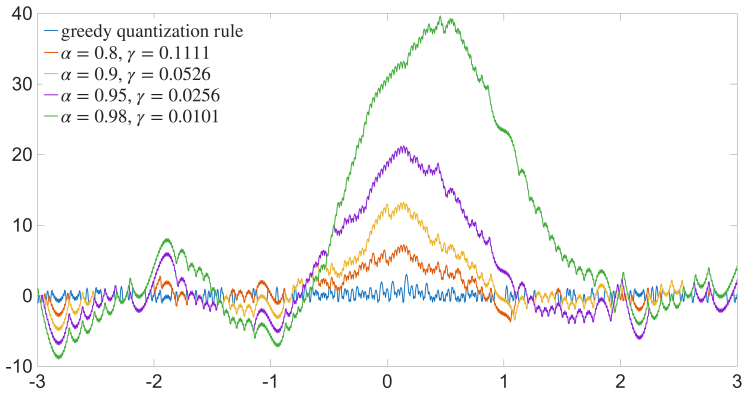
A state-of-the-art strategy for digitally representing a bandlimited signal $f$ is $\Sigma\Delta$ quantization. $\Sigma\Delta$ quantization schemes choose a bit sequence $(q_n)$ representing the samples $(y_n)$ of $f$ sequentially based on a state sequence $(u_n)$ defined via a recurrence relation of the form \begin{equation*} u_n = (h*u)_n + y_n - q_n, \end{equation*} where $h_j = 0$ for $j\le 0.$ The effectiveness of a quantization scheme crucially depends on the fact that it is stable, i.e. , the state variable remains uniformly bounded in a given class of signals. Thus, a common strategy is to choose $$q_n = \operatorname{sign}((h*u)_n + y_n).$$ It is well known that a sufficient condition for this quantization rule to induce stability is that $$ \|h\|_{\ell^1}+\|f\|_{\infty}\le 2.$$ At the same time, one empirically observes that this condition is conservative and stability holds significantly beyond this bound. In this paper, we address this gap by establishing the first stability guarantees beyond first order that outperform the $\ell^1$ based stability condition. In contrast to many previous approaches, our analysis describes the trajectories of the state variables rather than characterizing the invariant set, an approach that had previously been performed only in some specific example cases. This viewpoint has the main advantage that it makes it possible to treat longer filters, which are difficult to handle through invariant-set analysis because of the resulting high dimensionality. We apply our technique to second-order $\Sigma\Delta$ schemes with sparse feedback filters as proposed by G\"unturk \cite{gunturk2003one}, showing that the filter length required to guarantee stability significantly improves from the length $O\left(\frac{1}{1-\|f\|_{\infty}}\right)$ needed to apply the $\ell^1$ based criterion to $O\left(\frac{1}{\sqrt{1-\|f\|_{\infty}}}\right)$.
Editorial analysis
A structured set of objections, weighed in public.
Referee Report
Summary. The paper develops a trajectory-based stability analysis for 1-bit ΣΔ quantization schemes defined by the recurrence u_n = (h * u)_n + y_n - q_n with q_n = sign((h * u)_n + y_n). It contrasts this approach with invariant-set methods and applies it to second-order schemes using sparse feedback filters from Güntürk, deriving that the filter length guaranteeing stability improves from O(1/(1−∥f∥_∞)) under the ℓ¹ criterion to O(1/√(1−∥f∥_∞)).
Significance. If the trajectory bounds hold, the work supplies the first explicit stability guarantees for second-order ΣΔ beyond the ℓ¹ condition, with a concrete improvement in filter length that is relevant for practical bandlimited signal quantization. The trajectory viewpoint is credited for enabling analysis of longer sparse filters that are intractable via high-dimensional invariant sets.
major comments (2)
- [Section on application to second-order schemes] The central scaling claim (filter length O(1/√(1−∥f∥_∞))) rests on explicit trajectory bounds for the state sequence (u_n) under the sparse filter recurrence; the manuscript must supply the full derivation of these bounds, including the error estimates that convert the recurrence and sign rule into the √ scaling, as the abstract only states the result.
- [Trajectory viewpoint paragraph and second-order application] The weakest assumption—that the trajectory description can be bounded directly without a full high-dimensional invariant-set characterization—requires a concrete verification step for the specific sparse filters; without an explicit example computation or inductive estimate showing how sparsity yields the improved length, the improvement over the ℓ¹ criterion remains unverified.
minor comments (2)
- [Introduction and equation (1)] Notation for the convolution (h*u)_n and the assumption h_j=0 for j≤0 should be restated explicitly when first used in the stability theorem.
- [Application section] The comparison to the ℓ¹ bound ∥h∥_ℓ¹ + ∥f∥_∞ ≤ 2 would benefit from a short table listing the required filter lengths for representative values of ∥f∥_∞ (e.g., 0.5, 0.8) under both criteria.
Simulated Author's Rebuttal
We thank the referee for the thoughtful and constructive report. The comments highlight opportunities to strengthen the clarity of our derivations, and we will revise the manuscript to address them directly while preserving the core contributions of the trajectory-based analysis.
read point-by-point responses
-
Referee: [Section on application to second-order schemes] The central scaling claim (filter length O(1/√(1−∥f∥_∞))) rests on explicit trajectory bounds for the state sequence (u_n) under the sparse filter recurrence; the manuscript must supply the full derivation of these bounds, including the error estimates that convert the recurrence and sign rule into the √ scaling, as the abstract only states the result.
Authors: We appreciate this observation. The full derivation of the trajectory bounds appears in Section 4 of the manuscript, where we start from the recurrence u_n = (h * u)_n + y_n - q_n with q_n = sign((h * u)_n + y_n) and exploit the sparsity pattern of the Güntürk filters to obtain an inductive bound on ||u_n||. The √ scaling arises from a quadratic error accumulation estimate that improves upon the linear ℓ¹ summation. To make the intermediate steps fully explicit, we will add a dedicated subsection in the revision that isolates the error estimates, shows the precise role of the sign rule in canceling linear terms, and derives the O(1/√(1−||f||_∞)) length requirement step by step. revision: yes
-
Referee: [Trajectory viewpoint paragraph and second-order application] The weakest assumption—that the trajectory description can be bounded directly without a full high-dimensional invariant-set characterization—requires a concrete verification step for the specific sparse filters; without an explicit example computation or inductive estimate showing how sparsity yields the improved length, the improvement over the ℓ¹ criterion remains unverified.
Authors: We agree that an explicit verification strengthens the argument. The manuscript already contains an inductive estimate (Lemma 4.3 and the subsequent theorem) that uses the zero pattern of the sparse filter to control the state trajectory without constructing the full invariant set. In the revision we will augment this with a short, self-contained example computation for a representative second-order sparse filter (e.g., the length-5 case), walking through the first few steps of the induction to illustrate how sparsity prevents the linear growth that appears under the ℓ¹ criterion and produces the improved √ scaling. revision: yes
Circularity Check
No significant circularity detected
full rationale
The paper's central contribution is a trajectory-based stability analysis for second-order ΣΔ schemes that directly bounds the state sequence (u_n) via the recurrence and sign quantization rule, yielding an improved filter-length bound O(1/√(1−∥f∥∞)) for sparse feedback filters. This derivation is presented as independent of the prior ℓ1 criterion and does not reduce to any fitted parameter, self-defined quantity, or load-bearing self-citation chain. The cited Güntürk work supplies only the filter class; the stability improvement follows from explicit trajectory estimates that are internally consistent and do not presuppose the target result. The argument remains self-contained against external benchmarks.
Axiom & Free-Parameter Ledger
axioms (1)
- domain assumption The recurrence u_n = (h * u)_n + y_n - q_n with q_n = sign((h * u)_n + y_n) defines a valid quantization scheme whose stability is governed by bounds on h and f.
Reference graph
Works this paper leans on
-
[1]
C Sinan G¨ unt¨ urk. One-bit sigma-delta quantization with exponential accuracy.Commu- nications on Pure and Applied Mathematics: A Journal Issued by the Courant Institute of Mathematical Sciences, 56(11):1608–1630, 2003
work page 2003
-
[2]
Hi Inose, Y Yasuda, and Jun Murakami. A telemetering system by code modulation-δ- σmodulation.IRE Transactions on Space Electronics and Telemetry, pages 204–209, 1962
work page 1962
-
[3]
Analog-to-digital and digital-to-analog conversion techniques
David F Hoeschele. Analog-to-digital and digital-to-analog conversion techniques. In Analog-to-digital and digital-to-analog conversion techniques, pages 397–397. ., 1994
work page 1994
-
[4]
James C Candy and Gabor C Temes.Oversampling delta-sigma data converters: theory, design, and simulation. John Wiley & Sons, 1991
work page 1991
-
[5]
IEEE press Piscataway, NJ, 2005
Richard Schreier, Gabor C Temes, et al.Understanding delta-sigma data converters, vol- ume 74. IEEE press Piscataway, NJ, 2005
work page 2005
-
[6]
C Sinan Gunturk, Jeffrey C Lagarias, and Vinay A Vaishampayan. On the robust- ness of single-loop sigma-delta modulation.IEEE Transactions on Information Theory, 47(5):1735–1744, 2001
work page 2001
-
[7]
Soren Hein and Avideh Zakhor. On the stability of sigma delta modulators.IEEE Trans- actions on Signal Processing, 41(7):2322–2348, 2002
work page 2002
-
[8]
Ingrid Daubechies and Ron DeVore. Approximating a bandlimited function using very coarsely quantized data: A family of stable sigma-delta modulators of arbitrary order. Annals of mathematics, 158(2):679–710, 2003
work page 2003
-
[9]
¨Ozg¨ ur Yilmaz. Stability analysis for several second-order sigma—delta methods of coarse quantization of bandlimited functions.Constructive approximation, 18(4):599–623, 2002
work page 2002
-
[10]
Percy Deift, Felix Krahmer, and C Sınan G¨ unt¨ urk. An optimal family of exponentially accurate one-bit sigma-delta quantization schemes.Communications on Pure and Applied Mathematics, 64(7):883–919, 2011
work page 2011
-
[11]
PhD thesis, New York University, 2009
Felix Krahmer.Novel schemes for Sigma-Delta modulation: from improved exponential accuracy to low-complexity design. PhD thesis, New York University, 2009
work page 2009
-
[12]
Ronan Farrell and Orla Feely. Bounding the integrator outputs of second-order sigma- delta modulators.IEEE Transactions on Circuits and Systems II: Analog and Digital Signal Processing, 45(6):691–702, 2002
work page 2002
-
[13]
Op-amp swing reduction in sigma-delta modulators
Sunwoo Kwon, Franco Maloberti, et al. Op-amp swing reduction in sigma-delta modulators. InISCAS (1), pages 525–528, 2004. 32
work page 2004
-
[14]
Fu-Chuang Chen and Chih-Lung Hsieh. Modeling harmonic distortions caused by nonlinear op-amp dc gain for switched-capacitor sigma–delta modulators.IEEE Transactions on Circuits and Systems II: Express Briefs, 56(9):694–698, 2009
work page 2009
-
[15]
Nicolas Beilleau, Hassan Aboushady, and MM Louerat. Systematic approach for scaling coefficients of discrete-time and continuous-time sigma-delta modulators. In2003 46th Midwest Symposium on Circuits and Systems, volume 1, pages 233–236. IEEE, 2003
work page 2003
-
[16]
David A Johns and David M Lewis. Design and analysis of delta-sigma based iir fil- ters.IEEE Transactions on Circuits and Systems II: Analog and Digital Signal Processing, 40(4):233–240, 2002
work page 2002
-
[17]
Dimitris Anastassiou. Error diffusion coding for a/d conversion.IEEE Transactions on Circuits and Systems, 36(9):1175–1186, 2002
work page 2002
-
[18]
Stability in a general sigma delta modulator
Richard Schreier and Martin Snelgrove. Stability in a general sigma delta modulator. In [Proceedings] ICASSP 91: 1991 International Conference on Acoustics, Speech, and Signal Processing, pages 1769–1772. IEEE, 1991
work page 1991
-
[19]
Felix Krahmer and Rachel Ward. Lower bounds for the error decay incurred by coarse quan- tization schemes.Applied and Computational Harmonic Analysis, 32(1):131–138, 2012
work page 2012
-
[20]
C Sinan Gunturk and Nguyen T Thao. Refined error analysis in second-order/spl sigma//spl delta/modulation with constant inputs.IEEE Transactions on Information Theory, 50(5):839–860, 2004
work page 2004
-
[21]
Springer Science & Business Media, 2012
Sergei Mikhailovich Nikol’skii.Approximation of functions of several variables and imbed- ding theorems. Springer Science & Business Media, 2012
work page 2012
-
[22]
Felix Krahmer and Anna Veselovska. Enhanced digital halftoning via weighted sigma-delta modulation.SIAM Journal on Imaging Sciences, 16(3):1727–1761, 2023. 33
work page 2023
discussion (0)
Sign in with ORCID, Apple, or X to comment. Anyone can read and Pith papers without signing in.