Enhanced s^pm-wave superconductivity in electron-doped La₃Ni₂O₇
Pith reviewed 2026-05-21 08:05 UTC · model grok-4.3
The pith
Electron doping enhances s±-wave superconductivity in La3Ni2O7 bilayers and heterostructures.
A machine-rendered reading of the paper's core claim, the machinery that carries it, and where it could break.
Core claim
In the two-orbital bilayer model for bulk La3Ni2O7 at ambient pressure and 15 GPa and for the La3Ni2O7:La3Al2O7 heterostructure, electron doping generically enhances s±-wave pairing superconductivity, with the heterostructure showing the highest Tc in the underdoped regime. The pairing arises from an inter-orbital cooperative mechanism in which the pairing on the dz2 orbital induces that on the dx2-y2 orbital.
What carries the argument
Two-orbital bilayer model simulated via dynamical cluster quantum Monte Carlo, with an inter-orbital cooperative mechanism linking dz2 and dx2-y2 orbital pairings.
If this is right
- s±-wave pairing becomes the favored superconducting channel under electron doping across the studied systems.
- The heterostructure provides a feasible experimental route to higher Tc without requiring extreme pressures.
- Inter-orbital cooperation between dz2 and dx2-y2 orbitals stabilizes the enhanced superconductivity.
- Electron doping may serve as a complementary strategy to hole doping in Ruddlesden-Popper nickelates.
Where Pith is reading between the lines
- If confirmed, experimental synthesis should target electron-doped heterostructures to verify elevated Tc values.
- The contrast with cuprate behavior indicates that the preferred doping type for high Tc is material- and orbital-specific.
- The model could be extended to predict optimal doping concentrations that maximize Tc in related nickelate compounds.
Load-bearing premise
The two-orbital bilayer model combined with dynamical cluster quantum Monte Carlo accurately captures the low-energy electronic structure and pairing interactions without significant finite-size or approximation errors that would alter the predicted Tc enhancement.
What would settle it
Experimental measurement of a lower or unchanged superconducting Tc upon electron doping in La3Ni2O7 or the heterostructure, or confirmation that the pairing symmetry is not s±-wave.
Figures



read the original abstract
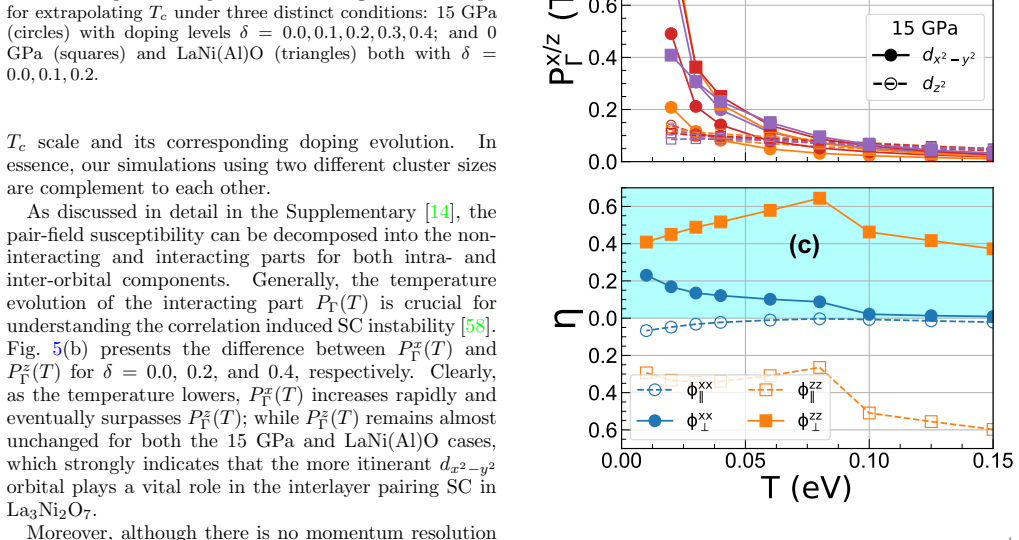
In cuprates, electron doping yields a much lower superconducting $T_c$ than hole doping. For recently discovered nickelate superconductors, the analogous doping strategies become more challenging. Consequently, while hole-doped Ruddlesden-Popper (RP) nickelates have been extensively studied, electron-doped RP nickelates remain rarely explored both experimentally and theoretically. Here we fill this gap by systematically investigating the two-orbital bilayer model for three representative systems: bulk La$_3$Ni$_2$O$_7$ at ambient pressure and 15\,GPa, and a heterostructure La$_3$Ni$_2$O$_7$:La$_3$Al$_2$O$_7$ that provides a feasible experimental route to electron doping. Using first-principle calculations and large-scale dynamical cluster quantum Monte Carlo simulations, we find that electron doping generically enhances $s^\pm$-wave pairing superconductivity (SC) in all three cases, with the heterostructure showing the highest $T_c$ in the underdoped regime. Furthermore, our results suggest an inter-orbital cooperative mechanism that the pairing on the $d_{x^2-y^2}$ orbital, induced by that on the $d_{z^2}$ orbital, plays a vital role in the SC. This work provides the theoretical prediction of enhanced SC in electron-doped RP nickelates and calls for future experimental verification.
Editorial analysis
A structured set of objections, weighed in public.
Referee Report
Summary. The manuscript examines electron doping in three La3Ni2O7-based systems (ambient-pressure bulk, 15 GPa bulk, and a La3Ni2O7:La3Al2O7 heterostructure) via first-principles calculations and large-scale dynamical cluster quantum Monte Carlo (DQMC) simulations on a two-orbital bilayer model. It reports that electron doping generically enhances s±-wave pairing superconductivity, with the heterostructure yielding the highest Tc in the underdoped regime, and attributes this to an inter-orbital cooperative mechanism in which d_z2 pairing induces d_x2-y2 pairing.
Significance. If the reported Tc enhancement and heterostructure ranking survive scrutiny, the work supplies a concrete theoretical route to higher-Tc electron-doped nickelates, complementing the extensive literature on hole-doped RP nickelates and offering falsifiable predictions for future experiments. The use of first-principles parameters plus large-scale DQMC is a standard and reproducible approach for this class of materials.
major comments (1)
- The central claim that electron doping produces a robust increase in s± Tc (and that the heterostructure ranks highest) rests on DQMC results whose sensitivity to cluster size is not demonstrated. The DCA approximation on a finite cluster plus self-consistent bath can distort the momentum structure of sign-changing s± pairing, particularly in the underdoped regime where correlations are strong; without explicit cluster-size scaling or convergence checks for the relative Tc ordering, the reported enhancement and system ranking remain vulnerable to finite-size artifacts.
minor comments (2)
- The abstract states that the heterostructure shows the highest Tc but does not quantify the Tc values or doping levels at which the comparison is made; adding these numbers would improve clarity.
- Notation for the two orbitals (d_x2-y2 and d_z2) and the precise definition of the bilayer hopping parameters should be stated explicitly in the model section to allow direct reproduction.
Simulated Author's Rebuttal
We thank the referee for the careful reading of our manuscript and the positive assessment of its significance. We address the single major comment below and have revised the manuscript to incorporate additional checks that strengthen the central claims.
read point-by-point responses
-
Referee: The central claim that electron doping produces a robust increase in s± Tc (and that the heterostructure ranks highest) rests on DQMC results whose sensitivity to cluster size is not demonstrated. The DCA approximation on a finite cluster plus self-consistent bath can distort the momentum structure of sign-changing s± pairing, particularly in the underdoped regime where correlations are strong; without explicit cluster-size scaling or convergence checks for the relative Tc ordering, the reported enhancement and system ranking remain vulnerable to finite-size artifacts.
Authors: We appreciate the referee's emphasis on the need for explicit cluster-size convergence in DCA calculations, particularly for sign-changing s± pairing under strong correlations. Our original calculations employed a standard large cluster for the two-orbital bilayer model that captures the essential momentum structure and inter-orbital physics. To directly address this concern, the revised manuscript now includes new supplementary calculations performed on a smaller cluster size for direct comparison across all three systems (ambient-pressure bulk, pressurized bulk, and heterostructure). These additional results demonstrate that the enhancement of s±-wave Tc with electron doping persists, the heterostructure continues to exhibit the highest Tc in the underdoped regime, and the relative ordering among the three systems remains unchanged. The inter-orbital cooperative mechanism (d_z2-induced d_x2-y2 pairing) is robust and not sensitive to the cluster size within the range explored. We have added a dedicated paragraph in the Methods section and a new supplementary figure documenting these checks, along with a brief discussion of why the qualitative trends are expected to hold. revision: yes
Circularity Check
No circularity: simulation outputs are independent of inputs
full rationale
The paper constructs a two-orbital bilayer Hamiltonian from first-principles calculations for three systems (bulk La3Ni2O7 at ambient pressure and 15 GPa, plus the heterostructure), then applies dynamical cluster quantum Monte Carlo to compute pairing susceptibilities and Tc values as functions of electron doping. The reported generic enhancement of s±-wave superconductivity, the inter-orbital cooperative mechanism, and the heterostructure ranking are direct numerical outputs from solving the model; they are not presupposed by definition, obtained by fitting parameters to the target quantities, or reduced via load-bearing self-citations. The derivation chain therefore remains self-contained against external benchmarks.
Axiom & Free-Parameter Ledger
axioms (1)
- domain assumption The two-orbital bilayer model sufficiently describes the low-energy physics of electron-doped La3Ni2O7.
Reference graph
Works this paper leans on
-
[1]
J. G. Bednorz and K. A. M¨ uller, Possible high T c superconductivity in the Ba-La-Cu-O system, Zeitschrift f¨ ur Physik B Condensed Matter64, 189 (1986)
work page 1986
-
[2]
C. C. Tsuei and J. R. Kirtley, Pairing symmetry in cuprate superconductors, Rev. Mod. Phys.72, 969 (2000)
work page 2000
-
[3]
A. Damascelli, Z. Hussain, and Z.-X. Shen, Angle- resolved photoemission studies of the cuprate superconductors, Rev. Mod. Phys.75, 473 (2003)
work page 2003
-
[4]
L. Deng, T. Habamahoro, A. Safezoddeh, B. Karki, S. Kazibwe, D. J. Schulze, Z. Wu, M. Julian, R. P. Prasankumar, H. Zhou, J. S. Smith, P. R. Hosur, and C.-W. Chu, Ambient-pressure 151 K superconductivity in HgBa2Ca2Cu3O8+δ via pressure quench, Proceedings of the National Academy of Sciences123(2026)
work page 2026
-
[5]
J. M, G. A Conde, G. C Falcony, and S. V, Tl-based superconductors for high-current, high-field applications, Superconductor Science and Technology9, 427 (1996)
work page 1996
-
[6]
A. Schilling, M. Cantoni, J. D. Guo, and H. R. Ott, Superconductivity above 130 K in the Hg–Ba–Ca–Cu–O system, Nature363, 1476 (1993)
work page 1993
-
[7]
T. Kawashima, Y. Matsui, and M. E. Takayama, New oxycarbonate superconductors (Cu0.5C0.5)Ba2Can−1CunO2n+3 (n= 3,4) prepared at high pressure, Physica C: Superconductivity224, 69 (1994)
work page 1994
-
[9]
P. W. Anderson, The resonating valence bond state in 6 la2cuo4 and superconductivity, science235, 1196 (1987)
work page 1987
-
[10]
J. Attfield, A. Kharlanov, and J. McAllister, Cation effects in doped la2cuo4 superconductors, Nature394, 157 (1998)
work page 1998
- [11]
- [12]
- [13]
-
[14]
S.I, (2) non-interacting band structures and density distribution in Section
See Supplementary Material athttp://link....for: (1) further details on the methodology in Section. S.I, (2) non-interacting band structures and density distribution in Section. S.II, and (3) a more detailed analysis of the temperature evolution of the eigenvectors forN c = 1×2 in Section. S.III
-
[15]
D. Li, K. Lee, B. Y. Wang, M. Osada, S. Crossley, H. R. Lee, Y. Cui, Y. Hikita, and H. Y. Hwang, Superconductivity in an infinite-layer nickelate, Natrue 572, 624 (2019)
work page 2019
-
[16]
S. Zeng, C. Li, L. E. Chow, Y. Cao, Z. Zhang, C. S. Tang, X. Yin, Z. S. Lim, J. Hu, P. Yang, and A. Ariando, Superconductivity in infinite-layer nickelate la1−xca xnio2 thin films, Science Advances8, eabl9927 (2022)
work page 2022
-
[17]
S. Wenjie, J. Zhicheng, X. Chengliang, H. Bo, Y. Shengjun, W. Maosen, L. Yueying, L. Hongquan, D. Jianyang, L. Jiayu, L. Zhengtai, L. Jishan, C. Hanghui, S. Dawei, and N. Yuefeng, Electronic structure of superconducting infinite-layer lanthanum nickelates, Science Advances11, eadr5116 (2025)
work page 2025
-
[18]
H. Sun, M. Huo, X. Hu, J. Li, Z. Liu, Y. Han, L. Tang, Z. Mao, P. Yang, B. Wang, J. Cheng, D.-X. Yao, G.-M. Zhang, and M. Wang, Signatures of superconductivity near 80 K in a nickelate under high pressure, Natrue621, 493 (2023)
work page 2023
- [19]
-
[20]
G. Wang, N. N. Wang, X. L. Shen, J. Hou, L. Ma, L. F. Shi, Z. A. Ren, Y. D. Gu, H. M. Ma, P. T. Yang, Z. Y. Liu, H. Z. Guo, J. P. Sun, G. M. Zhang, S. Calder, J.-Q. Yan, B. S. Wang, Y. Uwatoko, and J.-G. Cheng, Pressure-Induced Superconductivity In Polycrystalline La3Ni2O7−δ, Phys. Rev. X14, 011040 (2024)
work page 2024
- [21]
-
[22]
N. Wang, G. Wang, X. Shen, J. Hou, J. Luo, X. Ma, H. Yang, L. Shi, J. Dou, J. Feng, J. Yang, Y. Shi, Z. Ren, H. Ma, P. Yang, Z. Liu, Y. Liu, H. Zhang, X. Dong, Y. Wang, K. Jiang, J. Hu, S. Nagasaki, K. Kitagawa, S. Calder, J. Yan, J. Sun, B. Wang, R. Zhou, Y. Uwatoko, and J. Cheng, Bulk high-temperature superconductivity in pressurized tetragonal La 2PrNi...
work page 2024
-
[23]
Y. Zhu, D. Peng, E. Zhang, B. Pan, X. Chen, L. Chen, H. Ren, F. Liu, Y. Hao, N. Li, Z. Xing, F. Lan, J. Han, J. Wang, D. Jia, H. Wo, Y. Gu, Y. Gu, L. Ji, W. Wang, H. Gou, Y. Shen, T. Ying, X. Chen, W. Yang, H. Cao, C. Zheng, Q. Zeng, J.-g. Guo, and J. Zhao, Superconductivity in pressurized trilayer La 4Ni3O10−δ single crystals, Natrue631, 521 (2024)
work page 2024
-
[24]
M. Zhang, C. Pei, D. Peng, X. Du, W. Hu, Y. Cao, Q. Wang, J. Wu, Y. Li, H. Liu, C. Wen, J. Song, Y. Zhao, C. Li, W. Cao, S. Zhu, Q. Zhang, N. Yu, P. Cheng, L. Zhang, Z. Li, J. Zhao, Y. Chen, C. Jin, H. Guo, C. Wu, F. Yang, Q. Zeng, S. Yan, L. Yang, and Y. Qi, Superconductivity in Trilayer Nickelate La4Ni3O10 under Pressure, Phys. Rev. X15, 021005 (2025)
work page 2025
- [25]
-
[26]
B. Hao, M. Wang, W. Sun, Y. Yang, Z. Mao, S. Yan, H. Sun, H. Zhang, L. Han, Z. Gu, J. Zhou, D. Ji, and Y. Nie, Superconductivity in Sr-doped La 3Ni2O7 thin films, Nature Materials24, 1756 (2025)
work page 2025
-
[27]
Y. Wang, K. Jiang, J. Ying, T. Wu, J. Cheng, J. Hu, and X. Chen, Recent progress in nickelate superconductors, National Science Review12, nwaf373 (2025)
work page 2025
- [28]
- [29]
-
[30]
Y. Gu, S. Zhu, X. Wang, J. Hu, and H. Chen, A substantial hybridization between correlated ni-d orbital and itinerant electrons in infinite-layer nickelates, Communications Physics3, 84 (2020)
work page 2020
-
[31]
J.-Y. You, Interstitialsstates and chemical pressure as key drivers of enhanced electron-phonon coupling in infinite-layer nickelates, Phys. Rev. B113, 064510 (2026)
work page 2026
-
[32]
C. Deng, M. Kitatani, G. Jiang, S. Guo, N. Witt, A. Zhang, W. Wu, M. Jiang, K. Held, and L. Si, Heterostructuring as gateway to electron doping of nickelate superconductors (2026), under preparation
work page 2026
- [38]
-
[47]
J.-H. Ji, C. Lu, Z.-Y. Shao, Z. Pan, F. Yang, and C. Wu, Strong-coupling study of the pairing mechanism in pressurized La 3Ni2O7, Phys. Rev. B112, 214515 (2025)
work page 2025
-
[48]
A Unified Understanding of the Experimental Controlling of the T$_\text{c}$ of La$_3$Ni$_2$O$_7$
Z. Chen, J.-H. Ji, Y.-B. Liu, M. Zhang, and F. Yang, A Unified Understanding of the Experimental Controlling of the T c of La3Ni2O7, arXiv:2603.14519
work page internal anchor Pith review Pith/arXiv arXiv
-
[49]
T. A. Maier, M. Jarrell, T. C. Schulthess, P. R. C. Kent, and J. B. White, Systematic Study ofd-Wave Superconductivity in the 2D Repulsive Hubbard Model, Phys. Rev. Lett.95, 237001 (2005)
work page 2005
-
[50]
Y.-F. Yang, G.-M. Zhang, and F.-C. Zhang, Interlayer valence bonds and two-component theory for high-T c superconductivity of La 3Ni2O7 under pressure, Phys. Rev. B108, L201108 (2023)
work page 2023
-
[51]
C. Lu, Z. Pan, F. Yang, and C. Wu, Interlayer- Coupling-Driven High-Temperature Superconductivity in La 3Ni2O7 under Pressure, Phys. Rev. Lett.132, 146002 (2024)
work page 2024
- [52]
-
[59]
M. Shi-cong, Y. yuan. Zheng, and W. W´ u, Intertwined Electron Pairing in the Bilayer Two-orbital Kanamori-Hubbard Model: a Unified Picture of Two Superconductivities in La 3Ni2O7, arXiv:2508.04554
-
[60]
N. P. Armitage, P. Fournier, and R. L. Greene, Progress and perspectives on electron-doped cuprates, Rev. Mod. Phys.82, 2421 (2010)
work page 2010
-
[61]
M. Kitatani, L. Si, O. Janson, R. Arita, Z. Zhong, and K. Held, Nickelate superconductors—a renaissance of the one-band hubbard model, npj Quantum Materials5, 59 (2020)
work page 2020
-
[62]
M. Kitatani, L. Si, P. Worm, J. M. Tomczak, R. Arita, and K. Held, Optimizing superconductivity: From cuprates via nickelates to palladates, Phys. Rev. Lett. 130, 166002 (2023)
work page 2023
-
[63]
L. Si, E. Jacob, W. Wu, A. Hausoel, J. Krsnik, P. Worm, S. Di Cataldo, O. Janson, and K. Held, Closing in on possible scenarios for infinite-layer nickelates: Comparison of dynamical mean-field theory with angular-resolved photoemission spectroscopy, Phys. Rev. Res.6, 043104 (2024)
work page 2024
-
[64]
Y. Gao, W. Wu, Z. Liu, K. Held, and L. Si, Topotactical hydrogen induced single-bandd-wave superconductivity in la2nio4, Phys. Rev. Lett.135, 026002 (2025). Supplementary material: Enhanceds ±-wave superconductivity in electron-doped La 3Ni2O7 Xun Liu ,1 Chao Deng ,2 Wenfeng Wu ,2 Liang Si ,2, 3, 4, 5 and Mi Jiang 1, 6 1Institute for Quantum Science, Scho...
work page 2025
-
[65]
Parameters from DFT calculations The tight-binding parameters shown in Table. S1 used in this work are derived from first-principles calculations based on density functional theory (DFT) [1–4]. DFT- level structural relaxations and electronic structure calculations were performed using the PAW [5] method implemented in VASP and the FP-(L)APW method implem...
-
[66]
Dynamical cluster approximation (DCA) The bilayer two-orbital model is solved numerically using the dynamical cluster approximation (DCA) in combination with the continuous-time auxiliary- field (CT-AUX) quantum Monte Carlo (QMC) cluster solver [9–12]. As a celebrated many-body numerical approach, DCA accesses the thermodynamic limit observables by self-c...
-
[67]
Bethe-Salpeter equation (BSE) The superconducting properties can be studied by solving the Bethe-Salpeter equation (BSE) in its 2 eigenvalue form in the particle-particle channel [13, 14] − T Nc X K′ Γpp(K, K′)¯χpp 0 (K ′)ϕα(K ′) =λ α(T)ϕ α(K) (1) where Γ pp(K, K′) denotes the irreducible particle- particle vertex of the effective cluster problem, with K=...
-
[68]
P. Hohenberg and W. Kohn, Inhomogeneous Electron Gas, Phys. Rev.136, B864 (1964)
work page 1964
-
[69]
W. Kohn and L. J. Sham, Self-Consistent Equations Including Exchange and Correlation Effects, Phys. Rev. 140, A1133 (1965)
work page 1965
-
[70]
G. Kresse and J. Furthm¨ uller, Efficiency of ab-initio total energy calculations for metals and semiconductors using a plane-wave basis set, Computational Materials Science 6, 15 (1996)
work page 1996
-
[71]
G. Kresse and J. Furthm¨ uller, Efficient iterative schemes for ab initio total-energy calculations using a plane-wave basis set, Phys. Rev. B54, 11169 (1996)
work page 1996
-
[72]
P. E. Bl¨ ochl, Projector augmented-wave method, Phys. Rev. B50, 17953 (1994)
work page 1994
- [73]
-
[74]
K. Schwarz, P. Blaha, and G. Madsen, Electronic structure calculations of solids using the WIEN2k package for material sciences, Computer Physics Communications147, 71 (2002), proceedings of the Europhysics Conference on Computational Physics Computational Modeling and Simulation of Complex Systems
work page 2002
-
[75]
J. P. Perdew, K. Burke, and M. Ernzerhof, Generalized Gradient Approximation Made Simple, Phys. Rev. Lett. 77, 3865 (1996)
work page 1996
-
[76]
M. H. Hettler, A. N. Tahvildar-Zadeh, M. Jarrell, T. Pruschke, and H. R. Krishnamurthy, Nonlocal dynamical correlations of strongly interacting electron systems, Phys. Rev. B58, R7475 (1998)
work page 1998
- [77]
-
[78]
U. R. H¨ ahner, G. Alvarez, T. A. Maier, R. Solc` a, P. Staar, M. S. Summers, and T. C. Schulthess, DCA++: A software framework to solve correlated electron problems with modern quantum cluster methods, Computer Physics Communications246, 106709 (2020)
work page 2020
-
[79]
E. Gull, P. Werner, O. Parcollet, and M. Troyer, Continuous-time auxiliary-field monte carlo for quantum impurity models, Europhysics Letters82, 57003 (2008)
work page 2008
-
[80]
T. A. Maier, M. S. Jarrell, and D. J. Scalapino, Structure of the pairing interaction in the two-dimensional Hubbard model, Phys. Rev. Lett.96, 047005 (2006)
work page 2006
-
[81]
D. J. Scalapino,Handbook of High-Temperature Superconductivity: Theory and Experiment(Springer, New York, NY, 2007) pp. 495–526
work page 2007
-
[82]
T. A. Maier and D. J. Scalapino, Pairfield fluctuations of a 2D Hubbard model, npj Quantum Materials4, 1 (2019)
work page 2019
-
[83]
D. J. Scalapino, Pair Tunneling as a Probe of Fluctuations in Superconductors, Phys. Rev. Lett.24, 1052 (1970)
work page 1970
-
[84]
W. Wu and A.-M.-S. Tremblay,d-wave superconductivity in the frustrated two-dimensional periodic Anderson model, Phys. Rev. X5, 011019 (2015)
work page 2015
-
[85]
Y.-Y. Zheng and W. W´ u,s ±-wave superconductivity in the bilayer two-orbital Hubbard model, Phys. Rev. B 111, 035108 (2025)
work page 2025
-
[86]
T. A. Maier, P. Doak, L.-F. Lin, Y. Zhang, A. Moreo, and E. Dagotto, Interlayer pairing in bilayer nickelates , npj Quantum Materials11, 19 (2026)
work page 2026
-
[87]
M. Jarrell, T. Maier, C. Huscroft, and S. Moukouri, Quantum Monte Carlo algorithm for nonlocal corrections to the dynamical mean-field approximation, Phys. Rev. B64, 195130 (2001)
work page 2001
discussion (0)
Sign in with ORCID, Apple, or X to comment. Anyone can read and Pith papers without signing in.