HL-OutPaint: Coarse-to-Fine Video Outpainting for High-Resolution Long-Range Videos
Pith reviewed 2026-05-20 13:28 UTC · model grok-4.3
The pith
Separating global structure modeling from fine-grained synthesis enables stable coherent outpainting for large spatial expansions in long video sequences.
A machine-rendered reading of the paper's core claim, the machinery that carries it, and where it could break.
Core claim
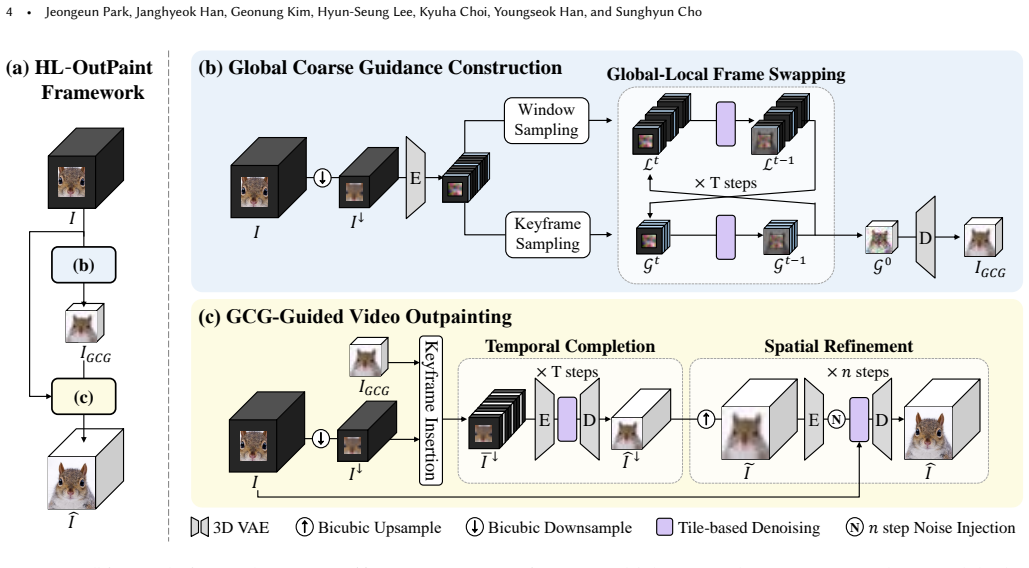
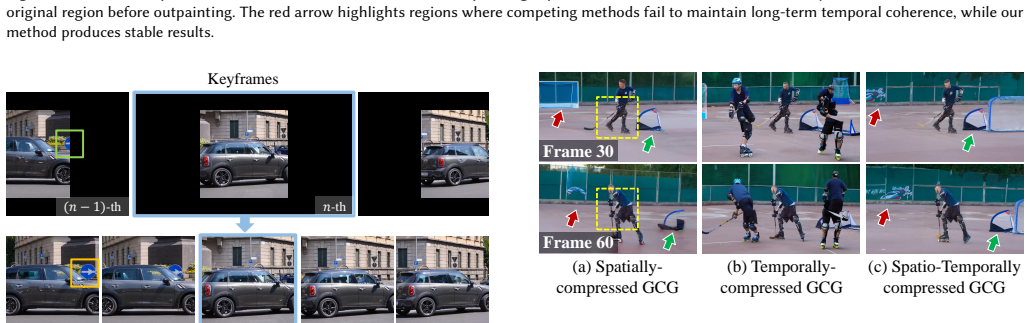
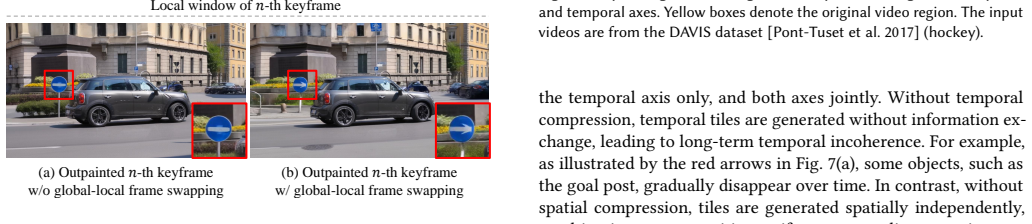
By constructing Global Coarse Guidance as a low-resolution representation through a novel global-local frame swapping mechanism that couples sparse global keyframes with local temporal windows, the method encodes both long-term structural consistency and short-term temporal dynamics in a unified way. This representation then guides the high-resolution outpainting stage to produce spatially detailed and temporally consistent content, achieving stable generation for large spatial expansion and long video sequences.
What carries the argument
Global Coarse Guidance (GCG), a low-resolution video representation constructed via global-local frame swapping that couples sparse global keyframes with local temporal windows to encode structure and motion for guiding later synthesis.
If this is right
- The two-stage separation supports coherent results even when spatial expansion is large and sequences are long.
- GCG provides a unified low-resolution encoding that maintains both distant structural consistency and nearby motion continuity.
- High-resolution synthesis guided by GCG avoids the global inconsistency problems seen in direct high-resolution approaches.
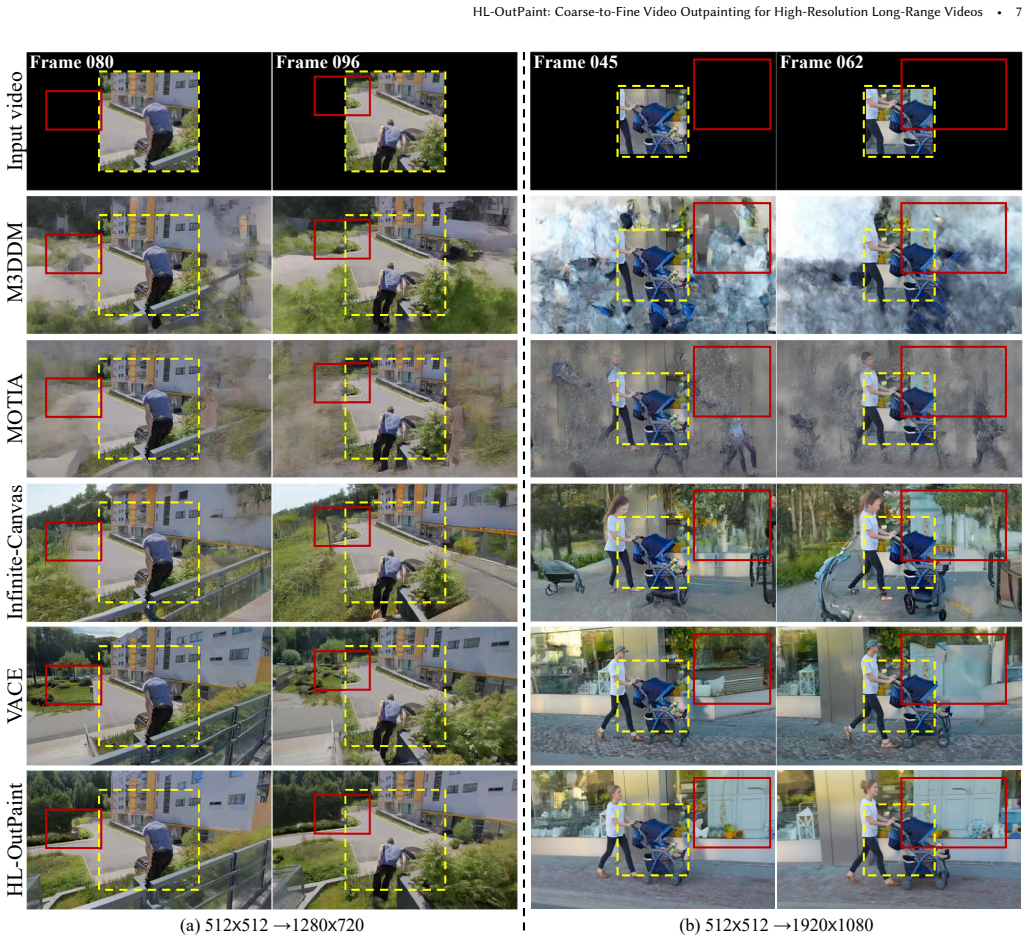
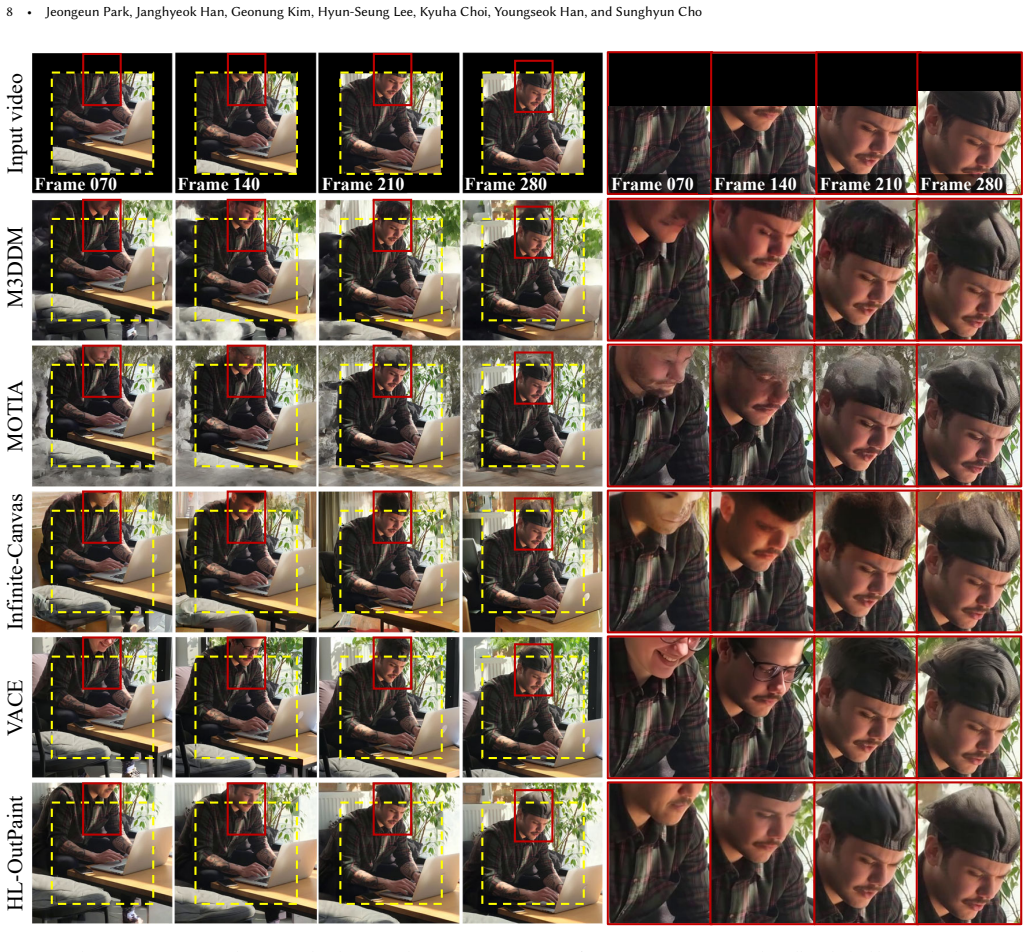
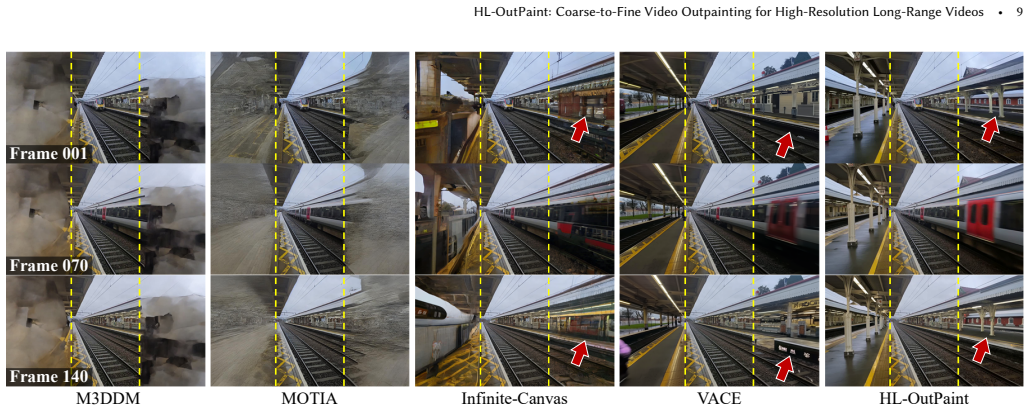
- The framework outperforms prior methods on challenging cases that combine wide extrapolation with extended video lengths.
Where Pith is reading between the lines
- The same coarse guidance idea could be tested on video tasks such as future frame prediction where long-range consistency is also needed.
- Removing the swapping mechanism and measuring the rise in artifacts would quantify how much of the performance depends on that specific construction step.
- Applying the global-local exchange idea to image outpainting might help with large single-frame extrapolations that lack temporal cues.
Load-bearing premise
The global-local frame swapping mechanism in building Global Coarse Guidance encodes long-term structural consistency and short-term temporal dynamics without introducing artifacts that propagate into the high-resolution stage.
What would settle it
Outpainting the same long sequences with large spatial expansion both with and without the frame swapping step in GCG construction, then checking whether the no-swapping version produces visibly more temporal drift or structural inconsistencies, would test whether that mechanism is necessary for the claimed stability.
Figures

read the original abstract
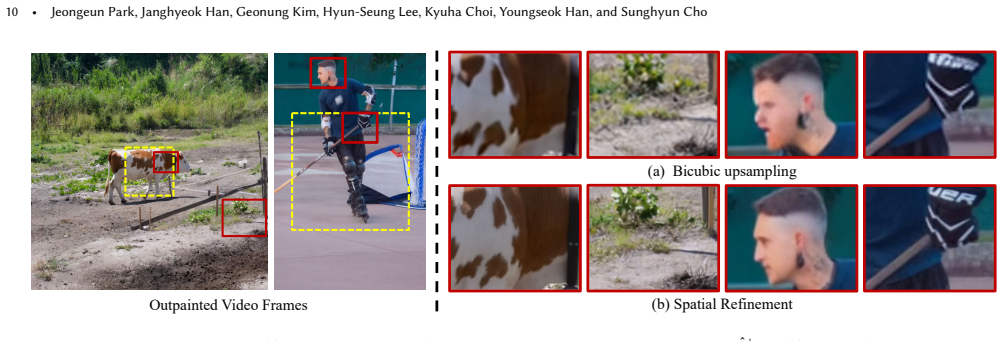
Video outpainting generates plausible visual content beyond the original spatial extent of a video, playing a key role in adapting videos to diverse display formats. To support such use cases, it must enable large spatial extrapolation over long sequences. However, most existing methods address only one of these challenges or lack explicit mechanisms for ensuring global spatio-temporal consistency, leading to notable limitations. In this paper, we propose HL-OutPaint, a high-resolution video outpainting framework for long sequences. Our approach follows a coarse-to-fine strategy with a two-stage pipeline. We first construct Global Coarse Guidance (GCG), a low-resolution representation that captures global structure and dominant motion across the video. Unlike naive downsampling, GCG is built via a novel global-local frame swapping mechanism that couples sparse global keyframes with local temporal windows and exchanges information during sampling. This enables GCG to encode both long-term structural consistency and short-term temporal dynamics in a unified representation. Guided by this representation, HL-OutPaint then performs high-resolution outpainting to generate spatially detailed and temporally consistent content. By separating global structure modeling from fine-grained synthesis, our framework achieves stable, coherent generation for large spatial expansion and long video sequences. Extensive experiments show that HL-OutPaint outperforms existing methods in challenging scenarios involving wide spatial extrapolation and long video sequences.
Editorial analysis
A structured set of objections, weighed in public.
Referee Report
Summary. The manuscript proposes HL-OutPaint, a coarse-to-fine two-stage framework for high-resolution video outpainting on long sequences. It first builds Global Coarse Guidance (GCG) via a novel global-local frame swapping mechanism that couples sparse global keyframes with local temporal windows during sampling, then uses this low-resolution representation to guide spatially detailed and temporally coherent high-resolution synthesis. The central claim is that separating global structure modeling from fine-grained synthesis enables stable outpainting for large spatial expansions and extended video lengths, outperforming prior methods.
Significance. If the GCG construction and separation premise hold under empirical scrutiny, the work could meaningfully advance video outpainting by addressing the combined challenges of wide spatial extrapolation and long-range temporal consistency that most existing approaches handle only partially. The coarse-to-fine strategy is a clear conceptual strength; credit is given for the explicit mechanism to encode both long-term structure and short-term dynamics in a unified low-res representation.
major comments (2)
- [Abstract and §3] Abstract and §3 (GCG construction): The claim that the global-local frame swapping successfully encodes long-term structural consistency and short-term temporal dynamics without residual inconsistencies that propagate to the high-resolution stage is load-bearing for the separation premise. The manuscript should provide a concrete analysis (e.g., via temporal alignment metrics or drift measurements) showing that information exchange during sampling is symmetric and constrained enough to prevent uncorrectable artifacts, as any drift would directly undermine the fine stage's ability to resolve it.
- [§4] §4 (Experiments): The abstract asserts outperformance in wide spatial extrapolation and long sequences, yet the provided description contains no quantitative results, ablation studies on the frame-swapping component, or error analysis. Tables reporting metrics across varying expansion ratios and sequence lengths are needed to substantiate that the GCG stage does not introduce uncorrectable inconsistencies.
minor comments (1)
- A diagram or pseudocode for the global-local frame swapping process would improve clarity of the information exchange during sampling.
Simulated Author's Rebuttal
We thank the referee for the thoughtful and constructive comments on our manuscript. We address each major comment below and outline the revisions we will make to strengthen the presentation of the GCG mechanism and the supporting experiments.
read point-by-point responses
-
Referee: [Abstract and §3] Abstract and §3 (GCG construction): The claim that the global-local frame swapping successfully encodes long-term structural consistency and short-term temporal dynamics without residual inconsistencies that propagate to the high-resolution stage is load-bearing for the separation premise. The manuscript should provide a concrete analysis (e.g., via temporal alignment metrics or drift measurements) showing that information exchange during sampling is symmetric and constrained enough to prevent uncorrectable artifacts, as any drift would directly undermine the fine stage's ability to resolve it.
Authors: We agree that explicit quantitative validation of the symmetry and bounded drift in the global-local frame swapping is important to support the separation premise. The mechanism alternates information exchange between sparse global keyframes and local temporal windows in a balanced, iterative manner during sampling, which is intended to keep inconsistencies minimal and correctable. In the revised manuscript we will add a dedicated analysis subsection in §3 that reports temporal alignment metrics (optical-flow consistency and keyframe drift) and drift measurements over extended sequences, confirming that residual inconsistencies remain within bounds that the high-resolution stage can resolve. revision: yes
-
Referee: [§4] §4 (Experiments): The abstract asserts outperformance in wide spatial extrapolation and long sequences, yet the provided description contains no quantitative results, ablation studies on the frame-swapping component, or error analysis. Tables reporting metrics across varying expansion ratios and sequence lengths are needed to substantiate that the GCG stage does not introduce uncorrectable inconsistencies.
Authors: We acknowledge that the experimental section must more clearly demonstrate the benefits of the GCG stage across the claimed regimes. The current manuscript contains quantitative comparisons, but we will expand §4 with additional tables that report PSNR, SSIM, and temporal consistency scores for multiple spatial expansion ratios (2×, 4×, 8×) and sequence lengths (up to several hundred frames). We will also include targeted ablations isolating the frame-swapping component together with error analysis showing how GCG-guided synthesis reduces drift relative to baselines. revision: yes
Circularity Check
No circularity; proposed two-stage mechanism is self-contained architectural design
full rationale
The paper describes a coarse-to-fine pipeline that first builds Global Coarse Guidance via a novel global-local frame swapping mechanism to capture long-term structure and short-term dynamics, then uses it to guide high-resolution outpainting. No equations, fitted parameters, or self-citations appear in the provided text that would reduce any claimed result to its own inputs by construction. The separation of global modeling from fine synthesis is presented as an explicit design choice rather than a derived equivalence or renamed empirical pattern, making the derivation self-contained against external benchmarks.
Axiom & Free-Parameter Ledger
Lean theorems connected to this paper
-
IndisputableMonolith/Foundation/RealityFromDistinction.leanreality_from_one_distinction unclear?
unclearRelation between the paper passage and the cited Recognition theorem.
We first construct Global Coarse Guidance (GCG), a low-resolution representation that captures global structure and dominant motion across the video... via a novel global-local frame swapping mechanism that couples sparse global keyframes with local temporal windows
-
IndisputableMonolith/Cost/FunctionalEquation.leanwashburn_uniqueness_aczel unclear?
unclearRelation between the paper passage and the cited Recognition theorem.
By separating global structure modeling from fine-grained synthesis, our framework achieves stable, coherent generation for large spatial expansion and long video sequences.
What do these tags mean?
- matches
- The paper's claim is directly supported by a theorem in the formal canon.
- supports
- The theorem supports part of the paper's argument, but the paper may add assumptions or extra steps.
- extends
- The paper goes beyond the formal theorem; the theorem is a base layer rather than the whole result.
- uses
- The paper appears to rely on the theorem as machinery.
- contradicts
- The paper's claim conflicts with a theorem or certificate in the canon.
- unclear
- Pith found a possible connection, but the passage is too broad, indirect, or ambiguous to say the theorem truly supports the claim.
discussion (0)
Sign in with ORCID, Apple, or X to comment. Anyone can read and Pith papers without signing in.