Microstructure evolution during rapid solidification of hypoeutectic Al-Ag alloys near absolute stability
Pith reviewed 2026-05-19 22:24 UTC · model grok-4.3
The pith
Concentrated hypoeutectic Al-Ag alloys reach absolute stability at growth rates below 1 m/s.
A machine-rendered reading of the paper's core claim, the machinery that carries it, and where it could break.
Core claim
The analysis predicts that V_abs follows a trend similar to that of the miscibility gap, first increasing and then decreasing with Ag concentration. Predicted values of V_abs are in good quantitative agreement with phase-field simulations over the entire hypoeutectic concentration range and with experiments for three concentrated alloys. This demonstrates that the absolute stability limit can be reached in sufficiently concentrated hypoeutectic Al-Ag alloys at growth rates well below the 1 m/s typically encountered in additive manufacturing.
What carries the argument
A sharp-interface linear stability analysis that uses a non-equilibrium, velocity-dependent phase diagram extracted from the phase-field model.
If this is right
- Microsegregation-free microstructures become achievable at practical additive manufacturing speeds for concentrated Al-Ag alloys.
- The absolute stability velocity can be predicted and tuned by adjusting silver concentration to follow the miscibility gap trend.
- Models combining phase-field simulations with velocity-dependent stability analysis can guide alloy selection for rapid solidification processes.
Where Pith is reading between the lines
- The same non-monotonic dependence of absolute stability on solute content may appear in other binary systems that possess a similar miscibility gap shape.
- Extending the velocity-dependent phase diagram approach to multicomponent alloys could identify additional compositions that reach absolute stability under additive manufacturing conditions.
- Direct measurement of interface velocities in thin-film experiments at varying laser powers would provide an independent test of the predicted V_abs values.
Load-bearing premise
The non-equilibrium, velocity-dependent phase diagram extracted from the phase-field model accurately represents the real thermodynamic and kinetic behavior of the Al-Ag system at the high velocities of interest.
What would settle it
Experiments that measure absolute stability velocities across a wider range of Ag concentrations and find significant deviations from the predicted increase-then-decrease trend with composition.
Figures


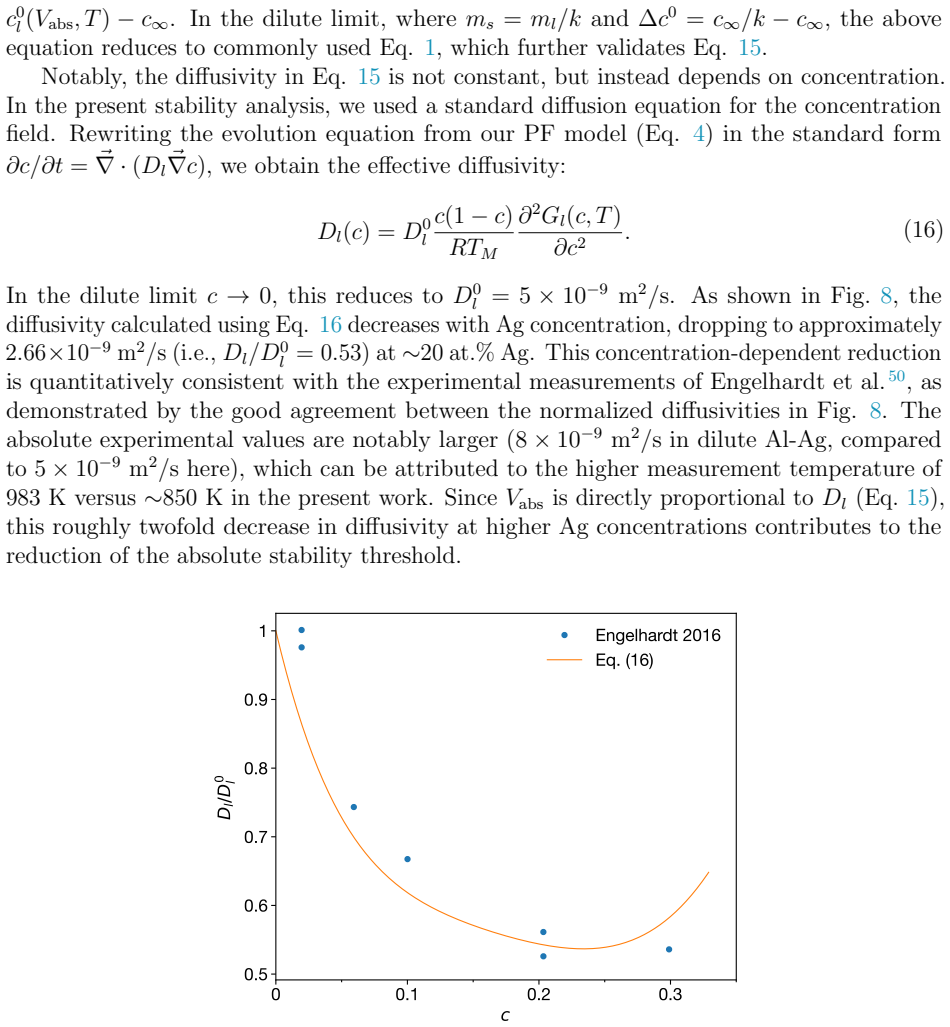
read the original abstract
Microsegregation-free microstructures can form by solidifying at velocities beyond the absolute stability limit ($V_{\text{abs}}$), where solute partitioning is suppressed by a stable, planar solid-liquid interface. Producing such microstructures is of considerable practical interest; however, $V_{\text{abs}}$ typically exceeds the ${\sim}1$ m/s growth rates encountered in additive manufacturing (AM). Here we demonstrate the absolute stability limit can be reached in sufficiently concentrated hypoeutectic Al-Ag alloys at growth rates well below the 1~m/s typically encountered in additive manufacturing. Dynamic Transmission Electron Microscopy (DTEM) of rapid solidification front evolution -- following laser spot melting of Al-Ag thin films -- combined with postmortem microstructural characterization, enables detailed quantitative comparison with both phase-field (PF) simulations and a sharp-interface linear stability analysis that uses a non-equilibrium, velocity-dependent phase diagram extracted from the PF model. The analysis predicts that $V_{\text{abs}}$ follows a trend similar to that of the miscibility gap, first increasing and then decreasing with Ag concentration. Predicted values of $V_{\text{abs}}$ are in good quantitative agreement with PF simulations over the entire hypoeutectic concentration range and with experiments for three concentrated alloys. These results inform the prediction and control of microstructural development in concentrated alloys near the absolute stability limit under AM conditions.
Editorial analysis
A structured set of objections, weighed in public.
Referee Report
Summary. The manuscript claims that the absolute stability limit V_abs can be reached below ~1 m/s in sufficiently concentrated hypoeutectic Al-Ag alloys. Using DTEM experiments on laser-melted thin films, phase-field simulations, and sharp-interface linear stability analysis that employs a non-equilibrium velocity-dependent phase diagram extracted from the same PF model, the authors predict that V_abs increases then decreases with Ag concentration (following the miscibility gap trend). They report good quantitative agreement between the analysis, PF results over the full hypoeutectic range, and experiments on three concentrated alloys, with implications for microsegregation-free microstructures under additive manufacturing conditions.
Significance. If the results hold, the work is significant for additive manufacturing because it identifies composition windows where planar, partitionless solidification becomes accessible at practical growth rates. The multi-method approach—combining in-situ DTEM, PF modeling, and analytical stability analysis—provides quantitative, falsifiable predictions of the non-monotonic V_abs trend. Explicit experimental checks on three alloys supply an independent anchor that partially offsets model dependence, strengthening the practical utility of the findings for controlling microstructures in concentrated alloys.
major comments (2)
- [§3 and §4] §3 (phase-field modeling) and §4 (sharp-interface linear stability analysis): the velocity-dependent phase diagram (including non-equilibrium liquidus and partition coefficient) is extracted from the PF model and then inserted into the stability analysis used to compute V_abs. This creates partial circularity when the analysis is compared quantitatively to the same PF simulations across the full hypoeutectic range (as shown in the relevant comparison figures); the agreement is therefore not fully independent. The three experimental alloys provide a partial external check, but do not validate the extracted diagram for the entire concentration range or the claimed trend.
- [Abstract and §5] Abstract and §5 (discussion of practical implications): the claim that V_abs lies below 1 m/s for concentrated alloys and follows the miscibility-gap trend rests on the assumption that the PF-derived velocity-dependent phase diagram accurately captures real Al-Ag thermodynamics and kinetics at the velocities of interest. No independent thermodynamic assessment or sensitivity study to the interface kinetic parameters is presented; this assumption is load-bearing for the AM relevance.
minor comments (2)
- [Figure captions] Figure captions for the DTEM and PF results should explicitly state the number of independent runs or measurements used to generate error bars and the precise laser parameters employed.
- [Notation] The first introduction of the velocity-dependent liquidus slope and partition coefficient should include a brief reminder of how they differ from their equilibrium counterparts to improve readability.
Simulated Author's Rebuttal
We thank the referee for the constructive and detailed comments. We address each major point below and indicate where revisions will be made to improve clarity and strengthen the manuscript.
read point-by-point responses
-
Referee: [§3 and §4] §3 (phase-field modeling) and §4 (sharp-interface linear stability analysis): the velocity-dependent phase diagram (including non-equilibrium liquidus and partition coefficient) is extracted from the PF model and then inserted into the stability analysis used to compute V_abs. This creates partial circularity when the analysis is compared quantitatively to the same PF simulations across the full hypoeutectic range (as shown in the relevant comparison figures); the agreement is therefore not fully independent. The three experimental alloys provide a partial external check, but do not validate the extracted diagram for the entire concentration range or the claimed trend.
Authors: We acknowledge that deriving the velocity-dependent phase diagram from the phase-field model and feeding it into the sharp-interface stability analysis introduces interdependence when the two modeling results are compared directly over the full hypoeutectic range. The phase-field parameters themselves originate from independent thermodynamic assessments and kinetic data reported in the literature for Al-Ag. The stability analysis nevertheless supplies an analytically distinct check on the trends. The DTEM experiments on three concentrated alloys furnish an external anchor for the key predictions. In the revised manuscript we will add explicit text describing the provenance of all model parameters and the complementary roles of the two approaches, and we will include a brief sensitivity test on the extracted liquidus and partition-coefficient functions to quantify the effect of small variations. revision: partial
-
Referee: [Abstract and §5] Abstract and §5 (discussion of practical implications): the claim that V_abs lies below 1 m/s for concentrated alloys and follows the miscibility-gap trend rests on the assumption that the PF-derived velocity-dependent phase diagram accurately captures real Al-Ag thermodynamics and kinetics at the velocities of interest. No independent thermodynamic assessment or sensitivity study to the interface kinetic parameters is presented; this assumption is load-bearing for the AM relevance.
Authors: We agree that the robustness of the non-monotonic V_abs trend and its implications for additive manufacturing depend on the fidelity of the non-equilibrium thermodynamics extracted from the phase-field model. The underlying free-energy functions are taken from established CALPHAD assessments of the Al-Ag system, and the kinetic coefficients are calibrated to available experimental interface-mobility data. Nevertheless, a dedicated sensitivity study was not presented. In the revised version we will add a short sensitivity analysis in which the interface kinetic parameters are varied within literature-reported bounds; the resulting changes in predicted V_abs will be shown and discussed with respect to the claimed trend and the practical velocity window below 1 m/s. revision: yes
Circularity Check
Velocity-dependent phase diagram extracted from PF model used in stability analysis and compared to same PF simulations
specific steps
-
fitted input called prediction
[Abstract]
"sharp-interface linear stability analysis that uses a non-equilibrium, velocity-dependent phase diagram extracted from the PF model. The analysis predicts that V_abs follows a trend similar to that of the miscibility gap, first increasing and then decreasing with Ag concentration. Predicted values of V_abs are in good quantitative agreement with PF simulations over the entire hypoeutectic concentration range"
The phase diagram serving as input to the stability analysis is derived from the identical PF model whose simulation outputs are later used as the benchmark for 'quantitative agreement.' This makes the match between analysis predictions and PF results partially non-independent by construction of the input extraction step.
full rationale
The paper extracts a non-equilibrium velocity-dependent phase diagram from its phase-field (PF) model and feeds it into a separate sharp-interface linear stability analysis to predict V_abs. This analysis is then shown to agree quantitatively with direct PF simulations across the concentration range. While the sharp-interface model is mathematically distinct, the shared origin of the thermodynamic/kinetic inputs creates partial dependence in the reported agreement. Independent experimental data for three alloys mitigates but does not remove the issue, resulting in moderate circularity.
Axiom & Free-Parameter Ledger
free parameters (1)
- Interface kinetic parameters in PF model
axioms (1)
- domain assumption Linear stability analysis remains valid when applied to the non-equilibrium, velocity-dependent phase diagram extracted from the PF model.
Reference graph
Works this paper leans on
- [1]
-
[2]
& Rappaz, M.Fundamentals of solidification(trans tech publications ltd, 2023)
Kurz, W., Fisher, D. & Rappaz, M.Fundamentals of solidification(trans tech publications ltd, 2023)
work page 2023
- [3]
- [4]
-
[5]
Deschamps, J., Georgelin, M. & Pocheau, A. Growth directions of microstructures in directional solidification of crystalline materials.Physical Review E—Statistical, Nonlinear, and Soft Matter Physics78, 011605 (2008)
work page 2008
-
[6]
Xing, H.et al.Phase-field simulation of tilted growth of dendritic arrays during directional solidification.International Journal of Heat and Mass Transfer90, 911–921 (2015)
work page 2015
-
[7]
Tourret, D. & Karma, A. Growth competition of columnar dendritic grains: A phase-field study.Acta Materialia82, 64–83 (2015)
work page 2015
-
[9]
Aziz, M. J. Model for solute redistribution during rapid solidification.Journal of Applied Physics53, 1158–1168 (1982)
work page 1982
-
[10]
Aziz, M. J. & Kaplan, T. Continuous growth model for interface motion during alloy solidification.Acta metallurgica36, 2335–2347 (1988)
work page 1988
-
[11]
Perepezko, J. & Boettinger, W. Use of metastable phase diagrams in rapid solidification. MRS Online Proceedings Library (OPL)19, 223 (1982)
work page 1982
-
[12]
Ji, K., Clarke, A. J., McKeown, J. T. & Karma, A. Microstructure development during rapid alloy solidification.MRS Bulletin1–12 (2024)
work page 2024
-
[13]
Ji, K., Zhong, M. & Karma, A. Phase-field model of alloy solidification far from chemical equilibrium at the solid-liquid interface.Physical Review Research7, 033128 (2025)
work page 2025
-
[14]
Mullins, W. W. & Sekerka, R. Stability of a planar interface during solidification of a dilute binary alloy.Journal of applied physics35, 444–451 (1964)
work page 1964
- [15]
-
[16]
Trivedi, R., Sekhar, J. & Seetharaman, V. Solidification microstructures near the limit of absolute stability.Metallurgical Transactions A20, 769–777 (1989)
work page 1989
-
[17]
Kurz, W. ., Giovanola, B. & Trivedi, R. Theory of microstructural development during rapid solidification.Acta metallurgica34, 823–830 (1986)
work page 1986
-
[18]
Rappaz, M., David, S., Vitek, J. & Boatner, L. Analysis of solidification microstructures in fe-ni-cr single-crystal welds.Metallurgical transactions A21, 1767–1782 (1990)
work page 1990
-
[19]
DeNonno, O., Saville, A., Benzing, J., Klemm-Toole, J. & Yu, Z. Solidification behavior and texture of 316l austenitic stainless steel by laser wire directed energy deposition. Materials Characterization211, 113916 (2024). 23
work page 2024
- [20]
- [21]
-
[22]
McKeown, J. T.et al.In situ transmission electron microscopy of crystal growth-mode transitions during rapid solidification of a hypoeutectic al–cu alloy.Acta Materialia65, 56–68 (2014)
work page 2014
-
[23]
Bathula, V., Liu, C., Zweiacker, K., McKeown, J. & Wiezorek, J. M. Interface velocity dependent solute trapping and phase selection during rapid solidification of laser melted hypo-eutectic al-11at.% cu alloy.Acta Materialia195, 341–357 (2020)
work page 2020
-
[24]
Liu, Y., Zweiacker, K., Liu, C., McKeown, J. & Wiezorek, J. Transmission electron microscopy of the rapid solidification microstructure evolution and solidification interface velocity determination in hypereutectic al-20at.% cu after laser melting.Acta Materialia 263, 119475 (2024)
work page 2024
-
[25]
Karma, A. & Sarkissian, A. Interface dynamics and banding in rapid solidification. Physical Review E47, 513 (1993)
work page 1993
-
[26]
McKeown, J. T., Clarke, A. J. & Wiezorek, J. M. Imaging transient solidification behavior.Mrs Bulletin45, 916–926 (2020)
work page 2020
-
[27]
Zhong, M.et al.Quantification and prediction of solidification textures under additive manufacturing conditions.Nature Communications(2025)
work page 2025
-
[28]
Ji, K., Dorari, E., Clarke, A. J. & Karma, A. Microstructural pattern formation during far-from-equilibrium alloy solidification.Physical Review Letters130, 026203 (2023)
work page 2023
-
[29]
Coates, D., Subramanian, S. & Purdy, G. Solid-liquid interface stability during solidifi- cation of dilute ternary alloys.Trans Met Soc AIME242, 800–809 (1968)
work page 1968
-
[30]
Colin, J. & Voorhees, P. W. Morphological instability of a solid sphere of dilute ternary alloy growing by diffusion from its melt.Journal of Crystal Growth448, 17–20 (2016). URLhttps://www.sciencedirect.com/science/article/pii/S0022024816301282
work page 2016
-
[31]
Tourret, D.et al.Morphological stability of solid-liquid interfaces under additive manufacturing conditions.Acta Materialia250, 118858 (2023)
work page 2023
-
[32]
Pinomaa, T., Lindroos, M., Walbr¨ uhl, M., Provatas, N. & Laukkanen, A. The significance of spatial length scales and solute segregation in strengthening rapid solidification microstructures of 316l stainless steel.Acta Materialia184, 1–16 (2020). URL https: //www.sciencedirect.com/science/article/pii/S1359645419307062
work page 2020
-
[33]
Chadwick, A. F. & Voorhees, P. W. The development of grain structure during additive manufacturing.Acta Materialia211, 116862 (2021)
work page 2021
-
[34]
URL https: //www.sciencedirect.com/science/article/pii/S1359645419307979
Karayagiz, K.et al.Finite interface dissipation phase field modeling of ni–nb under additive manufacturing conditions.Acta Materialia185, 320–339 (2020). URL https: //www.sciencedirect.com/science/article/pii/S1359645419307979
work page 2020
-
[35]
URL https://www.sciencedirect.com/science/article/pii/S235249282402172X
Ramirez-Ledesma, A.et al.Chill-cast solidification of a peritectic zn-10 ag (+ 1.0 mg) bioabsorbable alloy.Materials Today Communications41, 110191 (2024). URL https://www.sciencedirect.com/science/article/pii/S235249282402172X
work page 2024
- [36]
-
[37]
Caroli, B., Caroli, C. & Roulet, B. The mullins-sekerka instability in directional solidification of thin samples.Journal of Crystal Growth76, 31–49 (1986). URL https://www.sciencedirect.com/science/article/pii/0022024886900060
- [38]
-
[39]
Dinsdale, A. T. Sgte data for pure elements.Calphad15, 317–425 (1991)
work page 1991
-
[40]
McKeown, J. T.et al.Time-resolved in situ measurements during rapid alloy solidification: Experimental insight for additive manufacturing.Jom68, 985–999 (2016)
work page 2016
-
[41]
Campbell, G. H., McKeown, J. T. & Santala, M. K. Time resolved electron microscopy for in situ experiments.Applied Physics Reviews1(2014)
work page 2014
-
[42]
LaGrange, T.et al.Single-shot dynamic transmission electron microscopy.Applied Physics Letters89, 044105 (2006)
work page 2006
-
[43]
LaGrange, T.et al.Nanosecond time-resolved investigations using the in situ of dynamic transmission electron microscope (dtem).Ultramicroscopy108, 1441–1449 (2008)
work page 2008
-
[44]
LaGrange, T., Reed, B. W. & Masiel, D. J. Movie-mode dynamic electron microscopy. Mrs Bulletin40, 22–28 (2015)
work page 2015
-
[45]
Zweiacker, K.et al.Determination of crystal growth rates during rapid solidification of polycrystalline aluminum by nano-scale spatio-temporal resolution in situ transmission electron microscopy.Journal of Applied Physics120(2016)
work page 2016
-
[46]
Vishwanadh, B., McKeown, J. & Wiezorek, J. Microstructural evolution of rapidly solidified hypoeutectic al10cu alloy during non-isothermal annealing transients induced by nano-second laser pulses.Materials Characterization207, 113608 (2024)
work page 2024
-
[47]
Phase-field formulation for quantitative modeling of alloy solidification
Karma, A. Phase-field formulation for quantitative modeling of alloy solidification. Physical review letters87, 115701 (2001)
work page 2001
-
[48]
Echebarria, B., Folch, R., Karma, A. & Plapp, M. Quantitative phase-field model of alloy solidification.Physical review E70, 061604 (2004)
work page 2004
-
[49]
Leitner, M., Leitner, T., Schmon, A., Aziz, K. & Pottlacher, G. Thermophysical properties of liquid aluminum.Metallurgical and Materials Transactions A48, 3036–3045 (2017)
work page 2017
-
[50]
Engelhardt, M., Meyer, A., Yang, F., Simeoni, G. & Kargl, F. Self and chemical diffusion in liquid al-ag. InDefect and Diffusion Forum, vol. 367, 157–166 (Trans Tech Publ, 2016)
work page 2016
-
[51]
Journal of Crystal Growth532, 125418 (2020)
Pinomaa, T.et al.Phase field modeling of rapid resolidification of al-cu thin films. Journal of Crystal Growth532, 125418 (2020)
work page 2020
-
[52]
Kurz, W. & Fisher, D. Fundamentals of solidification, reprinted.Trans Tech Publ, Aedermannsdorf(1992)
work page 1992
-
[53]
Kittl, J., Sanders, P., Aziz, M., Brunco, D. & Thompson, M. Complete experimental test of kinetic models for rapid alloy solidification.Acta materialia48, 4797–4811 (2000)
work page 2000
-
[54]
Lavernia, E. J. & Srivatsan, T. S. The rapid solidification processing of materials: science, principles, technology, advances, and applications.Journal of Materials Science45, 287–325 (2010)
work page 2010
-
[55]
Langer, J. S. Instabilities and pattern formation in crystal growth.Reviews of modern physics52, 1 (1980). 25
work page 1980
- [56]
-
[57]
Monk, J.et al.Determination of the crystal-melt interface kinetic coefficient from molecular dynamics simulations.Modelling and Simulation in Materials Science and Engineering18, 015004 (2009)
work page 2009
-
[58]
Hoyt, J. J. & Asta, M. Atomistic computation of liquid diffusivity, solid-liquid interfacial free energy, and kinetic coefficient in au and ag.Physical Review B65, 214106 (2002). 26
work page 2002
discussion (0)
Sign in with ORCID, Apple, or X to comment. Anyone can read and Pith papers without signing in.