Building Resilience to Misinformation: A Cross-National Development of the Digital Media and Information Literacy Scale (DMILS)
Pith reviewed 2026-05-19 22:12 UTC · model grok-4.3
The pith
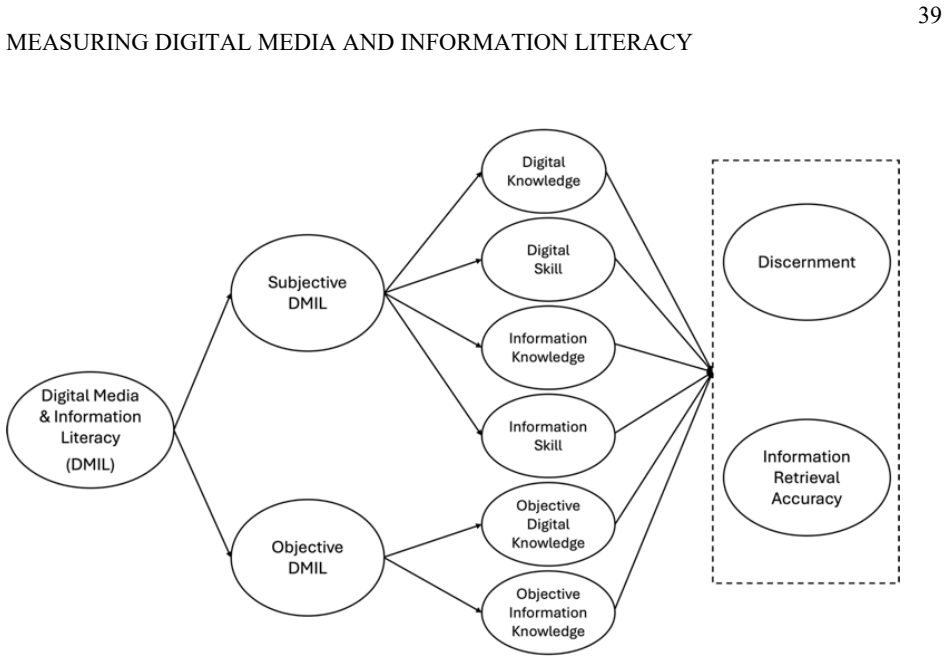
Researchers developed the DMILS as an 18-item self-report and 16-item objective scale to measure digital media and information literacy across the United States and Singapore.
A machine-rendered reading of the paper's core claim, the machinery that carries it, and where it could break.
Core claim
The authors developed the Digital Media and Information Literacy Scale (DMILS) as a multidimensional instrument consisting of an 18-item self-report battery and 16-item objective knowledge questions. Using three nationally matched samples from the United States and Singapore with a total N of 1,498, they demonstrate strong structural, convergent, and predictive validity and introduce a short form with 8 self-report and 8 objective items.
What carries the argument
The DMILS scale, which distinguishes domain (digital versus information/news), competency type (knowledge versus skill), and assessment method (subjective self-report versus objective questions).
If this is right
- The scale enables rigorous evaluation of media literacy interventions.
- It supplies a common metric for cross-national research on information competencies.
- The short form supports efficient assessment in large surveys or limited-resource settings.
- Higher DMILS scores can identify groups that may benefit from targeted support against misinformation.
Where Pith is reading between the lines
- Testing the scale in additional countries beyond the US and Singapore would check whether the same structure holds in more diverse settings.
- Pairing DMILS scores with longitudinal tracking of actual information-sharing behavior could test how well the measure predicts real resilience over time.
- Future studies could examine whether DMILS scores improve after specific digital education programs and whether gains differ by age or education level.
Load-bearing premise
The three nationally matched samples from the United States and Singapore provide a sufficient and representative basis for establishing cross-national structural, convergent, and predictive validity of the DMILS.
What would settle it
Administering the full DMILS to an independent sample in a third country and finding that the factor structure fails to replicate or that scale scores do not predict ability to identify misinformation would challenge the cross-national validity.
Figures


read the original abstract
Amid growing concern about information quality and credibility in digital media environments, researchers and educators still lack a concise, comprehensive yet psychometrically sound instrument for tracking the competencies that help people navigate this landscape. This article develops the Digital Media and Information Literacy Scale (DMILS), a robust and multidimensional measure that distinguishes domain (digital vs. information/news), competency type (knowledge vs. skill), and is measured through both subjective and objective items. Through two empirical studies with three nationally matched samples in the United States and Singapore (N = 1,498), we developed an 18-item self-report battery and 16-item objective knowledge questions, showing strong structural, convergent, and predictive validity, along with a short form (8 self-report and 8 objective items). By offering a parsimonious yet multidimensional yardstick, DMILS enables rigorous evaluation of media literacy interventions and supplies a common metric for cross-national research, critical for building an information ecosystem resilient to mis- and disinformation.
Editorial analysis
A structured set of objections, weighed in public.
Referee Report
Summary. The paper develops the Digital Media and Information Literacy Scale (DMILS), an 18-item self-report battery plus 16-item objective knowledge questions that distinguishes digital vs. information/news domains and knowledge vs. skill competencies. Using two empirical studies with three nationally matched samples from the United States and Singapore (N=1,498), the authors report strong structural, convergent, and predictive validity and supply a short form (8 self-report + 8 objective items) intended as a common metric for cross-national research on resilience to misinformation.
Significance. If the reported psychometric properties and cross-national equivalence hold, DMILS would supply a concise, multidimensional self-report and objective instrument that could be used to evaluate media-literacy interventions and to conduct comparable studies across countries.
major comments (2)
- [Abstract] Abstract: the claim of 'strong structural, convergent, and predictive validity' is asserted without any reported factor loadings, model-fit indices (CFI, RMSEA, SRMR), reliability coefficients, or exclusion criteria, preventing verification that the data support the stated conclusions.
- [Abstract and results sections] Abstract and results sections: the cross-national validity claim rests on three nationally matched samples from the US and Singapore, yet the manuscript does not report multi-group CFA or tests of measurement invariance (configural, metric, scalar) across countries. Without scalar invariance, mean-level comparisons and predictive-validity coefficients cannot be interpreted as equivalent, undermining the assertion that DMILS supplies a common metric for cross-national research.
minor comments (1)
- [Discussion] The two-country design (both high-income, digitally advanced nations) is narrow; the discussion should explicitly address the limits this places on generalizability to other cultural or economic contexts.
Simulated Author's Rebuttal
We thank the referee for their constructive comments on our manuscript developing the DMILS. We address each of the major comments below and outline the revisions we will make to strengthen the paper.
read point-by-point responses
-
Referee: [Abstract] Abstract: the claim of 'strong structural, convergent, and predictive validity' is asserted without any reported factor loadings, model-fit indices (CFI, RMSEA, SRMR), reliability coefficients, or exclusion criteria, preventing verification that the data support the stated conclusions.
Authors: The detailed psychometric results, including factor loadings, model fit indices (CFI, RMSEA, SRMR), reliability coefficients, and exclusion criteria, are presented in the Results section of the full manuscript. The abstract provides a high-level summary of these findings. To improve accessibility and allow immediate verification, we will revise the abstract to include key statistics such as the CFI, RMSEA, SRMR values, and reliability estimates for the DMILS scales. This revision will be made in the next version of the manuscript. revision: yes
-
Referee: [Abstract and results sections] Abstract and results sections: the cross-national validity claim rests on three nationally matched samples from the US and Singapore, yet the manuscript does not report multi-group CFA or tests of measurement invariance (configural, metric, scalar) across countries. Without scalar invariance, mean-level comparisons and predictive-validity coefficients cannot be interpreted as equivalent, undermining the assertion that DMILS supplies a common metric for cross-national research.
Authors: We recognize the importance of measurement invariance testing for cross-national research. Our study used nationally matched samples to support comparability, and we observed consistent patterns of validity across the US and Singapore samples. However, formal tests of configural, metric, and scalar invariance via multi-group CFA were not included in the original submission. We will conduct these analyses and report the results in the revised manuscript. Should scalar invariance not hold fully, we will discuss the limitations for mean comparisons and predictive validity, and consider partial invariance where appropriate. This will better support the use of DMILS as a common metric. revision: yes
Circularity Check
No significant circularity in empirical scale development
full rationale
The paper develops DMILS through two new empirical studies on three nationally matched samples (N=1,498) from the US and Singapore, establishing structural, convergent, and predictive validity via standard psychometric methods on fresh data. No load-bearing step reduces by construction to prior fitted parameters, self-defined quantities, or self-citation chains; the central claims rest on independent data collection and analysis that remains externally falsifiable.
Axiom & Free-Parameter Ledger
free parameters (1)
- Final item count and selection
axioms (1)
- domain assumption Self-report and objective items can jointly capture domain-specific knowledge and skill competencies in digital media and information literacy.
Lean theorems connected to this paper
-
IndisputableMonolith/Foundation/AbsoluteFloorClosure.lean, IndisputableMonolith/Cost/FunctionalEquation.leanreality_from_one_distinction, washburn_uniqueness_aczel unclear?
unclearRelation between the paper passage and the cited Recognition theorem.
Through two empirical studies with three nationally matched samples... we developed an 18-item self-report battery and 16-item objective knowledge questions, showing strong structural, convergent, and predictive validity
What do these tags mean?
- matches
- The paper's claim is directly supported by a theorem in the formal canon.
- supports
- The theorem supports part of the paper's argument, but the paper may add assumptions or extra steps.
- extends
- The paper goes beyond the formal theorem; the theorem is a base layer rather than the whole result.
- uses
- The paper appears to rely on the theorem as machinery.
- contradicts
- The paper's claim conflicts with a theorem or certificate in the canon.
- unclear
- Pith found a possible connection, but the passage is too broad, indirect, or ambiguous to say the theorem truly supports the claim.
Reference graph
Works this paper leans on
-
[1]
PDF 2. Spyware 3. Phishing 4. Hashtag 5. Chatbot 6. Algorithm 2. Digital Skill (DS) Instruction: Please select how much you agree or disagree with the following statements. (Strongly disagree to Strongly agree) 1. I know how to solve my own technical problems on digital devices and platforms. 2. I can learn new technologies easily. 3. I have the technical...
work page 2013
-
[2]
It has been scientifically established that cholesterol is present in animal organisms but not in plants. How would you best describe a TV commercial which claims that the sunflower oil manufactured by a particular producer contains no cholesterol? a. This is a valuable benefit, and it will encourage me to buy this brand of oil. b. This is manipulative an...
work page 2010
-
[3]
Image Headlines Instruction: Next, you will be shown four news posts, taken from various news and social media sites, each containing a photographic image and a text caption about what is going on in the photograph. Some of these photographs are correctly captioned, meaning that the text caption correctly represents what is happening in the image. Some ar...
discussion (0)
Sign in with ORCID, Apple, or X to comment. Anyone can read and Pith papers without signing in.