Coherence-Enhanced Quantum Battery Charging with Ergotropy Stabilization
Pith reviewed 2026-05-20 12:06 UTC · model grok-4.3
The pith
Initial charger coherence maximizes and stabilizes steady-state ergotropy in quantum batteries via dark-state protection.
A machine-rendered reading of the paper's core claim, the machinery that carries it, and where it could break.
Core claim
The paper establishes that initial charger coherence is the fundamental resource for maximizing and stabilizing steady-state ergotropy through dark-state protection. In the resource-efficient regime of comparable charger and battery sizes, internal charger coherence and reservoir squeezing jointly enhance transient charging power, with the advantages driven by the buildup of local battery coherence that integrates both internal and external coherence sources.
What carries the argument
Dark-state protection that uses initial charger coherence to shield ergotropy from dissipation while integrating reservoir squeezing as an external coherence source.
Load-bearing premise
Dark-state protection combined with the interplay of internal charger coherence and reservoir squeezing can counteract environment-induced dissipation without creating new loss channels when charger and battery sizes are comparable.
What would settle it
Measure steady-state ergotropy in a quantum battery experiment with and without prepared initial charger coherence under reservoir squeezing; the prediction fails if ergotropy does not reach a higher, more stable value when initial coherence is supplied.
Figures
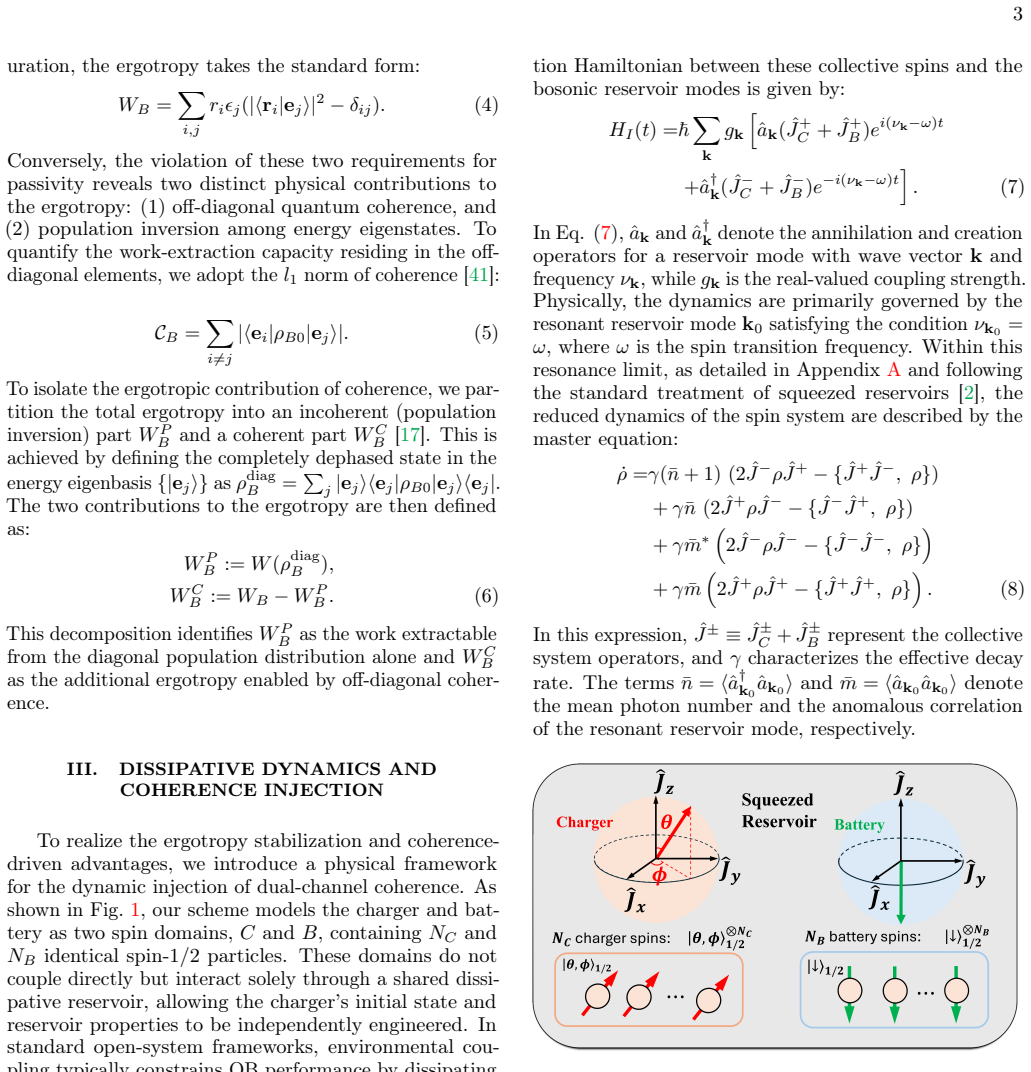


read the original abstract
Quantum batteries utilize nonclassical resources to achieve charging speed and energy storage performances that surpass classical thermodynamic limits. However, the practical realization of quantum batteries is often constrained by the inevitable environment-induced dissipation of both stored ergotropy and coherence. To actively counteract these losses, we propose a dual-channel coherence framework that exploits dark-state protection to stabilize ergotropy. We conduct, for the first time, an investigation of the synergistic interplay between internal charger coherence and reservoir squeezing, the latter acting as a source of external coherence. In the resource-efficient regime where charger and battery sizes are comparable, our study shows that internal charger coherence and reservoir squeezing jointly enhance the transient charging power. Crucially, initial charger coherence is the fundamental resource for maximizing and stabilizing steady-state ergotropy through dark-state protection. Our analysis reveals that these advantages are driven by the buildup of local battery coherence, which emerges from the integration of both internal and external coherence sources. These results offer a robust pathway for high-power, stabilized energy storage in quantum architectures.
Editorial analysis
A structured set of objections, weighed in public.
Referee Report
Summary. The manuscript proposes a dual-channel coherence framework for quantum batteries that exploits dark-state protection to stabilize ergotropy against environmental dissipation. It investigates the interplay between internal charger coherence and external coherence supplied by reservoir squeezing, focusing on the resource-efficient regime of comparable charger and battery sizes. The central claim is that initial charger coherence serves as the fundamental resource for maximizing and stabilizing steady-state ergotropy, with advantages arising from the resulting buildup of local battery coherence.
Significance. If the results hold, the work identifies a concrete mechanism for counteracting dissipation in quantum batteries using readily available coherence resources, which could improve both charging power and long-term energy storage stability in finite-size systems. The emphasis on the comparable-size regime addresses a practical constraint for scalable quantum devices.
major comments (2)
- [Model and Results sections] The central claim that dark-state protection plus internal coherence and reservoir squeezing stabilizes steady-state ergotropy without introducing new loss channels in the comparable-size regime (abstract and model section) requires explicit verification. The interaction term generating the dark state can still permit leakage once the charger and battery Hilbert-space dimensions become comparable; the manuscript should demonstrate that the steady-state ergotropy remains insensitive to small detunings and to the precise form of the squeezing operator, for example via analytic bounds or targeted numerical scans.
- [Results section] §3 (or equivalent results section): the reported enhancement of transient charging power and the buildup of local battery coherence must be shown to survive when the reservoir squeezing parameter and initial charger coherence strength are varied independently; if these quantities are the only free parameters, the advantage should be quantified relative to the case with zero initial coherence to confirm it is not an artifact of normalization.
minor comments (2)
- [Introduction] The abstract states that the study is conducted 'for the first time' on the synergistic interplay; a brief comparison paragraph in the introduction with the most closely related prior works on coherence-assisted charging would strengthen this positioning.
- [Model section] Notation for the dual-channel coherence framework and the definition of ergotropy in the open-system setting should be introduced with a single equation reference early in the model section to improve readability.
Simulated Author's Rebuttal
We thank the referee for the careful reading and constructive feedback on our manuscript. We address each major comment in detail below and will incorporate revisions to strengthen the verification of our claims.
read point-by-point responses
-
Referee: [Model and Results sections] The central claim that dark-state protection plus internal coherence and reservoir squeezing stabilizes steady-state ergotropy without introducing new loss channels in the comparable-size regime (abstract and model section) requires explicit verification. The interaction term generating the dark state can still permit leakage once the charger and battery Hilbert-space dimensions become comparable; the manuscript should demonstrate that the steady-state ergotropy remains insensitive to small detunings and to the precise form of the squeezing operator, for example via analytic bounds or targeted numerical scans.
Authors: We agree that explicit verification of robustness is necessary in the comparable-size regime. Our analysis indicates that the dark-state protection, combined with the buildup of local battery coherence, prevents leakage under the considered conditions, but we acknowledge that additional checks would strengthen the central claim. In the revised manuscript, we will add targeted numerical scans over small detunings and different forms of the squeezing operator, along with analytic bounds where possible, to confirm that steady-state ergotropy remains insensitive and no new loss channels are introduced. revision: yes
-
Referee: [Results section] §3 (or equivalent results section): the reported enhancement of transient charging power and the buildup of local battery coherence must be shown to survive when the reservoir squeezing parameter and initial charger coherence strength are varied independently; if these quantities are the only free parameters, the advantage should be quantified relative to the case with zero initial coherence to confirm it is not an artifact of normalization.
Authors: We will revise the results section to explicitly vary the reservoir squeezing parameter and initial charger coherence strength independently. We will also include direct comparisons to the zero initial coherence case, quantifying the relative enhancement in transient charging power and local battery coherence to demonstrate that the advantages are not normalization artifacts. revision: yes
Circularity Check
No significant circularity; derivation relies on standard open-system master equations
full rationale
The abstract and skeptic summary describe a model using dark-state protection, internal charger coherence, and reservoir squeezing to stabilize ergotropy in a quantum battery. No equations or self-citations are provided that reduce the central claims (e.g., steady-state ergotropy maximization) to fitted parameters or definitions by construction. The framework appears to solve a Lindblad master equation with coherence terms as inputs and ergotropy as an output observable, which is a standard non-circular procedure. Without explicit reduction of predictions to input normalizations or self-citation load-bearing, the derivation chain is self-contained against external benchmarks.
Axiom & Free-Parameter Ledger
free parameters (2)
- initial charger coherence strength
- reservoir squeezing parameter
axioms (2)
- standard math Dynamics of the charger-battery system are described by a quantum master equation that includes dissipation channels.
- domain assumption Dark states exist and can protect ergotropy against selected decoherence processes.
invented entities (1)
-
dual-channel coherence framework
no independent evidence
Reference graph
Works this paper leans on
-
[1]
Coherence-Enhanced Quantum Battery Charging with Ergotropy Stabilization
or active feedback control require external energy costs that can reduce the net energy gain [20]. These limitations suggest that many stabilization protocols ef- fectively force a trade-off between charging efficiency and storage longevity. One way to avoid these trade-offs is arXiv:2605.17700v1 [quant-ph] 17 May 2026 2 passive stabilization via dark-sta...
work page internal anchor Pith review Pith/arXiv arXiv 2026
-
[2]
Dicke Basis Expansion of the Charger State The charger is initialized in the collective spin- coherent state |θ, ϕ⟩C, defined by the rotation|θ, ϕ⟩C = ˆRz(ϕ) ˆRy(θ)|J, J⟩. Expanding this state in the Dicke basis |J, M⟩yields: |θ, ϕ⟩C = JX M=−J CM(θ, ϕ)|J, M⟩,(B1) where the coefficients are given by the generalized bino- mial distribution: CM(θ, ϕ) = s 2J ...
-
[3]
Dependence on Relative Phase The system dynamics are governed by a single com- bined phase parameterδ, rather than by the charger phase ϕ and reservoir phaseφ independently. As established in Sec. III, the evolution is governed by the master equation ˙ρ= 2 ˆLφρˆL† φ − ˆL† φ ˆLφρ−ρ ˆL† φ ˆLφ. Crucially, the jump operator defined in Eq. (11) carries the res...
-
[4]
M. O. Scully, M. S. Zubairy, G. S. Agarwal, and H. Walther, Extracting work from a single heat bath via vanishing quantum coherence, Science299, 862 (2003)
work page 2003
-
[5]
G. Agarwal and R. Puri, Cooperative behavior of atoms irradiated by broadband squeezed light, Physical Review A41, 3782 (1990)
work page 1990
-
[6]
R.H.Dicke,Coherenceinspontaneousradiationprocesses, Physical Review93, 99 (1954)
work page 1954
-
[7]
D. Ferraro, M. Campisi, G. M. Andolina, V. Pellegrini, and M. Polini, High-power collective charging of a solid- state quantum battery, Physical Review Letters120, 117702 (2018)
work page 2018
-
[8]
F. Campaioli, F. A. Pollock, F. C. Binder, L. Céleri, J. Goold, S. Vinjanampathy, and K. Modi, Enhancing the charging power of quantum batteries, Physical Review Letters118, 150601 (2017)
work page 2017
-
[9]
R. Alicki and M. Fannes, Entanglement boost for ex- tractable work from ensembles of quantum batteries, Phys- ical Review E—Statistical, Nonlinear, and Soft Matter Physics87, 042123 (2013)
work page 2013
-
[10]
F. Campaioli, S. Gherardini, J. Q. Quach, M. Polini, and G. M. Andolina, Colloquium: quantum batteries, Reviews of Modern Physics96, 031001 (2024)
work page 2024
-
[11]
D. Ferraro, F. Cavaliere, M. G. Genoni, G. Benenti, and M. Sassetti, Opportunities and challenges of quantum batteries, Nature Reviews Physics , 1 (2026)
work page 2026
-
[12]
G. M. Andolina, M. Keck, A. Mari, M. Campisi, V. Gio- vannetti, and M. Polini, Extractable work, the role of correlations, and asymptotic freedom in quantum batter- ies, Physical review letters122, 047702 (2019)
work page 2019
- [13]
- [14]
-
[15]
A. Ferreri, H. Wang, F. Nori, F. K. Wilhelm, and D. E. Bruschi, Quantum heat engine based on quantum inter- ferometry: The SU (1, 1) Otto cycle, Physical Review Research7, 013284 (2025)
work page 2025
-
[16]
F. Centrone, L. Mancino, and M. Paternostro, Charging batteries with quantum squeezing, Physical Review A 16 108, 052213 (2023)
work page 2023
-
[17]
H. Li, H. Ma, Y. Hao, and W. Yu, Enhancing ergotropy of a quantum battery with coherent chargers: The cata- lystlike role of indefinite causal order, Physical Review A 112, 042229 (2025)
work page 2025
- [18]
-
[19]
A. E. Allahverdyan, R. Balian, and T. M. Nieuwenhuizen, Maximal work extraction from finite quantum systems, Europhysics Letters67, 565 (2004)
work page 2004
-
[20]
G. Francica, F. C. Binder, G. Guarnieri, M. T. Mitchi- son, J. Goold, and F. Plastina, Quantum coherence and ergotropy, Physical Review Letters125, 180603 (2020)
work page 2020
-
[21]
J. Liu, D. Segal, and G. Hanna, Loss-free excitonic quan- tum battery, The Journal of Physical Chemistry C123, 18303 (2019)
work page 2019
-
[22]
S. Gherardini, F. Campaioli, F. Caruso, and F. C. Binder, Stabilizing open quantum batteries by sequential mea- surements, Physical Review Research2, 013095 (2020)
work page 2020
-
[23]
M. T. Mitchison, J. Goold, and J. Prior, Charging a quantum battery with linear feedback control, Quantum 5, 500 (2021)
work page 2021
-
[24]
F. Pirmoradian and K. Mølmer, Aging of a quantum battery, Physical Review A100, 043833 (2019)
work page 2019
-
[25]
J. Q. Quach and W. J. Munro, Using Dark States to Charge and Stabilize Open Quantum Batteries, Phys. Rev. Appl.14, 024092 (2020)
work page 2020
-
[26]
J.-Y. Gyhm, D. Šafránek, and D. Rosa, Quantum charging advantage cannot be extensive without global operations, Physical Review Letters128, 140501 (2022)
work page 2022
-
[27]
F. C. Binder, S. Vinjanampathy, K. Modi, and J. Goold, Quantacell: powerful charging of quantum batteries, New Journal of Physics17, 075015 (2015)
work page 2015
-
[28]
R. R. Rodríguez, B. Ahmadi, G. Suárez, P. Mazurek, S. Barzanjeh, and P. Horodecki, Optimal quantum control of charging quantum batteries, New Journal of Physics 26, 043004 (2024)
work page 2024
-
[29]
Auffèves, Quantum technologies need a quantum en- ergy initiative, PRX Quantum3, 020101 (2022)
A. Auffèves, Quantum technologies need a quantum en- ergy initiative, PRX Quantum3, 020101 (2022)
work page 2022
-
[30]
M.Fellous-Asiani, J.H.Chai, Y.Thonnart, H.K.Ng, R.S. Whitney, and A. Auffèves, Optimizing resource efficiencies for scalable full-stack quantum computers, PRX Quantum 4, 040319 (2023)
work page 2023
-
[31]
F. Mayo and A. J. Roncaglia, Collective effects and quan- tum coherence in dissipative charging of quantum batter- ies, Physical Review A105, 062203 (2022)
work page 2022
-
[32]
I. D. Leroux, M. H. Schleier-Smith, and V. Vuletić, Im- plementation of cavity squeezing of a collective atomic spin, Physical Review Letters104, 073602 (2010)
work page 2010
- [33]
-
[34]
R. Auccaise Estrada, E. R. de Azevedo, E. I. Duzzioni, T. J. Bonagamba, and M. H. Youssef Moussa, Spin coher- ent states in NMR quadrupolar system: experimental and theoretical applications, The European Physical Journal D67, 127 (2013)
work page 2013
-
[35]
J. Joshi and T. Mahesh, Experimental investigation of a quantum battery using star-topology nmr spin systems, Physical Review A106, 042601 (2022)
work page 2022
-
[36]
A. Angerer, K. Streltsov, T. Astner, S. Putz, H. Sumiya, S. Onoda, J. Isoya, W. J. Munro, K. Nemoto, J. Schmied- mayer,et al., Superradiant emission from colour centres in diamond, Nature Physics14, 1168 (2018)
work page 2018
- [37]
- [38]
- [39]
-
[40]
J. Q. Quach, K. E. McGhee, L. Ganzer, D. M. Rouse, B. W. Lovett, E. M. Gauger, J. Keeling, G. Cerullo, D. G. Lidzey, and T. Virgili, Superabsorption in an organic microcavity: Toward a quantum battery, Science advances 8, eabk3160 (2022)
work page 2022
-
[41]
Z. Niu, Y. Wu, Y. Wang, X. Rong, and J. Du, Experi- mental investigation of coherent ergotropy in a single spin system, Physical Review Letters133, 180401 (2024)
work page 2024
-
[42]
I. Maillette de Buy Wenniger, S. E. Thomas, M. Maffei, S. C. Wein, M. Pont, N. Belabas, S. Prasad, A. Harouri, A. Lemaître, I. Sagnes, N. Somaschi, A. Auffèves, and P. Senellart, Experimental analysis of energy transfers between a quantum emitter and light fields, Phys. Rev. Lett.131, 260401 (2023)
work page 2023
-
[43]
C.-K. Hu, C. Liu, J. Zhao, L. Zhong, Y. Zhou, M. Liu, H. Yuan, Y. Lin, Y. Xu, G. Hu, G. Xie, Z. Liu, R. Zhou, Y. Ri, W. Zhang, R. Deng, A. Saguia, X. Linpeng, M. S. Sarandy, S. Liu, A. C. Santos, D. Tan, and D. Yu, Quan- tum charging advantage in superconducting solid-state batteries, Phys. Rev. Lett.136, 060401 (2026)
work page 2026
-
[44]
T. Baumgratz, M. Cramer, and M. B. Plenio, Quantifying coherence, Physical review letters113, 140401 (2014)
work page 2014
-
[45]
J. M. Radcliffe, Some properties of coherent spin states, Journal of Physics A: General Physics4, 313 (1971)
work page 1971
-
[46]
F. T. Arecchi, E. Courtens, R. Gilmore, and H. Thomas, Atomic coherent states in quantum optics, Physical Re- view A6, 2211 (1972)
work page 1972
- [47]
-
[48]
K. V. Hovhannisyan, M. Perarnau-Llobet, M. Huber, and A. Acín, Entanglement generation is not necessary for optimal work extraction, Physical review letters111, 240401 (2013)
work page 2013
-
[49]
G. Vidal and R. F. Werner, Computable measure of en- tanglement, Physical Review A65, 032314 (2002)
work page 2002
-
[50]
M. B. Plenio, Logarithmic negativity: a full entanglement monotone that is not convex, Physical review letters95, 090503 (2005)
work page 2005
-
[51]
J. Y. Qiu, A. Grimsmo, K. Peng, B. Kannan, B. Lienhard, Y. Sung, P. Krantz, V. Bolkhovsky, G. Calusine, D. Kim, et al., Broadband squeezed microwaves and amplification with a josephson travelling-wave parametric amplifier, Nature Physics19, 706 (2023)
work page 2023
-
[52]
A. Bienfait, J. Pla, Y. Kubo, X. Zhou, M. Stern, C. Lo, C. Weis, T. Schenkel, D. Vion, D. Esteve,et al., Con- trolling spin relaxation with a cavity, Nature531, 74 (2016). 17
work page 2016
-
[53]
C. Aragone, G. Guerri, S. Salamo, and J. Tani, Intelligent spin states, Journal of Physics A: Mathematical, Nuclear and General7, L149 (1974)
work page 1974
-
[54]
Rashid, The intelligent states
M. Rashid, The intelligent states. i. group-theoretic study and the computation of matrix elements, Journal of Math- ematical Physics19, 1391 (1978)
work page 1978
discussion (0)
Sign in with ORCID, Apple, or X to comment. Anyone can read and Pith papers without signing in.