Modulating hydrodynamic flow by modifying the active patch of a colloid
Pith reviewed 2026-05-20 00:22 UTC · model grok-4.3
The pith
Varying the size of an active surface patch on a colloid switches its generated hydrodynamic flow from pusher-type to puller-type.
A machine-rendered reading of the paper's core claim, the machinery that carries it, and where it could break.
Core claim
The authors show that systematically varying the surface area of the active patch on the colloid changes the nature of the generated flow field from that of a pusher to a puller. The model uses multi-particle collision dynamics with momentum exchange at the active surface, where fluid is driven radially away from or toward the patch, imparting opposite momentum to the colloid for self-propulsion.
What carries the argument
The active surface patch whose area is varied to control the flow field type, implemented via a hybrid boundary condition that combines no-slip enforcement with stochastic momentum exchange.
If this is right
- Self-propulsion emerges in the Brownian colloid due to the surface-driven flow.
- The model enables study of effective hydrodynamic interactions between active and passive colloids by adjusting patch size.
- Interactions between two active colloids can be modulated similarly.
- Future simulations can explore collective behaviors in systems with tunable pusher or puller characteristics.
Where Pith is reading between the lines
- This patch-size control could serve as a design principle for engineering specific flow fields in synthetic active matter without changing particle shape or chemistry.
- Experimental realizations with patchy colloids activated by light or chemical gradients might reproduce the pusher-to-puller transition.
- Such modulation might affect the stability of clusters or the rheology of active suspensions in ways not captured by fixed-type approximations.
Load-bearing premise
The hybrid boundary condition correctly enforces no-slip while allowing momentum exchange between the MPC fluid and colloid surface without introducing artifacts that alter the far-field flow type.
What would settle it
Direct measurement or simulation of the velocity field far from the colloid for patches of varying fractional area, checking if the flow signature crosses from pusher (outward along axis) to puller (inward).
Figures


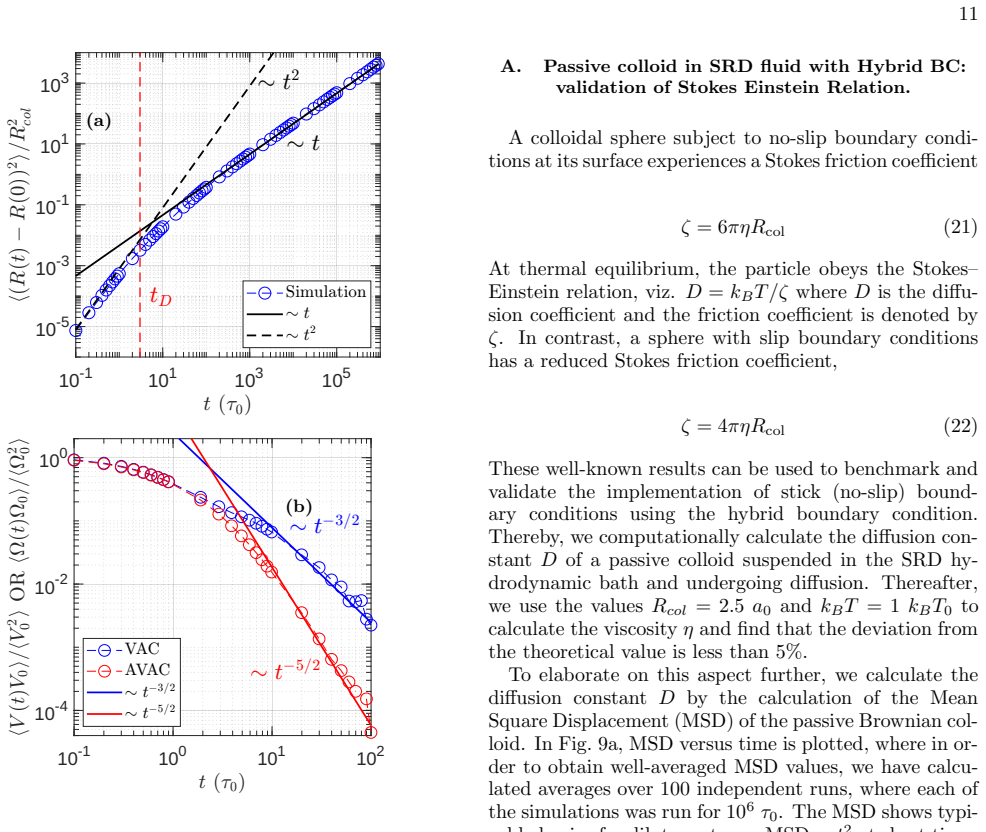


read the original abstract
We have developed a simulation model to study the hydrodynamic flow fields around Brownian colloidal particles with an active surface patch. Hydrodynamics is introduced by modeling low-Reynolds-number fluid flows around a colloid using multi-particle collision (MPC) dynamics and allowing momentum exchange between the MPC fluid and the colloid. This approach provides good estimates of both near- and far-field flows around the colloid. The size of the active patch is varied to generate different fluid flow fields around the colloid. In this framework, the fluid in the vicinity of the active patch is driven radially away from (or toward) the surface, and an equal and opposite momentum is imparted to the colloid to ensure momentum conservation. The resulting surface-driven flow generates self-propulsion of the particle, thereby converting an otherwise Brownian colloid into an active Brownian particle. Interestingly, as we systematically vary the surface area of the active patch on the colloid, the nature of the generated flow field changes from that of a pusher to a puller. To model such surface activity-driven flows, we developed a hybrid boundary condition that ensures a no-slip condition while incorporating momentum exchange between the flowing fluid and the colloid surface. This scheme integrates the advantages of bounce-back and stochastic boundary conditions while mitigating their respective limitations. Thus, in future studies, the effective hydrodynamic interactions between an active and a passive colloid, or between two active colloids, can be modulated by adjusting the size of the active patch.
Editorial analysis
A structured set of objections, weighed in public.
Referee Report
Summary. The manuscript presents an MPC-dynamics simulation of a Brownian colloid equipped with a tunable active surface patch. Radial activity is imposed on the patch while an equal-and-opposite momentum is imparted to the particle; a hybrid bounce-back/stochastic boundary condition is introduced to enforce no-slip at the colloid surface while permitting momentum exchange. Systematic variation of the active-patch area fraction is reported to drive a transition in the far-field flow from pusher-type to puller-type, thereby converting the particle into an active Brownian swimmer whose hydrodynamic signature can be modulated by patch size.
Significance. If the reported pusher-to-puller crossover survives quantitative validation, the work supplies a concrete, experimentally accessible handle (patch area) for tuning the hydrodynamic dipole of active colloids. This could directly inform design of micro-swimmers and studies of hydrodynamic interactions between active and passive particles. The hybrid boundary-condition scheme itself may be reusable in other MPC studies of surface-driven flows.
major comments (2)
- [hybrid boundary condition implementation] Section describing the hybrid boundary condition: the claim that the scheme 'ensures a no-slip condition while incorporating momentum exchange' without altering the far-field flow type is load-bearing for the central result, yet no quantitative test is provided that the extracted force-dipole coefficient retains the correct sign for patch radii below ~0.4R. In MPC, local momentum injection on the lattice can generate spurious higher-order multipoles that decay slower than 1/r^3; without a direct comparison to analytic squirmer solutions or a convergence study versus collision-cell size, it remains possible that the observed crossover is an artifact of the discrete implementation rather than a physical effect of patch area.
- [results on flow fields] Results section on flow-field characterization: the transition from pusher to puller is asserted on the basis of visual or qualitative inspection of streamlines, but the manuscript supplies neither error bars on the measured velocity fields nor an explicit definition of the dipole sign (e.g., the coefficient of the 1/r^2 term in the far-field expansion). Without these, the sharpness and robustness of the reported crossover cannot be assessed.
minor comments (2)
- [abstract] The abstract states that 'an equal and opposite momentum is imparted to the colloid'; a brief clarification of how this is implemented numerically (e.g., via direct force application or velocity rescaling) would improve reproducibility.
- [figures] Figure captions should explicitly state the patch area fractions shown and the distance at which the flow field is sampled to distinguish near-field from far-field behavior.
Simulated Author's Rebuttal
We thank the referee for their thorough review and valuable feedback on our manuscript. We appreciate the opportunity to clarify and strengthen our presentation of the hybrid boundary condition and the flow field analysis. Below, we provide detailed responses to the major comments and indicate the revisions we will implement.
read point-by-point responses
-
Referee: [hybrid boundary condition implementation] Section describing the hybrid boundary condition: the claim that the scheme 'ensures a no-slip condition while incorporating momentum exchange' without altering the far-field flow type is load-bearing for the central result, yet no quantitative test is provided that the extracted force-dipole coefficient retains the correct sign for patch radii below ~0.4R. In MPC, local momentum injection on the lattice can generate spurious higher-order multipoles that decay slower than 1/r^3; without a direct comparison to analytic squirmer solutions or a convergence study versus collision-cell size, it remains possible that the observed crossover is an artifact of the discrete implementation rather than a physical effect of patch area.
Authors: We acknowledge the referee's valid concern regarding potential numerical artifacts in the MPC simulations. The hybrid boundary condition was designed to enforce no-slip while allowing momentum exchange, and our tests during development indicated that the far-field behavior aligns with expectations. However, to address this rigorously, in the revised manuscript we will add a quantitative comparison of the simulated velocity field for small patch sizes (below 0.4R) to the analytic squirmer solution, confirming the correct (negative) sign of the force-dipole coefficient. We will also include a convergence study varying the collision cell size to demonstrate that the pusher-to-puller transition is not affected by discretization effects. These additions will provide stronger evidence that the crossover is physical. revision: yes
-
Referee: [results on flow fields] Results section on flow-field characterization: the transition from pusher to puller is asserted on the basis of visual or qualitative inspection of streamlines, but the manuscript supplies neither error bars on the measured velocity fields nor an explicit definition of the dipole sign (e.g., the coefficient of the 1/r^2 term in the far-field expansion). Without these, the sharpness and robustness of the reported crossover cannot be assessed.
Authors: We agree that a more quantitative presentation would enhance the clarity and credibility of our results. In the revised version, we will include error bars on the velocity field data, derived from averages over an ensemble of independent simulation runs. Additionally, we will explicitly define and report the dipole coefficient by fitting the far-field velocity to the expected 1/r^2 decay term and extracting its sign and magnitude as a function of patch area. This will allow readers to evaluate the sharpness of the transition and its statistical robustness. revision: yes
Circularity Check
Direct MPC simulation of patch-size variation yields pusher-to-puller transition with no definitional or self-citation reduction
full rationale
The manuscript reports results from explicit multi-particle collision dynamics simulations in which the active patch area is an independent input parameter that is varied systematically. The observed change in far-field flow character (pusher versus puller) is an output of the numerical integration under the stated hybrid boundary condition; no equation, fitted coefficient, or uniqueness theorem is defined in terms of the same flow-type classification, and no load-bearing step reduces to a prior self-citation or ansatz that already encodes the target result. The derivation chain is therefore self-contained against external benchmarks.
Axiom & Free-Parameter Ledger
free parameters (2)
- active patch area fraction
- activity strength (radial velocity at patch)
axioms (2)
- domain assumption Low-Reynolds-number flow around a sphere can be accurately captured by MPC with momentum exchange at the surface.
- ad hoc to paper The hybrid boundary condition preserves both no-slip and global momentum conservation without spurious torques or forces.
Reference graph
Works this paper leans on
-
[1]
The hydrodynam- ics of swimming microorganisms.Reports on progress in physics, 72(9):096601, 2009
Eric Lauga and Thomas R Powers. The hydrodynam- ics of swimming microorganisms.Reports on progress in physics, 72(9):096601, 2009
work page 2009
-
[2]
Praneet Prakash, Marco Vona, and Raymond E Gold- stein. Feeders and expellers, two types of animalcules with outboard cilia, have distinct surface interactions. Physical Review Fluids, 9(10):103101, 2024
work page 2024
-
[3]
Raymond E Goldstein. Green algae as model organisms for biological fluid dynamics.Annual review of fluid me- chanics, 47(1):343–375, 2015
work page 2015
-
[4]
Bacterial hydrodynamics.Annual Review of Fluid Mechanics, 48(1):105–130, 2016
Eric Lauga. Bacterial hydrodynamics.Annual Review of Fluid Mechanics, 48(1):105–130, 2016
work page 2016
-
[5]
Sourav Ganguly and Kiran Raj. Hydrodynamics of biomicroswimmers: A comprehensive review of theoret- ical foundations, locomotion strategies, and emerging frontiers.European Journal of Mechanics-B/Fluids, page 204529, 2026
work page 2026
-
[6]
Sourav Ganguly et al. Hydrodynamics of squirmers: A review on stokesian principles, analytical frameworks, and recent advances.Physics of Fluids, 37(12), 2025
work page 2025
-
[7]
Generalized squirming motion of a sphere.Journal of Engineering Mathematics, 88(1):1–28, 2014
On Shun Pak and Eric Lauga. Generalized squirming motion of a sphere.Journal of Engineering Mathematics, 88(1):1–28, 2014
work page 2014
-
[8]
Michael James Lighthill. On the squirming motion of nearly spherical deformable bodies through liquids at very small reynolds numbers.Communications on pure and applied mathematics, 5(2):109–118, 1952
work page 1952
-
[9]
A spherical envelope approach to ciliary propulsion.Journal of Fluid Mechanics, 46(1):199–208, 1971
John R Blake. A spherical envelope approach to ciliary propulsion.Journal of Fluid Mechanics, 46(1):199–208, 1971
work page 1971
-
[10]
Timothy J Pedley. Spherical squirmers: models for swim- ming micro-organisms.IMA Journal of Applied Mathe- matics, 81(3):488–521, 2016
work page 2016
-
[11]
Knut Drescher, Raymond E Goldstein, Nicolas Michel, Marco Polin, and Idan Tuval. Direct measurement of the flow field around swimming microorganisms.Physical Review Letters, 105(16):168101, 2010
work page 2010
-
[12]
Knut Drescher, J¨ orn Dunkel, Luis H Cisneros, Sujoy Ganguly, and Raymond E Goldstein. Fluid dynamics and noise in bacterial cell–cell and cell–surface scatter- ing.Proceedings of the National Academy of Sciences, 108(27):10940–10945, 2011
work page 2011
-
[13]
Enkeleida Lushi, Hugo Wioland, and Raymond E Gold- stein. Fluid flows created by swimming bacteria drive self-organization in confined suspensions.Proceedings of the National Academy of Sciences, 111(27):9733–9738, 2014
work page 2014
-
[14]
Knut Drescher, Kyriacos C Leptos, Idan Tuval, Takuji Ishikawa, Timothy J Pedley, and Raymond E Goldstein. Dancing volvox: hydrodynamic bound states of swim- ming algae.Physical review letters, 102(16):168101, 2009
work page 2009
-
[15]
The 2025 motile active matter roadmap.Journal of Physics: Condensed Matter, 37(14):143501, 2025
Gerhard Gompper, Howard A Stone, Christina Kurzthaler, David Saintillan, Fernado Peruani, Dmitry A Fedosov, Thorsten Auth, Cecile Cottin- Bizonne, Christophe Ybert, Eric Cl´ ement, et al. The 2025 motile active matter roadmap.Journal of Physics: Condensed Matter, 37(14):143501, 2025
work page 2025
-
[16]
Benno Liebchen and Hartmut Lowen. Synthetic chemo- taxis and collective behavior in active matter.Accounts of chemical research, 51(12):2982–2990, 2018
work page 2018
-
[17]
Theory of ac- tive suspensions
David Saintillan and Michael J Shelley. Theory of ac- tive suspensions. InComplex fluids in biological sys- tems: Experiment, theory, and computation, pages 319–
-
[18]
Zuyao Xiao, Juliane Simmchen, Ignacio Pagonabarraga, and Marco De Corato. Ionic diffusiophoresis of active colloids via galvanic exchange reactions.Nano Letters, 25(19):7975–7980, 2025
work page 2025
-
[19]
Phoretic motion in active matter.Journal of Fluid Mechanics, 922:A10, 2021
John F Brady. Phoretic motion in active matter.Journal of Fluid Mechanics, 922:A10, 2021. 19
work page 2021
-
[20]
Stefano Palagi, Andrew G Mark, Shang Yik Reigh, Kai Melde, Tian Qiu, Hao Zeng, Camilla Parmeg- giani, Daniele Martella, Alberto Sanchez-Castillo, Nadia Kapernaum, et al. Structured light enables biomimetic swimming and versatile locomotion of photoresponsive soft microrobots.Nature materials, 15(6):647–653, 2016
work page 2016
-
[21]
Technology roadmap of micro/nanorobots.ACS nano, 19(27):24174–24334, 2025
Xiaohui Ju, Chuanrui Chen, Cagatay M Oral, Semih Se- vim, Ramin Golestanian, Mengmeng Sun, Negin Bouzari, Xiankun Lin, Mario Urso, Jong Seok Nam, et al. Technology roadmap of micro/nanorobots.ACS nano, 19(27):24174–24334, 2025
work page 2025
-
[22]
Bioinspired micro- robots.Nature Reviews Materials, 3(6):113–124, 2018
Stefano Palagi and Peer Fischer. Bioinspired micro- robots.Nature Reviews Materials, 3(6):113–124, 2018
work page 2018
-
[23]
Niyou Wang, Yipei Yang, Zahra Rezaei, Mar´ ıa Jos´ e Veana Hern´ andez, Kannan Govindaraj, Car- olina Vazquez Garzon, Marina Colin, Alan de Je- sus Alarcon Rodr´ ıguez, Alvaro Dario Martinez Blanco, Jose Joaquin Velasco, et al. Advanced biofabri- cation techniques of muscle cell-powered biohybrid robots.International Journal of Extreme Manufactur- ing, 8(...
work page 2026
-
[24]
Microrobots for pulmonary drug delivery
Zhengxing Li, Hao Luan, Zheng Fang, Shichao Ding, Robert Kobrin, Ronnie H Fang, Liangfang Zhang, and Joseph Wang. Microrobots for pulmonary drug delivery. Nature Reviews Bioengineering, pages 1–17, 2026
work page 2026
-
[25]
Enzyme-powered hollow mesoporous janus nanomotors.Nano letters, 15(10):7043–7050, 2015
Xing Ma, Anita Jannasch, Urban-Raphael Albrecht, Ker- sten Hahn, Albert Miguel-L´ opez, Erik Schaffer, and Samuel S´ anchez. Enzyme-powered hollow mesoporous janus nanomotors.Nano letters, 15(10):7043–7050, 2015
work page 2015
-
[26]
Songsong Tang, Fangyu Zhang, Hua Gong, Fanan Wei, Jia Zhuang, Emil Karshalev, Berta Esteban- Fern´ andez de ´Avila, Chuying Huang, Zhidong Zhou, Zhengxing Li, et al. Enzyme-powered janus platelet cell robots for active and targeted drug delivery.Science Robotics, 5(43):eaba6137, 2020
work page 2020
-
[27]
Songsong Tang, Daitian Tang, Houhong Zhou, Yangyang Li, Dewang Zhou, Xiqi Peng, Chunyu Ren, Yilin Su, Shaohua Zhang, Haoxiang Zheng, et al. Bacterial outer membrane vesicle nanorobot.Proceedings of the National Academy of Sciences, 121(30):e2403460121, 2024
work page 2024
-
[28]
Zuochen Wang, Zhisheng Wang, Jiahui Li, Simon Tsz Hang Cheung, Changhao Tian, Shin-Hyun Kim, Gi- Ra Yi, Etienne Ducrot, and Yufeng Wang. Active patchy colloids with shape-tunable dynamics.Journal of the American Chemical Society, 141(37):14853–14863, 2019
work page 2019
-
[29]
Mihail N Popescu, Bogdan A Nicola, William E Uspal, Alvaro Dom´ ınguez, and Szilveszter G´ asp´ ar. Hydrody- namic stokes flow induced by a chemically active patch imprinted on a planar wall.Journal of Colloid and In- terface Science, 690:137296, 2025
work page 2025
-
[30]
Shape- anisotropic colloids at interfaces.Langmuir, 35(1):3–20, 2018
Thriveni G Anjali and Madivala G Basavaraj. Shape- anisotropic colloids at interfaces.Langmuir, 35(1):3–20, 2018
work page 2018
-
[31]
Programmable hydrodynamics of active particles.arXiv preprint arXiv:2512.20752, 2025
Lisa Rohde, Gordei Anchutkin, Viktor Holubec, and Frank Cichos. Programmable hydrodynamics of active particles.arXiv preprint arXiv:2512.20752, 2025
-
[32]
Marco De Corato, Xavier Arqu´ e, Tania Pati˜ no, Marino Arroyo, Samuel S´ anchez, and Ignacio Pagonabarraga. Self-propulsion of active colloids via ion release: Theory and experiments.Physical review letters, 124(10):108001, 2020
work page 2020
-
[33]
Andrea Scagliarini and Ignacio Pagonabarraga. Unravel- ling the role of phoretic and hydrodynamic interactions in active colloidal suspensions.Soft Matter, 16(38):8893– 8903, 2020
work page 2020
-
[34]
Microfluidics: The no-slip boundary condition.Perspec- tive, 17:1, 2006
Eric Lauga, Michael P Brenner, and Howard A Stone. Microfluidics: The no-slip boundary condition.Perspec- tive, 17:1, 2006
work page 2006
-
[35]
Apratim Chatterji and J¨ urgen Horbach. Combining molecular dynamics with lattice boltzmann: A hybrid method for the simulation of (charged) colloidal systems. The Journal of chemical physics, 122(18), 2005
work page 2005
-
[36]
A new model for simulating colloidal dynamics.New Journal of Physics, 6(1):54–54, 2004
Vladimir Lobaskin and Burkhard D¨ unweg. A new model for simulating colloidal dynamics.New Journal of Physics, 6(1):54–54, 2004
work page 2004
-
[37]
Ingo O G¨ otze, Hiroshi Noguchi, and Gerhard Gomp- per. Relevance of angular momentum conservation in mesoscale hydrodynamics simulations.Physical Re- view E—Statistical, Nonlinear, and Soft Matter Physics, 76(4):046705, 2007
work page 2007
-
[38]
Hiroshi Noguchi and Gerhard Gompper. Transport coef- ficients of off-lattice mesoscale-hydrodynamics simulation techniques.Physical Review E—Statistical, Nonlinear, and Soft Matter Physics, 78(1):016706, 2008
work page 2008
-
[39]
G Gompper, T Ihle, DM Kroll, and RG Winkler. Multi- particle collision dynamics: A particle-based mesoscale simulation approach to the hydrodynamics of complex fluids.Advanced computer simulation approaches for soft matter sciences III, pages 1–87, 2009
work page 2009
-
[40]
Particle-based mesoscale hydrodynamic techniques.EPL (Europhysics Letters), 78(1):10005, 2007
Hiroshi Noguchi, Norio Kikuchi, and Gerhard Gompper. Particle-based mesoscale hydrodynamic techniques.EPL (Europhysics Letters), 78(1):10005, 2007
work page 2007
-
[41]
Yasuhiro Inoue, Yu Chen, and Hirotada Ohashi. Devel- opment of a simulation model for solid objects suspended in a fluctuating fluid.Journal of statistical physics, 107(1):85–100, 2002
work page 2002
-
[42]
Mesoscopic model for solvent dynamics.The Journal of chemical physics, 110(17):8605–8613, 1999
Anatoly Malevanets and Raymond Kapral. Mesoscopic model for solvent dynamics.The Journal of chemical physics, 110(17):8605–8613, 1999
work page 1999
-
[43]
Fluid–solid boundary conditions for multiparticle collision dynamics
Jonathan K Whitmer and Erik Luijten. Fluid–solid boundary conditions for multiparticle collision dynamics. Journal of Physics: Condensed Matter, 22(10):104106, 2010
work page 2010
-
[44]
Martin Hecht, Jens Harting, Thomas Ihle, and Hans J Herrmann. Simulation of claylike colloids.Physical Re- view E—Statistical, Nonlinear, and Soft Matter Physics, 72(1):011408, 2005
work page 2005
-
[45]
Dan S Bolintineanu, Jeremy B Lechman, Steven J Plimp- ton, and Gary S Grest. No-slip boundary conditions and forced flow in multiparticle collision dynamics.Phys- ical Review E—Statistical, Nonlinear, and Soft Matter Physics, 86(6):066703, 2012
work page 2012
-
[46]
Antonio Lamura, Gerhard Gompper, Thomas Ihle, and DM Kroll. Multi-particle collision dynamics: Flow around a circular and a square cylinder.Europhysics Letters, 56(3):319, 2001
work page 2001
-
[47]
Andreas Z¨ ottl and Holger Stark. Simulating squirm- ers with multiparticle collision dynamics.The European Physical Journal E, 41(5):61, 2018
work page 2018
-
[48]
Michael P Allen and Dominic J Tildesley.Computer sim- ulation of liquids. Oxford university press, 2017
work page 2017
-
[49]
Gpu-based multiscale sim- ulation to model active matter hydrodynamics in fluid medium
SUHAL SIVA RATAN TN. Gpu-based multiscale sim- ulation to model active matter hydrodynamics in fluid medium. 2023
work page 2023
-
[50]
Fluid flow profiles for other values ofθis available in suuplementary information at [url]
-
[51]
JT Padding, A Wysocki, H L¨ owen, and AA Louis. Stick boundary conditions and rotational velocity auto- 20 correlation functions for colloidalparticles in a coarse- grained representation of the solvent.Journal of physics: Condensed matter, 17(45):S3393, 2005
work page 2005
-
[52]
Soudamini Sahoo, Sunil Pratap Singh, and Snigdha Thakur. Role of viscoelasticity on the dynamics and ag- gregation of chemically active sphere-dimers.Physics of Fluids, 33(1), 2021
work page 2021
-
[53]
Snigdha Thakur and Raymond Kapral. Dynamics of self- propelled nanomotors in chemically active media.The Journal of chemical physics, 135(2), 2011
work page 2011
-
[54]
Surabhi Jaiswal, Marisol Ripoll, and Snigdha Thakur. Diffusiophoretic brownian dynamics: characterization of hydrodynamic effects for an active chemoattractive poly- mer.Macromolecules, 57(15):6968–6978, 2024
work page 2024
-
[55]
Om Vandra and Apratim Chatterji. Hydrodynamics flow fields around an active patchy colloid, GitHub Repos- itory.https://github.com/captn-nem0/paper1_data. git, 2026
work page 2026
discussion (0)
Sign in with ORCID, Apple, or X to comment. Anyone can read and Pith papers without signing in.