A geometric Fano--Procrustes framework for purification-based distances and quantum channels analysis
Pith reviewed 2026-05-20 10:51 UTC · model grok-4.3
The pith
The optimization over purifications for mixed qubit states reduces to an orthogonal Procrustes problem on SO(3), yielding both maximal overlap and a misalignment angle.
A machine-rendered reading of the paper's core claim, the machinery that carries it, and where it could break.
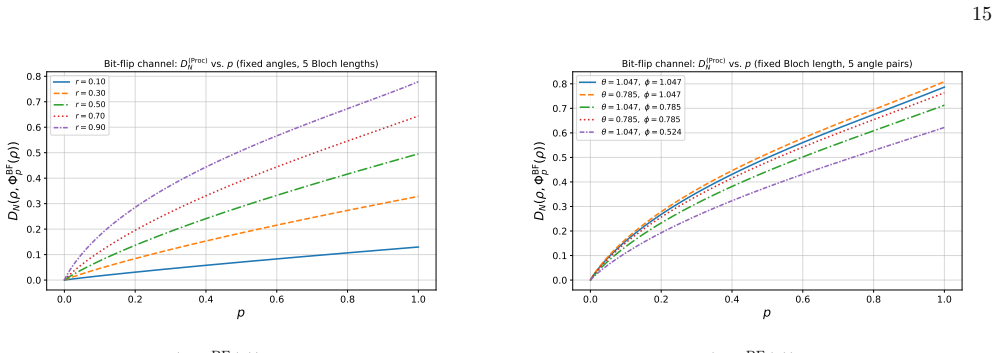
Core claim
Using the Fano representation of two-qubit pure states, a purification is described in terms of the Bloch vector of the system, the ancilla Bloch vector, and a real correlation matrix. For a fixed one-qubit mixed state, the freedom in the choice of purification can be parametrized by proper rotations acting on the ancillary degrees of freedom. As a result, the optimization over purifications entering the definition of the metric D_N is reduced to an orthogonal Procrustes problem on the Lie group SO(3). This reduction yields not only the maximal purification overlap, but also the optimal rotation relating the purification frames. From this rotation a purification misalignment angle Θ is also,
What carries the argument
Fano representation of two-qubit pure states together with the orthogonal Procrustes problem on SO(3) that optimizes purification overlap under ancillary rotations.
If this is right
- The pair (D_N, Θ) separates the size of the maximal purification overlap from the geometric reorientation of the optimal purification frames.
- Symmetry-adapted evolutions that preserve Bloch-vector direction produce a trivial optimal rotation and Θ equal to zero.
- Noncollinear channel actions produce a nonzero misalignment angle.
- The optimal Procrustes rotation lifts to a local unitary on the ancilla, giving an operational meaning to the optimal purification.
Where Pith is reading between the lines
- The misalignment angle could be tracked across successive channels to quantify cumulative geometric distortion in a quantum circuit.
- The same reduction might be tested on two-qubit mixed states once an analogous parametrization of their purifications is found.
- Because the rotation is realized by a unitary on the ancilla, the construction supplies a concrete laboratory procedure for preparing the optimal purification.
Load-bearing premise
The remaining freedom in purifying a fixed one-qubit mixed state is fully captured by proper rotations on the ancillary degrees of freedom.
What would settle it
An explicit pair of purifications of the same mixed qubit state whose relating transformation on the ancilla cannot be expressed as a rotation in SO(3).
Figures


read the original abstract
In this work we reformulate the Uhlmann purification-overlap optimization and develop a purification-based geometric framework for the analysis of mixed qubit states and qubit channels. Using the Fano representation of two-qubit pure states, a purification is described in terms of the Bloch vector of the system, the ancilla Bloch vector, and a real correlation matrix. For a fixed one-qubit mixed state, the freedom in the choice of purification can be parametrized by proper rotations acting on the ancillary degrees of freedom. As a result, the optimization over purifications entering the definition of the metric \(D_N\) introduced in Ref.~\cite{Lamberti2009} is reduced to an orthogonal Procrustes problem on the Lie group \(SO(3)\). This reduction yields not only the maximal purification overlap, but also the optimal rotation relating the purification frames. From this rotation we define a purification misalignment angle \(\Theta\), which provides geometric information not contained in scalar fidelity-based distinguishability measures. The formalism is applied to representative qubit channels, including depolarizing, bit-flip, phase-flip, amplitude-damping channels, and an imperfect quantum NOT gate. For symmetry-adapted evolutions preserving the Bloch-vector direction, the optimal rotation is trivial and \(\Theta=0\), whereas noncollinear channel actions generate a nonzero misalignment. The pair \((D_N,\Theta)\) therefore separates the magnitude of the maximal purification overlap from the geometric reorientation of the optimal purification frames. Since the optimal Procrustes rotation can be lifted to a local unitary acting on the ancilla, the construction also provides an operational interpretation of the optimal purification in terms of an ancilla-side transformation.
Editorial analysis
A structured set of objections, weighed in public.
Referee Report
Summary. The paper reformulates the Uhlmann purification-overlap optimization using the Fano representation of two-qubit pure states, expressing purifications via the system Bloch vector, ancilla Bloch vector, and real correlation matrix. For fixed one-qubit mixed states, purification freedom is parametrized by SO(3) rotations on ancillary degrees of freedom, reducing the optimization in the metric D_N (from Lamberti et al. 2009) to an orthogonal Procrustes problem on SO(3). This yields the maximal overlap together with an optimal rotation, from which a purification misalignment angle Θ is defined. The framework is applied to depolarizing, bit-flip, phase-flip, amplitude-damping channels and an imperfect NOT gate, showing Θ = 0 for symmetry-preserving evolutions and nonzero Θ otherwise; the pair (D_N, Θ) separates magnitude from geometric reorientation, with an operational interpretation via ancilla-side local unitaries.
Significance. If the central reduction holds, the work supplies a geometric refinement of purification-based distances that extracts directional information (via Θ) not available from scalar fidelity measures alone. The explicit mapping of ancilla unitaries to SO(3) rotations on the Bloch vector and correlation matrix, together with the operational lifting of the optimal rotation to a local unitary, constitutes a clear strength. The separation of magnitude and reorientation for representative qubit channels offers a concrete way to classify noise beyond distance values, potentially useful for channel analysis and experimental design.
minor comments (2)
- [Abstract] The abstract states the reduction to the Procrustes problem but does not display the explicit transformation rules (s ↦ R s, T ↦ T Rᵀ) or the purity constraint preservation; adding one short paragraph or equation block in the main text would make the central equivalence self-contained.
- When applying the formalism to the listed channels, the manuscript would benefit from a small table or explicit numerical values of Θ for at least one non-symmetric case (e.g., amplitude damping) to illustrate the claimed nonzero misalignment.
Simulated Author's Rebuttal
We thank the referee for the positive and insightful summary of our work, as well as for recognizing the geometric refinement and operational interpretation offered by the Fano-Procrustes framework. We are pleased that the referee recommends minor revision and appreciate the emphasis on the separation of magnitude and reorientation via the pair (D_N, Θ).
Circularity Check
No significant circularity; derivation is self-contained
full rationale
The paper takes the metric D_N as given from the external reference Lamberti2009 and performs a mathematical reduction of its purification optimization to an orthogonal Procrustes problem on SO(3) using the standard Fano parametrization of two-qubit states. For a fixed system Bloch vector, the ancilla freedom is parametrized by SO(3) rotations acting on the ancilla Bloch vector and correlation matrix; this map is bijective on valid purifications and directly converts the overlap maximization into the Procrustes problem without additional fitted parameters or self-referential definitions. The new misalignment angle Θ is extracted from the resulting optimal rotation and supplies geometric information beyond the scalar D_N value. No equation reduces the claimed results to inputs by construction, no self-citation chain carries the central claim, and the derivation relies on independently verifiable properties of qubit purifications rather than renaming or smuggling ansatzes.
Axiom & Free-Parameter Ledger
axioms (2)
- domain assumption Uhlmann's theorem on purification of mixed states
- domain assumption Fano representation of two-qubit pure states in terms of Bloch vectors and correlation matrix
invented entities (1)
-
purification misalignment angle Θ
no independent evidence
Lean theorems connected to this paper
-
IndisputableMonolith/Foundation/AlexanderDuality.leanalexander_duality_circle_linking echoes?
echoesECHOES: this paper passage has the same mathematical shape or conceptual pattern as the Recognition theorem, but is not a direct formal dependency.
Using the Fano representation of two-qubit pure states, a purification is described in terms of the Bloch vector of the system, the ancilla Bloch vector, and a real correlation matrix. ... the optimization over purifications ... is reduced to an orthogonal Procrustes problem on the Lie group SO(3).
-
IndisputableMonolith/Cost/FunctionalEquation.leanwashburn_uniqueness_aczel unclear?
unclearRelation between the paper passage and the cited Recognition theorem.
the pair (D_N, Θ) therefore separates the magnitude of the maximal purification overlap from the geometric reorientation of the optimal purification frames
What do these tags mean?
- matches
- The paper's claim is directly supported by a theorem in the formal canon.
- supports
- The theorem supports part of the paper's argument, but the paper may add assumptions or extra steps.
- extends
- The paper goes beyond the formal theorem; the theorem is a base layer rather than the whole result.
- uses
- The paper appears to rely on the theorem as machinery.
- contradicts
- The paper's claim conflicts with a theorem or certificate in the canon.
- unclear
- Pith found a possible connection, but the passage is too broad, indirect, or ambiguous to say the theorem truly supports the claim.
Reference graph
Works this paper leans on
-
[1]
In the convention used here, the channel is defined as [2] Φ dep p (ρ) = (1−p)ρ+pI 2,0≤p≤1
Depolarizing channel The depolarizing channel describes isotropic noise that drives a qubit toward the maximally mixed state. In the convention used here, the channel is defined as [2] Φ dep p (ρ) = (1−p)ρ+pI 2,0≤p≤1. Let the input state be written in Bloch form as [2] ρ(r) =1 2 (I+r·σ),r= (r x,ry,rz). The action on the Bloch vectorris simply r↦−→r′= (1−p)r
-
[2]
It is defined by [2] Φ BF p (ρ) = (1−p)ρ+pσxρσx,0≤p≤1
Bit-flip channel The bit-flip channel describes a stochastic error in which a Pauliσx operation is applied to the qubit with probabilityp. It is defined by [2] Φ BF p (ρ) = (1−p)ρ+pσxρσx,0≤p≤1. Equivalently, it admits the Kraus representation K0 = √ 1−pI, K 1 =√pσx, which satisfies K† 0K0 +K† 1K1 =I. Let the input state be written as ρ(r) =1 2 (I+r·σ),r= ...
-
[3]
It is defined by [2] Φ PF p (ρ) = (1−p)ρ+pσzρσz,0≤p≤1
Phase-flip channel The phase-flip channel describes a stochastic phase er- ror in which a Pauliσz operation is applied to the qubit with probabilityp. It is defined by [2] Φ PF p (ρ) = (1−p)ρ+pσzρσz,0≤p≤1. A Kraus representation is given by K0 = √ 1−pI, K 1 =√pσz, which satisfies K† 0K0 +K† 1K1 =I. Let the input state be written in Bloch form as ρ(r) =1 2...
-
[4]
Depolarizing channel The depolarizing channelΦdep p (ρ), with error probabil- ityp, acts on the Bloch vector as (cf. Sec.VIIA1) r↦−→r′= (1−p)r. The channel is thus purely radial: it preserves the di- rection of the Bloch vector and decreases only its length. Forp= 0the channel is the identity map, while for p= 1every input state is mapped to the maximally...
-
[5]
Bit-flip channel The bit-flip channelΦBF p (ρ), with error probabilityp, acts on the Bloch vector as (cf. Sec. VIIA2) r= (x,y,z)↦→r′= (x,(1−2p)y,(1−2p)z). For thez-axis family ρ(z) r = 1 2(I+rσz), one gets ΦBF p (ρ(z) r ) = 1 2 (I+ (1−2p)rσz), Since the input and output Bloch vectors are collinear, the corresponding density matrices commute and share a co...
-
[6]
Phase-flip channel The phase-flip channelΦPF p (ρ), with error probability p, acts on the Bloch vector as(cf. Sec. VIIA3) r= (r x,ry,rz)↦→r′= ((1−2p)rx,(1−2p)ry,rz). For equatorialx-axis states, the input and output are collinear in Bloch space. Thus, the Procrustes rotation is S⋆=I 3, and the misalignment angleΘvanishes. There- fore (see Appendix B) gPF(...
-
[7]
General diagonal Pauli channel A diagonal Pauli channel has the Bloch action r= (r x,ry,rz)↦→r′= (λxx,λyy,λzz), subject to complete positivity constraints. For axis- adapted families ρ(i) r = 1 2(I+rσi), i∈{x,y,z}, the output remains collinear with the input: ρ(i) r ↦→1 2(I+λirσi), the Procrustes rotation isS⋆=I 3, and the misalignment angleΘ = 0. Therefo...
-
[8]
Compute the output Bloch vector r′=Mr+c
-
[9]
Construct the canonical purification data(Ar,γr) and(A r′, ˜δr′), with Ar =O(n r) diag( √ 1−r2, √ 1−r2,−1),γ r =r ˆz, and analogously forr′
-
[10]
Form the Procrustes matrix K=A T rAr′ +γr ˜δT r′
-
[11]
Compute the singular value decomposition [13] K=UΣV T
-
[12]
Obtain the optimal proper rotation S⋆=VΛU T,Λ = diag(1,1,det ( VU T ) )
-
[13]
Form the aligned purification data B⋆=A r′S⋆,δ ⋆=S T ⋆˜δr′
-
[14]
Compute the optimized overlap from g2 ⋆= 1 4 [ 1 +r·r′+γr·δ⋆+ Tr(AT rB⋆) ] , and then evaluate DN(ρ,Φ(ρ)) = √ h2 (1 +g⋆ 2 )
-
[15]
Compute the purification misalignment angle through Θ(ρ,Φ(ρ)) = arccos (Tr(S⋆)−1 2 ) . B. Bit-flip channel In the Bloch representation, the bit-flip channel Φ BF p (ρ)acts as (cf. Sec. VIIA2) r= (r x,ry,rz)↦→r′= (rx,(1−2p)ry,(1−2p)rz). Thex-component is invariant, while the components perpendicular to thex-axis are contracted by the factor λ. Forp= 0the c...
work page 2023
-
[16]
Natural metric for quantum information theory,
P. W. Lamberti, M. Portesi, and J. Sparacino, “Natural metric for quantum information theory,” Int. J. Quantum Inf.7, 1009–1019 (2009)
work page 2009
-
[17]
M. A. Nielsen and I. L. Chuang,Quantum Computation and Quantum Information(Cambridge University Press, Cambridge, 2000)
work page 2000
-
[18]
B. Schumacher and M. D. Westmoreland,Quantum Pro- cesses, Systems, and Information, (Cambridge Univer- sity Press, Cambridge, 2010)
work page 2010
-
[19]
I. Bengtsson and K. Życzkowski,Geometry of Quantum States: An Introduction to Quantum Entanglement, 2nd ed., (Cambridge University Press, Cambridge), 2017
work page 2017
-
[20]
M. M. Wilde,Quantum Information Theory, 2nd ed., (Cambridge University Press, Cambridge, 2017)
work page 2017
-
[21]
Watrous,The Theory of Quantum Information(Cam- bridge University Press, Cambridge, 2018)
J. Watrous,The Theory of Quantum Information(Cam- bridge University Press, Cambridge, 2018)
work page 2018
-
[22]
D’Alessandro,Introduction to Quantum Control and Dynamics, 2nd ed
D. D’Alessandro,Introduction to Quantum Control and Dynamics, 2nd ed. (Chapman and Hall/CRC, Boca Ra- ton, FL, 2021)
work page 2021
-
[23]
H. M. Wiseman and G. J. Milburn,Quantum Measure- ment and Control(Cambridge University Press, Cam- bridge, 2010)
work page 2010
-
[24]
The transition probability in the state space of a∗-algebra,
A. Uhlmann, “The transition probability in the state space of a∗-algebra,” Rep. Math. Phys.9, 273–279 (1976)
work page 1976
-
[25]
Fidelity for mixed quantum states,
R. Jozsa, “Fidelity for mixed quantum states,” J. Mod. Opt.41, 2315–2323 (1994)
work page 1994
-
[26]
Purification-based metric to measure the distance between quantum states and processes,
T. M. Osán and P. W. Lamberti, “Purification-based metric to measure the distance between quantum states and processes,” Phys. Rev. A87, 062319 (2013)
work page 2013
-
[27]
Bures D., “An extension of Kakutani’s theorem on infi- nite product measures to the tensor product of semifinite w∗-algebras”, Trans. Amer. Math. Soc.135, 199-212 (1969)
work page 1969
-
[28]
R. Horn and C. Johnson,Matrix Analysis(Cambridge University Press, Cambridge, 1986)
work page 1986
-
[29]
On a parametrization of purifications of a qubit,
T. Constantinescu and V. Ramakrishna, “On a parametrization of purifications of a qubit,” Quantum Inf. Process.1, 409–424 (2002)
work page 2002
-
[30]
A general scheme for en- semble purification,
A. Bassi and G. C. Ghirardi, “A general scheme for en- semble purification,” Phys. Lett. A309, 24–28 (2003)
work page 2003
-
[31]
Bounds for the quantity of informa- tion transmitted by a quantum communication channel,
A. S. Holevo, “Bounds for the quantity of informa- tion transmitted by a quantum communication channel,” Probl. Inf. Transm.9, 177–183 (1973)
work page 1973
-
[32]
The capacity of the quantum channel with general signal states,
A. S. Holevo, “The capacity of the quantum channel with general signal states,” IEEE Trans. Inf. Theory44, 269– 25 273 (1998)
work page 1998
-
[33]
Sending clas- sical information via noisy quantum channels,
B. Schumacher and M. D. Westmoreland, “Sending clas- sical information via noisy quantum channels,” Phys. Rev. A56, 131–138 (1997)
work page 1997
-
[34]
Universal bounds for the Holevo quantity, coherent information, and the Jensen–Shannon divergence,
W. Roga, M. Fannes, and K. Życzkowski, “Universal bounds for the Holevo quantity, coherent information, and the Jensen–Shannon divergence,”Physical Review Letters105, 040505 (2010)
work page 2010
-
[35]
General state changes in quantum theory,
K. Kraus, “General state changes in quantum theory,” Ann. Phys.64, 311–335 (1971)
work page 1971
-
[36]
K. Kraus,States, Effects, and Operations: Fundamen- tal Notions of Quantum Theory(Springer-Verlag, Berlin, Heidelberg, 1983)
work page 1983
-
[37]
A generalized solution of the or- thogonal Procrustes problem,
P. H. Schönemann, “A generalized solution of the or- thogonal Procrustes problem,” Psychometrika31, 1–10 (1966)
work page 1966
-
[38]
O. Rodrigues, “Des lois géométriques qui régissent les déplacements d’un système solide dans l’espace, et de la variation des coordonnées provenant de ces déplace- ments considérés indépendamment des causes qui peu- vent les produire,” Journal de Mathématiques Pures et Appliquées5, 380–440 (1840)
-
[39]
R. M. Murray, Z. Li, and S. S. Sastry,A Mathematical Introduction to Robotic Manipulation(CRC Press, Boca Raton, 1994)
work page 1994
-
[40]
Jensen– Shannon divergence as a measure of distinguishability between mixed quantum states,
A. P. Majtey, P. W. Lamberti, and D. P. Prato, “Jensen– Shannon divergence as a measure of distinguishability between mixed quantum states,”Physical Review A72, 052310 (2005)
work page 2005
discussion (0)
Sign in with ORCID, Apple, or X to comment. Anyone can read and Pith papers without signing in.